



Tips for getting it right from the start
Does it make any sense for a market vegetable or flower grower to plant an apple orchard? It’s a question I’ve asked myself a fair bit over the last eight years of both growing for a 100-plus member CSA and managing a small, 500-tree certified organic orchard. As our orchard matures and we find ourselves putting certified organic apples (and smaller numbers of pears and plums) in summer, fall, and winter CSA boxes, I think the answer now, for us, is – YES!
Over those eight years of growing fruit, I’ve had plenty of time to think about what I could have done better at the start and how to simplify a market-garden-based approach to growing apples. When first considering planting an orchard, you will be overwhelmed by available information, much of which is geared either, on one extreme, toward much larger commercial orchards, or on the other, to homestead scale approaches.
In this article, my goal is to whittle down the bewildering array of decisions that go into starting an orchard into just a few relatively straightforward options to choose from, all with the market grower in mind. I’m far from an orchard expert, but I also know for sure that the market grower should ignore MOST of the orchard information out there and just focus on a few key approaches that will put apples in your CSA boxes and on your market table.
I’ll divide this article into the following categories: Site Considerations; Planting System;Variety Selection; Irrigation and Weed Control; Training and Pruning; Pest Spray Program; Thinning, Harvesting, and Marketing; Side Ventures You Should Consider (Side Shoots).
Site considerations
This is the easy one and we can get away with one paragraph here. The approach is simple and not much different from siting your vegetable blocks. 1. Soil should be well-drained; you can’t hope for trees to grow in water-logged soils that would not support vegetable crop growth. 2. You should definitely test soil nutrients and amend to a balanced soil. 3. Consider cover cropping a future orchard block for a year or two. It’s a great approach. This is all basic site-preparation stuff, well in the wheel-house of any market farmer.
Planting system- 2 options (not 20)
Here is where the decision making can seem overwhelming, with a bewildering array of options. However, for the small-scale, organic grower, I believe there are really only two options to consider.
These two planting system options have everything to do with apple rootstocks, so we’ve gotta talk rootstocks for a bit here. From the mid-1900s going back a few thousand years to the apple’s origins along the Silk Road trade routes, apples were planted on “standard” (for example, Antonovka) rootstocks, producing a slow-growing, very large tree (30-foot wide by 20-foot tall). Rule #1 of small-scale organic orcharding: there is no reason to ever use this rootstock on a market farm.
More recently, rootstocks have been developed for size control and even to confer some levels of disease-resistance. By and large, the newer rootstock varieties fall into three categories: 1. Russian Budhovsky (abbreviated B-9, B-118, etc.); 2. English Malling (M-111, M-9, etc.); and 3. American Geneva (G-890, G-935, etc.). Among these three “series” of rootstocks, there are dozens of varieties that fall into gradations of Semi-standard, Semi-dwarf, and Dwarf. I am here to go out on a limb (which some orchardists might want to shake a little) with my firm belief that a market farmer can forget about all but two of these rootstock varieties.
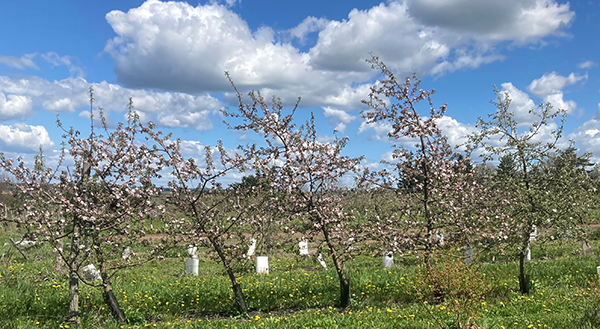
Trellised semi-dwarf (G-890 rootstock) apple trees in bloom. Note the posts and wires helping to support the trees.
We already know the first rule is not to plant Standard rootstocks. Second rule is, don’t bother with B-series rootstocks. There’s nothing wrong with them, but there’s nothing great about them either (they’re not high vigor and they don’t confer any disease resistance). Third rule is, don’t plant dwarf rootstocks of any of the series: they require sturdy, expensive trellising, they are vulnerable to weeds and grasses, and they don’t adapt well to an organic system. As busy market farmers, we want great rootstocks that cover our mistakes, our weeks of neglect while we tend to the insanity of spring, and that generally make up for our lack of orcharding skills.
The rootstocks that will do all that for you are M-111 and G-890. These are sturdy, vigorous, forgiving, grower-friendly, rootstocks. Unfortunately, each one requires a different planting system and so it’s here that we have hit our most major decision-making crossroads. (At least it’s a decision between two and not 20). But decisions are hard, and I’m not always the best at making them. So, eight years ago, we chose to do both in our orchard, and I can speak to the pros and cons of each (See Table 1).
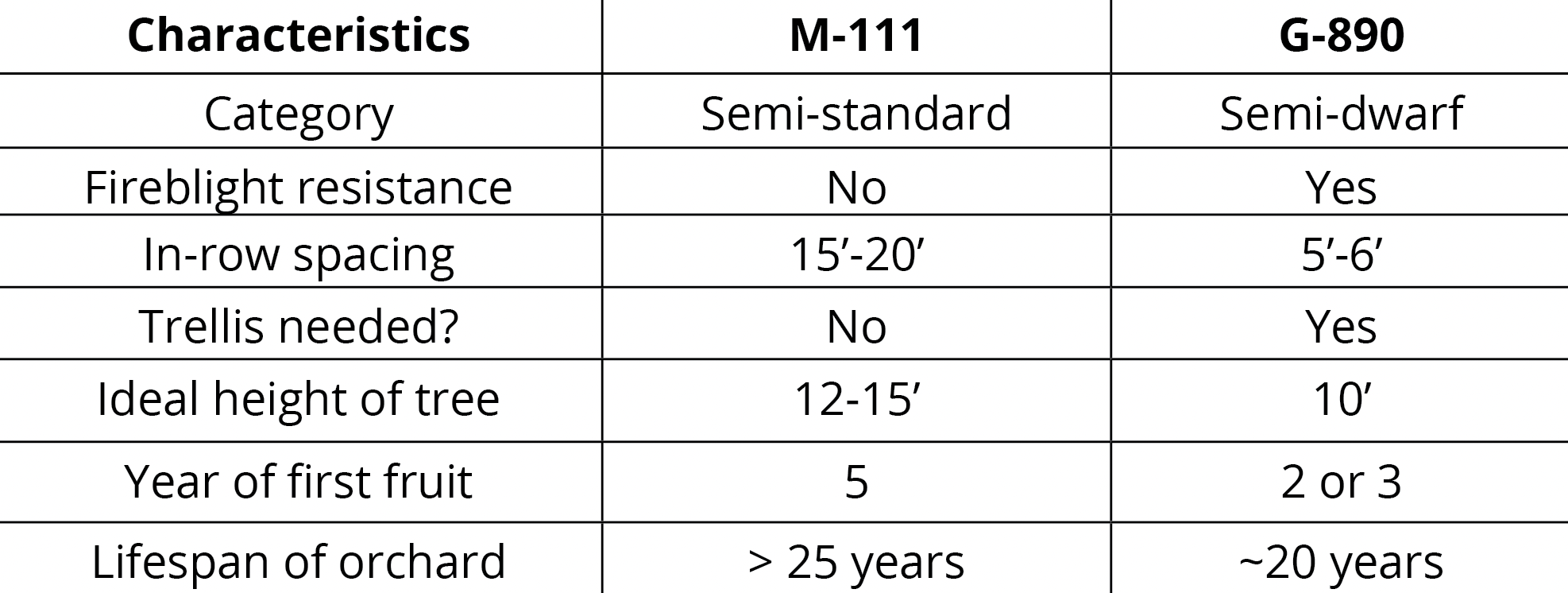
Table 1: A comparison of stand-alone M-111 orchard system and the trellised G-890 system. All images courtesy of the author.
The M-111 planting system: M-111 is a “semi-standard” tree that is well-anchored, widely adapted, and can be planted without any support as a stand-alone tree. It will grow to be a sizable tree, and needs plenty of room: 12’ –15’ between trees and 15’-20’ between rows. That means that in our 250’x250’ space that we allocated for M-111 trees, we fit ~250 trees.
The G-890 planting system: G-890 is a “semi-dwarf” tree that is reasonably well-anchored, widely adapted, and should be planted with some support. Support usually takes the form of a one to three wire trellis, meaning that you will need to pound locust or larch posts (we cut these from our own woodlot or purchase them locally) every 10 feet, pound angled posts as anchors at both ends of the trellis, and purchase 12.5 gauge high tensile wire and wire tensioners (all simple stuff any fencing store will have on the shelf).
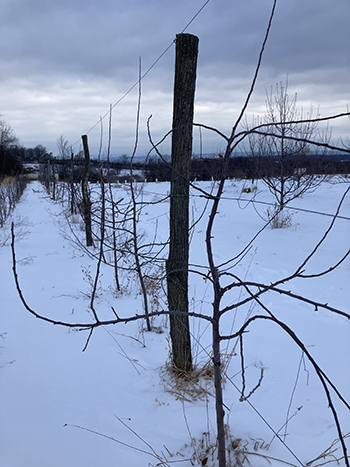
Two-year-old G-890 (semi-dwarf) apple trees showing the posts and wires needed to help support them.
I think two is ideal, one at 3 feet and one at 6 feet. These will support your trees in early years of growth and provide a handy surface to bend branches to (more on this later). Trees should be spaced 5-6’ in row and 15-20’ between rows. This means that in the 100’x250’ space we allotted for G-890 trees, we planted 250 trees. This is the same number of trees planted in the M-111 orchard, only we used 1/3 of the square footage.
So what’s the big difference between these planting systems? M-111, on the negative side, will take longer to bear fruit (year 5 and onward), will ultimately require more labor to prune big trees, will require ladders to harvest big trees, and does not carry any disease-resistance. On the positive side, it requires less infrastructure to plant an orchard and ultimately will provide longevity, with a productive life of 20-plus years.
G-890, on the negative side, requires a trellis, requires more attention to irrigation and weed control, and will not ultimately be a heritage orchard, probably timing out of its productive life before 20 years have passed. On the positive side, it fruits very young (Year 2 or Year 3), it offers a very simple and fast approach to pruning along with no-ladder harvesting, which both cut down labor substantially, and it carries fire blight resistance.
I look at the difference as hinging on labor and longevity. Labor: With G-890, you put your labor and costs in upfront for the trellis, and then save big with ease of pruning and harvest. With M-111, you don’t have to hassle with a trellis, but you do spend much more time pruning and lugging ladders around as the orchard matures. Eight years in, it now takes me an hour to prune three to four M-111 trees whereas I can prune 20 plus G-890 in that time period. Someone has to climb a ladder to harvest M-111; ladders never enter the G-890 area. Longevity: When my kids are adults, they can come home and pick M-111 apples; the G-890s will likely be long gone (maybe replaced by some fresh new trees!).
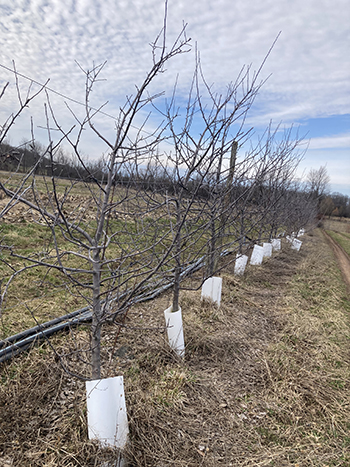
G-890 semi-dwarf apple trees showing the wire trellising that is necessary to help support them.
In summary, either of these two planting systems will work great on a small-scale farm; other planting systems, not so much. If you have the energy and resources to put a simple trellis in and you don’t mind the thought of replacing your trees 20 years from now: go with G-890. If you don’t want to deal with a trellis and do want to plant an orchard that will outlive you: go with M-111. Both are gonna give you apples. Just don’t plant dwarfs or standards.
(A note: I am trying to stay simple and true to what I would do in my own orchard in this article. I am confident that you cannot go wrong with G-890. However, you should know that there are a couple other Geneva rootstocks that are very similar to G-890. They can hold up to the organic market garden and work well for you. These are G-210 and G-935, which share much the same semi-dwarf and fireblight resistance characteristics of G-890. Also keep an eye on G-66, currently under testing. It looks very promising and is likely to be available over the next five years.)
Variety selection
Even more bewildering than the number of apple rootstocks available are the number of apple varieties available. Again, we can categorize them into some broad categories and then, as efficiency-seeking market farmers, delete most of these major categories.
1. Heirloom: these are old American, Asian, and European varieties with a wild array of flavor and texture profiles. They are awesome, fun apples (so tempting!), but also generally have a lot of undesirable and finicky traits like biennialism, upright branches, disease-susceptibility (the downfall!). They’re great for the collector, the homesteader, but just don’t fit on the market garden. The metaphor I always think of is this: We have a neighbor with a vast collection of antique tractors that fill about an acre — awesome to look at, but they don’t move much and they certainly only plow for show.
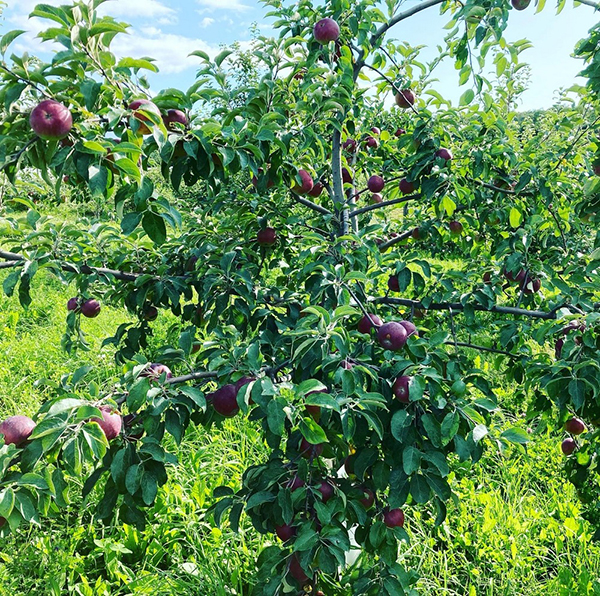
A Liberty apple tree loaded with fruit.
Over on my handful of acres, my 65 HP Kubota utility tractor is frequently on the move, doing tons of work around the farm. That’s where market farmers should be with apple varieties: on the search for 4WD-utility-tractor apple varieties. Delete heirlooms from the market garden (but plant a few around the house and barns).
2. Traditional Commercial Varieties: Apples like Macintosh, Cortland, Empire, Granny Smith, Golden Delicious, Gala, Jonagold, Jonamac, etc., — the ones we’ve all picked as kids and that we see on grocery store shelves — have no business in the organic market orchard. The only way to pull these apples off is if you want to be sitting on your tractor spraying sulfur and lime sulfur half your early mornings from May to July. All of these apples will absolutely get apple scab, the fungal bane of all U.S. orchards outside of Western desert or Mediterranean irrigation districts. I’ve worked on small-scale organic orchards growing these traditional varieties, and we’ve put our time in spraying sulfur, and gotten some nice apples out of the deal, but the whole experience was loaded with stress, stink, and lots of time and worry. My strong recommendation is to avoid these varieties entirely.
3. Modern Disease-Resistant Varieties: Finally, some apple trees ready to go to work on the market farm. If I was handing out farmer sainthoods, several would go immediately to the breeders at the public, land grant university collaboration between Purdue, Rutgers, and U. of Illinois — they have truly redeemed the fallen apple! The genius of the PRI apple varieties is that they are field immune to apple scab — no stinking, spring-ruining, all-work-and-no-play sulfur sprays, what a miracle. Disease-resistant apples have also emerged from Cornell, Nova Scotia, and an array of other breeders. As a market farmer, you can safely plant any of these varieties.
We definitely have some favorites, and to help sort them, I have developed a ranking system (see Table 2).
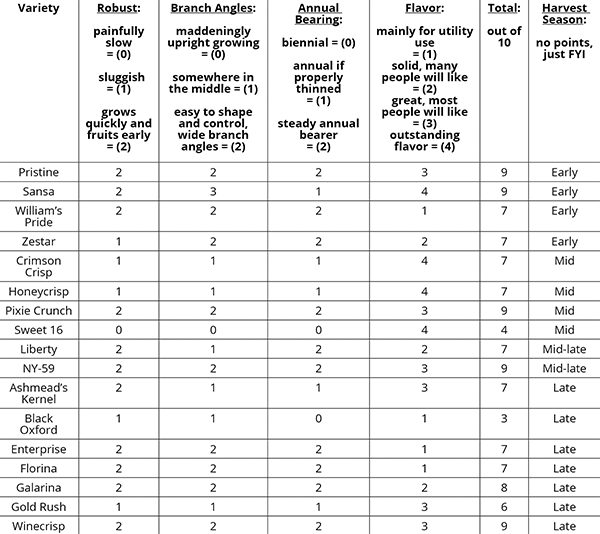
Table 2: A ranking system for disease-resistant apple varieties that make sense on a market farm.
In short, a wonderful, season-long, almost bomb-proof, small-farm orchard can be created from six varieties, listed in order of ripening: Pristine, Sansa, Pixie Crunch, Liberty, NY-35, and Winecrisp. This program would provide you picking apples from August to Halloween, and would provide storage apples (Winecrisp) until April. If you wanted to go even more lean, you could plant Pristine for an early apple, Liberty for a mid-season apple, and Winecrisp for a late season storage apple. Everyone will be happy.
How do you get your hands on these varieties on the right rootstocks? This can be tricky. However, there are some outstanding nurseries you can work with. Your best approach is to contact these nurseries at least one and ideally two years before you are planning to put your orchard in. Many nurseries, including Wafler, Cummins, Fedco, Adams County, and Fruition, will be highly familiar with the rootstocks and varieties I’ve emphasized in this article and will be willing to work with you to customize your orchard. (Shameless self-promotion: we have a nursery that focuses on local sales in Upstate New York, but we are willing to custom-graft and ship.)
Irrigation and weed control
Whether you choose G-890 trellis or M-111 stand-alone, young trees will need plenty of water their first year. You’ll only need to water during droughts in future years. The traditional goal the first season is a 5-gallon bucket per tree per week. If it rains, you can take a break. Irrigation is easier for a trellised G-890 orchard. You can drip irrigate long straight lines of closely spaced trees. We used two lines of drip tape per trellis for the first three years, laid right on the ground.
Eventually of course, these deteriorate; they can be replaced easily, but we are now looking to put thicker-walled orchard drip hose up off the ground, hung from the trellis. For the M-111 orchard, someone will need to spend a couple hours per week driving a water tank around and watering trees. (A good hack is to use your water wheel transplanter, if you already have one, with a long hose adapter.)
Weed control is especially important during the first three years of the orchard, and still pretty much a pressing issue in the G-890 orchard throughout its lifespan. The holy grail is a good well-rotted, hardwood wood chip mulch; we strive and aspire … but … does anyone have time for that?
Instead, landscape fabric has been our friend. In the G-890 orchard, we staple 3’ of fabric on either side of the trellis, leaving an approximately 1’ wide uncovered span in the middle where amendments, compost, and drip tape can go and where we try to keep up with weeds. We have also experimented with a Dutch white clover cover crop in this middle strip and seen some positive results. We do find that even when weeds get out of control in the uncovered span, trees seem to do just fine. The majority of their feeder roots are tucked underneath that 6’ span of moist, soft landscape fabric covered soil.
In the M-111 orchard, we stapled 4’x4’ squares of landscape fabric with a slit in the middle (these are commercially available pre-cut). These provided the young trees with a competitive edge during the first three years. We removed them after Year 3 and planted clover and some experimental comfrey as ground covers in the open space. By this point, the feeder roots on these robust rootstocks were out 5’ or 6’ in any direction and deep anchoring roots provided further nutrient- and water-mining power.
Training and pruning
I know this can be an intimidating topic when you are first learning trees. Eventually, you will build confidence. One of the beauties for a market farmer is that much of this work takes place in the cold season when you might not be quite so busy. For the G-890 system, training and pruning are greatly simplified. For the M-111 system, there’s a bit more to think about, and some extra work to put in. I’ll give a brief description for each system.
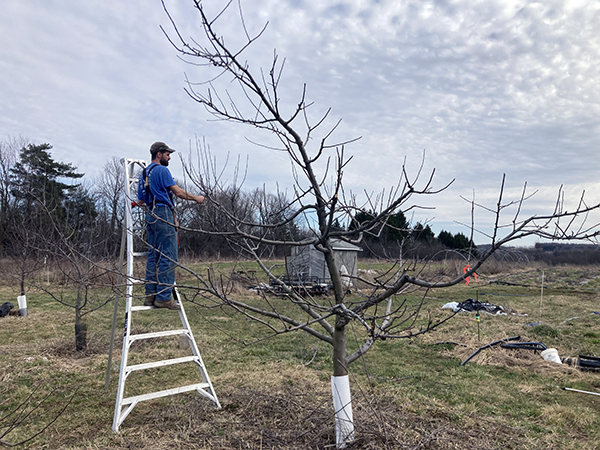
Trees grafted onto M-111 (semi-standard) rootstocks will involve a lot of ladder work, but don’t need trellising.
G-890 should be trained to a “tall-spindle” system with “renewal” pruning. Spend some time with these search words and you’ll find a lot of good information. The goal with this system is a 10’ tall tree with lots of nice horizontally bent lateral branches. During the first two years, you might not make any cuts at all, but rather focus on getting each of the tree’s branches bent out horizontal, either by tying down to the wires on the trellis or using home-made wooden branch benders. Keep in mind the simple biological fact that horizontal branches are fruitful whereas vertical branches are vegetative.
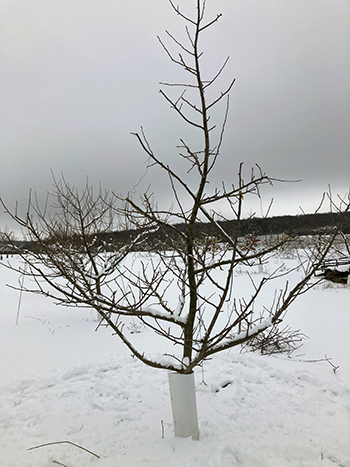
An M-111 (semi-standard) apple tree with branch benders to help widen out the branch angles for better fruiting. Note the characteristic “Christmas tree” shape this method of pruning produces.
Starting in late winter of Year 2 or 3, you’ll only want to make one or two major cuts — these entail removing the largest lateral branches (once they’ve grown half or more the diameter of the trunk) by making a renewal, aka “stub,” aka “bevel” cut. Leave a nice 1” stub with a big underbite (search images for renewal, stub, bevel cut — all the same thing.) Out of this cut will emerge a new branch to be nourished and trained in future years: renewal! Beyond that, you can make some small cuts to clean out dead branches and “singularize” lateral branches by singling up the terminal forks or crow’s feet to one main stem. Keep doing that for the life of the orchard. That’s it!
M-111 pruning is different. Here we are working with a “central leader” system and “permanent scaffold” pruning. Starting in Year 2, you will select an ascending series of three to four permanent scaffold branches: a whorl of three to four of them at about 3’ from the ground, another whorl of three to four of them 2-3’ above that, maybe another whorl of three to four of them 2-3’ above that, and then 2-4’ of straight leader for a 12-14’ tree. Ultimately, central leader trees should have a Christmas tree pyramid shape so that the bottom scaffold is very wide (up to 15’ across when the tree is mature) and each higher scaffold is kept headed back to form the ascending pyramid shape.
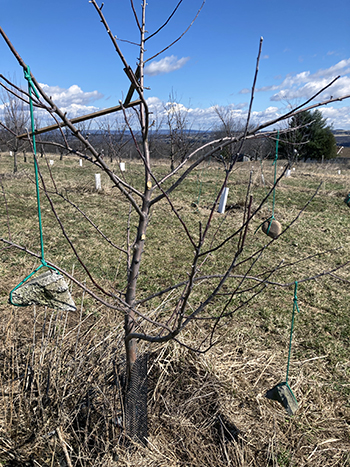
An M-111 tree with weights helping to widen the branch angles.
Like with the G-890 system, branch-bending is very important. You can use wooden branch benders, dixie cups filled with cement and a string to hang from branches, or you can truck around cinder blocks and rocks to tie down branches early on. The important thing is to do your best to shape all your permanent scaffolds to wide angle branches tending toward horizontal. Certain varieties grow stubbornly vertical and this is a big strike against them on the busy market farm; others are very easy to train and naturally have wide branch angles, making them a pleasure to work with on the busy market farm (see Table 2).
Pest spray program
Unfortunately, apple pests are unavoidable and will present some level of problem for you. A robust ecology around your farm will go a long way to helping keep many of the pests at low levels — things like not being totally mow-crazy and leaving some long grass and patches of wild land; having some wildlands such as hedgerows nearby to encourage bird predators; spreading some wood chips and compost to create a lively, forest-floor-duff-like substrate in the neighborhood of your orchard. Even with these farm biodiversity measures in place, two pests in particular are going to be a problem: plum curculio and codling moth.
For these guys, you are going to need to spray. We have narrowed our spray program to primarily just two OMRI-listed materials that many market growers will already be familiar with: Surround kaolin clay (for plum curculio and codling moth) and DiPel Bt (for codling moth). We tank mix some liquid fish fertilizer with each application. We are at a point where three to five well-timed sprays can get us through a season with reasonably pest-free apples. These sprays run from petal-fall to within a few weeks of harvest. When time and weather allow, we also do one to two dormant sprays of JMS stylet-oil in the fall and winter as an egg/larvae smotherer.
Kaolin clay is a difficult material to spray. Initially we did the whole orchard with a motorized backpack sprayer but this was brutal on the body. So we purchased a three-point, PTO-driven mist sprayer. We quickly found out that Surround loves to clog TeeJet mist sprayers, no fun. The solution that has been working really well for us over the last three years is a spray gun plumbed into the mist sprayer pressurized system.
We have an old, used gun, and it works great. We might splurge for a new John Bean 785 this year ($665). Sit on your tractor, drive along at ~1.5 mph, and lay the Surround on thick. When things go well, it looks like it snowed in the orchard afterward. Any old mist sprayer that makes pressure is gonna work with a decent spray gun. Having an agitator in the sprayer is another bonus, to help keep that clay in suspension.
Thinning, harvesting, marketing
Just a few quick points here. In a big fruit-set year, you will need to thin apples by hand, such that there is a softball size gap between each apple. We spend a few days on this, spread out over early July. It helps to have volunteers and local college students looking for a bit of work.
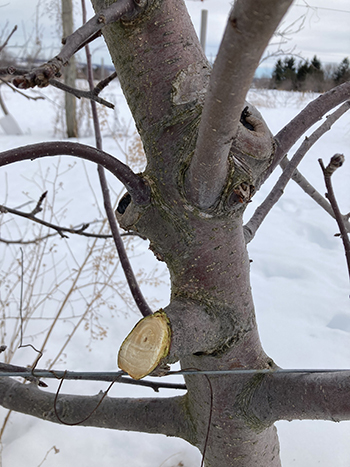
A renewal, aka “stub,” aka “bevel” cut on a G-890 semi-dwarf apple tree. Leave a nice 1” stub with a big underbite. Out of this cut will emerge a new branch to be nourished and trained in future years: renewal!
For harvest, we use apple-picking bags, flip-top bins, and duct tape on each bin to identify the varieties. We store our apples in walk-in coolers, trying to use ones that are not already packed with fall vegetables. We’re now up to three walk-ins on the farm, one of which is devoted primarily to apples in a good year. But also know that if your apples are stored in flip-top bins, you can get away with some mixing of veg and fruit, despite the fact that if exposed, ethylene gas given off by apples reduces the storage life of vegetables and flowers.
Our CSA and farmers market customers understand up front that we are not in the business of perfect apples. We market our apples as something very unique. They are varieties no one has ever heard of, they are certified organic, they taste amazing, they often have blemishes, and they are here-and-gone fast, so grab them up.
We wear cotton gloves to shine up and grade our apples and allow one to two blemishes on our “firsts.” “Utility apples” can have a number of blemishes but still look good to eat, maybe with a cut-out or two. “Cider” apples are just that. What gets harvested pretty much gets put in a CSA box or sold through our markets; our cull rate is a tiny percentage of apples, well under 5 percent. We shoot for $100-120/bushel for firsts and $80/bushel for utility apples, all sold in units smaller than a bushel. We figure cider apples produce $60-70/bushel but you then have to deduct time spent pressing and the cost of packaging. At the end of the day, especially through our utility apple marketing, we are getting excellent money for apples of all grades, including many that most orchards would cull or send to cider.
Side-shoots
There are a number of little side businesses that can come out of having an established orchard.
1. U-pick fruit. We love the community aspects of having people on the farm for U-pick. However, to avoid the potential chaos and weekend work of this, we market it through a U-pick CSA, which allows us to control numbers and educate pickers on timing, technique, and quantity. We combine our U-pick CSA with other plantings of strawberries, raspberries, black raspberries, currants, gooseberries, blueberries, pears and plums, allowing members to pick fruit for most of the growing season. We have essentially 100 percent retention in our U-pick CSA year to year and don’t really even advertise it anymore, so it’s a nice cadre of veteran pickers at this point, a win-win for everyone.
2. Learn to graft and make your own trees, then start a nursery. This has been a fun and exciting aspect of our farm business and we’ll see where it leads. I’ve been using my own trees to make new trees for five years now and we have established a nursery that we are selling thousands of dollars of trees out of each spring. We also sell scion wood online and I teach grafting workshops in early spring, all unexpected extra income to flow from the orchard.
3. Sweet cider. With a simple hydropress, quality grinder, and a stainless bottling tank (investment ~$5000), you can also be making organic apple cider from your orchard. This is a fun side shoot and, of course, the product is in very high demand. However, we do find that we make more money selling “utility” apples than if we were to crush, press, and bottle these same apples. So the economics of sweet cider are not necessarily so great (unless maybe you already have some old derelict orchards on site that produce a surfeit of unmarketable apples that are perfect for cider).
4. Hard cider. This is actually a vast topic, with enough material for a whole separate article. Artisan hard cider is a booming business around the country and especially in New York where a farm cidery license can be obtained, allowing you to produce and sell an alcoholic beverage both on your farm and at farmers markets. To make a high quality, artisan hard cider requires some very specialty apple varieties that we have not mentioned in this article. At our farm, we are pointed down this path, and, in fact, have an entirely separate hard-cider-variety planting that I could elaborate on via email if anyone is interested. Suffice it to say, this can very much be its own interesting farm enterprise!
Conclusions
In summary, the world of orcharding can be very overwhelming when you first approach it. My goal in this article has been to simplify it down to a few approaches that have high probability of success, specifically for market growers crazy enough to take on a new venture. My take on the small-scale market farmer’s community orchard is:
1. Don’t plant standard or dwarf trees.
2. Decide between a trellised semi-dwarf G-890 orchard or a stand-alone semi-standard M-111 orchard.
3. Don’t waste precious orchard space on heirloom or traditional varieties.
4. Instead, choose a series of hardy, robust, disease-resistant varieties, from among 3-6 basically bomb-proof varieties.
5. Be prepared to control weeds, water, train, and prune your trees.
6. Enjoy some home-grown apples and make your customers happy!
I would be happy to answer any questions or talk other aspects of the small scale community orchard any time so please reach out at kingfisherfarm.jason@gmail.com.
Jason Townsend is the owner of Kingfisher Farm, a certified organic vegetable and fruit farm near Utica, NY. Kingfisher Farm is 12 acres of vegetables, orchard, small fruit, and a tree nursery marketing through CSA, farmers markets, and online sales.
Copyright Growing For Market Magazine.
All rights reserved. No portion of this article may be copied
in any manner for use other than by the subscriber without
permission from the publisher.