










Preparing for the worst can avoid full-blown disasters
Before I quit my job to farm full-time, I had a career in cybersecurity and risk management. At first glance, this might sound like it has nothing to do with farming. But farming might involve more risk management than almost any other profession. A large part of my previous job was creating risk registers and brainstorming worst case scenarios for large international companies, then helping them create plans to manage these risks. We’ve taken a similar approach to managing risks on our farm.
Farming will always involve some level of risk, but being prepared for the worst can help you avoid a full-blown disaster. What if the farm truck breaks down the morning of market? What if the greenhouse heater breaks in the middle of the night during a cold snap? What if your farm manager needs to take an unexpected month off? These are all scenarios you can think through in advance, to minimize panic and prevent monetary loss when they actually occur.
Step 1: Creating a Risk Register
A Risk Register is just a fancy term for a list of risks the farm faces. We keep our Risk Register as a simple spreadsheet. To get started, we held two 45-minute brainstorming sessions and just dumped all of the risks we could think of into the spreadsheet. Dividing risks into different categories helped us organize our thoughts and be thorough. The categories we used included Production Risk, Marketing Risk, Infrastructure Risk, and People Risk, but your categories may vary depending on your farm.
This exercise can be uncomfortable and scary, but that’s the point. By working through your risks ahead of time, you’ll be better prepared when they inevitably occur.
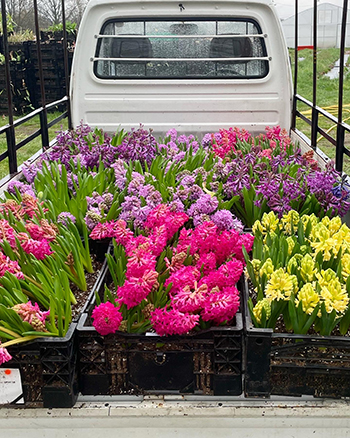
Each time we add new infrastructure like a new vehicle to the farm, we update our Risk Register to include associated risks.
When listing out risks, it’s important to be specific. For example, “Crop disease” could be a general risk any farm faces, but listing “Fusarium destroys the majority of our lisianthus crop” is much more helpful for this Risk Register as it will allow for specific planning. Be sure to include all kinds of risks — including everyday risks, like aphids in the spring, as well as risks that seem improbable (but not impossible), like a 100-year flood wiping out the farm fields. Later, we’ll rank them based on their likelihood, as well as their impact, in order to prioritize the risks. The Risk Register is meant to be a living document you can return to throughout the season and over the years, so don’t expect it to cover everything from the start.
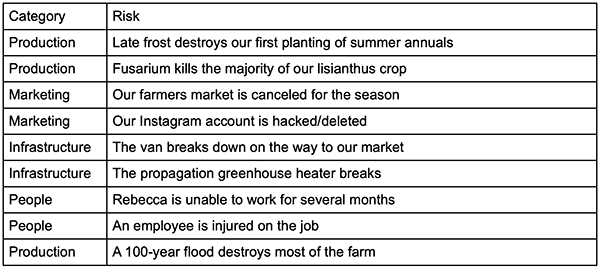
Examples from our own Risk Register.
Step 2: Assessing the risks
Once you have your list of risks, it’s time to assess and sort them. Whole books and classes have been written about risk assessments, but it does not need to be an overly complicated exercise. Your Risk Register likely has dozens or even hundreds of risks written out — ours had close to 200 by the time we were done brainstorming.
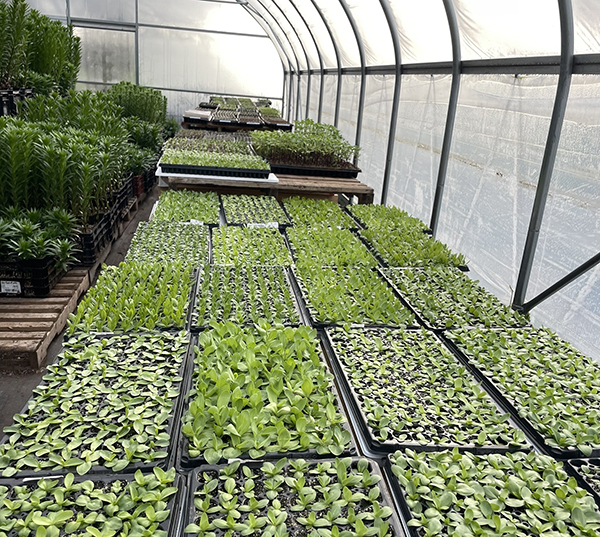
Our propagation greenhouse freezing is one of the biggest risks our farm faces.
Of course, they are not all equal in terms of priority. Sometimes I find we get bogged down by the scariest risks (like that 100-year flood) while the more banal risks are much more likely to impact our business. As a simple yet consistent way to prioritize your risks, follow this formula: Risk Level = Likelihood x Impact.
For each of our risks in the spreadsheet, we added a column for Likelihood and a column for Impact. We then ranked each from 1 to 5, with 1 being lowest and 5 being highest. It can help to add specific monetary or frequency values. For example, for our farm, we defined an impact of “1” as having less than $1,000 loss, while an impact of “5” meant a whole season or more of lost income. For Likelihood, a “1” was defined as a “once in a lifetime” event, whereas a “5” meant something we could expect to definitely happen at least once per year.
We then added a third column to multiply the Likelihood and Impact together. This became our Risk Level, and allowed us to sort our risks by their actual importance.
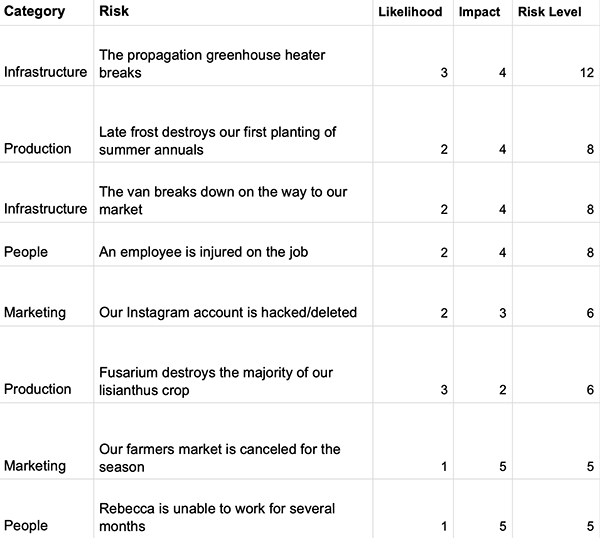
Here are the example risks, sorted by their risk level.
Organizing our risks like this really helped us think clearly and focus our efforts. For us, risks that are moderately likely to happen with a moderately high impact are more important to worry about than the once-in-a-lifetime risks that could wipe out the farm. We know we’ll never be able to solve every issue on our farm, but having this Risk Register sorted in order of priority has helped us figure out where to spend our time.
Step 3: Controls and response plans
This step is the real point of this whole exercise. This phase is where we go through the top risks and figure out how we can minimize them. Some of these will be existing controls that we already have in place, but many of them will be new ideas for the farm to pursue. The key here is to focus on realistic, affordable solutions that you can actually implement. With enough money and time, most risks can be reduced to zero, but that will not be realistic for most farms.
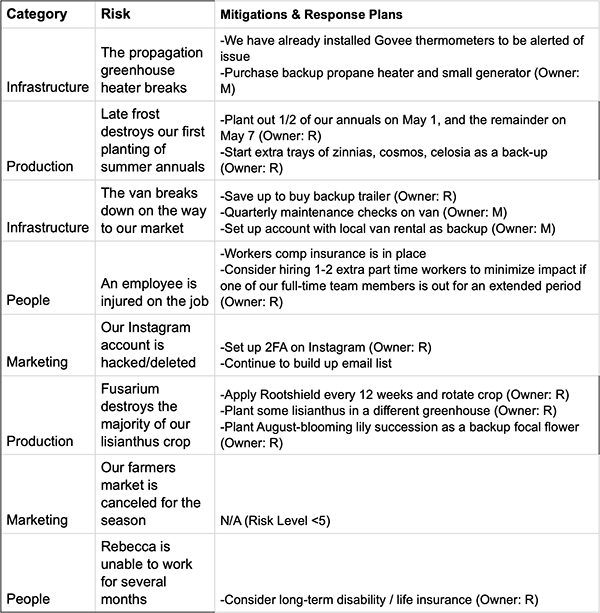
Depending on how much time you have for this exercise, you might not create mitigations for each risk. Whether you choose to address everything will depend on your own risk tolerance. For our farm, risks with a rating above 5 definitely warrant a close examination.
While for a farm, many of the solutions will be things we do ourselves, we can also outsource some risks by purchasing insurance, such as life insurance or long-term disability insurance. We have also recently joined the USDA’s Noninsured Crop Disaster Assistance Program (NAP), which provides some protection against catastrophic loss.

Major crop loss on critical crops, like our peonies, is a key risk to include in the Risk Register.
For any new response plans, we tag an action owner during the discussion and ideally a deadline. It’s that person’s job to actually follow up and implement the mitigation. Depending on how much time you have for this exercise, you might not create mitigations for each risk. Whether you choose to address everything will depend on your own risk tolerance. For our farm, risks with a rating above 5 definitely warrant a close examination.
Step 4: Committing to regular risk reviews
After initially building a Risk Register for your farm, the most important step is committing to regular reviews. We try to return to ours at least once a quarter. A good reminder is to do it each time we file our quarterly sales tax returns.

Risks related to staffing and marketing should also be included in the Risk Register.
Circumstances are constantly changing on the farm. Old infrastructure is retired, and new equipment is purchased. Crop plans and markets are constantly shifting. And with each shift comes new risk.
An old boss in my previous risk management career loved to say: “You don’t know what you don’t know.” This philosophy applies well to farming, where we are constantly learning about new issues as well as facing the changing climate. Staying in touch with fellow farmers to learn about the risks and issues they’re facing — through conferences, forums, and by reading magazines like this —is a great way to stay aware of what might be coming next for your farm.
So much of farming is completely out of our control, but having a thoughtful view on our risk landscape has helped us feel more comfortable in navigating these unknowns.
Rebecca Kutzer-Rice owns Moonshot Farm, a specialty cut flower farm in East Windsor, NJ. She grows flowers year-round including in a geothermal greenhouse, for retail markets in and around NYC.
Copyright Growing For Market Magazine.
All rights reserved. No portion of this article may be copied
in any manner for use other than by the subscriber without
permission from the publisher.