











Expansion and investments add to the farm over time
In 2003, one year out of college, my partner David and I drove across the country, from Alabama to Washington State, to spend the summer interning on Full Circle Farm in Carnation, WA. Fortunately for us, Brady Hatch and Brendan McQuillen were doing the same that summer, traveling from the northeast coast.
When our internship ended in the fall, David and I returned to Alabama to start Snow’s Bend Farm. After a brief stint in Florida where Brady worked on Sweetwater Farm, the two of them made their way to her home state of Maine and started Morning Dew Farm.
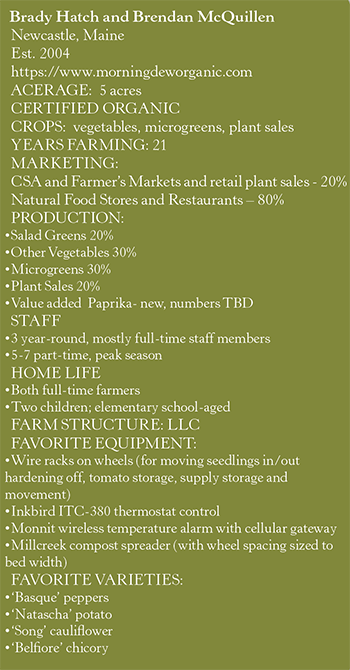
The farm began with a lease on her family’s land, including the house Brady grew up in. Besides a neighbor harvesting hay off the land, a family member had not grown crops on it — yet. They started that first year with an 18-week CSA, a farmer’s market, and sales to a local co-op and restaurant. Both of our farms drew from what we learned at Full Circle, or the marketing model at least.
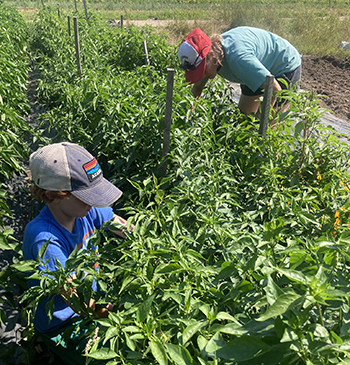
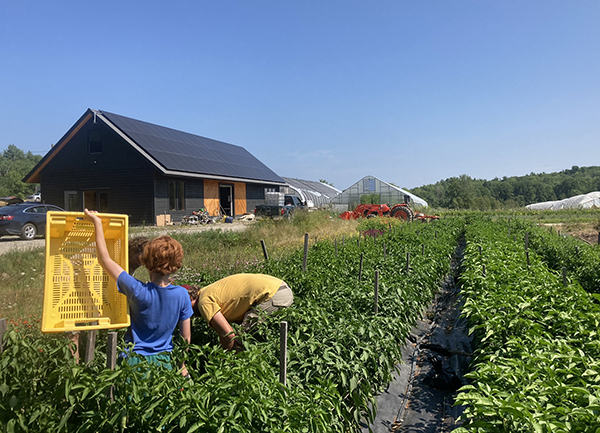
Picking peppers on Morning Dew Farm. All images courtesy of the author.
The family land was hilly, with not enough tillable land, so they quickly began exploring other pieces around the area, traveling as far as an hour and a half away at one point. As demand grew, they began to seriously think about purchasing land. After leasing property down the road from their home for four years, they bought it. They had a sense of the production and were confident it was the right place for them to expand.
That same year, 2017, they acquired a multi-year lease on a nursery close by. They had begun spring plant sales a few years earlier with around 500 square feet in a 15 x 96 tunnel, crowding them in with their nascent microgreen operation and starts for the farm. With the nursery, they went up to 1100 square feet. Now, the entire 2300 square foot tunnel is filled with spring plants for sale.
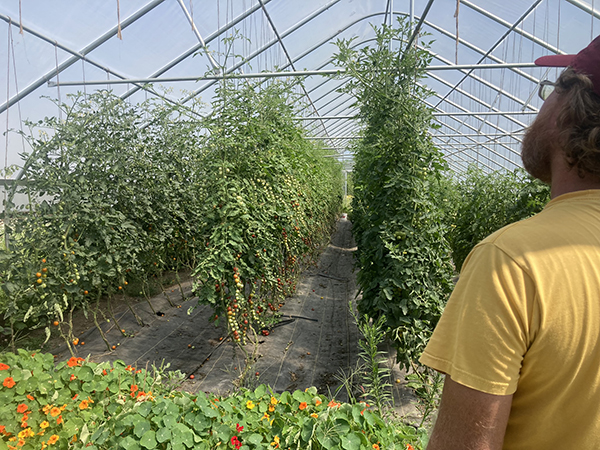
The tomato greenhouse on Morning Dew Farm.
They also have two 20 x 30 hoop houses for hardening off and retail sales. The plants are marketed through an online Shopify store for pick-up, as well as sold on site at the nursery and farmers’ market, plus wholesale to locally-owned businesses.
They offer an incredible variety: artichokes to squash, cucumbers and cucamelons, rhubarb to winter squash. There are separate online shop entries for vegetables, flowers, seeds, soil, or supplies. The marketing is impressive, providing detailed descriptions and explaining how their plants stand out against others. Success is proven by the number of repeat customers they have year after year.
In 2014 they began dabbling in microgreen production, which also became an area of expansion with the acquisition of the new land and nursery. In 2020, they made the decision to produce microgreens year-round, providing consistent supply. The Covid-19 pandemic opened up new channels at natural food stores and now makes up 30 percent of their sales and almost an entire 2880-square-foot greenhouse constructed for the purpose.
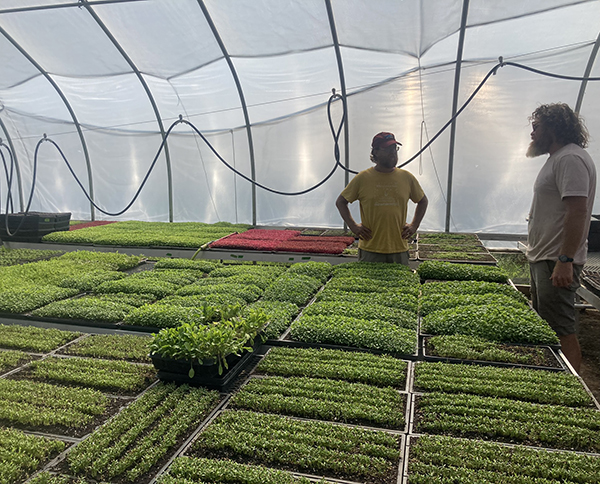
The microgreen greenhouse on Morning Dew Farm.
The microgreen greenhouse construction was part of a larger project geared to support year-round production. Initially, they washed them under market tents and in a rough three-season outbuilding. In 2021, at the entrance to the land they purchased they built a new wash and pack facility, with a walk-in cooler, office space, and ample room to sort and pack.
Solar panels adorn the roof, providing much of the power they need. It is wired for a portable generator, too, for when the power goes out as it recently did for three days during an ice storm. A REAP (Rural Energy for America Program) grant helped cover some of the cost for solar panels. They also received a $50,000 grant from the Maine Farmland Trust through a program formerly titled Farming for Wholesale, now called Farming for the Long Haul. They were eligible for a low-interest rate loan from the Maine Department of Agriculture, Conservation, and Forestry’s Farms for the Future program.
The microgreens greenhouse was a significant investment. What I, and many farmers I talk with, are beginning to realize is that these grants and other financial assistance are critical to our success. Being able to find, apply for, and receive them allows farms like ours to grow our businesses by supporting planning practices, technical assistance, and accelerating investments that farmers have already identified as critical through hard-fought growing seasons. Brady and Brendan were ahead of the curve, as they seem to always be.
On top of the plant sales, deliveries to restaurants and natural food stores, they attend the Damariscotta Farmers Market and offer a Free Choice CSA pick-up there. It uses digital gift cards through Shopify POS (point of sale). Members can be looked up via QR code or their last name and their balance easily tracked. Shopify is what they use for most sales, but Quickbooks is how they invoice and track wholesale sales.
They offer a 6-pick-up, bi-weekly CSA membership in the fall and are offering a 3-pick-up bi-weekly CSA membership this spring.
“We found the fall CSA a good way to wrap up the season, and heartening because we got to connect and visit with customers, especially around the food-centric Thanksgiving holiday, and economically valuable as our seasonal restaurant customers slow down,” Brady told me. “We thought the spring CSA would be a nice way to jump-start the season with similar community connection and vibrant greens.”
In August of 2022, we were able to visit them and their farm again, having only been there once before for their wedding several years earlier when they were still farming the family land. It was warm in Maine when we arrived, though not nearly as hot as Alabama. Maine was in a drought.
The microgreen greenhouse construction was part of a larger project geared to support year-round production. In 2021, at the entrance to the land they purchased, they built a new wash and pack facility, with a walk-in cooler, office space, and ample room to sort and pack.Solar panels adorn the roof, providing much of the power they need. It is wired for a portable generator, too, for when the power goes out as it recently did for three days during an ice storm. A REAP (Rural Energy for America Program) grant helped cover some of the cost for solar panels.
Their farm was in peak production, yet they welcomed us warmly, feeding us, staying up late catching up with us even though they had to wake up early and work all day. That time of year we always aim to get out of the sweltering south, but it is different in Maine in August.
We offered to help out. The four of us, along with their two kids and ours, picked peppers, harvested cherry tomatoes, and when the work was done, we received a full tour of their impressive operation. A state-of-the-art greenhouse was filled with trays of microgreens in every color and shape and at various stages of growth.
Brendan said the benches were costly and time consuming to put together, but the way they slid back and forth smoothly, creating lanes of navigation, appeared to be worth it and helped maximize the productive square footage. Many of the microgreens were being grown in baking sheets, but some were in 20-row seed flats, some in shallow 10 x 20 trays, and some in paper pot catch trays. Their top sellers are a mix they combine themselves, pea shoots, cilantro, and an herb mix.
As I write this, they lost power once again due to weather. This time for four days. Many of the investments they are choosing to make on the farm are geared toward reducing vulnerabilities in an increasingly volatile climate. These investments include putting parts of the farm into a permanent bed system, establishing backup power, improving drainage on the farm, and diversifying enterprises (seedlings and paprika).
Talking with Brady and Brendan is like a masterclass in farming. They think every decision through thoroughly, innovating and bringing a level of creativity to all of their farming enterprises.
Margaret Ann Snow is co-owner and operator of Snow’s Bend Farm.
Copyright Growing For Market Magazine.
All rights reserved. No portion of this article may be copied
in any manner for use other than by the subscriber without
permission from the publisher.