











Compost mulch in tarped no-till did the best; research is ongoing
In recent years, many small-scale organic vegetable farmers have adopted reduced or no tillage approaches. However, few university research trials have been conducted or published on these promising practices. Cornell University researchers Ryan Maher, Anu Rangarajan, and Brian Caldwell, along with many students, conducted a permanent bed organic vegetable research trial from 2015 to 2018.
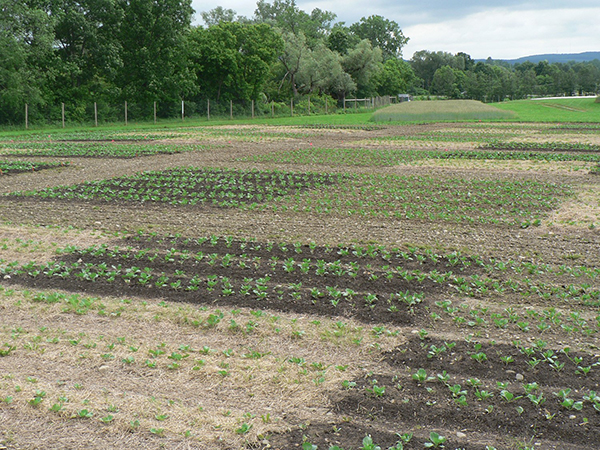
Our experiment at the whole-field scale showing mulched treatments in cabbage.
It was the first phase of an eight-year experiment in collaboration with the University of Maine. In it, we tested four tillage regimes and three types of mulch.
The tillage regimes were conventional (CT, with tractor mounted rotovator), shallow (ST, same as CT with rotovator set to ½ depth), no-till (NT, no primary or secondary tillage), and no-till with tarping (NTT, same as no till but also using tarps). The mulches were none (NM), compost (CM, ~1.5-2 inches), and rye hay (RM, ~4 inches). CM and RM were renewed annually. Rye hay was made from cereal rye plants harvested before anthesis (flowers opening). It had higher concentrations of nutrients than straw, and almost no weed seeds.
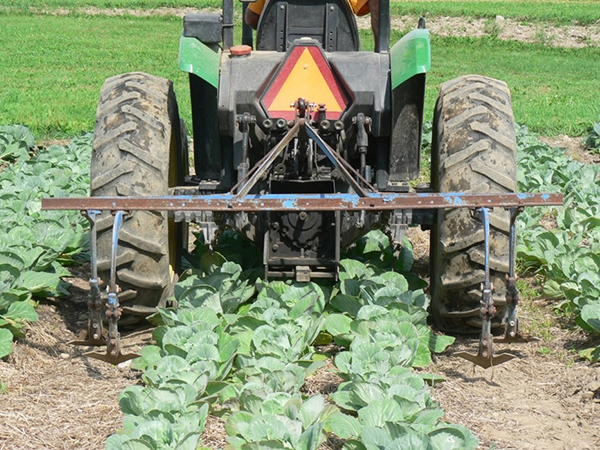
Field traffic was restricted to between-bed pathways.
We felt that these treatments captured a wide range of what small-scale organic vegetable growers were doing, or considering, to reduce or eliminate tillage on their farms and improve soil quality while maintaining good yields and profitability. We set out to compare production, labor requirements, economics, and soil results over consecutive seasons where we would inherit the soil and weed management legacy of previous years.
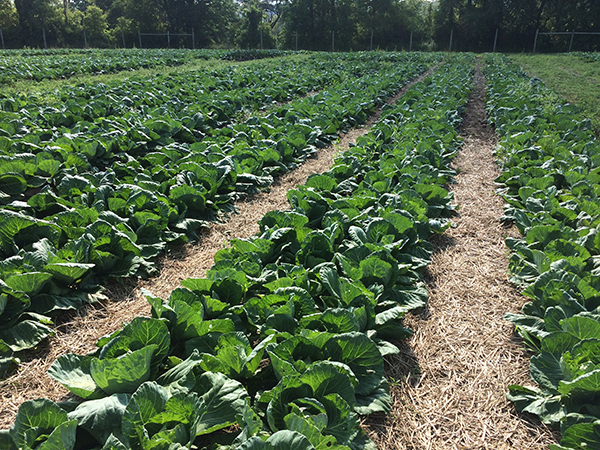
Cabbage planted in permanent beds, where beds were maintained in the same location over course of the experiment.
Each mulch was applied to each tillage regime — for a total of 12 treatments in all — and replicated four times. Each replicate included three beds, 4-feet wide and 25-feet long. The result was a 1¼ acre field divided into a patchwork quilt. We took crop data measurements from the middle section of the middle bed, so that edge effects were eliminated.
Pathways between the beds were 2-feet wide and were cultivated with a tractor several times each season to control weeds. The beds remained in the same place with the same treatments for all four years. Beds were not raised, although the CM beds became somewhat raised over time. Compost mulch and fertilizers were applied to the beds, but not the pathways.
We grew two transplanted crops, cabbage (reflecting the performance of brassicas) and winter squash (representing cucurbits) in alternate years. The crop cultivars were Bush Delicata winter squash and Farao cabbage. Approved organic pest control products were used according to IPM protocols uniformly to all plots. We applied 2000 pounds per acre of Krehers crumbles (5-4-3) each year to the NM and RM plots, but not to CM plots which had very heavy nutrient additions from the manure-based compost.
Weeds were managed with tractor cultivation when feasible, and hand hoeing that varied by treatment. Tractor cultivation was not done on CM plots, to preserve the layer of mulch. In spring in RM, mulch was raked from the beds onto the pathways to apply fertilizer and transplant. After one tractor cultivation we added fresh rye hay to attain a 4-inch layer.
An extensive set of data was tracked and recorded. It included all inputs, tillage and cultivation events, labor hours of hoeing and hand weeding, hours applying mulches and tarps, and marketable yields. Crop budgets were prepared to compare the economic performance of each growing system based on the data. After four years, we sampled our soils (depths of 0-4 feet, 4-8 inches, and 8-12 inches) to identify changes in soil organic matter and soil nutrients.
Results
We analyzed and interpreted the data over time by comparing each practice to a reference or “standard practice,” in this case we used conventional tillage without mulch (CT + NM). This allowed us to see how ST and NT practices stacked up over the course of all four years.
Yields of cabbage and winter squash were generally good over the course of the trial, except for poor yields in the RM plots in the first two seasons. Yields tended to be higher in years three and four.
In general, CM yielded more than NM, and both were considerably higher than RM in the first two seasons. In years 3 and 4, however, RM yields were the same or better than NM in seven of eight cases, and only slightly less than CM.
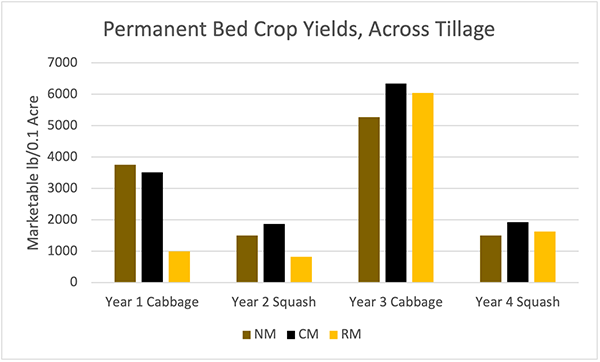
Figure 1 In general, CM yielded more than NM, and both were considerably higher than RM in the first two seasons. In years 3 and 4, however, RM yields were the same or better than NM in 7 of 8 cases, and only slightly less than CM.
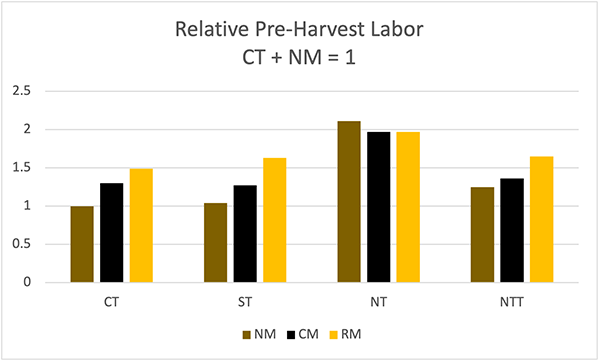
Figure 2.
Shallow tillage (4-inches deep) yielded the same as conventional tillage (8-inches deep) in all years, except for the RM treatments, in which it had lower yields. NT (without tarps) yields were similar to or less than CT, while the addition of tarping increased NT yields in some cases. Over the whole experiment, NTT + CM yielded 26 percent more than the standard practice of CT + NM.
Yields reflect the significance of mulches and a learning curve in the implementation of tillage and mulch methods. An example of this was the experience in the first two years of the RM systems. In the first year, cabbage was transplanted directly into the mulch and grew slowly. Even though cabbage is a cool weather crop, soil temperatures and nutrient availability were presumably too low during establishment and the crop did not get a good start. After that year, rye mulch was applied after crop establishment.
In the following year, there was a severe infestation of striped cucumber beetles. Some leaves had over 100 beetles. Surprisingly, the squash plants in the RM plots had the highest numbers, with many plants killed. When the squash crop returned in the fourth year of the trial, we put row covers over all squash plants. While SCB numbers were low that year, this was a risk we did not want to take again.
Pre-harvest labor hours were tracked. In general, the fewer labor hours needed for a crop, the better. Since harvest labor might be increased with higher yields, especially with squash, we thought not including it was the best way to compare the treatments.
All other treatments required significantly more pre-harvest labor than the “standard practice,” CT + NM, except ST + NM. No till without tarps, regardless of mulch, required roughly twice the pre-harvest labor as the standard due mostly to additional hand weeding. NT labor was reduced using tarps, but NTT pre-harvest labor was still 25 to 65 percent higher than CT + NM. The additional labor required for mulch application and tarp management was not fully offset by reduced hand weeding.
For net returns, we again compared other treatments to “standard practice,” CT + NM. The overall performance reflects both crops over the four-year study. Our crop budget model was comprehensive and included overhead costs as well as detailed operations costs for each growing system. We computed net returns per hour of total labor (including harvest) since that is an important metric for farmers.
Standard practice, ST with both NM and CM, and NTT+CM all gave the highest and equivalent net returns. Low profitability in RM was attributed to both lower yields and higher labor costs. Driving our results were a combination of added costs — extra mulch costs, labor hours required for weeding in NT (without tarping), and labor of handling both mulches and tarps. For NT systems, NTT+CM stood out, which was mostly due to better crop yields.
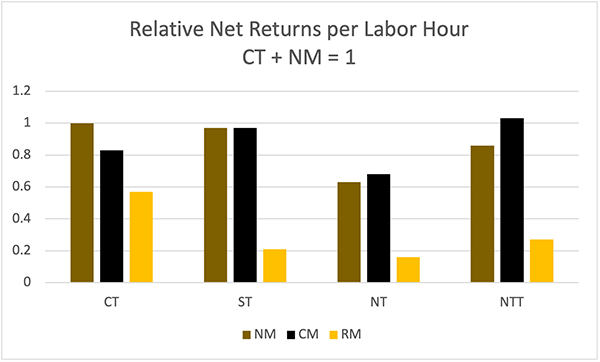
Net returns for cabbage were higher than those for winter squash. Seasonal cabbage returns for NM and CM ranged from $21 to $78 per labor hour, and for RM were -$5 to $69. Squash for all treatments ranged from -$12 to $31 per labor hour.
Soil nutrient and organic matter levels after four years reflected mulch inputs into the systems. Each yearly application of a 1.5 to 2 inch layer of compost averaged about 34 tons per acre per year (dry weight), containing about 800 pounds of total nitrogen (N), 15,000 pounds of carbon (C), and 340 pounds of phosphorus (P). The rye mulch application was about 5.4 tons per acre per year (dry weight), containing 70 pounds of N, 5000 pounds of C, and 18 pounds of P. In addition, organic fertilizer applications (in NM and RM plots) were 120 pounds of N and 72 pounds of P each year.
The yearly nutrient additions were not all in available form. However, N and P in the CM plots were far in excess of crop needs.
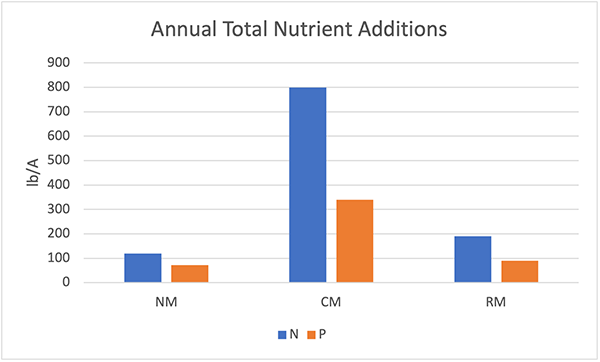
As expected, after four years, the top foot of soil in the CM plots had very high soil organic matter levels. In the top 4 inches, soil organic matter was as high as 14 percent in CM vs 5 percent in NM. Soil organic matter changed little in NM and RM treatments. The top foot of soil in CM plots had about 1350 pounds/A more total N than NM. However, about 4000 pounds of total N had been applied in compost over the course of the experiment, including at establishment in the fall before cropping.
We didn’t measure the amount of N exported from the plots in harvested crops. However, if we assume that it was roughly equal to the amount of fertilizer N applied to the RM and NM plots (120 pounds N/A/year), over half of the compost-applied N was lost. We didn’t find a difference in total C or N between NM and RM plots.
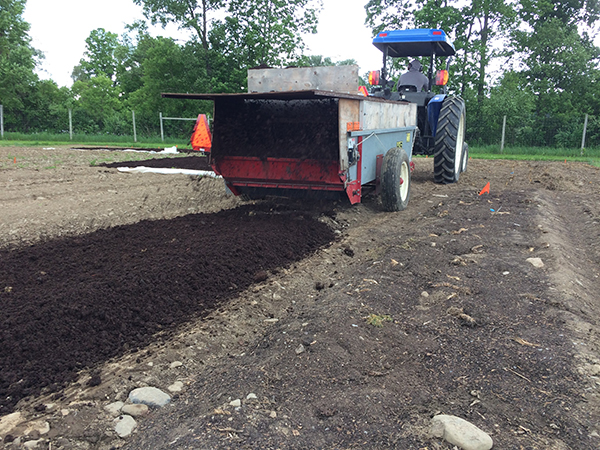
Compost was mechanically applied at mulching rates and then hand raked evenly over the bed.
Available P after four years, as measured by the Modified Morgan soil test, was 165 pounds/A in CM, 29 in NM, and 38 in RM. We can assume that most of the applied P was held in the soil, mostly by being converted to unavailable forms. However, at very high soil P levels, a small portion can leach into groundwater. For this soil type and test, over 40 pounds/A (roughly 20 ppm) is considered a high level. The extremely high P levels in CM do not improve crop performance; that P would be better used elsewhere.
Takeaways
While this experiment may not have implemented these practices exactly as any individual farmer would have, it provides a good indication of general trends:
Similar to the experience of many farmers, we had a learning curve when trialing a new practice. It probably reflected most on RM, whose results improved markedly in years 3 and 4. However, even in those years net returns were lower for RM than NM or CM. In implementing a major new practice on one’s farm, it is wise to expect setbacks and revelations in the first few years.
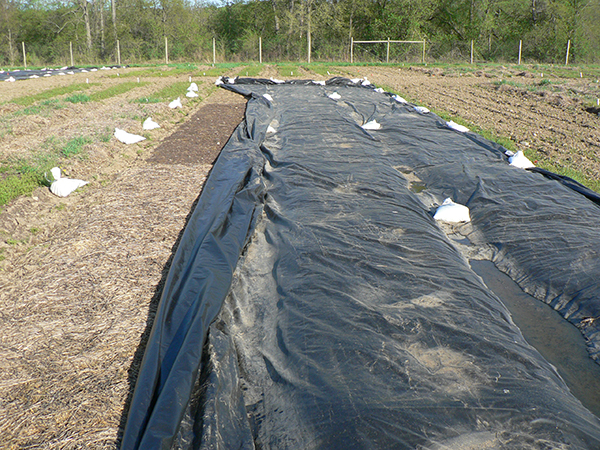
Tarps applied over no-till treatments to prepare beds for planting.
The standard practice, CT + NM, performed well as could be expected. Results from ST + NM were very similar. For farmers wanting to reduce tillage impact quickly and easily, shallow tillage is a good first step.
NT yielded well but required more labor hours, reducing net returns. Tarping reduced NT labor needs significantly and improved profitability.
CM had the overall highest yields. When CM was combined with NTT, it produced both high yields and net returns.
Standard practice, ST with both NM and CM, and NTT+CM can be equally profitable, as reflected in net return per hour of total labor. When overall net return for each hour of labor is high, workers can be paid well and the farm can still make a profit.
However, the over-application of nutrients, both P and N, in CM is a valid problem. Especially concerning is the loss of nitrogen. We did not determine the fate of lost N, but it is likely that both leaching into groundwater and volatilization including the production of N2O occurred.
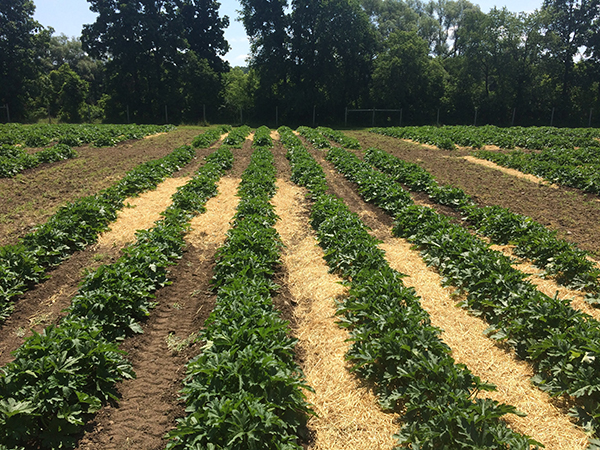
Winter squash in beds where tilled (left) and no-till tarp (right) treatments are shown side by side.
We wonder whether many of the positive outcomes of CM in a NTT system could be attained with only one or two years of heavy compost applications. Soil nutrient levels would be boosted along with soil texture and ease of working. Then a switch to no mulch or hay mulch might continue with positive results. There are many research questions about compost mulch management that could be asked – changing rates, frequency, and/or source feedstocks.
We continued this experiment for another four years within these same permanent beds and explored this type of transition, along with growing different crops. Stay tuned for those results!
Brian Caldwell has run Hemlock Grove Farm since 1978, now producing certified organic apples, pears, chestnuts, hazelnuts, American persimmons, and pawpaws. He worked on organic cropping system experiments at Cornell University until his retirement in 2018.
Ryan Maher spent 10 years as a Research and Extension Specialist in the Cornell Small Farms Program, based in Ithaca, NY, focusing on soil health practices in vegetables. He is now the Organic Farm Coordinator with the Cornell Agricultural Experiment Station where he supports organic research and outreach on AES managed farms and is the farm supervisor for the Dilmun Hill Student Farm.
Copyright Growing For Market Magazine.
All rights reserved. No portion of this article may be copied
in any manner for use other than by the subscriber without
permission from the publisher.