











At the height of the growing season, when the fields are planted and we’re busy harvesting vegetables and flipping beds for fall crops, how we package our produce may seem like an afterthought. But packaging is one of the first things the customer sees and it impacts shelf-life. In addition to marketing and product quality, how we package our food also impacts pollution —plastics in the ocean or landfills, or greenhouse gas emissions from making all those bags and clamshells. Plastics are petrochemicals; the same oil companies that make gasoline make all that plastic we see everywhere.
Plastic products are about 2 to 3.4 percent of global greenhouse gas emissions.1,2, To put this in perspective, the United States contributes about 13.5 percent of annual global greenhouse gas emissions, and of that about 10 percent comes from agriculture.4 That means globally, plastic products like packaging produce about 150 to 250 percent more greenhouse gas emissions than all U.S. agriculture. By 2050, plastics will total 20 percent of all oil consumption and up to 15 percent of global carbon emissions.1 This isn’t small potatoes.
About 9 percent of plastic is recycled, 19 percent is incinerated, and the rest ends up in landfills or pollutes our soil, wetlands, streams, rivers, oceans, and even our tap water.3 Plastic manufacturing plants, like the infamous 150 facilities in Louisiana dubbed ‘cancer alley,’ spew air pollution and chemicals that literally kill us and tend to be located in poor communities without the resources to do much about it.
Microplastics, little bits of plastic in our water and environment, have been linked to heart disease. Most plastic is used once and then thrown away. Concern about health impacts and plastic disposal has led to plastic bag bans, straw bans, and growing consumer backlash. Where ocean currents naturally slow, very large garbage patches form loaded with floating plastic. The largest of these is literally bigger than the size of Texas.5 Ocean plastic can fatally smother, entangle, or be ingested by turtles, sea birds, and other sea life, the same goes for plastic that ends up in our wetlands, rivers, or soil.
Before diving into the scintillating world of life cycle assessments and bioplastics like PLA, or petroleum plastics like PET, and HDPE/LDPE, it’s important to mention that most plastic that is ‘recycled’ isn’t actually recycled. A recent report by Greenpeace6 found that although just over half of recycling facilities accept number 5 plastic, less than 5 percent is actually recycled.
The same goes for number 1 plastic bottles. Despite being the most recyclable only 21 percent of the bottles put in the recycling bin are actually recycled, the rest are incinerated, end up in landfills, or pollute the environment — even though it was sent to a recycling facility.
A report titled, The Fraud of Plastic Recycling: How Big Oil and the plastics industry deceived the public for decades and caused the plastic waste crisis7 details how recycling is more expensive than using ‘virgin’ materials and key technical challenges — plastic degrades after one or two uses, different types can’t be melted together, and the more plastic is reused the more toxic it becomes, preventing most plastic from being recycled. Whether mechanical or chemical recycling is used, it is too expensive or just doesn’t work as well as advertised. In short, we’re not recycling our way out of this.
What’s a farmer to do?
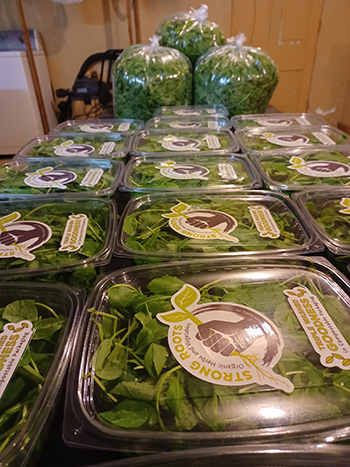
We are trying to grow sustainable, low carbon food at our farm. That means looking at everything from propane, electricity, and fertilizers to plastic. For a few years, we’ve used compostable clam shells for our salad greens and shoots, advertising “Triple Washed Goodness Compostable Packaging.” We also found shells improved our quality and gave our customers longer shelf-life.
Compostable shells like ours are bio-based and made from sugarcane, beets, or corn. These crops use photosynthesis to suck up atmospheric carbon dioxide; the carbon in the crop is then turned into polylactic acid (PLA) and formed into the compostable shells we use in our pack house. Seemed like paying the premium for compostable shells was a win-win in terms of environmental sustainability and improving product quality for the customer. But the reality is our local composting facility won’t accept PLA bioplastic and they can’t be recycled. This means in practice that the shells just get thrown away and degrade in the landfill or ocean at about the same rate as plastic. So, are we just greenwashing?
It depends. In terms of climate change, bioplastics like the PLA we use don’t add as much carbon to the atmosphere. A plastic-based shell uses fossil fuels, and that carbon came from the ground which means that when it degrades new carbon is added to the atmosphere. Compostable shells ‘borrow’ carbon from the atmosphere before returning it, but petroleum-based shells made out of PET add carbon that had been stored underground to the atmosphere.
But there’s more to it, when you convert the crops used in PLA to a bioshell, the process is very energy intensive and can be inefficient, converting petroleum into a plastic shell needs less energy.
Research has shown that fertilizers, water, and diverting land from growing food for packaging or other bioplastic also has important impacts. And there is still the issue of disposal. According to Dr. Morton Barlaz at North Carolina State University, who was interviewed for this article, if PLA bioplastics are thrown away or composted, they must reach 130°F to degrade. If they don’t, bioplastics eventually break apart into smaller pieces like plastic, but over very large time scales similar to petroleum-based plastic.
Figuring out if bioplastic shells are more sustainable than a plastic shell is not straight-forward. To cut through all the different impacts, we looked at the scientific literature and life cycle assessments (LCAs). LCAs are used by scientists to compare the environmental impact of different products across the lifetime of the product.
For plastics, greenhouse gas emissions are driven by petroleum extraction (~61 percent), production (30 percent), and disposal (9 percent).2 As outlined above, recycling is a dubious at best solution and most plastics are single-use or have a linear life-cycle (extraction > production > use > disposal).
A circular lifecycle is based on recycled or renewable materials. In theory, the bioplastic shell could be recycled into new shells, or renewable crop, crop-waste, or algae biomass from oceans could be grown for new shells. Depending on the technical assumptions scientists use, bioplastics can reduce greenhouse gas emissions by about 50 to 60 percent compared to petroleum-based PET shells — although this is less if methane is formed in the landfill and not captured for energy.2, 8,9,10 According to Dr. Barlaz, at most, about 5 to 10 percent of the bioplastic could be lost to methane in landfill, and even with this potential loss there are still emissions benefits.
But what about the land demand, water use, and other pollution from bioplastics? This is where things get murky, especially when you scale-up bioplastics to fully replace plastic. Aside from relatively small oil fields and refineries, plastic doesn’t take up much land — especially compared to crops grown in fields. Replacing plastic packaging (just under half of all plastic production) would require more than half of the world’s corn production.2,9 This is an area larger than Texas. These crops would also require more than 5 times the amount of water used to irrigate crops in California.2,9,11 And that’s just for packaging. Bioplastics would also worsen ocean acidification12 and nutrient pollution like eutrophication13 compared to plastics like PET, HDPE, or LDPE.
Today’s bioplastics could reduce greenhouse gas emissions but could clearly worsen water pollution and divert too much land, water, and food to be sustainable. In the future, using crop wastes or algae could improve many of these outcomes. Other potential improvements include using renewable energy or improving the efficiency of the manufacturing process. Increased demand could mean better infrastructure is put in place so that disposal of bioplastics leads to carbon neutral energy production, recycling, or composting — rather than landfills or environmental pollution. So, there is potential down the road, but those are a lot of ifs.
In the short-term, there is no clear answer as to whether the shells we use are sustainable or greenwashing. If you focus on climate change, there is a benefit to bioplastics. If you look at other environmental issues, bio-based plastic could be worse. In the future, if bioplastic has a breakthrough we will reconsider the sustainability of our packaging.
At our farm, in the here and now, we have very reluctantly decided to forgo using compostable shells with mixed environmental benefits and move to plastic shells or bags for our customers. Although the greenhouse gas emissions may be higher for plastic, we can manage for that more easily than the land use change, water demand, and water pollution that comes from the manufacturing and use of bioplastics.
We are estimating the greenhouse gas emissions associated with petroleum-based bags or shells, and also how long the material will last in the environment if not properly disposed. We will estimate the greenhouse gas emissions associated with our final choice, and how to reduce these emissions through no-till and reduced tillage, enhanced rock weathering, and other climate friendly farming practices. One thing we learned through this process is that how we package our produce is way more complicated than an afterthought.
Sidebar: Enhanced rock weathering
Enhanced rock weathering (ERW) is a technique farmers can use on fields that involves applying specific types of rock powders to remove carbon dioxide from the atmosphere. These rock powders are very similar to limestone powders that farmers currently use, but limestone contains calcium carbonate—a specific type of mineral . For ERW, often, rocks containing silicate minerals are used. Rainwater will naturally weather rock over time. Essentially, carbon dioxide in the atmosphere is absorbed in rainwater; water and carbon dioxide form carbonic acid, and the carbonic acid chemically weathers the rock. Think of old sculptures, headstones, or even entire mountain chains weathering over time. By using finely ground powders the weathering is much faster (or enhanced). With silicates, the byproducts of this chemical weathering include the carbon dioxide from the atmosphere that was first absorbed in the rain. These byproducts, like bicarbonate, are stored in the soil or eventually washed into the groundwater and oceans. The specific amount of carbon that can be stored depends on a lot of different factors: the pH of the soil, soil type and texture, the underlying mineralogy, application rates, and the specific type of minerals used. Silicates are a type of mineral that have been researched by scientists for their carbon storing properties.1
Basalt is a type of rock containing silicate minerals; we are looking at using basalt on our gravel road and also in our fields to sequester atmospheric carbon. Other minerals may be even better depending on site specific factors and what’s locally available. Important considerations are the cost of the rock powder and transportation emissions from hauling the powder from the quarry to the manufacturer, and then to the field where it is applied. We are currently in conversations with a quarry in Pennsylvania to buy basalt powder and apply it to our field. This helps reduce costs and transportation emissions that could offset the carbon benefit of the rock powder. ERW is one of many climate smart solutions that can be used on farms—regardless if you’re a small scale, commercial grower like us, or a very large farm.2 A bonus is that applying silicates like basalt also helps improve crop yields, increases soil fertility (Ca and Mg), and reduces soil acidification. If enough of these minerals are applied at a large scale, some suggest it can even help reduce ocean acidification. We are currently developing precise estimates of how climate smart solutions like this can help us grow carbon neutral or even carbon negative food— and offset emissions from our packaging.
Ethan and Siobhan Davis own and operate Strong Roots farm in beautiful Woodward, PA. They have been farming for about ten years and grow vegetables and herbs. They also have developed a sustainability plan (http://www.strongrootsorganicfarm.com/sustainability.html) and use a locally focused strategy to combat climate change, enhance biodiversity, and protect their watershed. Ethan has also worked with farmers and other companies to help them estimate and reduce their greenhouse gas emissions and implement climate smart farming to achieve net zero emissions and mitigate climate change.
1 https://www.nature.com/articles/s41586-020-2448-9
2 https://www.pnas.org/doi/full/10.1073/pnas.2319436121
1 https://www.epa.gov/plastics/impacts-plastic-pollution
2 https://www.nature.com/articles/s41578-021-00407-8
4 https://www.epa.gov/climate-indicators/climate-change-indicators-us-greenhouse-gas-emissions
5 Stephen Buranyi, The Plastic Backlash: What’s Behind Our Sudden Rage—and Will it Make a Difference?, Guardian (Nov. 13, 2018), https://www.theguardian.com/environment/2018/nov/13/the-plastic-backlash-whats-behind-our-sudden-rage-and-will-it-make-a-difference.
7 https://climateintegrity.org/plastics-fraud
8 https://www.news.pitt.edu/sites/default/files/documents/TaboneLandis_etal.pdf
9 https://www.sciencedirect.com/science/article/pii/S2590332220303055
10 https://www.sciencedirect.com/science/article/pii/S2352550924001507
12 https://www.sciencedirect.com/science/article/pii/S2352550924001507
13 https://www.sciencedirect.com/science/article/pii/S0957582024006359
Copyright Growing For Market Magazine.
All rights reserved. No portion of this article may be copied
in any manner for use other than by the subscriber without
permission from the publisher.