








We all spend a good deal of time in our washing and packing sheds. Mechanization in this area presents real potential to save on labor and ease our workload overall. I’ve been considering purchasing an AZS Rinse Conveyor for a couple of years, but have had some hesitations.
This piece of equipment is essentially a covered conveyor with overhead washing stations, though there is the potential to expand upon this base at the beginning and/or end of the conveyor. I did some research, surveyed farmers I know who own one, and visited friends to get an in-person demonstration.
AZS is a father-son partnership which started when the father, Ammon Shirk, built his own washer for the tomatoes, cantaloupe, Chinese radishes, and cabbages he was producing. In 1984, he began to build brush washers for local growers, and eventually, manufacturing brush washers became his full-time job.
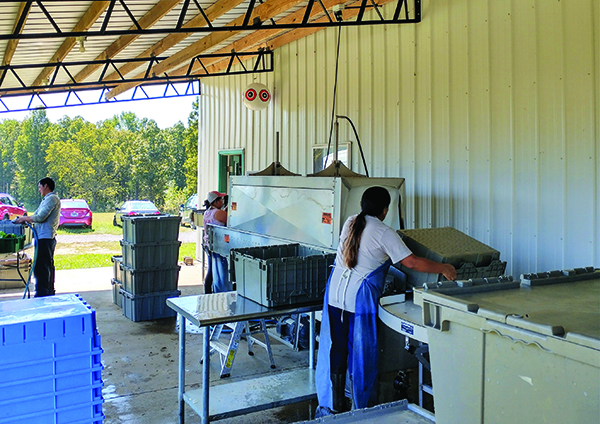
AZS Rinse Conveyor in use on Mountain Sun Farm. “It helps to set and maintain a pace. No one can loiter or slow things down on the line when it is in use,” says Liz Simpson.
Harvey, his son, still farms the original 50 acres where the company operates, raising beef cattle as well as corn, beans, and barley for the feed. Aside from the Rinse Conveyor and its many additions, AZS manufactures a Plastic Hole Puncher for planting into mulch and a sweet corn Desilker.
At my friend’s farm, Mountain Sun Farm in Mentone, Alabama, the demonstration begins with washing purple potatoes. There are options for bin dumpers, though I haven’t heard from any farmers using them. Here, the potatoes are simply dumped from a tote onto the conveyor belt — easy enough. White flaps at the entrance and exit to the conveyor prevent water splashing out.
On the other side of the flaps is the first of three distinct wash stages, which is called the ‘recirculation’ stage. Recirculation is always used. This stage only requires the base tank to be filled and then no more outside water is needed; instead, it recirculates what is in the holding tank. The recirculation water gently rinses and hydro-cools the produce, then the second stage is chosen, either ‘pressure’ washing or ‘misting.’
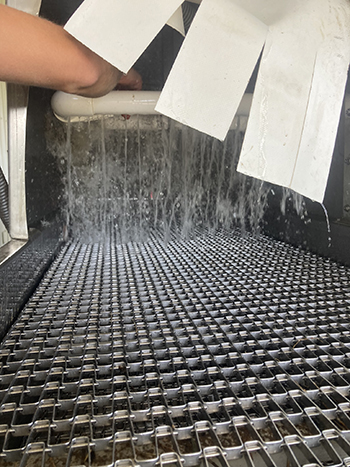
The first or “recirculation” stage precedes either a mist or pressure wash stage, and uses recirculated water to start the process of getting dirt off produce.
The potatoes run through on the pressure wash setting and come out gleaming. This farm has the rotary table addition at the end, a large, round landing space for people to sort and pack the produce, ready to go out to customers.
Carrots are run through twice to get them really clean, also on the pressure setting. Harvey at AZS tells me this second run through can be avoided by presoaking the carrots and/or using a larger pressure pump, as opposed to the smaller pump. Eggplant gets the misting setting, as would head lettuce and other greens.
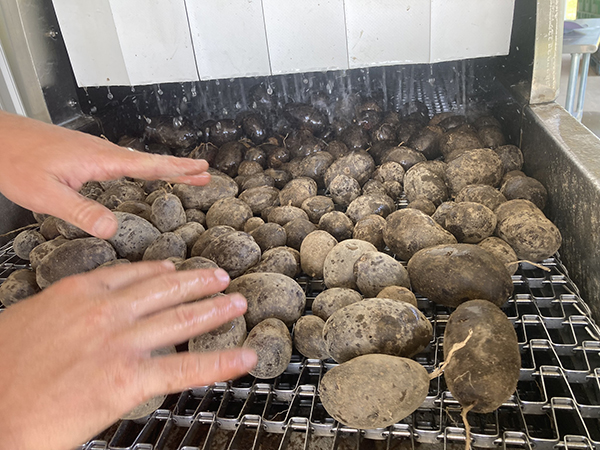
Purple potatoes being loaded into the recirculation stage- produce should be only one layer high. The white flaps keep water from splashing out. All photos courtesy of the author.
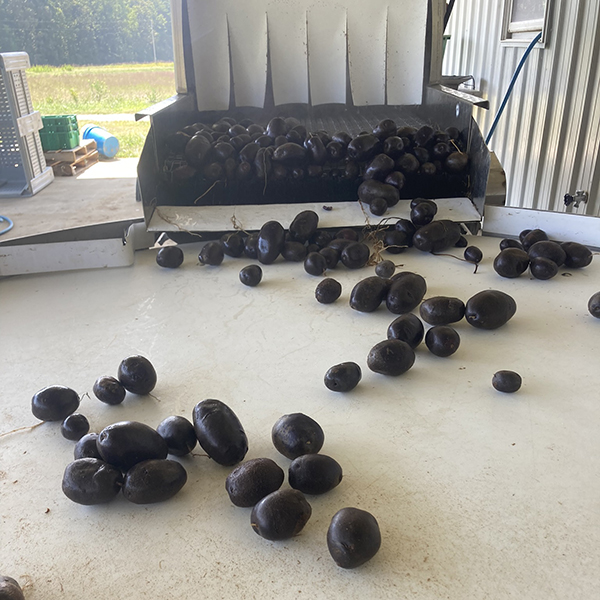
Purple potatoes coming out and landing on the rotary table for sorting and packing.
“For sensitive crops like head lettuce, a three-sink dunking setup will still work better,” says Brian Simpson of Mountain Sun Farm. “But the conveyor is faster and eliminates the downtime from draining and refilling sinks for new water. We dunk once after the conveyor and our customers are happy.”
It can be run at differing speeds and settings, which the farmers I visited figured out by spending an afternoon running various crops through at various speeds and tweaking until they found the one that worked best. They have graciously shared the chart they use for reference, which is attached to the wall adjacent to their AZS.
Cleaning the machine is straight-forward. The tank is drained, a few filters removed, and everything sprayed well. Anyone should be capable of doing this easily, which is done at the end of each day.
Pros of owning an AZS
It’s versatile. Not only can you use it for washing produce, but many of the farmers I spoke with feel it is worth it for the bin and crate washing alone (often run with some form of sanitizer added), which “staff is all happy to do” says Emma Jagoz of Moon Valley Farm. Both she and the farmers at Mountain Sun Farm tell me it can also be used to wash greenhouse trays.
It sets a good pace. You and your staff have to keep up. You also get standard results, regardless of who is working.
It’s great for scaling up (especially roots).
You can hydro-cool in waxed boxes. Simply harvest bunches of greens, summer squash, and cucumbers into waxed boxes and send them through on the misting option to bring the temperature down.
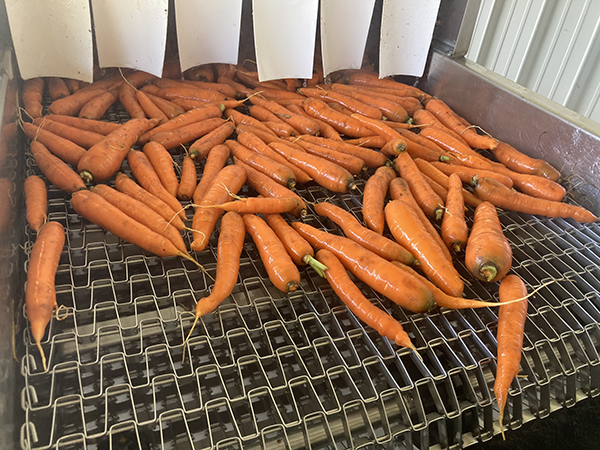
Carrots after two runs through the AZS. The second run can be avoided if carrots are pre-soaked.
It helps you meet food safety requirements through easily washing produce and making sanitizing harvest and storage totes a breeze. Russell Honderd of Love is Love Cooperative Farm says: “We have also started to add organically-allowable sanitizer to our recirculated water (a requirement for our food-safety audit) and are hoping it will help extend the storage life of crops. We haven’t been doing it long enough to have good data but we have heard it is effective.We use SaniDate 5.0 and use the label and test strips to maintain the appropriate concentration for the use. Veggie wash is a much lower concentration than when used for sanitizing food contact surfaces.”
There are several accessories you can add that do a multitude of things regarding putting the produce in, how it comes out, and other components along the way. One of the areas offering the most accessories is what happens at the end, when the produce exits. The farmers I surveyed almost all have the rotary table, but there are many other options, including sorters and sizers.
It is customizable. The conveyor can have brushers, absorbers, sizing units, side packing tables, driers, overhead brushers, casters for rolling and moving the equipment around, and more. You could start with the base and add on from there. They also offer a 4-unit and a 5-unit package, which has some of the most common additions.
The company is regularly receiving feedback from farmers and making adjustments to newer models.
Potential hesitations
My quote was $12,660. That said, the four farmers I surveyed unanimously agreed it was completely worth the investment.
It requires a covered space, but not enclosed, due to noise. Placement should also consider the dimensions. It is 24 inches wide and varies in length (11 to 38 feet), depending on customization. The extensive brochure available from AZS provides detailed explanations and diagrams of all the options. Plenty of space should be allowed for on either end and at least one side, for people and bins to move around.
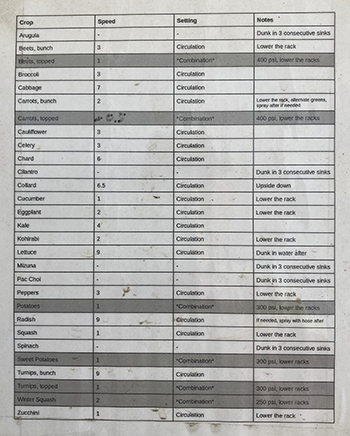
A fact sheet for speeds and other variables for the AZS rinse conveyor, courtesy of Mountain Sun Farm.
Energy and water requirements were a concern for me as I consider buying one. My farm runs on well water with a small cistern serving our packing shed. Most farmers surveyed say this is negligible. One farmer said it uses a 220 outlet and when it goes down, they cannot use it, but they also said customer service is great. There is a gas-powered option if needed. On this same farm, both their irrigation and pack shed use the same well water; if they are irrigating during a drought, they cannot use the pressure washing feature, but can use the other washing stages (recirculation and misting).
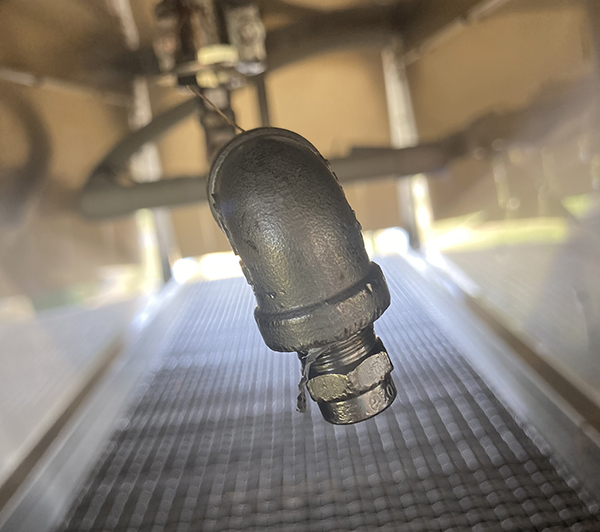
The upper pressure washing wand washes sprays produce from above- the angle should be adjusted based on what is being washed.
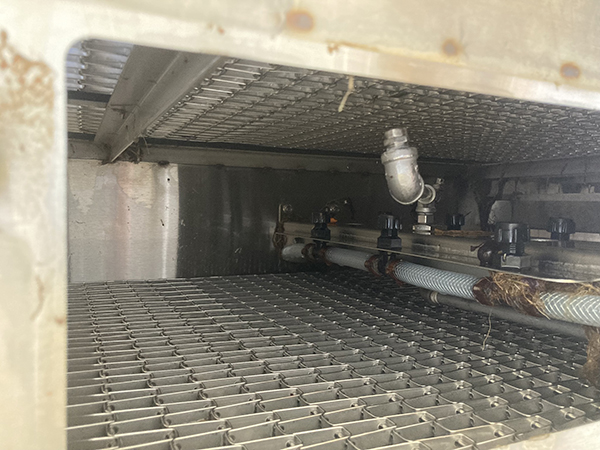
The lower pressure wand sprays from below the conveyor. It is important to ensure both wands are spinning while the conveyor is running.
Safety of staff is a concern. Only one of the four farms surveyed reported any injuries, but there are already modifications available to prevent this type of injury. Worker’s compensation is recommended (This is recommended on farms in general, too, though).
Not everyone will know how to operate the machine right away. There are adjustments to be made, such as the angle of the pressure washing nozzles, which are nuanced and call for experience. However, Harvey tells me that there are prototypes which eliminate the need for these adjustments.
All four farms I surveyed strongly urged other farmers to get an AZS rinse conveyor. Their only regret being they didn’t buy one sooner. Heather Anderson of Green Wagon Farm adds: “We easily could justify a purchase for washing/sanitizing crates alone.”
That said, each farm is a unique ecosystem, with its own assets and challenges. Figuring out if this enticing piece of equipment is right for yours can only be done by you. There are plenty of resources to help you make that decision. The folks at the University of Vermont Extension are actively building their already substantial information stock on the subject and the owners of AZS are very helpful.
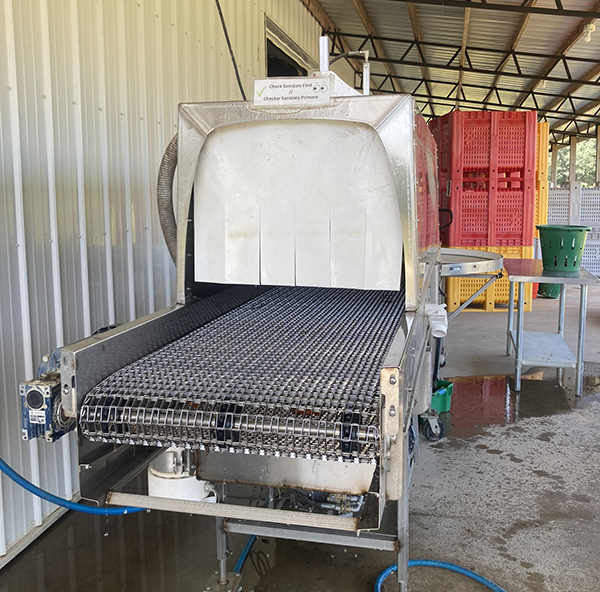
The entrance of the machine.
I’m still undecided. Mainly because we have decided to scale down on our farm, not up. However, it appeals to me more as a quality-of-life upgrade and as we think about setting our farm up for aging bodies. Looking for ways to make the work easier on ourselves, it is clear the AZS Rinse Conveyor does that.
If you have questions or concerns not addressed in this article, please feel free to contact me and I will do my best to find an answer.
margaretann@snowsbendfarm.com
To order an AZS rinse conveyor, contact Harvey Shirk:
(717) 733-2584; azsbrusher@ibyfax.com
Margaret Ann Snow is co-owner and operator of Snow’s Bend Farm.
Copyright Growing For Market Magazine.
All rights reserved. No portion of this article may be copied
in any manner for use other than by the subscriber without
permission from the publisher.