











A new farm store model is growing in France
Imagine a farm shop that is not only yours, but also belongs to 28 other farmers. Here customers find everything that can be produced locally: eggs, vegetables, fruits, cheeses (very important if you are French!), flour, meat, and more. More than 80 farmers offer products. Don’t call it a farmers’ supermarket because it feels very different- more like an on-farm shop. Welcome to the “magasin de producteurs” (producer’s store) — a special status restricted by French law.
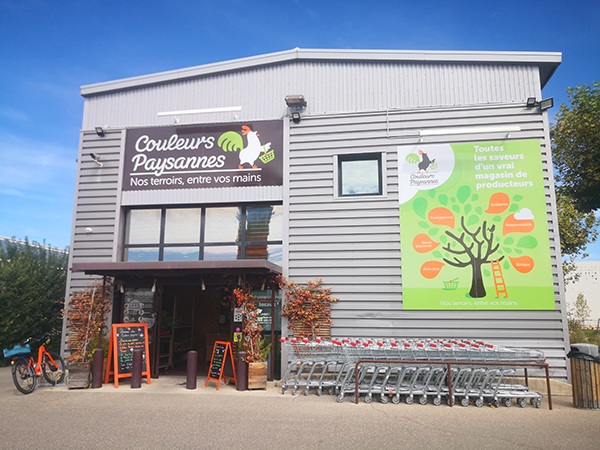
Most magasins de producteurs (producer’s stores) are outside of cities. All photos courtesy of the author.
The first magasin de producteurs was established in 1978 by seven young farmers near Lyon. Today, there are more than 300 in the country, 15 in my region Provence Alpes-Côtes d’Azur. To use that name, the shop must be run by farmers, incorporated in a non-profit, a cooperative or a company. The sales of the collective’s farmers must represent 70 percent of all sales, while the remainder can come from farms outside the group.
A 16 percent commission on each sale covers the cost of the shop, usually several employees, rent, taxes, and investments. A software platform generates the invoices at the end of each month. Also, at most magasins de producteurs, farmers must work there one or two days a month as cashiers or serving cheese and meat. I work two Saturday mornings each month. I love these rendezvous with the clients. Often, members must participate in monthly business meetings to make decisions. However, some shops appoint a team of farmers to decide for the group.
Sales of one million Euros
Four years ago, I co-created a collective shop with 28 other farmers. It’s called La Bardane (burdock in English) and is located in Cadenet, seven kilometers from my farm in Provence Alpes-Côtes d’Azur. It’s one of my top sales sites. I drop off herbs and salads every day. The shop is a success with $1 million euros in sales — double what we predicted when we opened it. For many of us, it balances out the very random fluctuations in organic sales at markets in the last few years due to inflation. Many organic French farms have difficulties selling their products.
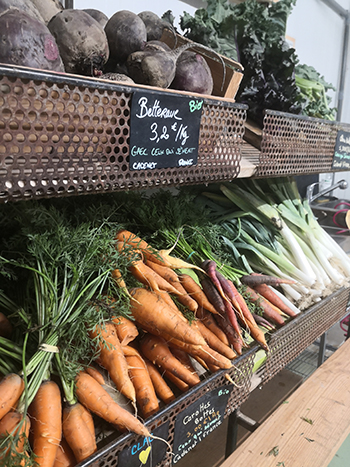
Each farmer has their name on the sign for the produce they grew.
Each day more than 150 people buy food there. “The shop attracts people who we used to see at the market,” explains Camille Chagué, who works part time for La Bardane. “But also other people who come here as they would a supermarket, a bit more conscientious.”
Camille has a farm nearby with her partner, Yohan. They grow strawberries, apples and pears. “Markets never really worked well for us, here we never have leftovers,” she said. The farm was started decades ago with wholesale organic strawberries by Yohan’s parents. “This shop was a missing link between clients and farmers,” Camille said. We thought so, too.
We started from scratch in 2020. We formed a group and raised €25,000 (euros) among us and an additional €18,000 with crowdfunding. We found a location — a very long and hard task — and then did the laborious work of turning an old factory into a shop. The European Union financed a big part of the investment (more than €150,000) but we also had to convince a bank to lend us money. The subsidy money arrived two years after we were awarded it. Soon after we opened, we bought the building for €400,000.
La Bardane changed the way many of us work. “Thanks to the magasin de producteurs, we managed to reduce the number of crops that we grow, from 53 to 37,” relates Alix Roux. She works with Gaétan Raoux at a farm near the shop. At La ferme de ceux qui sèment they grow on just over six acres along with a greenhouse.
They are associated with two producers collectives where they sell mainly fall, winter and spring vegetables. Other farmers grow during the summer. With this shift, they cut their summer working time in half to just seven to eight hours a day. They also now work by themselves and don’t hire employees. They also stopped going to a market in Marseille (an hour drive away). They planted 38,000 leeks for the two shops and a CSA, along with carrots, squash, onions and winter greens. “We know exactly what we sell and the sales are not impacted by the weather,” she said.
Each farmer can check online what has been sold during the day. The magasin de producteurs works so well there is not much left every night in the cold storage.
Weekly crop calendar
More than 15 farmers supply the shop with vegetables, which represent 32 percent of sales. How does it work? The associates have priority to choose what crops are planned. Several times a year we meet to discuss which crops everyone will grow next season. Some people stick to their specialities and some change. I grow aromatics and small salads like roquette, mizuna or mesclun all year. (See the article in the October 2024 GFM, “Why and how to grow culinary herbs all year round,” for more about the author’s farm.)
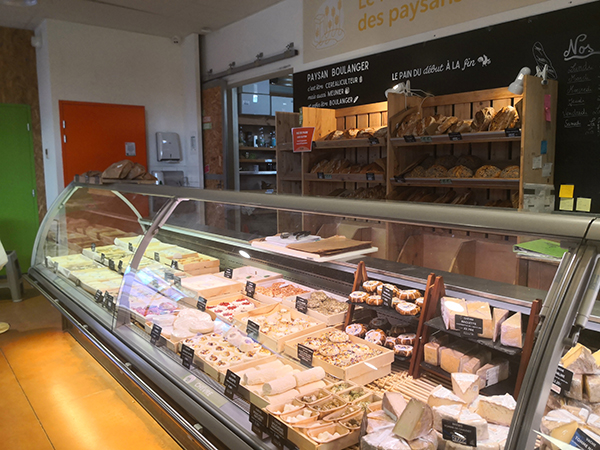
There is a lot of cheese available at Couleurs Paysannes.
The most difficult topic is tomatoes as almost all farmers want to be the one selling them when they are the most profitable. If a crop is missing, then we have a list of farmers who can supply it. Varieties are split among farmers for the main products like courgettes (zucchini) or tomatoes. (See our crop calendar.) Each farmer sets the price of his or her products, but they have to be the same prices set for markets or other shops. I sell my herbs at €1.20 per bunch with a commission of 16 percent, which makes €1.08 for me. In classic organic shops, I sell it to them for €1, then they mark it up to €1,60 or €1,80. And, you only get paid for what has sold.
Quality charter
The magasin de producteurs are different from each other because it depends on who runs it and who builds it. In Cadenet for example, all the founders are organic and even if the shop is mostly organic we offer some conventional, non-organic products. I deliver herbs to a magasin de producteurs in Venelles near Aix en Provence, Couleurs Paysannes, where it is exactly the opposite: very little organic and a lot of product from hydroponics or other non-organic methods. They have sales of €3 million at one of their locations.
Some shops have two different sections: organic and conventional. Most have a quality charter where farmers explain how they work and what practices they prohibit, such as heated greenhouses or meat from intensive farming.
Another interesting fact, la Bardane is part of an experiment called CLAC. A hundred families with low incomes from the village get a €150 monthly budget to buy organic and healthy locally grown food. The Fondation de France, an international foundation which finances this trial, defrays fully all vegetables bought from the shop by these families.
More and more producers’ collectives
There are all types of shops. In Pays de la Loire, a group of farmers created a network of seven shops called, La ferme de chez nous. A very interesting model because each one is its own business, but they build a brand and share some costs. They sell products from more than 500 farms. “Each shop has a delicatessen and charcuterie,” says Céline Alland, who works for one of them.
The brand marketing is simple but strong: everything comes from fewer than 100 kilometers away. “Clients want local products, this is the most important fact,” Céline said. “We wanted to distinguish ourselves from organic stores that sell products from Peru or China.” They even opened one in another region, helping the local group of farmers with their experience.
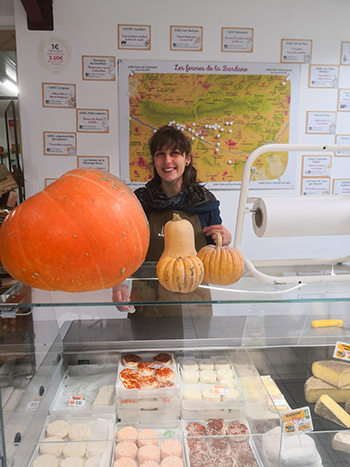
Camille is both a farmer and an employee at this magasin de producteurs.
The turnover varies a lot. Still, a study, from Trame, a non-profit that helps farmers build and run such shops, offers a positive outlook. Based on 39 shops, it shows that the average turnover is €830,000 a year. They identified what makes a place more efficient: as many products as possible, as many farmers, being outside the village, next to a main road, and open at least 50 hours a week. Some small shops in the countryside only open three days a week, and they still attract farmers to participate. The size of the shop also matters — at least 100 square meters.
I studied those numbers because we are working on a new magasin de producteurs, in a bigger city, Pertuis, 15 minutes from the original shop. Some colleagues from the original shop are part of it, but there are other farmers who we recently met. They are going to make the new place unique and different from the first one.
For example, there’s Thierry and Sophie Perez, who raise goats and are quite famous locally for their yogurt. There will also be duck meat and local fish. We already have 20 associates. I bet there will be more by the time we open the shop next February. We found the location, but now we have to find money to finance everything that is needed. It is lots of work but definitely worth it.
Another study from Trame and INRAE questioned the local impact of the magasin de producteurs. They interviewed the 300 members of five shops in my area, Luberon. Half of them do more business since joining a shop. One euro spent in a magasin de producteurs brings, according to this study, €2,8 euros spent in a 80 kilometer area. Which proves that those kinds of shops are not only good for clients and farmers but also for the local economy.
Clémentine Vaysse grows herbs and greens since 2017 in the South of France. Based in Lauris, near Aix-en-Provence, the farm is called Les herbes de la mésange bleue and is certified organic. A former journalist, Clementine is passionate about small scale farms and low tech in agriculture, specially if they include horses.
Copyright Growing For Market Magazine.
All rights reserved. No portion of this article may be copied
in any manner for use other than by the subscriber without
permission from the publisher.