











The variety showcase: bringing farmers, seed breeders and chefs together
One of the most important learning tools in my toolbox over the years has beenfarmer gatherings, places where farmers are able to get together and share notes. Actual farm tours and field days are often the best, but also important to me have been farm conferences. One of the best I’ve attended annually for the past ten years has been the Variety Showcase that is put on by my friend Lane Selman, the founder of the Culinary Breeding Network. This year’s event happened earlier in September and I thought I’d share some of the ways this event in particular has been useful to me, and how I approach conferences and events in general to get the most out of them.
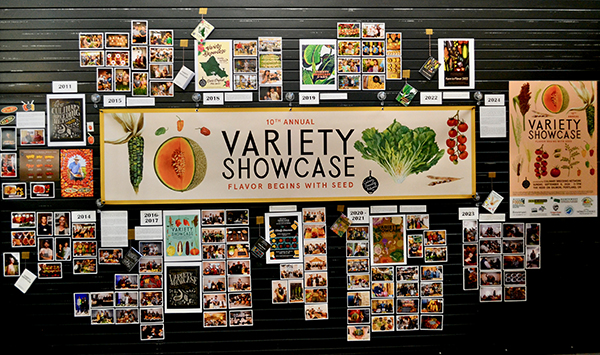
A collage of photos from Variety Showcase events going back 10 years. There have been Variety Showcases put on by Culinary Breeding Network in multiple places around the country and the home is in Portland, Oregon. The event highlights regional seed breeding and culinary professionals with representatives from multiple regions of the country. All photos courtesy of the author.
The Variety Showcase builds on work done in the Pacific Northwest in three different specialties which are all inter-related: farming, seed breeding, and food preparation. The event brings farmers, seed breeders, chefs and bakers together, literally putting them all in the same room and talking together, all while sampling food prepared by the cooks and bakers, grown by the farmers and made from the breeders’ work. As an attendee you walk into a beautiful large event space with tables around the edges.
At each table there is information about a particular variety from a breeder who typically works on breeding specifically for organic growers. In addition to the information on the variety there is a chef offering tastings and culinary information for their particular preparation of that variety. With the breeder and the chef both at the table there is plenty of opportunity to not only read the signage and taste the result, but also to ask questions and have conversations.
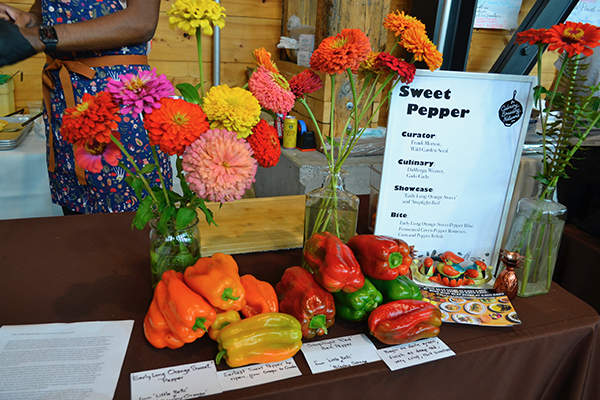
Frank Morton is the breeder at Wild Garden Seeds and a tasting where his Stocky Red Roaster sweet peppers not only got top marks from local chefs for flavor, but also for their structure was one of the key ah-ha moments that led to the creation of the Culinary Breeding Network 14 years ago. His table this year featured some of his pepper breeding projects and zinnias originally bred by Jim Baggett.
In the early years the event was weighted more heavily toward vegetable varieties, but as it has grown and evolved there have been more and more grains highlighted, as well as fruit (and this year I noticed a few of the breeders accenting their tables with flower breeding projects, food for the soul). While the event grew out of farmer to farmer, farmer/breeder and farmer/chef conversations, it is open to the larger eating public and now draws many people from diverse backgrounds, all excited to experience new tastes and to learn about the breeding work and collaborations making those tastes possible.
While the event is specifically highlighting new breeding work and current culinary trends, there are many nods to the historical breeding and culinary roots. Posters trace maps of the origins of important staples like maize and beans. A beautifully curated art collection is in one room of the event, featuring prints of centuries old still life paintings of fruits and vegetables, as well as paintings of produce market scenes, farmscapes and farm labor. There are no “heirloom” varieties featured on the tasting tables, but all of the varieties are potential “heirlooms of tomorrow,” and all the varieties featured build on the genetic materials passed down for generations. This is really no different than all varieties everywhere, although there may be some difference in the acknowledgement of the importance of those connections.
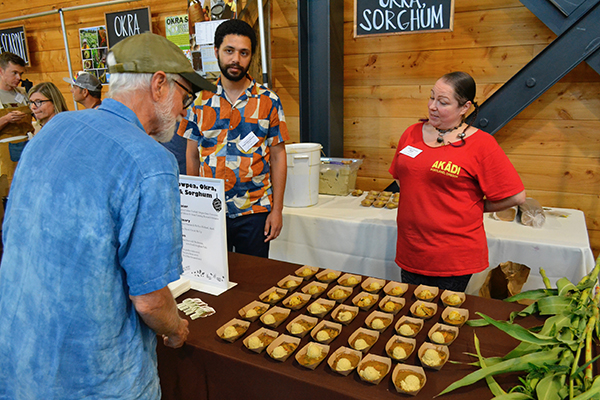
At the event chefs have prepared tastes of the varieties for participants to sample and both the varieties and tastes often spark questions and conversation. Many of the varieties and preparations highlight specific cultural traditions.
Writing and thinking more deeply about all of the implications of this event is tricky as there are so many layers, connections and opportunities all contained in a relatively short single day that it is impossible to hit on all of them in any reasonable amount of time. That is both the draw of many conferences, and can also a be a challenge of attending and coming out the other side feeling satisfied personally, and feeling like your time and expense in attending was well spent.
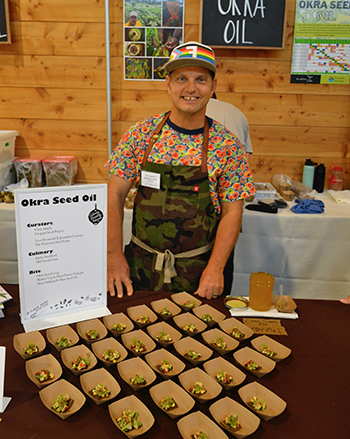
While the main Vegetable Variety Showcase is held in Portland, Oregon, participants come from around the country. Jamie Swoford of Old North Farm in North Carolina came to highlight the work being done with okra breeding for oil seed by the The Utopian Seed Project.
To address this common issue when attending conferences and gatherings I try to set my intentions for the event in advance. This includes having a clear sense of why I’m attending the event, what I plan on getting out of the event, and a strategy for how to make that happen. There are a range of reasons I might attend a conference.
When I was just starting out farming the goals were often just to gain a better understanding of the range of topics and the people who were involved. In that case the strategy was really a broad one of sampling a variety of workshops, allocating time to spend walking any vendor and researcher displays, and listening as much as possible to conversations that were happening in public spaces. At this phase of my learning the larger, more structured conferences were probably the most valuable.
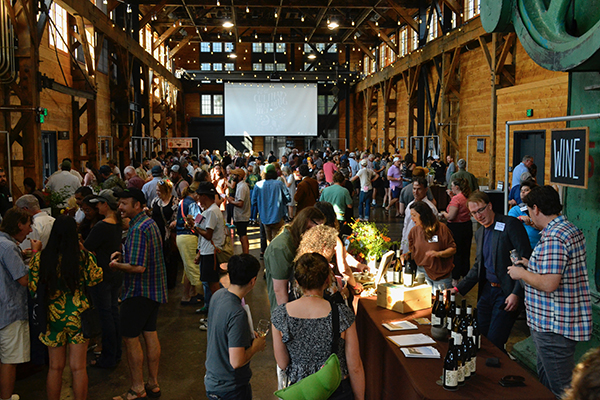
An old foundry space in the SE industrial district of Portland which has been converted for hosting events is the location for the Variety Showcase.
As I got further into my farming career I started to come to conferences with more specific questions, and often I found it helpful to actually create a list of those questions for myself before the event so that I was clear about what I was looking for. These were specific questions about production issues like how to deal with a specific pest or disease, resources available such as tool suppliers, and maybe the best varieties of specific crops for my needs. I was fortunate to connect with some really excellent farmer to farmer gatherings during this phase of my learning, gatherings where the emphasis was on creating spaces for experienced farmers to interact and exchange information and experiences rather than having “experts” at the front of the room give presentations on topics.
Having a focus on very specific questions didn’t mean I always got a clear answer, or that my key take-away was on the specific question I came with in mind, but it did give me a sense of purpose and helped me get more out of the events. Even with specific questions I kept an open mind and if conversations or workshops were leading somewhere else interesting I’d follow them. But if the conversation or workshop session both wasn’t addressing my specific question and wasn’t clearly leading somewhere interesting, it was much easier to make the decision to cut my losses and leave for a different workshop, or to shift to a different conversation.
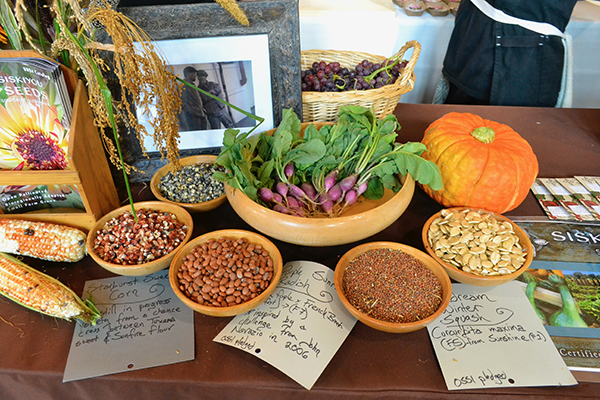
Don Tipping from Siskyou Seeds showed off some of his breeding projects with a tip of the hat to some of his mentors and colleagues who passed in recent years and who in the past have been presenters at the event: Jonathan Spero and John Navazio.
At some point one of the reasons for attending events like the Variety Showcase simply became having the opportunity to re-connect with friends from the farming world who I only see at events like this. At the Variety Showcase this year my other intention was to give back to the community, and so I worked volunteer shifts, helping to set up and break down the event. Events like this, while looking seamless from the attendee perspective, are actually really logistically complicated to pull together and thus expensive to put on. Volunteering doesn’t necessarily make them less expensive or complicated to put on (there’s a lot of work that goes into just managing volunteers), but it can be a great opportunity for folks with the time to connect more deeply with the event and sometimes it can help make them less expensive to attend.
Even after many years of attending conferences it’s still interesting to me to see new things, and to meet new people, just like it was when I was first starting. Unlike when I was first starting the simple draw of seeing new things and meeting new people isn’t enough of a reason for me to attend an event, and if that is the only thing I can expect out of an event I won’t attend. Lucky for me there are plenty of events that fit my needs and I can pick and choose.
Josh Volk farms in Portland, Oregon, and does consulting and education under the name Slow Hand Farm. He is the author of the books Compact Farms: 15 Proven Plans for Market Farms on 5 Acres or Less, and Build Your Own Farm Tools, Equipment & Systems for the Small-Scale Farm & Market Garden, both available from Growing for Market. He can be found at SlowHandFarm.com.
Copyright Growing For Market Magazine.
All rights reserved. No portion of this article may be copied
in any manner for use other than by the subscriber without
permission from the publisher.