











Farmers can submit comments until December 30
“Even in the 7 years since I’ve done this work, I can feel how much hotter it is. And one thing about heat exhaustion is that the heat is cumulative. That starts to sit in your body. So, three days in the 90s – not too bad. Three weeks in the 90s – that is a different situation. I think about how much the heat is sustained and it’s not a one-off occurrence. It is very much a prolonged series of droughts and heat that is getting ever worse as we watch.”
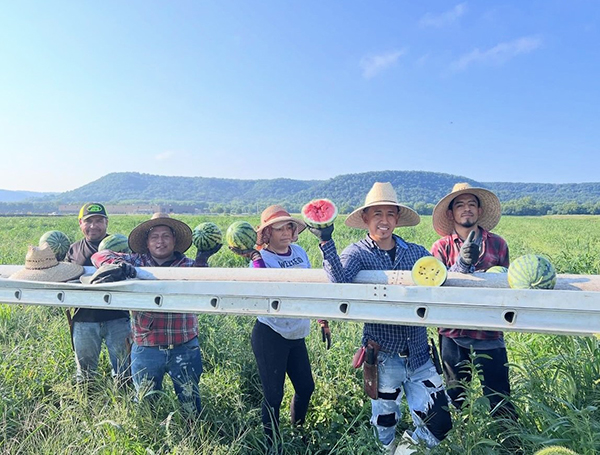
The Featherstone Farm crew pauses for melons. All photos courtesy of the author.
Roman, a Pennsylvania-based farmworker, shared these thoughts during a recent focus group discussion on navigating extreme heat organized by Not Our Farm – a national non-profit farmworker storytelling project. Farmers are known for working in any and all weather conditions, but as temperatures continue to soar, this can quickly become dangerous – even deadly. Heat safety is a contentious issue across most industries, and agriculture is no exception.
While a few states – California, Colorado, Minnesota, Oregon, and Washington – have formal heat protections in place, others like Florida and Texas are actively legislating against city and county governments’ ability to require employers to institute practices like water and rest breaks for workers. With 2023 officially the hottest summer on record, many welcomed the recent publication of the Occupational Safety and Health Administration’s (OSHA) proposed rule on “Heat Injury and Illness Prevention in Outdoor and Indoor Work Settings.” If published, this rule would create a national heat standard for a number of industries, including agriculture.
After exploring a few components of the proposed rule, we’ll hear from other farmworkers who joined Roman in sharing their reactions to the draft standard. Farm owners and managers will then introduce some of the policies, systems, and work cultures they have been building to prioritize human safety in the face of extreme heat.
OSHA’s proposed heat rule
OSHA published its proposed standard in August. As it is written, the rule would apply to any farm employer with at least one hired worker – a notable departure from many current OSHA rules which often exempt smaller-scale farms. The information below provides a high-level summary of certain aspects of this rule. For a more detailed accounting, check out OSHA’s 2-page “Heat NPRM Fact Sheet.”
Heat Injury and Illness Prevention Plan (HIIPP). The HIIPP would include all of the policies and procedures a farm would need to follow in order to comply with the standard – from training details and documentation, to the farm’s plan for monitoring hazards and more. Farm employers would be required to invite input from workers during the plan’s initial development and then at least once per year as part of its annual evaluation and review. Currently, the requirement that the HIIPP be written would apply to farms with more than 10 employees.
Heat Safety Coordinator. An appointed and trained Heat Safety Coordinator from within the farm’s staff would be tasked with ensuring successful implementation of the HIIPP. The coordinator’s responsibilities might also include observing employees for signs and symptoms of heat-related illnesses and taking supportive action as needed.
Heat Triggers. This rule includes an initial heat trigger and a high heat trigger, set to a heat index of 80 and 90 degrees Fahrenheit or a wet bulb globe temperature equal to the National Institute for Occupational Safety and Health’s recommended alert. Different components of the rule – like access to cool water and shade, mandatory and paid rest breaks, a buddy monitoring system, hazard alerts, and acclimatization plans – would go into effect when those triggers are met.
Acclimatization. According to OSHA, an average of 3 out of every 4 heat-related deaths happen during someone’s first week on the job. This proposed rule includes a “20% heat exposure” component so that once that initial heat trigger is met, any worker who hasn’t labored in similar conditions during the previous 14 days is increasing their tolerance by 20% each day.
Recordkeeping. Employers would be required to keep records on certain things for 6 months at a time, including when heat-related trainings are delivered, any heat acclimatization information, and formal records of heat-related illnesses or injuries. It is likely that heat illnesses and related deaths are undercounted since employers are not required to share this information. Keeping these records would help with prevention efforts.
In addition to formal components of the proposed rule, OSHA identified several administrative controls that may help farm employers further strengthen heat safety on the farm. Some of them likely sound familiar, like shifting work schedules and shortening the duration of high-intensity tasks, while others may feel more nuanced – like examining how certain forms of personal protective equipment (PPE) may in some cases amplify heat safety concerns. Now, let’s bring this down to a more personal level and hear from several farmworkers who shared their reactions.
Farmworkers share their responses
In September, 20 farmworkers from across the country came together as part of Not Our Farm’s focus group series. They spoke about their own experiences working in extreme heat, and they shared their reactions to OSHA’s proposed rule. Below are a few key themes that emerged.
There was acknowledgement. So often, urgency and farming go hand-in-hand. Talia, who farms in Colorado, commented that operating in a capitalist system means farmers often feel pressure to meet aggressive production goals – “a context that is not setting us up to be in tune with how we are feeling throughout the day.” Based in Ohio, Becky reflected on how certain pieces of this rule might provide a counter to some aspects of production that put people at greater risk within this system.
“I think there is a culture of just pushing yourself as hard as you can and not paying attention to heat indicators and things like that. I know I’ve had bosses who needed fewer breaks and less water than I do, and I always felt like I was weaker for needing that. That’s not a nice way to feel when you’re trying to be productive and you want to be a farmer, too. You want to feel tough enough. So I appreciate having some actual standard things to point to in this rule,” Becky said. At the same time, many expressed a general feeling of wariness. As Liana shared from New Mexico, “I think the ‘tuff’ culture of ag work is always going to bully rules and regs.”
There was cautious optimism. A farmer’s role in this industry deeply shapes their relationship with heat and may impact how much power they are able to exercise to keep themselves safe. Josué, a community organizer based in California, shared that, “For a lot of the people working in the community I organize in, there are specific seasons when they are getting paid per basket. So they don’t use the restroom or they skip water breaks in order to be able to make the most out of the 8 hour day they are allowed.”
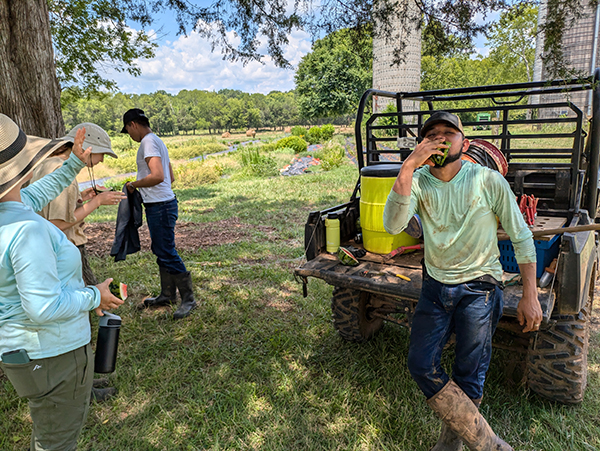
Shade break at Wild Hope Farm in South Carolina.
And as Josué pointed out, especially within more vulnerable populations and depending on immigration status and potential language barriers, workers may “fear retaliation if they were to speak up.” As it’s currently written, OSHA’s proposed heat rule recognizes the unique challenges that piece-rate workers face and would require that individuals be compensated at their normal rate of pay for mandatory rest breaks. But many farmworkers – like Chloe Lazarus in New York – wondered about the conditions already present on some farms and whether they would adapt to recognize these new requirements. “Is there some sort of protection for workers to ensure that folks aren’t scared to be showing their heat illnesses or to take breaks?”
There was shared concern. Farming in Rhode Island, Sajo reflected that “This heat rule is a necessary protection for farmworkers in this climate, especially as climate catastrophe brings more extreme weather every year.” And at the same time, many wondered what type of support would be available to farms to help them put these new requirements into place. Sajo went on, commenting that, “In order to ensure that the rule is put into practice, federal and state governments should also be dedicating resources towards implementation, including for small farmers’ purchase of shade structures, coolers, and other heat safety supplies.”
Over in New York, Nora echoed these sentiments – calling for significant funding to help farm employers comply with the rule. “I think a lot of farm owners want to do the best for everyone, but they are just so busy. The extreme heat comes in July and August when you’re already so underwater.” Colorado-based farmworker Talia agreed that “funding to buy shade structures and water coolers and the physical things that would make these protections more possible” feels like a critical piece of the equation.
“There are a lot of business owners that don’t treat their workers like humans, but there are also a lot of small business owners who genuinely feel like they can’t,” said Talia. Based in Washington, Alex is hoping to see OSHA get a little creative in this regard. “One thing I would love to see is low-cost ideas for how to fulfill requirements – maybe in partnership with Extension offices. Like adapting caterpillar tunnels to be shade structures. Some PVC, rebar and shade cloth could be a quick cheap field shade structure.”
There was disappointment and resignation. While this proposed rule would apply to farm owners with one or more hired employees, as it is currently written, there is no complaint mechanism for farms with fewer than 10 employees. This means that while those farms would technically need to comply, there is no way for farmworkers to formally speak out if they aren’t.
To Alabama-based farmworker Katie, “It sort of feels like you don’t have any rights if you work on a farm with less than 10 employees. There is no incentive for the owner to protect you except that they don’t want you to die because they need your labor. What harm is there to having a way for those hazards and dangers to be reported, so at least they can see that heat related risks are still huge on these farms?”
Another farmworker in Washington put it this way: “That leaves something to be desired from an employee standpoint. It’s like ‘Oh they care. And then – oh wait, no they don’t.’” Similarly, there was confusion and concern about why farms with fewer than 10 employees would not need to have a written Heat Injury and Illness Prevention Plan. As Nora pointed out from New York, “That is sort of an issue on small farms in general – you don’t know what plans or policies exist because most stuff isn’t written. So how will workers know what this plan is then?”
There was a recognition of deeper complexity. A number of farmworkers commented on how different factors can combine to create greater vulnerability, like poor air quality, work being spread across multiple sites, and rapid variations in weather conditions – especially along the coasts. Over in Rhode Island, Sajo shared that even when working for employers who are very thoughtful about heat, there is still a discretionary part to this.
“The weather conditions change rapidly at our farm both between different satellite fields and because of our proximity to the ocean. I am completely vulnerable to the judgment of my employer – who is by no means careless, but who is also easily surprised by the heat changes,” said Sajo. Having clear protections and a means of implementing them – including through two-way communication and a hazard alert notification system, as the proposed rule specifies – may bring more clarity and structure to these situations.
Meanwhile, over in Washington, Alex brought in another layer of complexity. “I think that sometimes the things you least expect to cause problems are the most impactful and the most dangerous. We have a lot of old farm trucks that don’t have air conditioning or good ventilation and sit out in the field for hours in 100-plus degree heat. And you bust your butt in the field for 3 hours and then get into a truck that is probably 130 degrees inside and then have to drive in from the field. And that’s when I’ve seen people come in with heat stroke. They’re okay until they get in the truck. That is one of the things we often don’t think about, that there are these hidden places that often cause injury.”
One rule may not be able to anticipate every potentially dangerous situation, but it can prompt protective action – like mandatory trainings – and provide crucial tools. “Taking precautions and having really great resources so you’re going into those situations empowered with knowledge in how to take care of yourself and your coworkers is critical,” Alex reflected. “And having legal protections is probably the best way to prevent a lot of these problems.”
And finally, there is opportunity. Many farmworkers see this proposed rule as a welcome starting point, one that has the potential to keep them safer and to create work environments that are responsive to extreme heat. Farming in Maryland, Erin Close joined her peers in emphasizing just how high the stakes are. “The viability of farm work for livelihood is a great challenge, financially and physically. As a farmworker, I’m counting on the food we can grow, harvest, and sell to earn a living – despite the weather. After working through the hottest and driest summer on record, we must take a hard look at how to stay safe and sustain ourselves in this work.”
Many farmworkers spoke about how high heat often brings more work, which is usually paired with greater urgency because of quality concerns. As Erin pointed out, “This increased physical demand during extreme heat puts farmworkers at great risk and makes the farm operations much more vulnerable.” This rule is about safety, but it is also an opportunity for OSHA to make a strong statement about the value of workers’ lives and their instrumental contributions to these labor-intensive, often dangerous industries. Erin left off by echoing what many of her peers also voiced: “Putting farmworker protections in place is essential.”
Safety in Action
OSHA rules usually take about 7 years to go into effect. While many are hopeful this rule will move forward more quickly, rising temperatures and intensifying heat waves won’t wait for these protections to pass. Fortunately, farmers across the country have been busy creating policies, systems, and work cultures that prioritize human safety during extreme heat. As the industry prepares for this rule, many employers will no doubt be wondering what it might look like in practice. Below, we explore how some farms are already doing this work and paving a path for others to follow.
Judith Redmond co-owns Full Belly Farm in California. I spoke with her about what it was like when California’s heat rule for outdoor workplaces went into effect in 2006. “When Cal-OSHA first started talking about a heat stress prevention rule almost two decades ago, a lot of us were hostile towards the change because of the difficulty of managing all the specifics on our busy farm – lots of access to water, shade in the fields, acclimatization, and so on.” Farm employers reading this article may be feeling some of these same things right now – concern, frustration, even desperation.
Judith went on to say that “After thinking about it and talking with our crew about how to implement the regulations, these things have now become a habit. Fill up the coolers on each truck every morning. At lunch, give everyone their own thermos, move the shade tents around in the field when we need to, and so on.” For Judith, implementing these protections represents more than just checking legal boxes. “Our temperatures were over 100 degrees day-in and day-out last summer. We want to take care of our crew and we want them to know that we care. Overall I think it’s been good for our business.”
Meanwhile, over in South Carolina, Wild Hope Farm is using a combination of formal policies and informal practices to keep everyone safe when temps inevitably rise. “We shift our schedule throughout the summer to account for extreme heat and daylight hours. Our goal is to get all harvesting done before lunch and primarily do packshed or lighter field work in the afternoon,” explained Operations Manager Peanut Belk. A big part of this equation has been modifying farm spaces.
“We ended up converting the space where we pack our CSA into a semi-cooled space using 2 AC units and coolbots. We used to have to pack CSA and markets first thing in the morning because even inside our packshed, it would get too hot.” Peanut said that making these adjustments allowed the team to pack later in the day. “We also use this space to bag leafy greens in the afternoon as an easier task when we need a break from the heat. So now we are able to make sure we get important field work done earlier when it is cool and push back packshed tasks to after lunch. There have really only been a handful of days when we had to cut the day short due to the heat and not having enough easy or indoor tasks to complete.”
In addition to building a supportive and adaptive work environment, heat and safety is part of the farm’s communications. “The entire management team is on top of temps and we also write it on the board when it starts warming up as a reminder. We talk about excessive heat during our morning meetings and sometimes after lunch during our afternoon meetings with the team.” And one other key thing? “We also try not to hire new people after July as acclimatization is key for heat safety.”
In Minnesota, Featherstone Farm’s Production Manager Abby Benson spoke about annual trainings that increase knowledge and set the stage for a culture of safety. “Each season we conduct trainings on all sorts of health and safety issues, including heat stress. Especially when we can see that a particularly hot stretch is coming, we will get everyone together for a meeting in Spanish to reinforce that we want them to take care of themselves and their coworkers. We remind people of the warning signs of heat stress and how to recognize it in themselves and in others.”
This is further supported by concrete actions. “Each group has a 5 gallon insulated jug which they fill with water and ice (we have an ice maker on site!) and take with them into the field. We also provide jugs of Gatorade powder for each group to use during the especially hot stretches. We already take a 15 minute break for every 4 hours worked, and employees are encouraged to take extra breaks as needed during these hot times, and to return to the air conditioned warehouse if needed.”
Featherstone Farm recently joined the Fair Food Program – a worker-driven social responsibility initiative that readers may recognize as coming out of the decades-long organizing efforts of the Coalition of Immokalee Workers. “Since joining the Fair Food Program, we have also added a monthly Health and Safety meeting where a representative group of employees comes together to discuss any concerns they may have. It is a good opportunity for us to hear directly from employees at a specific time they know is designated just for that purpose, and at each meeting we discuss the actions that have been taken to address any concerns from the previous meeting.”
Featherstone’s crew consists mostly of individuals with H-2A visas. Because of the inherent power imbalances within the H-2A program, workers may hesitate to speak out when they feel unsafe – something that Josué commented on earlier. With this in mind, Abby shared that, “The biggest thing for us is really stressing and demonstrating through our actions that we want our crew to take care of themselves and each other above all else and that they are expected to take these extra precautions even if the work moves a little slower during these hot stretches.”
Like Judith, Abby sees this as a moral imperative that also has a positive impact on the business. “We care for our employees as human beings and want them to be healthy and comfortable. It also makes so much sense for the business in general, because we want to be known as an excellent place to work so that our employees continue to come back year after year, learning new skills, being engaged, and motivated to constantly improve as a team.”
What comes next?
As countless organizations and workers’ rights groups continue their mobilizing efforts to advance worker safety, more and more farm employers and managers are responding to the real risks that high heat poses and are making the choice to prioritize human health and wellbeing. These farms can serve as a valuable resource for one another, and readers can find a small but growing number of examples detailing how farms across the country are doing this work at: go.wisc.edu/d9397c. Eventually, this will take the form of a collaborative audio-visual project supported by UW-Extension, Not Our Farm, and FairShare CSA Coalition where farmers record short clips answering the question, “What does heat safety look like where you work?”
As for OSHA, this proposed heat rule is coming at a time when rising temperatures are making farming an increasingly deadly profession – and when heat remains the number one weather-related killer in the United States. While there is no doubt a long road ahead, farmers have an opportunity to help shape the final version of the rule by submitting public comments through OSHA’s website by December 30, 2024. To submit a comment or to read more about the proposed rule, visit www.osha.gov/heat-exposure/rulemaking.
In the meantime, big questions remain, and California-based farmworker Skot leaves us – and OSHA – with a few to contemplate. “What happens if a farm doesn’t do this? What are the consequences for failure? Where are the teeth of this law? And also, how are farms supported? It’s easy to regulate things, but then are you going to give farms some money to make this happen?”
Sources:
poweratwork.us/surviving-the-heat-podcast
weather.gov/hazstat/
osha.gov/sites/default/files/publications/heat-rulemaking-factsheet.pdf
Sarah Janes Ugoretz (she/her) works with UW Extension in partnership with FairShare CSA Coalition. She collaborates closely with farmers to build positive labor experiences on diversified vegetable farms and earned her PhD from UW-Madison. Feel free to get in touch with Sarah at sarah.janesugoretz@wisc.edu.
Copyright Growing For Market Magazine.
All rights reserved. No portion of this article may be copied
in any manner for use other than by the subscriber without
permission from the publisher.