









Selling vegetables to chefs can either be very satisfying or turn into a nightmare: isolated orders, outstanding invoices, and last-minute calls. Still, when it works, restaurants and caterers can be a stable and interesting way to increase farming incomes. Here are some essential ingredients to make the most of it based on my experiences and those of other farmers who grow exclusively for chefs or not.
3-Michelin-star products
Eric Roy has been growing mini carrots, beets, radishes, and salsify for more than a decade. “My clients are mostly two or three Michelin stars chefs,” explains Eric. “Sixty percent is sold directly to the restaurants and forty percent through specialist intermediaries.”
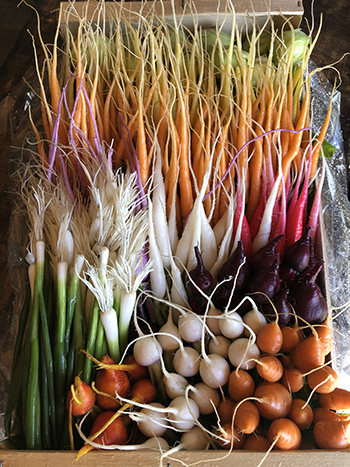
Eric Roy’s mini vegetables ready to be shipped.
Based in Touraine on very fertile soil next to the Loire, Eric started in 1995 growing salad and classic greens for supermarkets on his family farm. “I made some tests for mini vegetables with three or four chefs nearby,” he said. “I wanted to offer very special, tender, tasty juvenile root vegetables.”
He farms on 5 hectares (about 12.3 acres) and nearly 2 hectares (just under 5 acres) in greenhouse space. He employs three workers and serves about 30 restaurants. One of his famous clients is Anne-Sophie Pic, the most decorated female Michelin starred chef in the world. She currently has 12 Michelin stars across her restaurants in Paris, Dubai, Singapore, London and Hong Kong.
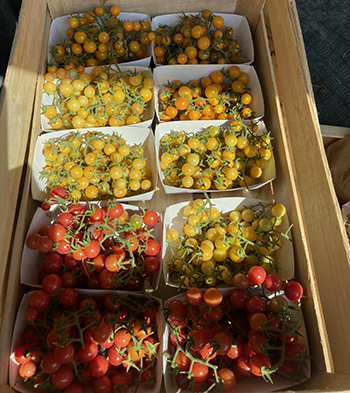
Jean-Pierre Juigner’s unique mini tomatoes. All photos courtesy of the author.
“I use an air seeder and very classic methods for my mini vegetables but the moment to harvest has to be very precise,” Eric told me. “We select the exact size that the chef wants because chefs have an exact idea of what the plate has to look like.” The crops are washed carefully on a conveyor belt washer (like an AZS rinse conveyor; see the review in the October 2024 GFM) and packed in a thin wooden bucket covered by a plastic film.
They are sent everyday at 2 or 2:30 in the afternoon with a post service called Chronofresh and arrive the next morning. Eric charges 30 euros for delivery and the mini veggies are billed by the unit. His advice? “Adapt yourself, be super precise. Bring yourself to standards but the most difficult is to keep the quality, delivery after delivery.”
Tiny tomatoes
Growing for chefs can also be a way to sell extraordinary products. Jean-Pierre Juigner has been selecting, collecting and reproducing rare tomatoes for decades as a passion. Since 2019, he has been growing them commercially and offers them to chefs, mostly Michelin-starred. His farm, called Jardin Gastronomique (worth a look on Instagram), is set in Lourmarin, Provence, in an old cherry orchard.
“I cultivate this very little cherry tomato called ‘Bianca,’ extremely sweet and savory, with a truffle aftertaste,” Jean-Pierre said. It’s far smaller than a normal cherry tomato. He is always keeping an eye out for new varieties or nearly lost old ones. He recently discovered two American varieties: Tim’s Taste of Paradise sold by Wild Boar Farm and the incredible Texas Wild Cherry by Native Seeds.
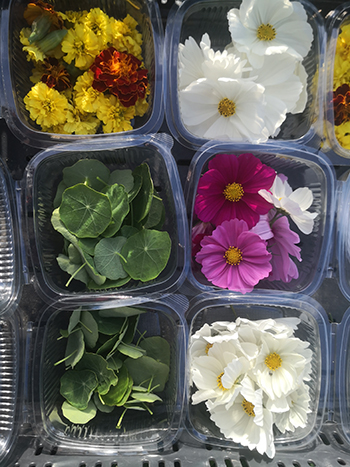
Nasturtium leaves, marigolds and two types of cosmos destined for chefs.
“A new pink version of the Bianca has shown up in our garden,” he said. “We kept it and called it Line, after my granddaughter.” These take much longer to harvest than normal tomatoes since he uses scissors and very small trays. The price ranges from 16 to 20 euros a kilo, twice more than normal cherry tomatoes. Still, chefs in the area are fighting to have it on their menus. Jean-Pierre delivers his products to a few lucky restaurants and also offers some lesser known crops like malabar spinach, lambsquarters or tomatillos.
With some chefs Jean-Pierre sells “carte blanche.” They agree on a weekly delivery for a certain price and the farmer composes a unique basket with herbs, tomatoes and everything that has been growing in his garden.
Reluctantly embracing chefs
As for me, restaurants are not my only customers, but this year I’ve been working weekly with five to six local chefs from March to October. I have to admit that it is very pleasant to see the crops transformed and honored. Plus, it can bring some significant sales. I had tried to work with restaurants before but had been disappointed by the lack of consistency and difficulties being paid.
Chefs had been contacting me quite often in the last five years, but I only considered working properly with them last year when I met Minou Sabahi, a young Iranian chef who worked at a restaurant near my farm for the summer. We met at the farmers market where she bought herbs every week all summer.
During winter other chefs asked me for herbs, but I was still a bit reluctant because my offerings were a bit too limited to be worth the delivery. I’ve always been growing some edible flowers on my farm just for the pleasure and decided to offer them to the chefs. Marigolds, cosmos and nasturtiums. I started with the seeds I already had. Simple, but efficient. In winter, borage is a safe bet in tunnels. Chefs also love roquette, mizuna flowers and violas. Marigolds can stand a bit of cold, too.
I also grow more specialty herbs than before: lemon basil, purple basil, Thai basil, several types of geranium, and several marigolds. Talking with chefs, I understood that they were looking for herbs to decorate the plates, so small leaves, extra fresh, ready to be used. The best sellers are the baby leaves of tagetes lemmonii (mountain marigold), which smell like passion fruit. In winter, I also started growing sorrel, claytonia, baby roquette and baby mizuna. Zucchini flowers and baby zucchini complete the offer. Every Monday I produce an online list with the herbs and flowers available for the week.
Commitment
After a few disappointing experiences, I now sell to every chef who wants to work with me under a “contract” where I explain how I work and some requirements. Each order is at least 40 euros, deliveries are charged ahead of time, delivery days are set for the season, orders have to be sent the day before. I ask them to “commit” for the season, that is, ordering regularly, in general weekly. Of course, we can skip one week if the restaurant closes, but they understand that isolated orders are not acceptable. In addition, I ask them to return the plastic boxes that I use to protect the small leaves so they can be reused.
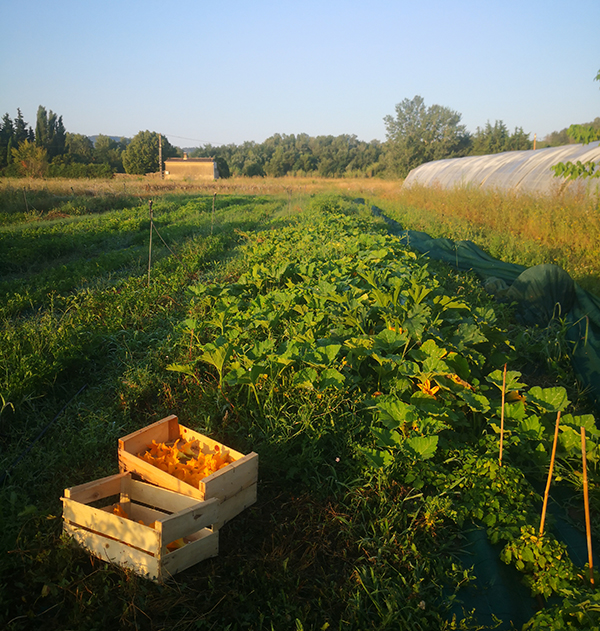
The author chose “tromba de albenga,” an old Italian variety for Zucchini flowers. They are longer and easier to fill for the chefs.
Classic crops
Restaurants are interested in buying more classic crops as well. Anne Aït-Touati grows vegetables, flowers and spices in La Bâtie-Montsaléon, in the Alps. The farm, Sarriette et roquette, is comprised of three associated farmers with 1 hectare (almost 2.5 acres) of vegetables, 1,200 square (about a third of an acre) in tunnels, and laying hens. “We work with six restaurants,” explains Anne, “It represents a growing part of our turnover.”
Last spring, she organized a meeting at the farm with the chefs to plan the season. “They gave us their needs and spikes and we explained our seasonality,” she said. This was crucial for them as they are growing in a mountainous terrain. The restaurants are all in Gap, 40 minutes from the farm.
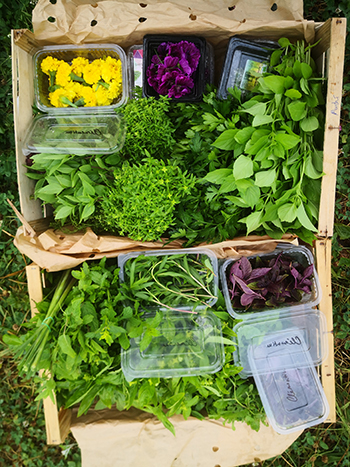
A summer delivery of the author’s, with five types of basil, others herbs and some flowers.
“We started with only one delivery per week, one restaurant asked for a second, we offered the others and they were also interested,” she said. “Even now in winter, the chefs continue to order a lot, even if we only have carrots, Chinese cabbage, leeks and mesclun.” They even decided to apply to Gap farmers markets.
Do they ask for a commitment? “Not really, let’s say that a form of commitment came with trust,” she explained. “The meeting helped them to feel involved. We are very happy because this partnership with restaurants is compensating for the sales declines at farmers markets.”
Each farm must find its way to work with restaurants, and it is worth working on the relationships. What about restaurants that never pay their bills? I now send them to the magasin de producteurs (producers store, see the cover story in the Nov/Dec 2024 GFM) but warn them not to take all the cilantro without telling me first!
Clémentine Vaysse grows herbs and greens since 2017 in the South of France. Based in Lauris, near Aix-en-Provence, the farm is called Les herbes de la mésange bleue and is certified organic. A former journalist, Clementine is passionate about small scale farms and low tech in agriculture, specially if they include horses.
Copyright Growing For Market Magazine.
All rights reserved. No portion of this article may be copied
in any manner for use other than by the subscriber without
permission from the publisher.