











In 2018 I made the leap from a career in biomedical research to a life of small-scale organic farming. I started by training on working farms, doing my ‘dirt time’ and learning from experienced farmers. As soon as I set foot on a farm, I knew that the work could be complemented and supported by looking at some of the challenges through a scientific lens.
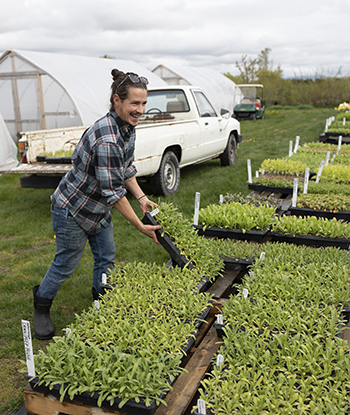
The author loading up hardened-off seedlings to be transplanted into the field. Photo by Chris Benzakein.
I saw the farm as a complex living system, albeit a system with many variables outside of one’s control, unlike the highly controlled environment I was used to in the laboratory. Farmers must deal with changing and often unpredictable weather conditions, pest and disease pressure, variable soil conditions across field blocks and variable performance of different plant varieties.
When faced with such a complex system, farmers must be keen observers, critical thinkers and problem-solvers. Farmers pay close attention to changing conditions and make adjustments accordingly. If you’re looking to implement changes in the hopes of increasing yield, reducing plant disease or tackling other challenges, some key lessons from the scientific method can help you track, analyze and evaluate the effects of those changes.In the spring of 2022, with a few seasons under my belt, I had the opportunity to join Floret Flower Farm as their greenhouse, pest and disease specialist. One on-farm area that I approached with a scientific mindset has been in evaluating different seedling mix recipes. One challenge we had in the greenhouse that spring was in our zinnia seedlings.
Zinnias are quite susceptible to a range of fungal and bacterial pathogens. For a heat-loving crop like zinnias, our cool, wet Pacific Northwest environment doesn’t help matters. That spring, we had seedlings that looked less than ideal and were losing a percentage of them to the fungal disease Botrytis (for more on botrytis, read the article “Managing gray mold in cut flowers” from the January 2024 GFM). Colder and wetter than normal weather conditions delayed planting in the field, and as such our heat-loving crops remained in seeding trays for longer than intended.
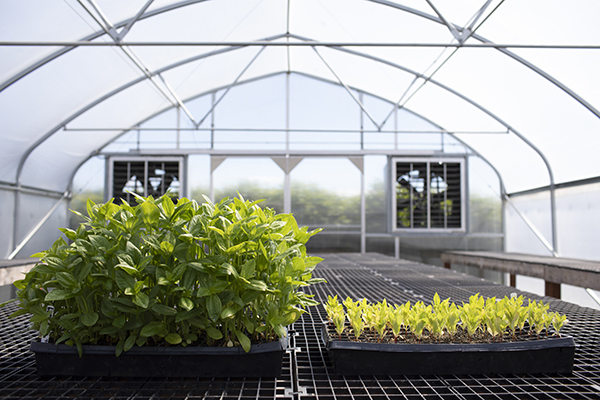
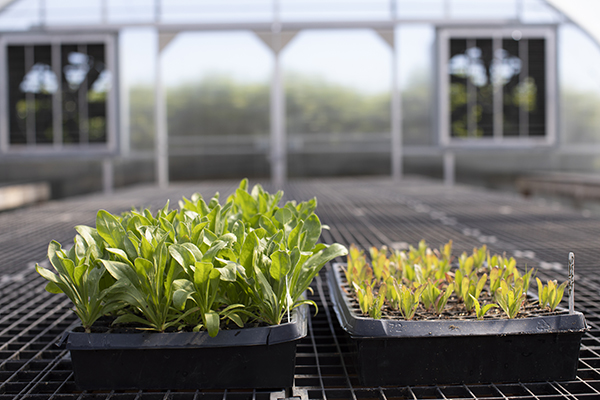
Above is a side-by-side comparison of zinnias and calendula growing in our high-fertility and low-fertility mixes, showing more vigorous growth with additional fertility. Seedlings grown in the high-fertility mix also had more robust root development and less susceptibility to disease.
One observation about the zinnia seedlings was clear: overall they were not robust and healthy after prolonged time in trays. They appeared to suffer from nutrient deficiency and were beginning to succumb to disease. Under careful observation, we could see yellowing of leaves, a classic sign of nitrogen deficiency, as well as a purple tinge to the leaves in some seedlings, which signaled that there could be a phosphorous deficiency as well. We all agreed that certainly nutrient deficient, stressed plants would likely have weakened defense against plant pathogens like Botrytis.
In order to produce healthier seedlings, we wanted to evaluate changes to our potting soil recipe that might improve seedling health. We had been using a very low-fertility potting mix with peat, perlite, vermiculite and a small amount of compost and granular fertilizer. I had previously had good results growing robust seedlings using a potting mix with a higher level of compost and fertility, and thought that this would work well to reduce the poor health and disease we had been seeing in our zinnias.
I decided to do some side-by-side comparisons of potting mix recipes, and the process began to feel a bit like running an experiment. This inspired me to start looking at the challenge through a scientific lens. It felt valuable to go through the thinking process that I was used to from my scientific training, and reframe the challenge as a hypothesis that could be tested.
Since then, I’ve been finding myself routinely facing on-farm challenges by first asking if the problem could be addressed by taking a casual experimental approach. Walking through the steps of the scientific method provided a framework for tackling some of these challenges, including improving the health of our greenhouse seedlings.
Scientific method and key takeaways
When we have unanswered questions based on observations, the scientific method can provide us with a problem-solving framework. Typically, the method follows a few key steps: initially, an observation we make (seedlings have yellowing leaves and succumb to disease), leads us to question (is low fertility in our soil mix causing poor health and disease?) what is the root cause of our observation. We then consider what information we do know and reframe our question in the form of a hypothesis.
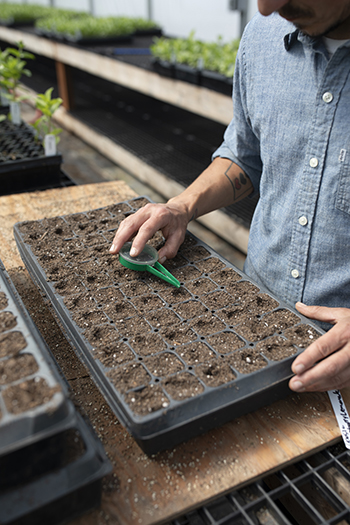
Seedling health begins in the soil. We find that sowing into a relatively high fertility seedling mix gives the best results for most of the species we’re working with. Both photos by Chris Benzakein.
A hypothesis is simply a question that can be tested using an experimental approach. In this case, our hypothesis was: improved potting soil leads to healthier seedlings and reduces loss due to disease. To utilize the scientific method, we must then design and conduct an experiment, make observations, analyze the data and form conclusions.
Prior to setting up an experiment, it is essential to define the purpose of the experiment. By defining the purpose, you’re clearly stating what it is that you hope to achieve and what information you hope to gain. Having a clear purpose will help you decide what observations you’ll need to make and what data you’ll need to record.
In the case of our greenhouse seedlings, the purpose of comparing the mixes were twofold: to produce healthier seedlings and to understand more about what makes a good seedling mix. Defining the purpose of the experiment helps you decide what variables to test. A variable in a scientific experiment is a condition or parameter that you change in order to test its effect.
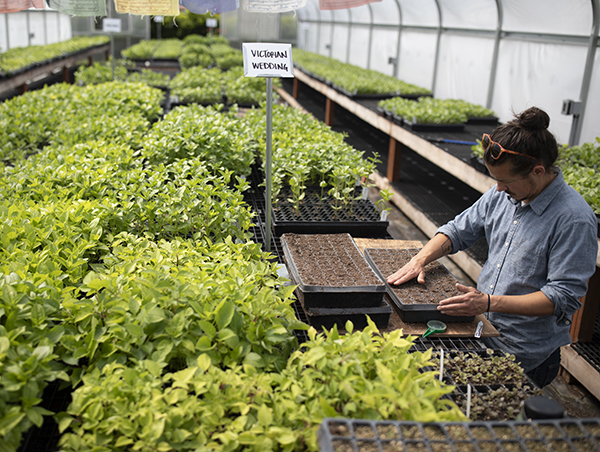
To test our hypothesis, I set up a simple, side-by-side comparison of our old, low-fertility seedling mix and a mix containing increased compost and fertilizer. This side-by-side comparison we casually call an “experiment,” though we aren’t following a highly controlled process like you would in a laboratory. Being on a working farm, it isn’t practical or necessary to stick to a rigid scientific process, rather I like to use the scientific method as more of a guiding framework that helps keep me observant and thinking critically.
Testing two soil mixes side by side
To test the hypothesis that increased fertility and compost would give us healthier seedlings, I made up a batch of our old, low fertility mix and a batch with increased compost and fertility. Both recipes used a commercial blend of peat, perlite and vermiculite to which I added amendments. The fertility source I used was a blend of bone meal, blood meal and kelp meal to supply NPK and micronutrients.
The old mix contained about 3 percent compost and about 1/3 cup of the granular fertilizer per cubic foot of soil. The new mix I amended with 20 percent compost, and 1 and 1/3 cups of fertilizer per cubic foot of soil. For this first comparison, I treated compost and granular fertilizer as though they were one variable and increased them both at the same time. For both of these mixes, I sowed trays of three different species: zinnia, celosia and calendula.
Once germination was underway, I started making observations and gathering data. For the soil mix comparison, I wanted to assess whether the increased fertility and compost resulted in a faster rate of growth, a decrease in yellowing/nutrient deficient plants, and a decrease in number of plants lost to disease. I also wanted to see if the increase in fertility had any additional effects aside from our hypothesized improvement in health. These effects included: germination, damping off, and root burning.
For each species, I tracked the time to germination, percent germination, number of seedlings damped off, and number of mature seedlings lost to Botrytis. I found that our new mix did not impact germination rate or damping off of any of the species tested, and also did not seem to negatively impact root growth for these three species of seedlings.
Above is a side-by-side comparison to independently test compost and granular fertility. A brassica variety was sown into seedling mix containing either: no additional fertility, compost alone, granular fertilizer alone, or compost and granular fertilizer in combination. This test showed a more significant contribution from the granular fertilizer in terms of vigor. Facing page: Careful observation of plant health in the greenhouse allows us to monitor the effects of any changes to our seedling mix or other aspects of the greenhouse program. Both photos by Chris Benzakein.
By the end of the experiment, the zinnia trays were beginning to show signs of the fungal disease Botrytis, so I was also able to compare the two mixes in terms of susceptibility to disease. The old, low-fertility mix showed an average of seven plants per zinnia tray (~10%) lost to Botrytis. The new, high-fertility mix averaged about one plant per zinnia tray lost to Botrytis.
I also monitored the rate of growth and took photographs of the trays weekly to record their progress. I assessed the plants in each mix for overall growth and vigor, and there was a clear increase in vegetative growth in our high fertility mix for all three of the seedling species I tested (see photos). When I assessed root development in these two mixes, there were no striking differences observed.
One of the most important aspects of this process is to question whether there is more than one possibility for what you are seeing. If you are working in a complex system there are usually multiple variables at play and it can be difficult to isolate a single root cause. For example, if you notice a particularly good crop yield after switching to a new fertilizer, you may think the increased yield was directly due to the new fertilizer. However, there could be other variables at work that are easily missed.
It could be that the increased yield was indeed due to the new fertilizer, or perhaps it was just a particularly good year for that crop due to weather conditions. Without anything to compare the result to, it is difficult to know for sure if the new fertilizer is truly the cause of the increased yield. With our seedling health experiment, I became curious to separate out two variables in our potting mix: the compost and the fertility blend.
To take a look at these variables independently, I simply expanded the experiment described above and tested the effect of compost and fertility separately. I set up four conditions to test: 1) the commercial potting blend with no added compost or fertility, 2) the full high-fertility blend described above, 3) the commercial potting blend amended with 20 percent compost alone, and 4) the commercial potting blend amended with fertility alone.
This setup allowed me to discern if the improved seedling growth seen in the first experiment was due to the added compost, fertility, or both. After a few weeks of growth, differences between the mixes became clear. The seedlings in the un-amended mix were stunted and showed yellowing leaves (see photos). The seedlings in the high-fertility mix were much larger, vibrant and green. The seedlings in the ‘compost only’ mix showed an intermediate level of growth and after extended time in trays showed yellowing of cotyledons, likely due to the lower level of nitrogen in this mix compared to the high fertility mix. The mix with high fertility but no compost looked almost indistinguishable from the complete mix.
These results suggest that both the compost and granular fertilizer can supply fertility to growing seedlings, but that the more dramatic increase in vegetative growth we are seeing results primarily from the increase in the granular fertilizer.
Experimentation
One thing that is really valuable about doing these kinds of side-by-side comparisons is that it allows you to identify specifically what works for you, in your conditions. Are you working with species that are very susceptible to damping off after germination? Or perhaps species with roots that are very sensitive to over-fertilization. You could test out using a compost-free soilless medium with just a small amount of added fertility.
No matter what your challenge, doing a side-by-side comparison of this type can give you a clear and definitive result of what works best in your conditions that can then be applied on the farm. Applying a methodical, scientific framework to problems on the farm can help turn a challenges into learning opportunities.
Sam would like to thank Erin Benzakein and Chris Benzakein for guidance and photos.
Sam Hoot has been the greenhouse, pest and disease specialist at Floret Flower Farm since 2022. Sam earned his PhD from the University of Washington in 2008 and after years in biomedical research, made the transition to farming in 2018 with a focus on market gardening. Sam will soon be re-launching his passion project, Wildheart Farm, a small-scale diversified vegetable operation based in Western Washington.
Copyright Growing For Market Magazine.
All rights reserved. No portion of this article may be copied
in any manner for use other than by the subscriber without
permission from the publisher.