










Elevating designs in spring and summer
As a flower farmer and an ambassador of the Slow Flower Movement (which promotes local, seasonal, and sustainable floriculture), I always try to come up with beautiful eye-catching combinations that make an impression. Beautiful flowers should always start a conversation. Like many of you, I can fill fields year after year with gorgeous annual varieties, but at some point, we hit saturation. There are not many undiscovered varieties, but there are still extra tools in our toolboxes. I wanted to reach into mine and pull a few out to write about.
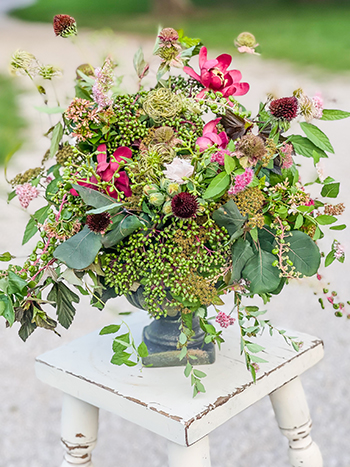
One of my most favorite and visually pleasing arrangements – each perennial element naturally growing and producing abundant design element options: pink spirea bush, echinacea centers, bee balm, elderberry flower heads, clematis seed heads (post pollination / pre seed formation), sweetshrub, white magnolia, eucalyptus (perennial here) and young rose of Sharon buds with blush deutzia.
As a grower and floral designer, some of my most striking and memorable arrangements have featured elements foraged from the wild — the graceful curves of bittersweet vine, delicate sprays of Queen Anne’s lace, or lichen-crusted branches gleaming with raindrops. Foraged materials lend our designs a unique beauty and connection to place that can be difficult to capture with field-grown flowers alone.
Foraged and woody materials have the power to elevate floral designs with unique, eye-catching combinations for market that really stand out from traditional flower farm bouquets. Consumers are used to a wide range of varieties when supporting local flower production, but adding a few non-typical wild elements makes your arrangements stand out.
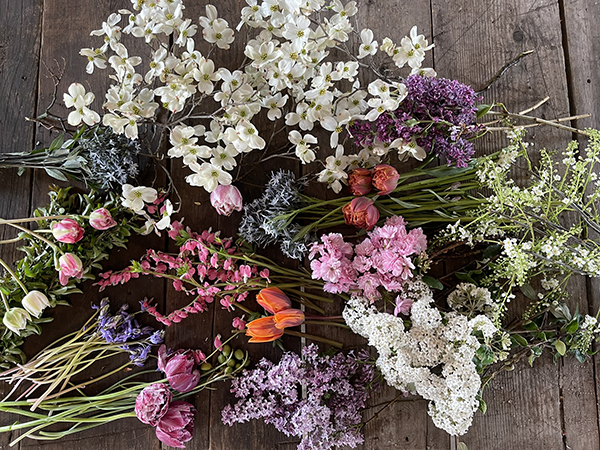
Dogwood, tulips, bluestar, mock orange, lilac, viburnum, bleeding hearts, curly willow, and bluebell.
If you’re a flower farmer or florist interested in incorporating more foraged elements into your designs and offerings, here’s a guide to some of the most desirable wild materials in the spring and summer and how to source them sustainably. (A companion article on fall and winter plants will run later this year.)
Investing in woody offerings
Firstly, let me qualify this by saying that our farm has plenty of space that isn’t dedicated to row flower production. Over the years, I have planted a huge array of woody offerings and easy bulbs. I’m not suggesting you go as crazy as I have in retrospect, but it’s not too late for you to consider some of these unsung arrangement heroes.
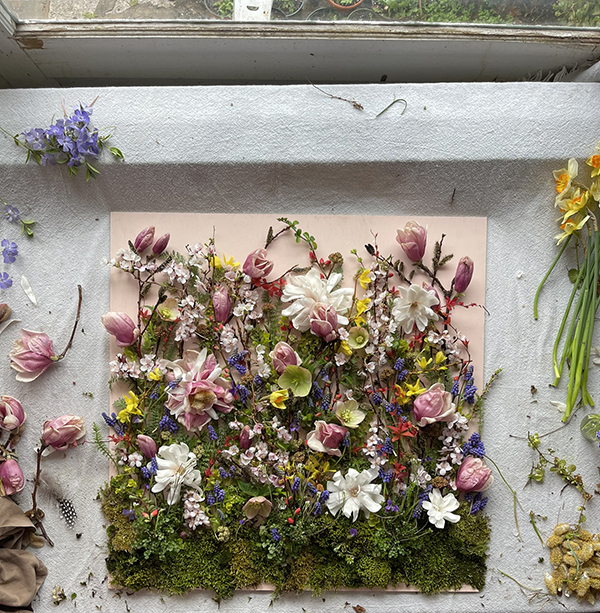
Spring flatlay with foraged elements.
To retell even a brief part of this story is to also include this bit as a cautionary tale: When my husband and I got married almost a decade ago, instead of a typical wedding registry, we asked for trees and plants, and that’s exactly what we got. If you do this, you will undoubtedly spend your honeymoon digging holes — my husband dug 140 holes. All have survived, matured and become a dependable source of materials for extra color and texture that I can draw on for design elements. Many bloom and are ready well before our last frost date in spring; others are still producing long after the first frost in fall.
I think of these easy reoccurring elements as well as natives and some invasives as ‘wild.’ By planting and doing the front end work to get them established and developing healthy root structures, you’re investing in future outcomes that not only adds unique textures, colors, and forms not found in commercial flowers, but also offers you maximum versatility, range, and provides dependable material of a scale unlike commercial flower production that always needs a careful eye to nutrients, pest pressure, and targeted watering. “Wild” and foraged materials free you from that and get increasingly less dependent on your time and intervention.
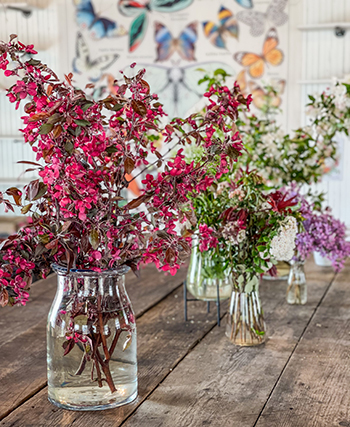
In the author’s studio with crabapple, Japanese maple, leatherleaf viburnum, lilac and cherry blooms.
And another important point — post-Covid and the huge influx of new growers and beginning growing practices offers two advantages: an even playing field for this incoming generation of flower growers still defining their scope, but also offers established growers a way to stand out with these ‘wild’ elements that take a few years to establish. Either way, it’s a win/win for all.
Woody wonders: Branches and vines
Flowering branches and woody vines add height, structure, and often a sense of drama to arrangements. Some of the most sought-after include:
- Flowering dogwood (Cornus florida) – Large white bracts
- Flowering Quince (Chaenomeles speciosa) – Striking coral, salmon, and red flowers on angular branches.
- Apple and crabapple (Malus sp.) – Soft pinks and whites
- Forsythia – Exuberant golden yellow flowers
- Magnolia – Stately and fragrant
- Grapevine (Vitis sp.) – Rustic curving vines
The key to foraging woody materials is timing — you’ll want to catch flowering branches at their peak of bloom, and vines when their shape and color is most vibrant. This is often early spring for blooming branches, and late fall for decorative vines.
Willow varieties
I’m in USDA zone 7a here in the Midwest. Our first outdoor blooming flowers in early February are snowdrops, followed by crocus, then hellebores, daffodils, jonquils, and narcissus. I love pairing them with my favorite ‘wild’ offering – willow. My go-tos for early spring bouquets and arrangements are:
- Golden Willow (Salix alba ‘Vitellina’) – Bright yellow stems that add a pop of cheerful color to late winter/early spring designs.
- Scarlet Willow (Salix alba ‘Britzensis’) – Vibrant red stems for a dramatic contrast against snow or evergreens.
- Pussy Willow (Salix discolor) – Soft, silvery catkins that evoke a cozy, spring feeling. Look beautiful in bud vases or woven into wreaths.
- Dappled Willow (Salix integra ‘Hakuro-nishiki’) – Variegated foliage in shades of pink, white, and green. Adds interesting texture to arrangements.
They each peak at different times so don’t compete but take turns. Right in there is also red dogwood for eye-catchingly bright red branches and tiny seed clusters that look like dried bouquets at the tips. I cannot stress enough how simple and beautiful willow are in a vase alone. Any of the varieties are striking. And whether or not you have an extended growing season (greenhouse/hoop house) and winter blooms, peak willow season adds so much to anything you pair them with. Customers are immediately drawn to them.
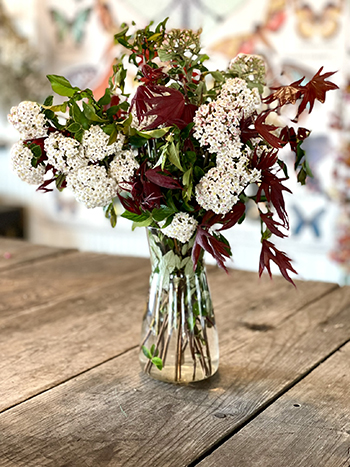
Springtime bouquet with blooming branches.
Curly willow also is a universally gorgeous element for your toolbox. In winter after its leaves have dropped it is pure delicate curls of caramel wood tones, or from spring until fall resplendent with its delicate sliver of leaves, curly willow adds interest and appeal to arrangements. For those who do event floral design, curly willow is your best friend for helping create structures and adding romantic twizzled lines, but especially in anything that needs to be a statement piece with dimension and height.
Spring blooming branches and wildflowers
The deeper we get into spring, the more blooming branches are available as additional bouquet ingredients. If you have these materials available, these are in high demand for spring wedding work. So, I strongly suggest you reach out to wedding floral professionals in your area to let them know you have these high-demand offerings. Some of my favorites for early to mid-spring include:
- Serviceberry (Amelanchier sp.) – Delicate white flowers that resemble a froth of lace.
- Spicebush (Lindera benzoin) – Clusters of tiny, fragrant yellow flowers along the branches.
- Trillium (Trillium sp.) – Simple, three-petaled flowers in shades of white, pink, or red.
- Virginia Bluebells (Mertensia virginica) – Nodding clusters of blue-pink bell-shaped flowers.
- Wild Columbine (Aquilegia canadensis) – Intricate, drooping red and yellow flowers beloved by hummingbirds.
The demand for specific flowering branches may vary depending on the season, region, and current wedding trends. Many couples and florists also appreciate the unique beauty and character of locally sourced or lesser-known flowering branches, which can add a personal and distinctive touch to wedding designs. Buying locally is key since flowering branches shed petals easily and don’t ship well.
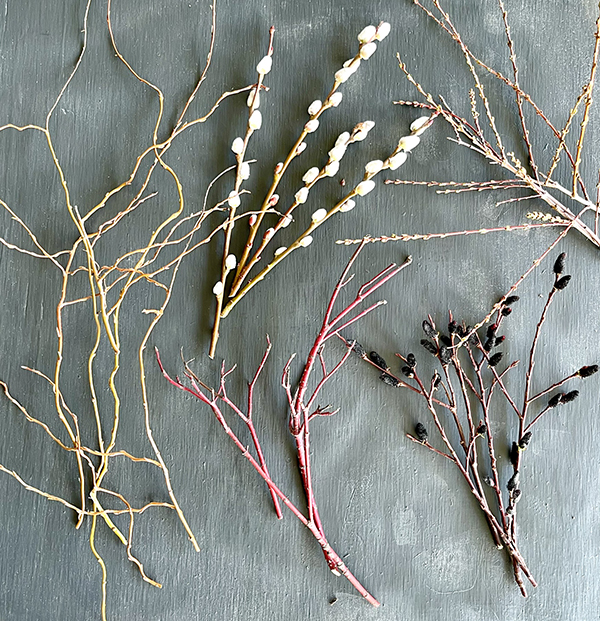
Willow form and shape comparison.
As spring progresses, even more options emerge:
- Spirea – Spirea: The genus is Spiraea, and there are many species and cultivars. Some common ones include Spiraea x vanhouttei (Vanhoutte Spirea), Spiraea japonica (Japanese Spirea), and Spiraea thunbergii (Thunberg’s Spirea). Delicate clusters of small white flowers on arching branches. Absolutely stunning when dried at the end of fall.
- Redbud (Cercis canadensis) – Vibrant magenta buds that hug the branches before the leaves emerge.
- Witchhazel (Hamamelis sp.) – Wispy, spidery flowers in shades of yellow, orange, and red. One of the earliest blooms.
- Lilac (Syringa vulgaris) – Fragrant purple, pink, or white flower panicles. I grow a couple of different varieties that offer slight chromatic shifts in their hues. One of my favorites is ‘Little Kim’.
- Crabapple (Malus sp.) – Abundant pink or white flowers that create a cloud-like effect.
- Ninebark (Physocarpus opulifolius) – Clusters of white or pink flowers. Foliage ranges from deep purple to lime green.
- Mock Orange (Philadelphus sp.) – Fragrant white flowers that smell like citrus and jasmine.
- Solomon’s Seal (Polygonatum sp.) – Arching stems with dangling white or green bell-shaped flowers.
- Dame’s Rocket (Hesperis matronalis) – Spikes of fragrant purple or white four-petaled flowers.
- Forget-Me-Nots (Myosotis sp.) – Low-growing plants with charming blue flowers.
- Wild Geranium (Geranium maculatum) – Delicate pink or purple flowers above deeply lobed leaves.
- Virginia Pepperweed (Lepidium virginicum) – Delicate white flowers on slender stems, adding an airy texture to arrangements.
- Bluestar (Amsonia sp.) – Star-shaped light blue flowers that create a soft, ethereal effect.
- Creeping Phlox (Phlox stolonifera) – Low-growing mats of pink, purple, or white flowers.
- Hosta Flowers – Tall spikes of lavender or white bell-shaped flowers rising above the foliage.
Late spring to summer
Once we hit that last frost, a whole new world of foraged possibilities opens up. Some standout wildflowers and woody plants for late spring and summer include:
- Sweetshrub (Calycanthus floridus) – Unusual, fragrant maroon flowers with a tropical look.
- Viburnum: There are many species in the Viburnum genus, including Viburnum opulus (European Cranberrybush), Viburnum dentatum (Arrowwood Viburnum), and Viburnum lantana (Wayfaring Tree).- Showy white flower heads and glossy leaves. Attractive berries follow in fall.
- Wild Pennycress (Thlaspi arvense) – Tall stems with clusters of dainty white flowers. Beautiful filler.
- Queen Anne’s Lace (Daucus carota) – Lacy white flower umbels that add an airy touch.
- Butterfly Weed (Asclepias tuberosa) – Vibrant orange flowers that are a magnet for pollinators.
- Smokebush (Cotinus coggygria) – Large, fuzzy flower panicles in shades of pink and smokey purple. Foliage ranges from burgundy to chartreuse.
- Wild Yarrow (Achillea millefolium) – Flat-topped clusters of white or pink flowers on sturdy stems.
- For late spring, I love pairing ninebark with peonies, sweetshrub with anything but especially on their own (they are so tropical looking and in a shade of red that has a dusty hue to it). For late spring fragrance, nothing beats viburnum. Ox eye daisies, are always a happy companion to any arrangement. I don’t want to hear about using not using invasives. Beauty is in the eye of the beholder, and one man’s ceiling is another man’s floor. To me some of the things you might call ‘weeds’ are beloved materials. It’s a personal choice, but pennycress has me completely smitten ever year (and they sell it commercially, so there’s that).
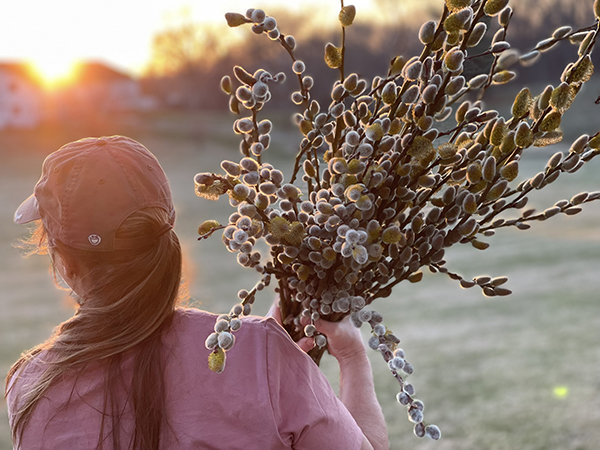
Blooming curly willow at sunset. All images courtesy of the author.
Summer abundance
Summer brings an explosion of wildflowers and woody plants to forage. Some standouts include:
- Black-Eyed Susan (Rudbeckia hirta) – Bright yellow daisy-like flowers with dark centers.
- Purple Coneflower (Echinacea purpurea) – Large, pink or purple daisy-like flowers.
- Bee Balm (Monarda sp.) – Shaggy heads of red, pink, or purple flowers loved by bees and hummingbirds.
- Summersweet (Clethra alnifolia) – Fragrant spikes of white or pink flowers.
- St. John’s Wort (Hypericum perforatum) – Sunny yellow flowers with a profusion of stamens.
- Swamp Milkweed (Asclepias incarnata) – Clusters of small pink or mauve flowers. Important monarch butterfly host.
- Joe Pye Weed (Eutrochium sp.) – Large, domed heads of mauve-pink flowers on tall stems.
- Ironweed (Vernonia sp.) – Striking spikes of deep purple flowers.
- Mountain Mint (Pycnanthemum sp.) – Silvery bracts surround small white or lavender flowers.
- Summer is a treasure chest of possibilities. In addition to all the production flowers at their peak, I use a lot of smokebush. I grow it in royal purple (red) and golden tree (chartreuse) as foliage and filler. I collect wild yarrow from our pasture for its gorgeous white purity (and also because it is toxic to animals), coneflowers in every color imaginable and strange but true, I adore pokeweed. Actually, I hate it while it is growing but as soon as it forms berries, I use it all over the place (if you ever consider exploring working with natural pigments, pokeweed makes a fantastic royal purple, and it also has beautiful structural form after the berries have dropped and has been kissed by frost).
Queen Anne’s Lace is a favorite element in arrangements, but Rudbeckia is probably my favorite wild summer bloom. Another secret show-stopping element is Elderberry. Whether you harvest it as a giant white cluster of blooms or you wait for the changeover to berries, I love it and I have never not had someone spot it in an arrangement and not love it. It also produces a gorgeous deep grape pigment.
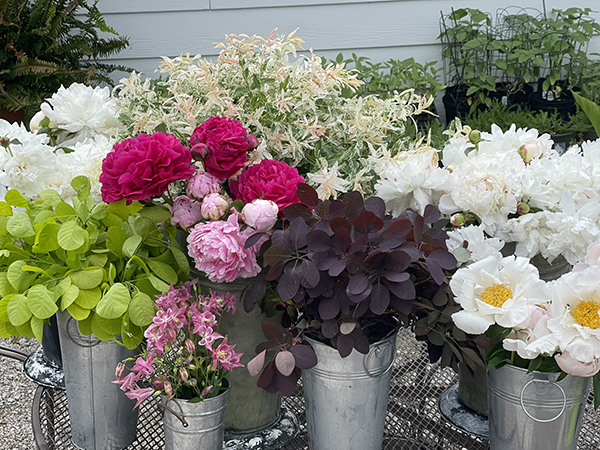
Peony season! With smokebush (oxblood & chartreuse), dappled willow in bloom with blush tips and columbine.
And don’t forget the woody plants that bloom in summer:
- Elderberry (Sambucus sp.) – Large, flat clusters of tiny white flowers followed by deep purple berries.
- Buttonbush (Cephalanthus occidentalis) – Unusual spherical flower heads that resemble pincushions.
- Smokebush (Cotinus coggygria) – Large, airy plumes of flowers in shades of pink and purple.
- Chaste Tree (Vitex agnus-castus) – Spikes of lavender flowers on a large, shrubby plant.
- Gooseneck Loosestrife (Lysimachia clethroides) – Arching spikes of white flowers that resemble a goose’s neck.
- Artemisia (Artemisia sp.) – Silvery, finely-cut foliage that adds a soft, tactile element to designs.
- Sweetgum (Liquidambar styraciflua) – Star-shaped leaves that turn vibrant shades of red, orange, and purple in late summer.
- Magnolia Leaves – Glossy, evergreen leaves that provide a structured, tropical feel.
- Crape Myrtle (Lagerstroemia sp.) – Colorful flower clusters in shades of pink, red, purple, or white, followed by attractive peeling bark.
To forage or not to forage
While foraging connects us to nature and expands our creative palette, it’s essential that we do so responsibly to preserve wild populations. Some key guidelines: Never forage on private property without express permission. Establish relationships with local farmers and landowners. On public lands, check with the managing agency about foraging rules and permits. Many state and national parks prohibit collecting. Harvest minimally from each plant. Never collect rare or endangered species. Use sharp, clean pruners to make precise cuts that don’t damage plant health. Avoid foraging in areas that may have chemical contamination, such as roadside ditches. Consider propagating some wild favorites in a dedicated cutting garden to reduce pressure on wild populations.
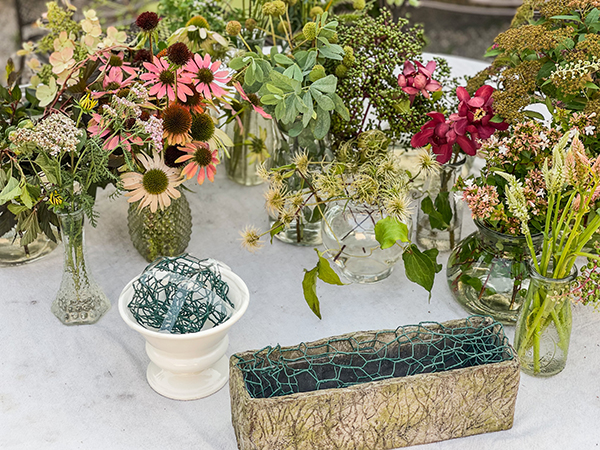
Materials set up for an all-natives arrangement shoot.
Adding forageable/wild elements to your farm is a great way to offer something unique to your customers and connect your offerings to your regional ecology. To get started, consider: Allow edges of your fields to grow wild and harvest volunteers like goldenrod and asters. Plant hedgerows with a mix of native flowering shrubs like dogwood and wild roses. Include flowering vines like honeysuckle or clematis on trellises. Manage a small coppiced woodland for woody material production.
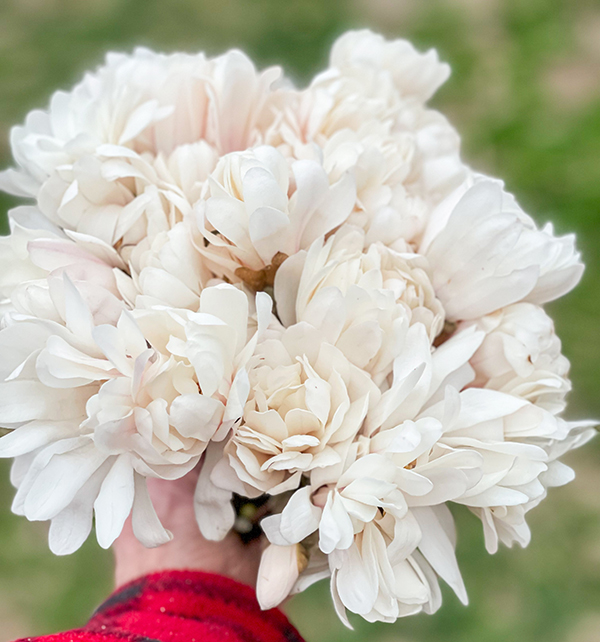
White magnolia blooms.
Keep in mind that the varieties and seasons I’ve listed are for my Midwestern 7a USDA zone, so bloom times will vary based on your region and microclimate. The best way to get to know your local wildflowers is to take walks in natural areas throughout the growing season, observing what’s in bloom and jotting down notes and photos to build your own foraging calendar. Seek out growers who specialize in woody varieties, willows, flowering trees and grasses. Adding them to your growing practice has so many benefits to you and the environment.
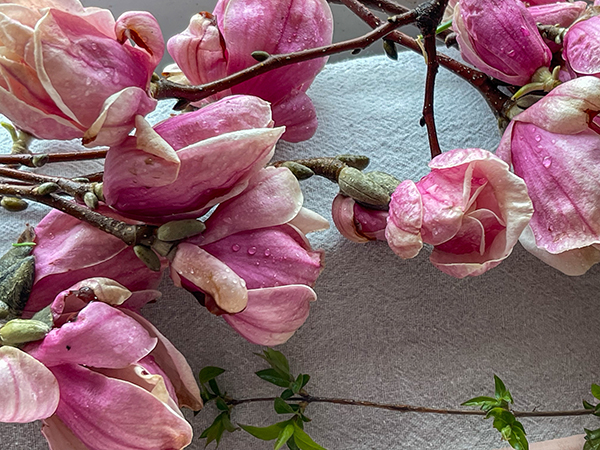
Pink magnolia blooms.
You can also partner with local conservation organizations or landowners to establish foraging best practices and sanctioned areas, ensuring a sustainable supply of foraged goods.
Whether you’re harvesting from the wild or from your own fields, foraged florals are a beautiful way to diversify your designs, support sustainability, and celebrate your local ecology. With responsible practices and an eye for unique beauty, foraged and wildflowers are becoming an essential part of the progressive flower farming and floral design movement.
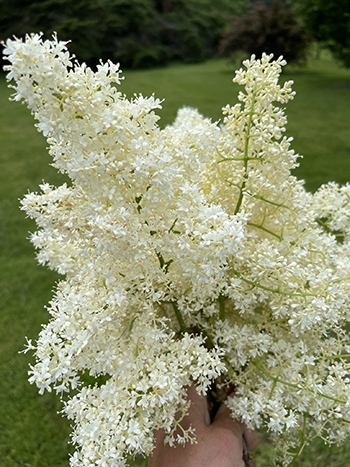
Japanese white lilac.
Resources
- “The Flower Farmer: An Organic Grower’s Guide to Raising and Selling Cut Flowers” by Lynn Byczynski
- “Foraged Flora: A Year of Gathering and Arranging Wild Plants and Flowers” by Louesa Roebuck and Sarah Lonsdale
- “Native Plants of the Southeast: A Comprehensive Guide to the Best 460 Species for the Garden” by Larry Mellichamp
- “Harvest: Unexpected Projects Using 47 Extraordinary Garden Plants” by Stefani Bittner and Alethea Harampolis
- “The Wreath Recipe Book: Year-Round Wreaths, Swags, and Other Decorations to Make with Seasonal Branches” by Alethea Harampolis
- “Midwestern Native Shrubs and Trees: Gardening Alternatives to Nonnative Species” by Charlotte Adelman & Bernard L. Schwartz
Elizabeth Fichter of Queen Bee Blooms & Kuhs Estate and Farm is a St. Louis Missouri flower farmer and floral designer. With a passion for sustainable floristry and local ecosystems, she incorporates foraged and wild elements into her designs. Elizabeth shares her knowledge and love of nature through photography, workshops, writing, and exploring the intersection of art and science with flowers. Connect with her at queenbeeblooms.com and on Instagram and Facebook, also as Queen Bee Blooms. Eighty-three newly released varieties of gorgeous blooms are available on the Queen Bee Blooms website. Please feel free to reach out with questions or for assistance.
Copyright Growing For Market Magazine.
All rights reserved. No portion of this article may be copied
in any manner for use other than by the subscriber without
permission from the publisher.