











Handy for hard-to-measure surfaces and double checking the accuracy of other thermometers
I was looking back through Instagram photos tagged #toolsforgrowingformarket and came across one from a few years ago from my friend Martin at Slow and Steady Farm on Whidbey Island in Washington. In the photo he’s showing a $20 infrared thermometer he’s using to check the temperature of his soil blocks. At the time I hadn’t used one myself and didn’t know how quick and easy they were to operate!
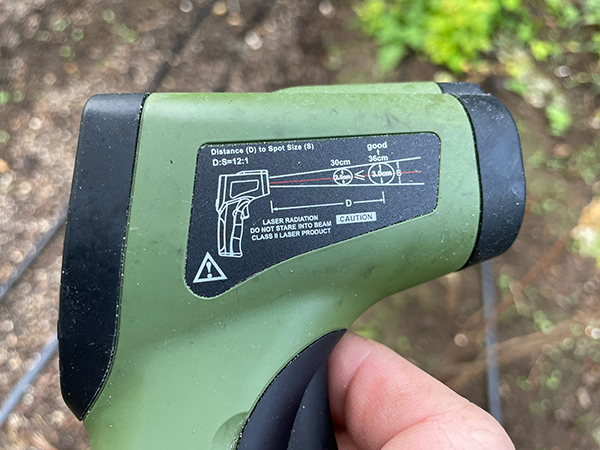
The spot ratio is listed on the side of my thermometer and shows how the area read varies with distance. All images courtesy of the author.
While I wouldn’t consider it an essential tool for every farm it’s certainly a handy one to have on hand. I bought one last year for cooking (which it’s also super nice for), and I have also used it as a learning tool in the greenhouse and in my germination chamber to check soil surface temperatures in specific spots. Martin points out that you can also use it to check field soil temperatures for planting by simply digging to seeding depth (usually within the top inch) and then taking the temperature there. The thermometer can also be used for spot checking coolers and produce temperatures, and temperatures of dunk tanks or anything else produce is coming into contact with.
Using the thermometer is super simple: basically you just point it at whatever you want to take the temperature of and then pull the trigger. The display will almost immediately give you a temperature reading.
There are a few important things to keep in mind when using this type of thermometer. The first is that the thermometer is only taking surface temperatures, and the emissivity of some surfaces can give false readings. Fortunately surfaces like soil have good emissivity so they give good readings, shiny surfaces tend to be problematic so stainless countertops or glossy painted surfaces may not give good readings. It also is most accurate if you’re close to perpendicular to the surface and not at an extreme angle.
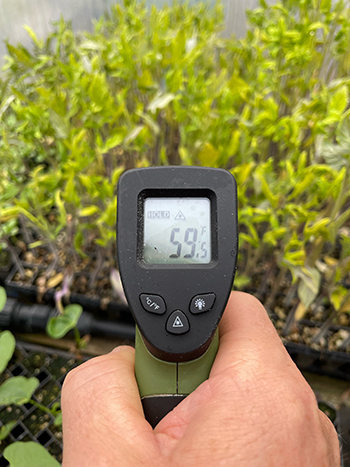
Three simple buttons under the display allow toggling between Fahrenheit and Centigrade, backlighting the dispay for reading in the dark, and a laser pointer that indicates the approximate center of the spot being measured. When the trigger is pulled a temperature reading is taken and then that temperature holds on the screen until the trigger is pulled again.
Another thing to look for is the “spot size”, the size of the area that the thermometer is reading the temperature in. Again, typically not a problem for soil temperatures where the temperature is relatively even over a large area, but if you’re trying to get the temperature of a very specific spot you need to pay attention to how your particular thermometer is reading spot size. This is a ratio of the distance from the object being measured to the diameter of the spot the thermometer is averaging the temperature over.
My thermometer has a ratio of 12:1 meaning if it’s 12” from the spot it’s taking the average temperature of a spot that is 1” in diameter. If I’m 3’ (or 36”) from the surface it would be averaging the temperature of a spot that is 3” in diameter. Different models have different ratios and also different maximum and minimum temperatures they can read.
On the farm one thing that can potentially be an issue is dust and/or water vapor and condensation. Infrared thermometers are essentially optical devices looking at the surfaces they’re measuring. Anything that obscures their view of that object, either a dust cloud or steamy cloud, or something on its lens like condensation or dust will cause problems. If you wear glasses you’ll know how your glasses can fog up when walking into a hot, steamy greenhouse from the cool outdoors, or get dusty sitting on the dashboard of a truck, and the infrared thermometer is going to experience the same problem.
Josh Volk farms in Portland, Oregon, and does consulting and education under the name Slow Hand Farm. He is the author of the books Compact Farms: 15 Proven Plans for Market Farms on 5 Acres or Less, and Build Your Own Farm Tools, Equipment & Systems for the Small-Scale Farm & Market Garden, both available from Growing for Market. He can be found at SlowHandFarm.com.
Copyright Growing For Market Magazine.
All rights reserved. No portion of this article may be copied
in any manner for use other than by the subscriber without
permission from the publisher.