











Wheel hoes have been around in one form or another for centuries. The basic form most of us are familiar with are two handles that you push attached to a hoe blade that cuts through the soil while a wheel in front of that helps you set the depth and support the weight of the tool. Like any tool it’s not hard to start using it and see immediate results, and after years of using it, I’m still learning, and re-learning little subtleties of how to be more effective with it. One of those subtleties is that it often works better to run it backwards.
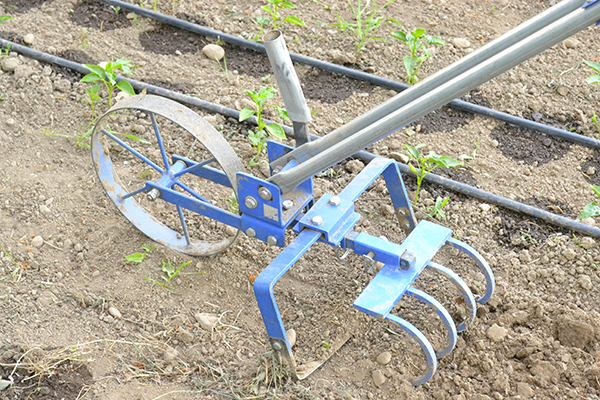
The wheel hoe with a 14” blade followed by a four tine rake. The rake tends to run a little deeper than the blade which is a good thing but makes this combo only work in limited conditions.
The wheel hoe I’ve been using for the past 10 years or so is a Valley Oak model and it’s been a real workhorse. I especially like how easy it is to swap implements, just a simple, common wire lock pin securing the implement. You can even mount two implements at the same time: back-to-back hoe blades are my favorite combo, but sometimes I’ll use a hoe blade followed by the rake. If you only want one, you can flip the other upside down just like on a cultivating tractor, keeping it with you for when you need it but mostly out the way while you use the other implement. The other feature I really like is the quick release handle adjustment since we have many users of very different heights on the farm. There are lots of other wheel hoe types that probably work just as well and that the following techniques would also work with.
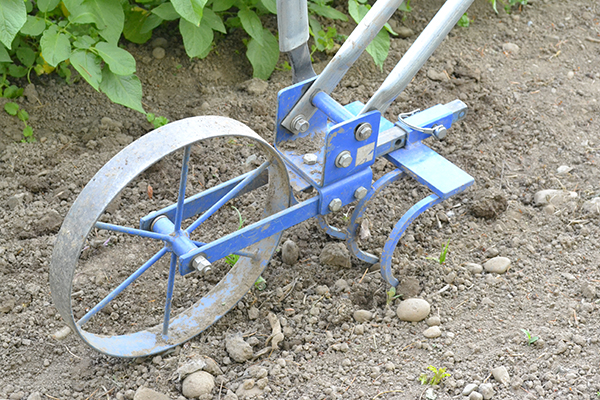
Running the rake backwards and pulling the wheel hoe works much better for me than trying to push the rake through the soil in the usual configuration.
What I really wanted to talk about was running the wheel hoe backwards. A few years ago I posted a photo of it on my social media and my friend Frank Morton from Wild Garden Seed mentioned in a comment that he pulls it backwards to cover his footprints. I didn’t care that much about my footprints at the time so it took me a few years to realize that covering your footprints aren’t the only reason to pull it instead of pushing.
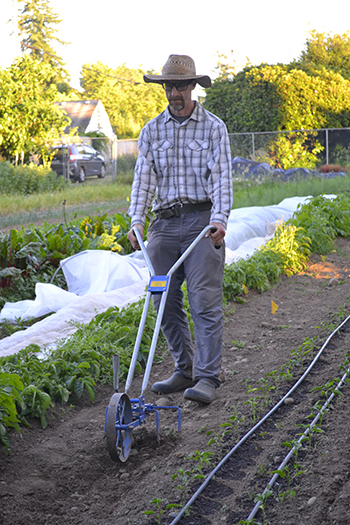
Pulling the wheel hoe, typically with straight arms, usually takes less effort than pushing but requires being comfortable walking backwards without being able to see where you’re going.
Back in February I wrote an article here about using tine weeders and rakes and mentioned that they work better for me than blades in rough and wet early season conditions when I’m trying to get a cultivation in and knock weeds back until the soil dries out a little more. I have a four tine rake for the Valley Oak wheel hoe, but it’s never worked well for me as it’s been very hard to push in those wet conditions – but this spring I turned it around and it worked great when I pulled it instead of pushing!
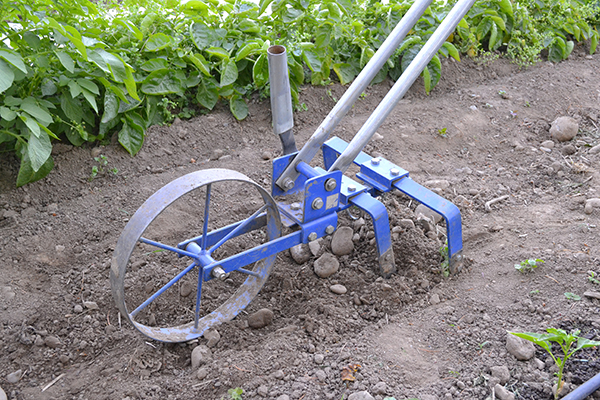
I often double up the blades, running both my narrower 9” blade with the wider 14” blade just behind. This tumbles the soil a little more as it comes off of the blade helping knock soil off the roots of undercut weeds and more effectively killing them. I’m typically trying to hoe when the weeds are hard to see like they are here. It’s a lot faster and more effective to kill weeds when they are this small.
Pulling requires being comfortable walking backwards (not being able to see where you’re going) but it’s less physical effort than pushing for me. I tend to pull with straight arms and constant speed. The wheel still helps to set the depth, and I’ve found that the handle height adjustment also makes a difference. If the handle is set higher the angle of the tines is steeper so they dig in more, or you can do the opposite.
When you push you’re pushing forward, but you’re also pushing down against the ground a bit. In very soft conditions, like when it’s wet, this can especially be a problem. When you pull you’re not pushing the implement down into the ground so you have to rely on the angle of the implement to pull itself into the ground. If the tool angle is too shallow it won’t dig in. If the angle is too steep it’ll dig itself in too much.
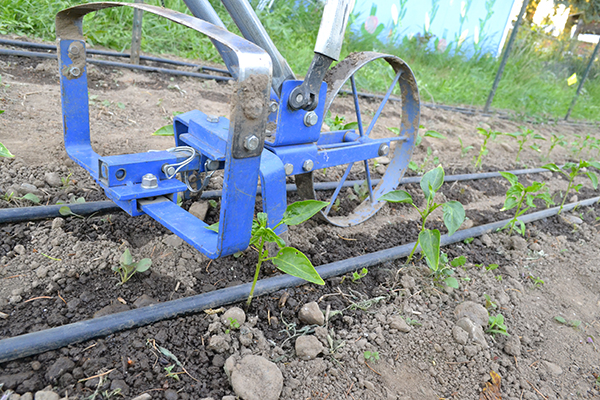
When I need to only run a single blade, I can flip the second blade upside down to keep it with me for when I do need it. Here the second blade is too wide for the spacing between rows, so I’ve flipped it up. Cultivating with drip on isn’t ideal, but sometimes it’s better than not cultivating at all. All photos courtesy of the author.
I’ve been using the backward approach with the hoe blades a lot this spring too. It works particularly well on small weeds, less than ¼” high – the ideal time to get them. If I’m trying to knock down really large weeds, 4-8” high – something I try to avoid – sometimes, even with a steep blade angle, there’s just not enough down force to dig in. In that case pushing works better.
If I’m doing a lot of wheel hoeing I’ve also found myself switching off between forward and backward hoeing every few rows. This variety of motions lets the specific muscles to each different motion rest and lets me work longer with less fatigue.
Josh Volk farms in Portland, Oregon, and does consulting and education under the name Slow Hand Farm. He is the author of the books Compact Farms: 15 Proven Plans for Market Farms on 5 Acres or Less, and Build Your Own Farm Tools, Equipment & Systems for the Small-Scale Farm & Market Garden, both available from Growing for Market. He can be found at SlowHandFarm.com.
Copyright Growing For Market Magazine.
All rights reserved. No portion of this article may be copied
in any manner for use other than by the subscriber without
permission from the publisher.