











From fecal shields to golden shells
While tortoise beetles (species in the Cassidinae subfamily) may not be a worrisome agricultural pest that causes significant crop loss, they do occasionally show up in larger numbers that may cause concern at first sight. Understanding this insect’s habit and lifecycle can help growers avoid unnecessary pesticide applications.
As the name suggests, tortoise beetles resemble miniature turtles, with their domed carapace. Though the adult beetles invite curiosity with their sometimes eye-catching colors, the larvae have an interesting defense mechanism that can be off-putting. Adult tortoise beetles lay their eggs on the undersides of leaves on host plants, where the larvae that hatch out protect themselves with a “fecal shield,” built upon their “anal fork,” which they can raise up against potential predators (Fig. 1).
Pest identification and lifecycle
There are many species of tortoise beetles globally. In this article we focus on the two that are commonly noticed on crops: clavate tortoise beetle (Plagiometriona clavata) and golden tortoise beetle (Charidotella sexpunctata).
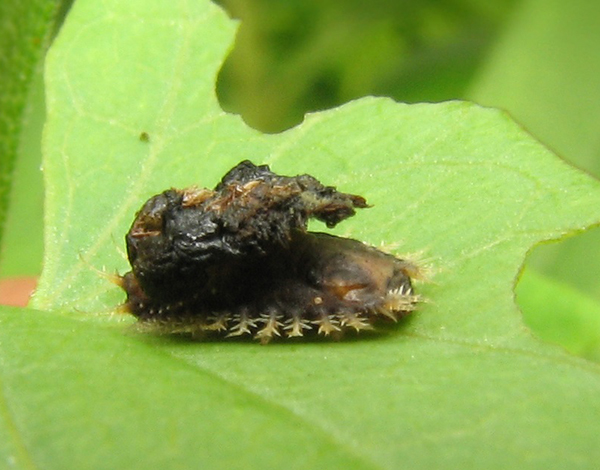
Figure 1: Golden tortoise beetle, Charidotella sexpunctata, larva with fecal shield on bindweed. Pennypack Restoration Trust, Montgomery County, Pennsylvania, USA. https://bugguide.net/node/view/308321.
Clavate tortoise beetles feed on solanaceous plants, probably exclusively. They are oval to square in shape, clear to slightly metallic looking with a dark square marking on the center of their back. Once you see one you will remember it. Some describe the dark marking as looking like a teddy bear.
Overwintered adults come out in mid- to late-spring and begin feeding and laying eggs. This overwintered generation is likely the most noticeable, as their minor feeding damage looks more dramatic on smaller late-spring plants. Larvae will feed on the same plants, and their presence may overlap with the overwintered generation.
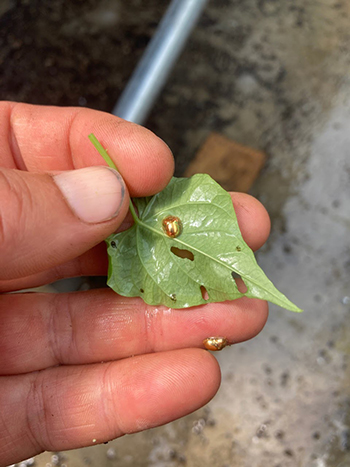
Figure 2: Golden tortoise beetles often appear to be made of shiny gold and are also sometimes called “gold bugs.” Photo courtesy of Christa Bahner.
Golden tortoise beetles have a very similar lifecycle but feed exclusively on plants in the Convolvulaceae (morning glory) family. Golden tortoise beetles often appear to be made of shiny gold and are also sometimes called “gold bugs” (Fig. 2). A chameleon of sorts, these beetles have a remarkable color-changing ability and may hide their metallic gold coloration and appear orange to red with black dots at some points in their development or, most noticeably, in response to being disturbed (see Fig. 3). The golden sheen disappears after death, disappointing would-be collectors and jewelry makers.
In northern states, both species of tortoise beetle are expected to produce only one generation per year. Development from egg to adult stage takes around six weeks for both species. After larvae pupate and emerge as adults, they will feed a little bit and then enter diapause — remaining inactive until the following spring. Further south however, both species may produce two or more generations in a season.
Damage and crops affected
Damage from both species of tortoise beetle is typically minor and limited to small holes chewed through leaves of their host plants. Clavate tortoise beetles feed on plants in the Solanaceae family and may be found on peppers, eggplants, ashwagandha, tomatillos, potatoes, tomatoes, datura, solanaceous weeds, etc. Golden tortoise beetles feed on plants in the Convolvulaceae family and may be found on sweet potatoes, morning glory, moonflower, Ipomoea lobata, bindweed, etc.
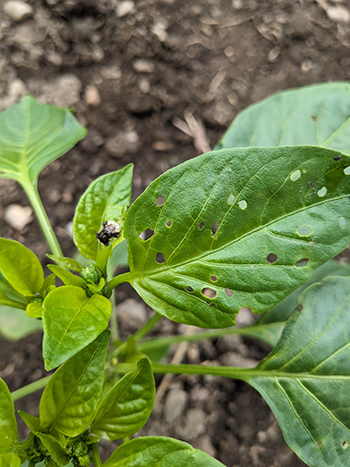
Figure 4: Clavate tortoise beetle adult and damage on pepper plant. Courtesy of MOFGA.
Management options
Most commonly, these beetles are a minor pest — more of a curiosity than a concern. They do not usually build up a large enough population to cause serious damage and do not warrant spraying. When in small numbers you can ignore them, as they are unlikely to affect yields. In small growing areas the beetles can be easily managed by hand removal.
Golden tortoise beetle can sometimes be considered a larger problem for ornamental crops — though only if you are concerned about aesthetic damage on foliage. Small holes in leaves of food crops will likely not affect yields or marketability of edible portions (with the exception of sweet potato greens). In very rare situations where populations are substantial over a larger growing area, both species are susceptible to common organic pesticides.
While both species have the ability to fly, neither are overly active fliers and clavate tortoise beetles rarely do so after finding a preferred host plant.
Scouting: Pro-active scouting is not recommended because of the rarity of significant damage from these species. If a population will build up enough to cause real damage, the damage itself will likely be the instigator and primary target of any scouting. Both adults and larvae can be found feeding on the underside of leaves, where eggs are also laid, but adults may also be seen feeding on the topside of leaves. Because they typically chew holes all the way through a leaf, feeding damage is an early and easily visible sign of their presence (Fig. 4).
Cultural: Tortoise beetles could be easily excluded with row cover or exclusion netting applied before their emergence. They are relatively easily removed by hand or with a handheld vacuum in smaller growing areas. Similarly, eggs of the next generation can be easily squished when checking leaf undersides.
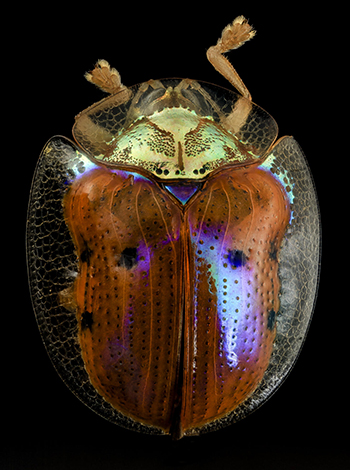
Figure 3: The golden tortoise beetle, Charidotella sexpunctata— One of the many variations of this electric beetle, exquisite in its color, form, and blends of neon all free of charge from your friend: Nature. The red and black coloration is a stress response as the result of being disturbed, likely a defense against predation. Courtesy of U.S. Geological Survey, Department of the Interior/USGS Bee Inventory and Monitoring Lab, Beltsville, Maryland.
Biocontrol options: Both species are likely to be preyed upon by several common insect predators. In fact, their presence in low numbers may even be a net positive in terms of their role as prey to wild populations of predators and parasitoids. Possible predators include spiders, lady beetle species, and predatory bug species (e.g., assassin bug, damsel bug, spined soldier bug). Golden tortoise beetles have been reported as hosts of the parasitoid wasp Tetrastichus cassidis and the parasitoid fly Eucelatoriopsis dimmocki.
Organic pesticides (as a last resort): Larval stages of tortoise beetles are likely susceptible to pesticides containing azadirachtin (the active ingredient derived from neem). Adults and larvae are likely susceptible to pyrethrin-containing pesticides (e.g., PyGanic). Entomopathogenic fungi-based materials (e.g., products containing Beauveria bassiana, like Mycotrol ESO among several other brands) may also put a dent in their populations if applied more than once and when conditions are favorable (i.e., low sunlight and/or gentle wet weather).
Please note: This information is for educational purposes. Any reference to commercial products or trade/brand names is for information only, and no endorsement or approval is intended. Pesticide registration status, approval for use in organic production, and other aspects of labeling may change after the date of this writing. It is always best practice to check on a pesticide’s registration status with your state’s board of pesticide control, and for certified organic commercial producers to update their certification specialist if they are planning to use a material that is not already listed on their organic system plan. The use of any pesticide material, even those approved for use in organic production, carries risk — be sure to read and follow all label instructions. The label is the law. Pesticides labeled for home garden use are often not allowed for use in commercial production unless stated as such on the label.
Caleb Goossen, Ph.D., is the organic crop specialist of the Maine Organic Farmers and Gardeners Association (MOFGA) and the author of MOFGA’s Pest Report newsletter (sign up at mofga.org/newletter-sign-up-pest-report). Formed in 1971, MOFGA is the oldest and largest state organic organization in the country. MOFGA’s mission is to transform the food system by supporting farmers, empowering people to feed their communities, and advocating for an organic future. Learn more at mofga.org.
Copyright Growing For Market Magazine.
All rights reserved. No portion of this article may be copied
in any manner for use other than by the subscriber without
permission from the publisher.