










Small scale equipment can make a big difference
My husband and I were perusing the trade show at the New England Vegetable and Fruit Conference and stopped to talk with a vendor who had given a compelling presentation on tractor equipment for organic growers. Matthew’s eyes were getting that distant, dreamy look, imagining shiny new tractor equipment to help our small farm scale up. I started getting a nervous pit in my stomach imagining taking out a huge loan to pay for it all.
Then, the sweet vendor, also an organic farmer, shared something that ended up saving us a massive amount of money in our journey to scale up to potato production using tractor equipment. He encouraged us to think about ways we could scale up our operation using the tiny 30 HP Kubota tractor that we already had.
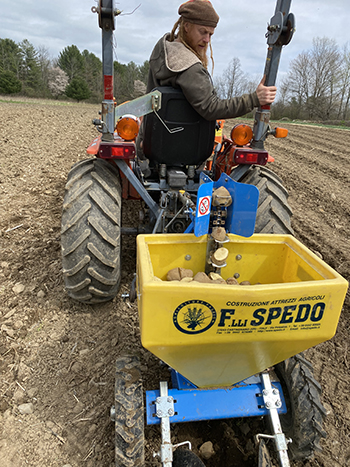
Matthew planting with the “Baby Potato Planter” by Spedo from Italy.
We started our farm in 2010 with this tractor, and it has served us well for the past 15 years. We know how to use it. We already had a small arsenal of PTO attachments for our intensive veggie operation. This trade show vendor told us it’s possible to find the necessary implements for scaling up our operation using the tractor we already owned.
Our farm, Lovin’ Mama Farm in Amsterdam, New York, mainly focuses on intensive, no-till production on 2.5 acres. We are certified organic and market directly to our customers at five regional weekend farmers markets.
The key to our success is diversity. We aim to be a one stop shop for our customers. Therefore, we try to produce as many of the commonly consumed vegetables as possible. According to the USDA, potatoes are the most highly consumed vegetable in the United States, with sweet corn, tomatoes, lettuce, garlic, and carrots following closely behind.
Most small-scale farms don’t have the space to plant “field crops” like potatoes and sweet corn. These crops are notorious for bringing a small return per square foot. Therefore, small growers don’t prioritize growing them in their fancy (high-end real estate) no-till beds. Cut flowers, baby greens, baby root veggies, and fruiting crops like tomatoes and zucchini bring a much higher return per square foot.
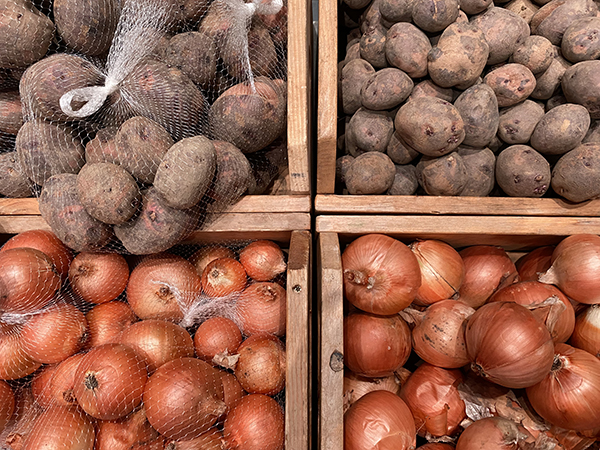
Storage crops like potatoes and onions are an important part of our winter sales strategy.
I’ve often pondered the ethics of only growing the high-return-per-square-foot crops, such as leafy greens, herbs, and radishes. Is it ethical to only grow the high-return crops like baby greens, cut flowers, and heirloom tomatoes? Do we have a responsibility to our community to grow more calorie rich, affordable foods, like potatoes and winter squash?
An old mentor, John Jeavons (head of the global Ecology Action and a leader in biointensive agriculture), recommends that small farms focus on the 60-30-10 rule for soil and community health: 60 percent of crops are high calorie and soil building crops, 30 percent are specialty roots, and 10 percent are leafy greens and income producing crops. He says other ratios can work, too.
After living through extreme poverty during our early years of farming, I’m a huge advocate for farmers growing whatever they need to survive economically. Yet, as a farmer who is driven to grow a balanced diet for myself and my community, I’d like to get my ratio a little closer to Jeavons’ recommendations.
We are attempting to grow more calorie rich crops like roots, potatoes, and winter squash to balance the high return per square foot crops like leafy greens. I will be honest, there are economic incentives to growing field crops, too, since we can store them for sale during the winter months. We made the leap to farm and market 12 months to keep our core group of employees on year round. So, I’m constantly finding ways to expand our winter offerings to boost our winter sales.
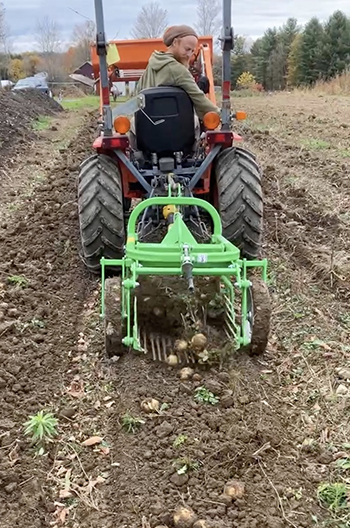
Matthew harvesting with our small Kubota tractor and the Bursa potato harvester.
We are blessed to lease 10 acres of family land. Figuring out a long-term lease with family is incredibly complicated, and that’s a story for another article. What’s important is that we have access to a completely undeveloped 5-acre field where we are experimenting with larger scale organic and regenerative methods for field crops like potatoes, onions, garlic, corn, and winter squash.
At least in our markets, we discovered there was a huge market gap for certified organic field crops like potatoes. Plus, as our farm scaled up to go to markets year round (no small feat in frigid Upstate New York), we needed more storage crops on our tables to increase winter sales.
Our goal was set: figure out how to produce a larger scale of potatoes using our tiny tractor. We started researching attachments, and sure enough, we found the “Baby Potato Planter,” an Italian-made planter by the Spedo company. We also found a small-scale potato harvester, Ursa, made in Poland by Bomet.
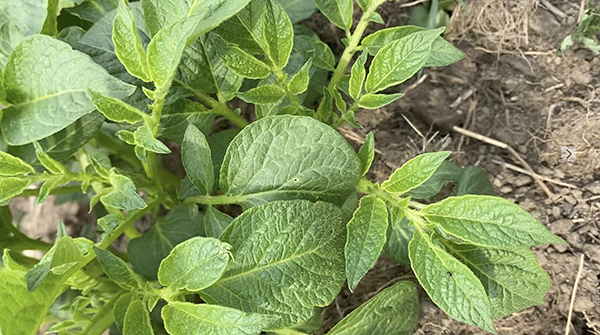
A growing potato plant.
Hint for small scale producers: plan on importing tractor implements from Europe or Japan. American made products tend to be built for 100 plus acre farms. We found a local distributor who imports these machines (OESCO Inc., in Conway, Massachusetts), and had them in stock. We were able to avoid shipping costs by picking them up.
The total bill for both was $5,610 (in 2023). We were able to pay out of pocket with zero debt — another great side effect of using small scale tools for your small scale tractor. As growers who’ve always done pretty much everything by hand, it was a novel and exciting moment to have a planter and harvester in our toolkit.
We ordered 500 pounds of organic seed potatoes and prepped the soil using our trusty Kubota and rotary harrow (also imported from Italy). We added a small dusting of organic fertilizer. Then, we put our baby planter to work. All 500 pounds of potatoes planted in half a day is a profound experience when you’re a first timer using a tractor mounted planter.
It planted about 1,750 row feet, single rows with a 10-inch spacing. Since we are growing potatoes in a field with no water system, we timed our planting with rain in the forecast. Within two weeks, all the potatoes had sprouted.
The hilling and weed management proved the most challenging with our small Kubota. We have a simple tool bar attachment that we mounted two discs on for hilling. We were able to hill the potatoes twice, and then they got too large for our small tractor to drive over. That’s when the weeds started to set in. We tried using the sweep attachments on the tool bar to keep the weeds at bay. But with the intensive no-till veg and flower operation taking most of our waking hours, I will admit that the potato patch got quite weedy.
We knew the weeds would tangle up the harvester, so we decided to flail mow the potatoes pre harvest. That really helped the Ursa harvester get through, although the big weed root balls were a challenge and would sometimes clog up the harvester. We had two people do the harvesting — one to drive the tractor and the other to call out when the harvester got clogged with weeds and clear the root balls out before the harvester could continue.
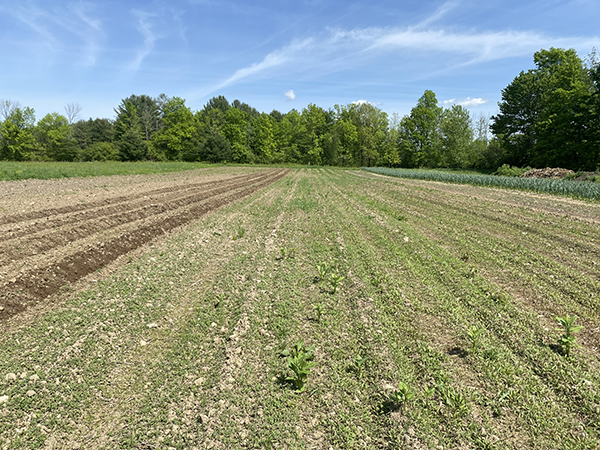
he left side of the potato field has been freshly hilled (and weeded at the same time).
Though we created a bit of trouble for ourselves with the weeds, we were still able to harvest thousands of pounds of potatoes in two days. Our main, eight person veg crew went out to pick all the potatoes up after the harvester had driven through, packing them into bulb crates. We filled one of our walk in cooler rooms to the brim with unwashed potatoes for our winter markets. We set the walk in cooler to 45°F and put a humidifier inside. We had potatoes to sell all winter long.
We are slowly investing in more tiny equipment (like the Treffler tine weeder) to help with weed management. We are getting better at hilling for weed prevention. Our soil is slowly improving out in our big field as we add compost and use cover crops.
The potatoes have been a big hit at our markets. The German Butterballs sold out before winter even started. We sold them in full pint baskets for $5. Meanwhile, we charge $4 per pound for our bulk potatoes, which is definitely on the high side, I know. I’m always pushing the envelope for a price point, because I know how expensive it is to farm organically.
I also see other organic growers in my market selling for that price. Toward the end of the storage season (March and April), we sell 4-pound mesh bags for $10 to get the cooler cleared out in preparation for the upcoming growing season.
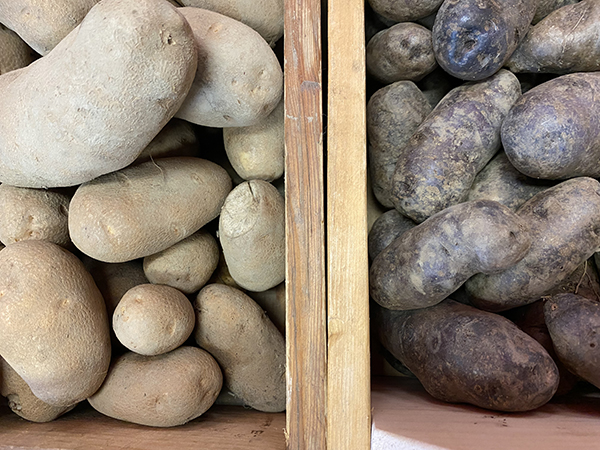
Potatoes on display at market in our handmade wooden boxes.
In late February, we go through all the remaining bins to pick out any rotten ones and to break off any eyes that are sprouting. We’ve also experimented, with great luck, planting the wrinkly leftovers the following May.
I always thought we would have to invest in a bigger, new tractor plus expensive, specialized equipment to be able to get into the potato game. I’m here to say, as a small scale grower, perhaps just stick with the equipment you have, invest without debt into some “baby” sized implements, and give field crops like potatoes a try.
The best part of this whole experiment, and the main reason we farm anyways, is walking out to the potato storage room (50 feet from my house) to grab as many potatoes as my heart desires for dinner. The deep wealth and security I feel from growing my own calorie rich, organic crops is priceless. And knowing that I’m providing an organic potato option for my customers is the frosting on top.
Corinne Hansch is an organic farmer, writer, mentor, activist, chef and entrepreneur. She farms with her husband and a hard working crew at Lovin’ Mama Farm in Amsterdam, NY, while homeschooling her three kids. She grows over 400 varieties of veg and cut flowers using regenerative practices such as no-till, perennial plantings, and living wages for employees, producing over 50,000 pounds of food per year and hundreds of thousands of stems of cut flowers on three acres. They direct market at five regional markets per week and are building a line of value added products for online sales.
Copyright Growing For Market Magazine.
All rights reserved. No portion of this article may be copied
in any manner for use other than by the subscriber without
permission from the publisher.