









It’s August on our flower farm, Moonshot Farm in East Windsor, NJ–and usually at this point in the season, we’re feeling burnt out, cash-strapped, and about ready to quit farming. This year, however, the farm is feeling a lot more manageable. Last spring, I shared the top things we did to make our farm profitable (“Eleven things we did to make our farm profitable [finally],” in the March 2024 GFM), and I’m happy to report that we’re more profitable than ever. Our gross revenue this year is on track to jump by 75% (on the exact same acreage), yet we are also feeling a lot less stressed. Here are my favorite changes–some big, some small–we’ve made on the farm this year to make more money and be happier.
1. Brought on weekend help
For years, we’ve had a standard Monday-Friday workweek for our farm crew with relatively set hours year-round. While the predictability has worked well for our team, the reality of farming is that plants rarely stick to a set schedule. Sundays are meant to be my husband’s and my day off, but instead we found ourselves spending Sundays watering plants and completing urgent harvests of flowers like tulips, lilies, sunflowers, peonies, and other blooms which require daily cutting to catch them in their ideal stage. We also run a Sunday farm stand and although it’s self-serve, we still have to set it up. While our crew was just working five days a week, we were working seven days a week year round–and feeling exhausted.
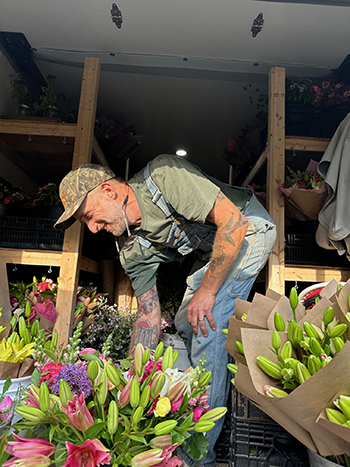
Purchasing a refrigerated truck was one of the biggest investments we’ve ever made on the farm, but using the USDA FSFL program meant a low rate and reasonable annual payments. The truck has paid for itself in bringing additional volume to markets, and enabled us to sleep in on market mornings.
This year we added weekend hours for our staff and it’s been a game changer. In the winter, when we have a skeleton crew of year-round workers, we rotate Saturday/Sunday hours amongst the team. A couple of folks come in to get critical tasks like harvesting and watering done. In the summer when we have a larger team including our H-2A workers, we’ve worked weekends into our normal weekly schedule.
I was nervous that weekend work might be a drag for our team, but it turns out our workers don’t mind the weekend hours. Most are eager for overtime hours, and for others it has enabled them to have more flexibility in their schedules. One of our team members, for example, now leaves an hour early every day, which has let his wife take on an evening job; and he is happy to make up the five extra hours on the weekend.
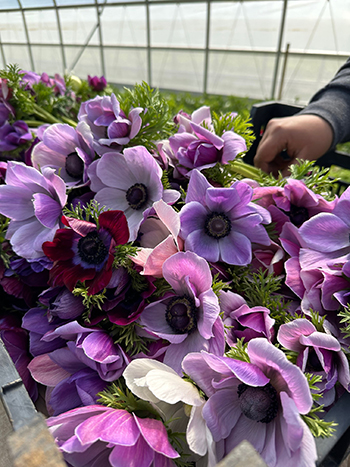
Scheduling workers to come in on Saturdays and Sundays has given us our weekends back.
Now that everyone is trained up on weekend tasks, Saturdays and Sundays can run smoothly without us. The team harvests, waters, and sets up the farm stand. And we get to sleep in!
2. Invested in refrigerated truck
Of all the items in this article, this one is the most expensive–but also probably the best improvement we’ve made. At the end of December, we purchased a 16’ refrigerated box truck using a USDA Farm Storage Facility Loan (FSFL). Due to the loan parameters as well as a desire to offset some large grant income, we purchased a new vehicle. The cost was daunting (over $100,000), but the payback has been enormous.
Before purchasing the truck, we used an XL passenger van for years to deliver flowers to market. We could fit a lot of buckets in the van, but as the farm has grown we started running out of room. Because the van was not refrigerated, we had to load it up every morning before the market by hand. Our markets are over an hour away, so my husband Mark was out at 3:30am twice a week loading the van bucket by bucket. After a long day at market, he would then have to unload any leftovers from the van back into the cooler.
The reefer truck has standby power, which means the cooling unit can be plugged in and run while the engine is off. That enables us to load up the night before market, providing a precious extra hour of sleep twice a week. When Mark returns at night from the farmers market, he can just plug the truck in and be done.
Cold transport also means our flowers are extra fresh at market and have a longer vase life. Due to the larger vehicle, we’re able to bring way more product to market. The FSFL loan has a low rate (around 3%) and long terms. We’re earning the annual payment every month in all of the extra flowers we’re now able to sell. Although the FSFL loan application process was long and complex, the truck has taken our farm to the next level and given us over 100 hours of sleep back a year.
3. Kept more records with Google Forms
Like many farmers I know, I’m always striving to keep better records but struggle with sticking to them when the season gets busy. With a few tweaks this year, we’re keeping better records than ever.
First, I’ve learned that I need to delegate almost all production records. As our farm has grown, I’m rarely the person with their hands on the daily harvest or sowing seeds. It’s impossible to remember to go take records about a task I didn’t actually complete. Instead, I’ve made record keeping the responsibility of my crew, who are much more likely to remember than me.
For easy record keeping, we use simple Google Forms on our phones as they’re much easier to use than a big unwieldy spreadsheet. The forms feed into a spreadsheet on the backend, so that I can analyze the data on the computer. We provide Wi-Fi to our employees in the barn, and the Chrome browser will automatically translate the Google Form into an employee’s preferred language.
As an example, one of my harvest crew members is in charge of recording the daily harvest. Other crew members report their bunch counts to her, and she is responsible to make sure it’s entered into a Google Form before she takes lunch.
We’ve also implemented a simple form to track all of our seeding and plant propagation. Whoever is sowing seeds or taking cuttings is responsible for tracking the varieties and quantities planted. With the form, it only takes a few seconds to input this information. The result is an up-to-date inventory of everything in the propagation greenhouse.
For easy access to the Google Forms, we’ve printed out QR codes which we laminate and then stick in logical spots for that task. For example, our harvest log QR code is on the outside of our flower cooler and the Seeding Tracker QR code is on the shelf where we store our vacuum seeder.
As a result of improved record keeping, it’s now so much easier to analyze profitability for specific crops, identify optimal planting dates, and keep track of varieties we like.
4. Prioritized farmer friendships
Taking time to socialize during the busy farm season is tough, and it’s easy to feel isolated. Many of my non-farm friends don’t understand when I can’t hang out because it’s dahlia season or why I had to decline a wedding that was the same week as our tulip bulb arrival. This year I’ve been prioritizing my friendships with other farmers, as they really get what I’m going through. I’m learning that most farmers feel isolated like me, and that people usually respond so positively when I reach out to them to connect.
While I’ve had a lot of informal interactions, like a regular coffee date with a veggie farmer friend and monthly phone chats with a flower farmer out west, I also joined a more formalized peer support group with three other farmers. Every month we meet via Zoom to catch up on life and farming. They’re all in similar situations to me including farming with their spouses, and it’s been great to have this forum. In between our monthly sessions, we keep up with each other via group texts as well as an app called Marco Polo, which lets users share short unedited videos. We use this to share glimpses of our farms, ask questions about crops, share personal dramas, and so many other topics. It’s been extremely rewarding to deepen my peer relationships and I am feeling so much less alone this year.
5. Fired our first employee
Somehow, six years in, it wasn’t until this spring that we ever fired someone. Instead, regrettably, we’ve usually let poor-performing employees stick around, crush morale, and linger until they eventually quit. It’s been a big source of stress and, frankly, a sign that we had a lot of growth to do as managers.
This year we had an employee start and within just a few days we could tell it wasn’t going to be a great fit. They showed signs of poor judgement and didn’t respond well to feedback. In the past, we’d have likely let this go on for months and tried to work toward improvement. Instead, we let them go almost immediately. Firing someone right after they started was disappointing for everyone, and in the future we’ll plan to have longer trial periods for new staff so that a termination is less of a surprise. But I’m also relieved by this decision and happy to report that their replacement is a rockstar. Going forward, I’m a lot less afraid of firing people who aren’t the right fit for our farm and doing it sooner before it grows into a larger problem.
6. Bought supplies in bulk
Last year during Thanksgiving week (one of our busiest flower weeks of the year), we ran out of rubberbands. It was too late in the day to run out to a store, so my staff walked around the farm scrounging up rubber bands from the ground. That night I ordered 50,000 rubber bands and I didn’t have to buy them again for a long time.
Since that experience, I’ve been buying everything I can in 6-12+ month quantities. We used to buy Kraft sleeves in boxes of 500, a couple boxes at a time, every few weeks. Now we get them by the pallet of 15,000. We used to run to a store to buy mason jars for flower arrangements every Wednesday, but we recently ordered several thousand, enough jars for the year.
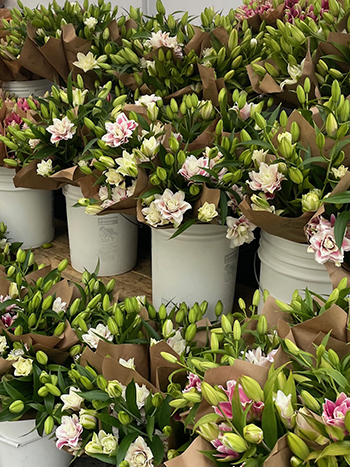
We now buy supplies in 6-12 month quantities, like the kraft sleeves we use for most of our flowers.
While bulk ordering can be limited by cash flow, storage space, and perishability of supplies, I’m trying to do it as often as feasible. It’s taken off a big mental load of remembering to order supplies and improved efficiency as we have the supplies we need. As a bonus, many of our suppliers offer steep discounts by ordering in larger quantities.
7. Put drip lines on lily and tulip crates
We grow almost all of our lilies and tulips in bulb crates filled with soil (like mini raised beds). For many years we hand watered the crates on a daily basis, but last year we started using drip lines on our lilies. It worked so well we tried drip on the tulips this year and were thrilled with the results.
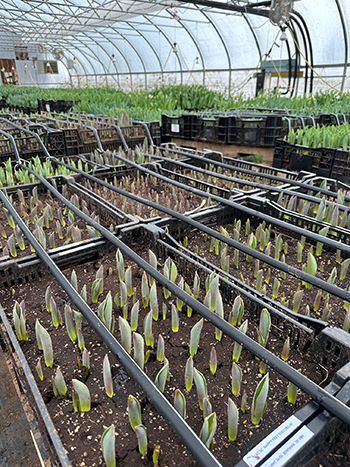
Adding drip lines to lily and tulip crates, instead of hand watering, has saved precious labor hours and improved plant health.
We run 3 lines across the crates and use zip ties or baling twine every five crates or so to loosely attach them. Once the plants are actively growing, they hold the lines in place. Unlike hand watering, we find we are able to water much more deeply and evenly with the drip lines. We also find that the foliage stays completely dry, which decreases incidence of disease. Overall our tulips and lilies watered by drip lines are significantly healthier with less loss than in hand-watered crops.
I was worried that the drip lines might cause overwatering in young plants, as mature lilies and tulips require much more water than freshly planted bulbs. To prevent this, we place our crates onto pallets so there is some air beneath the crates. Excess water simply drains off.
I was also concerned that it may be difficult to swap crates out with fresh successions. However we’ve found that once a crate has been fully harvested, it’s easy to pull it out from under the drip lines and slide a fresh crate in.
We previously would spend 4-5 labor hours a week handwatering these crops. Using drip lines not only has improved crop quality, but it’s saved thousands of dollars in labor.
8. Bought in more plugs
We’ve long relied on a mixture of starting seeds ourselves and buying in plugs. Typically we buy in plugs for anything we have trouble germinating (for us, delphinium and poppies) as well as plants that take a long time to grow (e.g., eucalyptus and lisianthus). Over the last year, as the farm has grown faster than we can keep up with staffing, we’ve embraced buying in more plugs, especially for the fall season.
Typically for fall planting, we’re starting seeds in September when it’s brutally hot. Trays need to be watered daily and often twice a day. Meanwhile, it’s one of the busiest seasons on our farm as thousands of dahlias are in peak bloom.
This year we bought in dozens of trays of plugs instead of starting our own seeds. We even purchased plugs for varieties that are easy to start ourselves (like yarrow and feverfew), or plants that can be readily direct sown (e.g., nigella and larkspur). It was an incredible relief to have boxes of perfect plugs arrive exactly when we needed them. Plants also seemed to take off quicker and be healthier than our own farm-grown plugs, which suffered through our summertime neglect.
Although purchasing plugs is slightly less profitable than starting our own plants, we’re saving a lot on labor and planting out many more plugs than we’d be able to grow ourselves.
9. Buried our irrigation lines
I know this one will seem like a no-brainer to many, but we finally got around to burying our irrigation lines this year and can’t believe we didn’t do it sooner. Until now, our whole farm was irrigated from a single hydrant in our barn. Because we grow year-round, winter irrigation was a nightmare. On cold days we unrolled hundreds of feet of hose every morning to water plants, then re-rolled them and brought them inside every night so they wouldn’t freeze. In the summertime, we’d need to move irrigation lines constantly to avoid running them over with mowers.
I think we delayed so long because we thought burying lines would be complicated and expensive. But it turned out to be pretty quick and easy. We ordered some parts from a local plumbing supplier and rented a trencher from Home Depot for around $300. With the right tools, the whole project only took around 3 days.
We now have hydrants in most of our greenhouses and high tunnels, making year-round irrigation easy. We’re saving lots of labor hours in hauling around hoses, and our staff is thrilled to have water when they need it, where they need it. My only regret is that we didn’t do this years ago.
10. Took a real vacation
Farming year-round means we don’t get many opportunities to rest and relax. Stress and burnout are major threats to our business (and our family). We’ve taken a few vacations, the longest being 4-5 nights away, and it never felt like enough time to truly unplug.
This year I set a big goal for us, to take a ten-day vacation away from the farm–and, we managed to do it! Summer’s our slow season, and we looked at sales records to identify what our slowest weeks were. The weeks around the 4th of July have historically been some of our worst weeks, just because so many customers are travelling. We decided that would be the perfect time for a vacation.
Leaving the farm in the middle of July certainly wasn’t easy, but with plenty of planning and setting realistic expectations, everything was fine. Other than some weeds taking over, everything stayed alive, plantings happened, and flowers were harvested. Our staff even did a whole weekend of farmers markets (from harvesting and bunching to transporting via truck and marketing) without us.
I actually think leaving the farm enabled our crew to grow in their roles and take on more accountability. In the weeks after our vacation, I’ve noticed they’ve retained a lot of the tasks they took on when we were away, and as a result the farm is running more smoothly than ever.
Rebecca Kutzer-Rice owns Moonshot Farm, a specialty cut flower farm in East Windsor, NJ. She grows flowers year-round including in a geothermal greenhouse, for retail markets in and around NYC.
Copyright Growing For Market Magazine.
All rights reserved. No portion of this article may be copied
in any manner for use other than by the subscriber without
permission from the publisher.