











Blue flower magic
If you have a cut flower operation, delphinium and larkspur offer that rare and hard to find blue flower. Besides cynoglossum (forget-me-not), bachelor button, and statice, I can’t really think of any other long-lasting, highly productive, and easy-ish to grow blue annuals. Blue flowers are magic when it comes to selling market bouquets.
Whenever I put blue in my bouquets, they sell. In fact, I’ve found that bouquets with blue are always the first to sell out. It doesn’t matter if it’s blue and purple, blue and pink, blue and yellow, blue and white — bouquets with blue sell themselves.
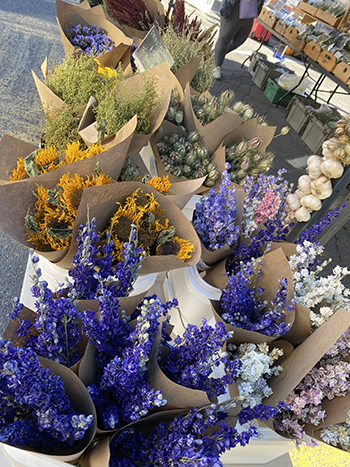
Dried blue larkspur is a best-seller at market.
There’s something so soothing about a blue flower. I think folks are attracted to blue flowers because, number one, they are rare, and, number two, because they imbue a sense of calm serenity. Blue flowers work wonders in rainbow bouquets, which is another sure-fire bouquet recipe for great sales at market.
Delphinium elatum, cultorum, or belladonna are perennials that can be grown like an annual in the ranunculus family. Larkspur is an annual type of delphinium called Delphinium consolida. In the trade, we refer to the perennials as “delphinium” and the annuals as “larkspur.” It’s helpful to learn the latin names of flowers so that you can order seed from wholesale catalogues such as GeoSeed. Plus, it helps boost your confidence when talking to other farmers or customers.
Delphinium and larkspur come in many other soft pastels besides blue. They are one of the most whimsical and cottage core flowers you can grow (i.e., trendy flowers with a high sales potential). I will share my must-grow varieties, plus a straightforward “how-to” from seed to harvest to sale.
I must note that larkspur and delphinium are poisonous, especially the seed. We will not be tempted to use their petals as decorations for cakes. And, we will warn our customers who have curious indoor cats to avoid larkspur and delphinium.
Varieties
Must-have larkspur (Delphinium consolida) varieties for your cut flower operation include the QIS series — dark blue, white, purple and dark pink are great colors from this series. I also love the Smokey Eyes variety, which is a dusty blue almost gray that is incredibly romantic and a designer’s dream. You could also go with a basic mixed variety that will have a blend of white, pinks, and blues.
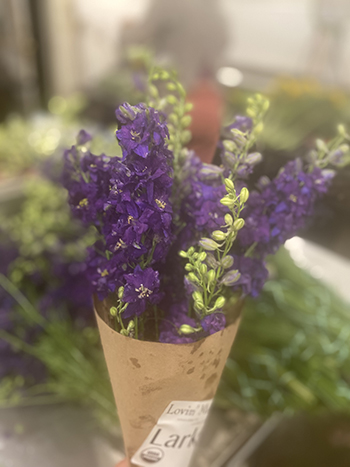
Larkspur bundled as a straight bunch.
For delphiniums, make sure to get varieties that flower their first year (FYF). The Guardian series (Delphinium cultorum) is hands down the best. The seed is a bit expensive, but worth every penny. The Guardian Blue is the most delicious Atlantic blue color, with an iridescent purple hue and a contrasting white “bee” (the white or black center petals are called a “bee”). I also love the Guardian Lavender, which is more of a baby blue with lavender iridescence.
The Magic Fountains series (also Delphinium cultorum) is another great delphinium variety. I love them because they flower their first year, come in an amazing selection of colors and shades, and they are the perfect height for bouquets and straight bunches. Some delphiniums can get out-of-control tall, which is fun for a display garden and less useful for a cut flower operation.
I grow every single Magic Fountain variety, and my favorites are Cherry Blossom, Dark Blue (both the white and black bees are stunning), and Light Blue (both black and white bees). I’m also partial to the White Black Bee, which is a very stylish white delphinium with a black bee.
Delphinium belladonna is a smaller, daintier type of perennial delphinium which is highly productive and comes in blue shades. Belladonna is essential for bouquets. “Cliveden Beauty” is a pretty pale blue with a white center, while “Maxima” is my favorite dark electric blue.
Germination
The old adage is to store your delphinium seeds in the freezer to simulate the cold of winter. Delphinium and larkspur require cold stratification, or two weeks in the refrigerator or freezer, before they will germinate. For years I followed this rule, and kept my seed in the freezer for a few weeks before planting.
One year, I forgot to put them in the freezer and I was already getting a late start in seeding my delphinium and larkspur. I was exasperated with all the needy flowers I was growing, and decided to just try seeding them without the cold stratification. The seed had been stored in our pack shed, which holds at about 45°F throughout the winter, so I hoped this would be enough.
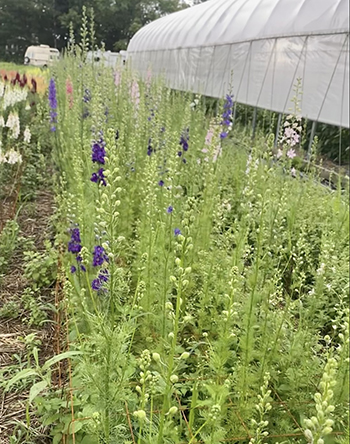
Larkspur with cages for support.
I also messed up that year by accidentally putting the freshly seeded and watered trays into our incubation chamber. Our incubation chamber is nothing fancy. We just put a small space heater with an Inkbird thermostat in one of our insulated walk in cooler rooms and set the temp to 68°F. Our walk in coolers are built into equipment trailers, and we have ended up with several rooms for the different crops we grow. These rooms really come in handy during the winter months when we can stack their use as an incubation chamber.
The delphinium and larkspur must have accidentally gotten moved into the incubation room with a load of other freshly seeded trays. Low and behold, I got incredible germination from both larkspur and delphinium in the incubation chamber (set at 68°F).
I seed my larkspur (by hand) into 4 inch paper pot trays. We drop two seeds per cell and cover with a light dusting of Pro-Mix. That way, even if I get spotty germination, I still get abundant production. We seed our delphinium (by hand) into 128 Winstrip trays. Be patient, as they can take up to two weeks to germinate. Luckily, they do not need light to germinate.
When we farmed in California, we direct seeded our larkspur in late winter. In Upstate New York, that is not an option since the ground tends to be frozen several feet deep until April, so we have to get a jump start using transplants. The larkspur does really well using the paperpot system. And, the delphinium does really well with direct transplanting. We space our plants 6 inches apart and get several years of blooms from one planting.
I highly recommend using fresh seed every year. It’s worth it. I’ve had spotty germination when I used last year’s leftover seeds. Make sure to give yourself plenty of time before your field planting date to get these slow growing flowers started in time.
I start my delphiniums the last week of February. They take almost two weeks to germinate, then they need about 12 weeks to grow up enough before they are ready for the field. We transplant them out late April or early May.
Larkspur grow a bit faster, so I start them the first or second week of March. They germinate in about a week and take 10 weeks of growing on before they are ready for transplanting. Adjust your planting dates for warmer climates.
Planting and trellising
The paper pot transplanter makes quick work of the larkspur. The 4-inch paperchain plants 88 row feet. We squeeze four rows of larkspur per bed with rows spaced about 8 inches apart. It takes about 4½ (of the 4-inch paperpot) trays to fill an entire bed. I seed nine trays in total to plant two beds of larkspur.
We do an entire 100-foot row of the blue varieties, and another 100-foot row of mixed colors. I make sure to transplant them as early as possible, just as the first set of true leaves are appearing. Larkspur sends down a long tap root, so you want to make sure you transplant before the starts get rootbound in their paperpot cells.
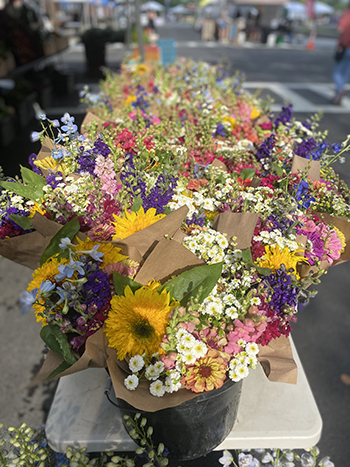
Summer market bouquets sell like hotcakes when blue flowers are included.
Larkspur are slow growing, so weed control is crucial during the first few weeks after transplanting. We use the wire weeders once a week to get weeds at the thread stage. The wire weeders are the best I’ve found for working in between tightly spaced paperpot rows. The wire is gentle enough to rub right up against the paper chain strips without disturbing the planting.
The key is timing — the wire weeders are lightweight and meant for getting the weeds at the thread stage. We also spend one day hand pulling any weeds that got away from the wire weeders, right before we put the cages on for trellising. Once the cages are on, it’s impossible to cultivate, so it’s crucial that the beds are weed free before caging. The other reason we plant the larkspur at such a close spacing is to outcompete weeds while bringing in high yields per square foot.
We plant the delphiniums into the four-hole, pre-burnt weed cloth from Farmers Friend, or into a deep straw mulch. We pack them in, using a 6-inch or 8-inch spacing between plants. Because they are slow growing, weed control is crucial in the first few weeks after transplanting.
Delphiniums and larkspur get quite tall, so you will definitely want to trellis them. We use metal cages (using concrete mesh panels) to trellis all of our flowers. I wrote about our metal cages in detail in my Snapdragons article in the April 2025 issue of GFM. The cages, though expensive to build up front, are a game changer for trellising flowers. They offer solid support with low labor to install.
It’s important to remember that all of my growing notes are from zone 5 region. We have long frigid winters and cool summers, and the delphinium family thrives in a cooler climate. That being said, I worked at a flower farm in hot Northern California that grew epic, perennial delphiniums.
If you get your timing right, you shouldn’t have an issue growing delphiniums in hotter climates. Give them plenty of water. If you can find a slightly shaded location, like the north side of a greenhouse, this will help keep them cooler and extend their lifespan. Where winters are more mild, you can experiment with planting larkspur in the late fall or winter.
Harvest
Delphiniums need to be harvested at a minimum of twice a week. Perhaps three times per week if you have time. We harvest when at least half of the florets have opened. It’s worth investing in some tall buckets for your delphiniums. We use square 4-gallon buckets.
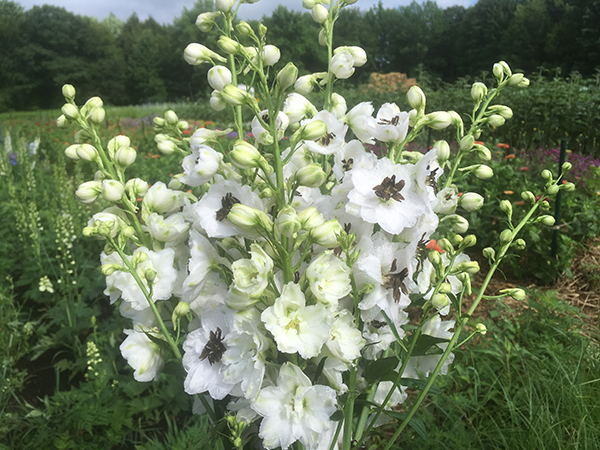
Magic Fountains “White Black Bee.”
When harvesting any flowers on our farm, we load up the van or ATV with clean buckets, fill buckets about half full with cold well water, and park as close to the row of flowers we are harvesting as possible. We walk down the rows picking massive handfuls until we can’t hold any more, then, run the flowers back to the buckets, so we don’t have to lug buckets around.
It’s important to harvest delphiniums in the cool of the morning to prevent drooping. We rush them directly to the walk in cooler where they will store for at least two weeks. We make sure to pack the buckets efficiently, filling them as full as possible without squishing and breaking any stems. We also make sure the stems are standing straight up and down, so the delphiniums keep their elegant length without bending during storage in the cooler.
Larkspur comes on fast and furious. Harvest is every other day. We harvest differently for drying versus fresh market sales. Blue larkspur is our best selling dried flower, and we harvest most of the blue larkspur we grow for drying.
When harvesting for drying, we want all but the top three or four florets open. If you wait till they are fully blown open, they will shed a lot or all of their petals during drying. If you pick them too early, with only two or three florets open, there won’t be much color in the finished dried product.
When we are picking for fresh market sales, we harvest when half of the florets are open. The main stalk of the larkspur plant will be the tallest, nicest stem from the plant. We often use this prime stem for fresh market sales. Then the side shoots come in strong, and we harvest them for drying or fresh market sales if needed.
Marketing
As I said, blue flowers sell. They sell as straight bunches, single stems, and in bouquets. I generally save my best stems of delphiniums to sell as single stems, and I get $4 per stem. These tall, blue and lavender fairy flowers are real show stoppers, and customers love spending time choosing their favorite stems to add to straight bunches or bouquets from our stands.
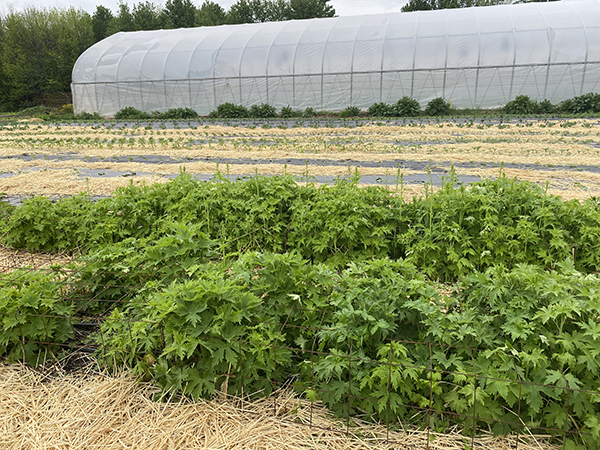
Perennial delphiniums year two with support cages.
I’m not a huge fan of selling flowers by the stem, but I make exceptions for delphiniums, peonies, and sunflowers. These are the only flowers we ever sell by the stem at our busy market stands. I’ve found that selling flowers this way often results in a lot of losses as customers damage the stems while hemming and hawing over which stem to choose. I’ve also found that I can sell more flowers once they are wrapped in brown paper with a label on them.
The exception to this rule is with showstopper single stems like delphiniums. Especially if you have a glut of tall stems to sell and you’ve maxed out your bouquets, single stems of delphiniums offer an easy way to move a lot stems while giving customers a special way to interact with the flowers at your stand.
I still use a lot of delphiniums and larkspur in my bouquets. As I’m making bouquets, I will set aside the taller stems for single stem sales and use the shorter ones for bouquets. My most popular bouquet recipe is a rainbow: at least one of each color including red, orange, yellow, green, blue and purple. This bouquet combo is totally uplifting, joyous, and irresistible.
I also sell a lot of straight bunches of larkspur. I put about 10 stems in each bunch, and we sell our straight bunches for $15 each, or three for $40. Any unsold bunches get hung to dry. My thinking is, if I can sell it now, while it’s fresh, great. If it doesn’t sell while fresh, we just unwrap and then hang to dry.
Drying
I’m a huge fan of drying any and all flowers that come home from market as a way to minimize loss and maximize year round sales. Larkspur is one of the few flowers we grow specifically for drying, since they are our most popular dried flower.
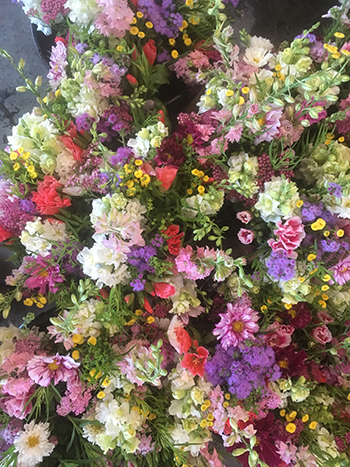
Pink larkspur bouquets. All photos courtesy of the author.
Any unsold bouquets from our weekend markets get deconstructed, then re-bundled for drying as straight bunches. We put about 15 stems in a bunch, trim down to fit on our drying lines, then hang using an opened paperclip hook stuck into the rubber band. In our humid summer climate, we use a dehumidifier in our dry room to ensure the flowers crisp up and don’t mold while hanging.
In the winter, we sell our dried bunches the same as we do our fresh — $15 per bunch or three for $40. I love using larkspur in dried flower wreaths, evergreen wreaths, and dried bouquets. We sell every single stem of dried larkspur. I can’t seem to grow enough.
You can also dry delphiniums. They are so tall they can be awkward to fit into dried arrangements or wreathes. I will cut them down into 6-inch pieces for wreaths, or sell them as straight bunches.
Corinne Hansch is an organic farmer, writer, mentor, activist, chef and entrepreneur. She farms with her husband and a hard working crew at Lovin’ Mama Farm in Amsterdam, NY, while homeschooling her three kids. She grows over 400 varieties of veg and cut flowers using regenerative practices such as no-till, perennial plantings, and living wages for employees, producing over 50,000 pounds of food per year and hundreds of thousands of stems of cut flowers on three acres. They direct market at five regional markets per week and are building a line of value added products for online sales.
Copyright Growing For Market Magazine.
All rights reserved. No portion of this article may be copied
in any manner for use other than by the subscriber without
permission from the publisher.