








Two sometimes misunderstood farm essentials
There are few farm tools as iconic as the pitchfork and yet when most people come to my farm they don’t actually know how to use one, or even that there is a difference between a pitchfork and a digging fork. It’s small wonder as even just doing a quick Google search before writing this article I came up with a popular home repair website reviewing “5 pitchforks” which basically lumped digging forks into that category and proceeded to review digging forks, which they considered more useful for home gardeners than actual pitchforks. A lesson in the reliability of some of the reviews out there on the internet?
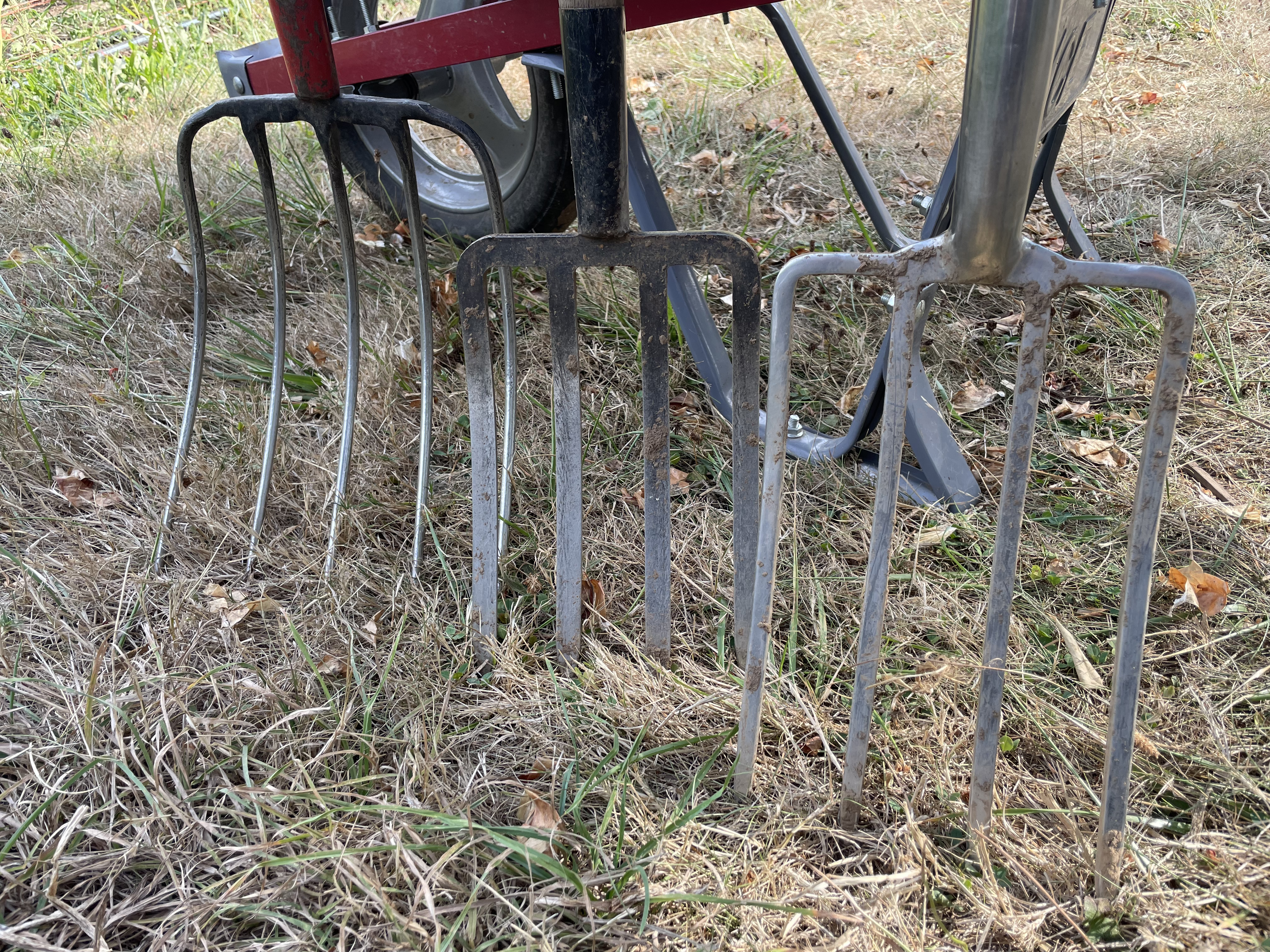
A five tine pitchfork with narrow deeply curved tines, a harvest fork with four broad, flat tines, and a digging fork with four stout, square tines.
Pitchforks are designed and made for picking up relatively bulky materials and for moving them, often by “pitching” or throwing. Digging forks are designed and made for loosening soil when it is compacted, and one variant of the digging fork is a harvest fork which is designed specifically for loosening the soil that roots or tubers are in and bringing them to the surface.
On my farm we use a pitchfork for a variety of tasks: picking up large weeds, leaves and other discarded plant material from the soil surface, building and spreading compost piles, and spreading wood chips. We also use digging forks: often to harvest roots and tubers like carrots and potatoes, and occasionally to loosen soil, especially if it’s infested with quack grass rhizomes (in which case we’re essentially harvesting the grass roots).
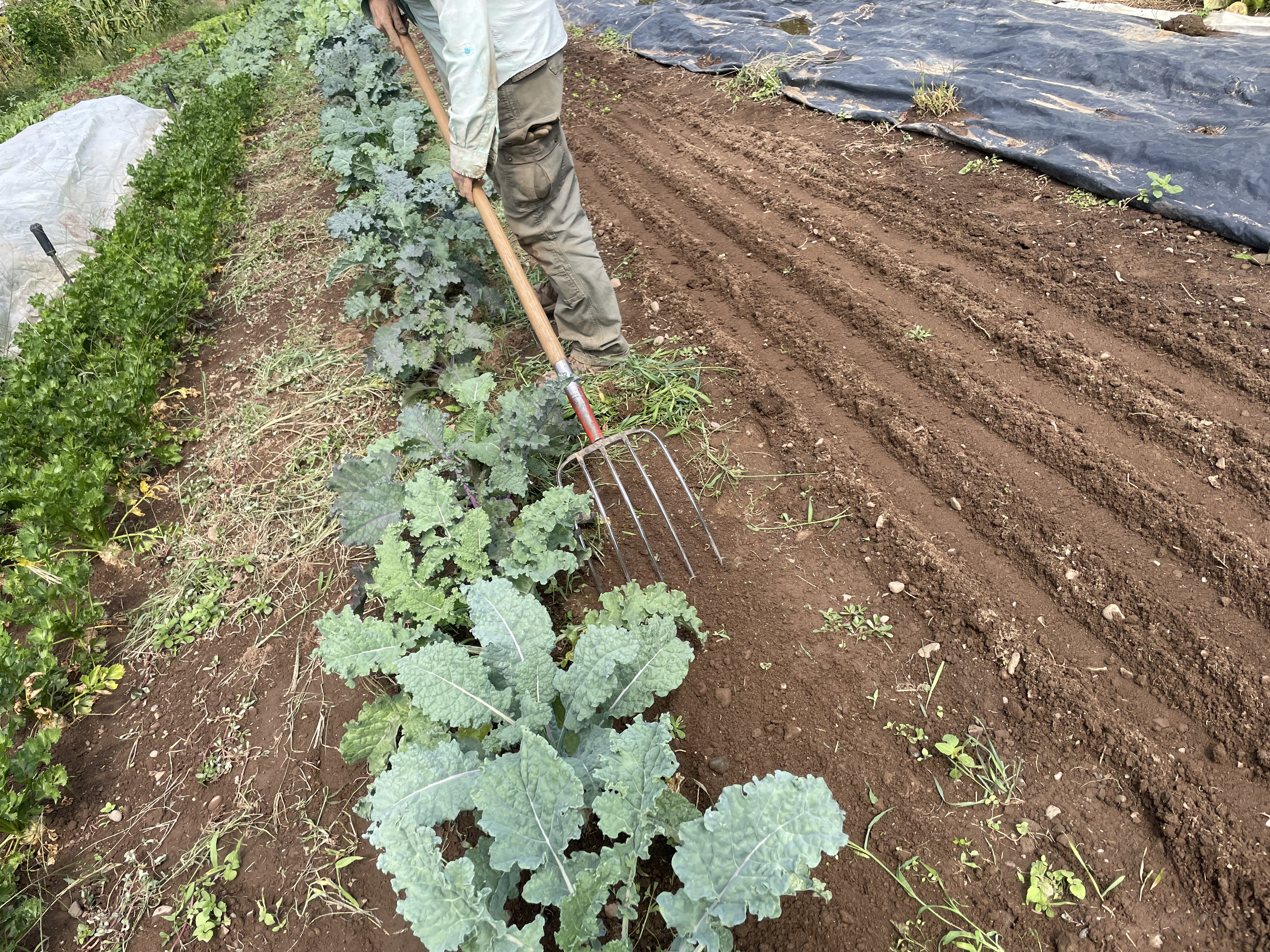
On our farm we use a pitchfork a lot for raking up plant material from pathways and loading it into a wheelbarrow.
Pitchforks have relatively light, thin tines, often longer and with a bit more curve than a digging fork tine. The lighter, thinner tines slide more easily into bulky materials and make it easier to lift and even throw the material. Depending on the structure of the material you’re trying to move you can get a fork with as few as 2 and as many as 12 or more tines. The fork we use on my farm is a 5 tine fork with a long handle, and in my home garden I use one called a “compost fork” which has 4 tines. The 5 tine fork has a long handle which makes it useful for raking up loose materials on bed tops and in pathways, loading them into a wheelbarrow and then tossing them onto the compost pile.
My compost fork has a shorter, T-handle which is more convenient in smaller spaces and more ergonomic for lifting slightly heavier bulky materials, like compost. Because the tines on both of these forks are thin and light weight, they not only make inserting it into the material easier, they also make lifting the fork much easier than lifting a digging fork. They are not really strong enough for any kind of serious soil loosening, and even if they were they’re not broad enough to fracture most soil effectively.
There is definitely a learned technique for picking up and pitching materials with a pitchfork and the curve to the tines helps. With loose weeds I’m typically using the fork almost like broom to rake them into a pile, and I find that rolling the pile as I make it so that it binds itself almost into a ball helps keep it together when I flip the tines over and insert them into the pile for lifting. I’m not lifting from under the pile, rather from closer to the middle of the pile. The curve of the tines does help if I need to get under the pile though, allowing the tines to slide along the ground while the handle is up off the ground.
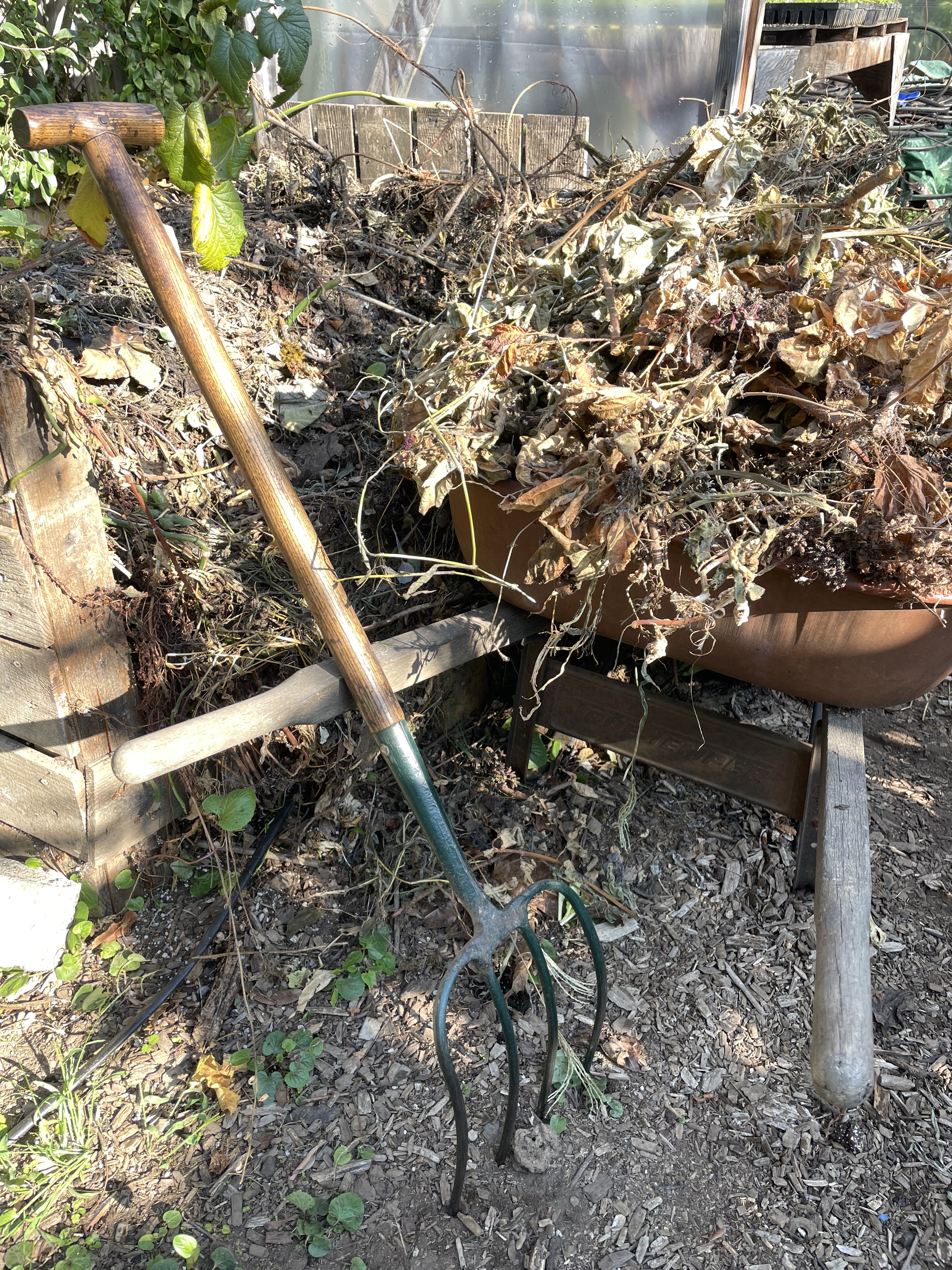
A T handled compost fork with four tines.
Digging forks on the other hand have relatively thicker, heavier tines, almost always four of them, although broadforks, which are a type of very large digging fork, often have more tines and two handles. The classic garden fork for loosening soil has gently tapering tines with a square cross-section and a slight curve. Digging forks designed specifically for harvesting typically have flatter, wider tines which aren’t quite as sturdy but move a bit more soil and are less likely to leave small roots behind, cushioning the roots you’re harvesting a tad more.
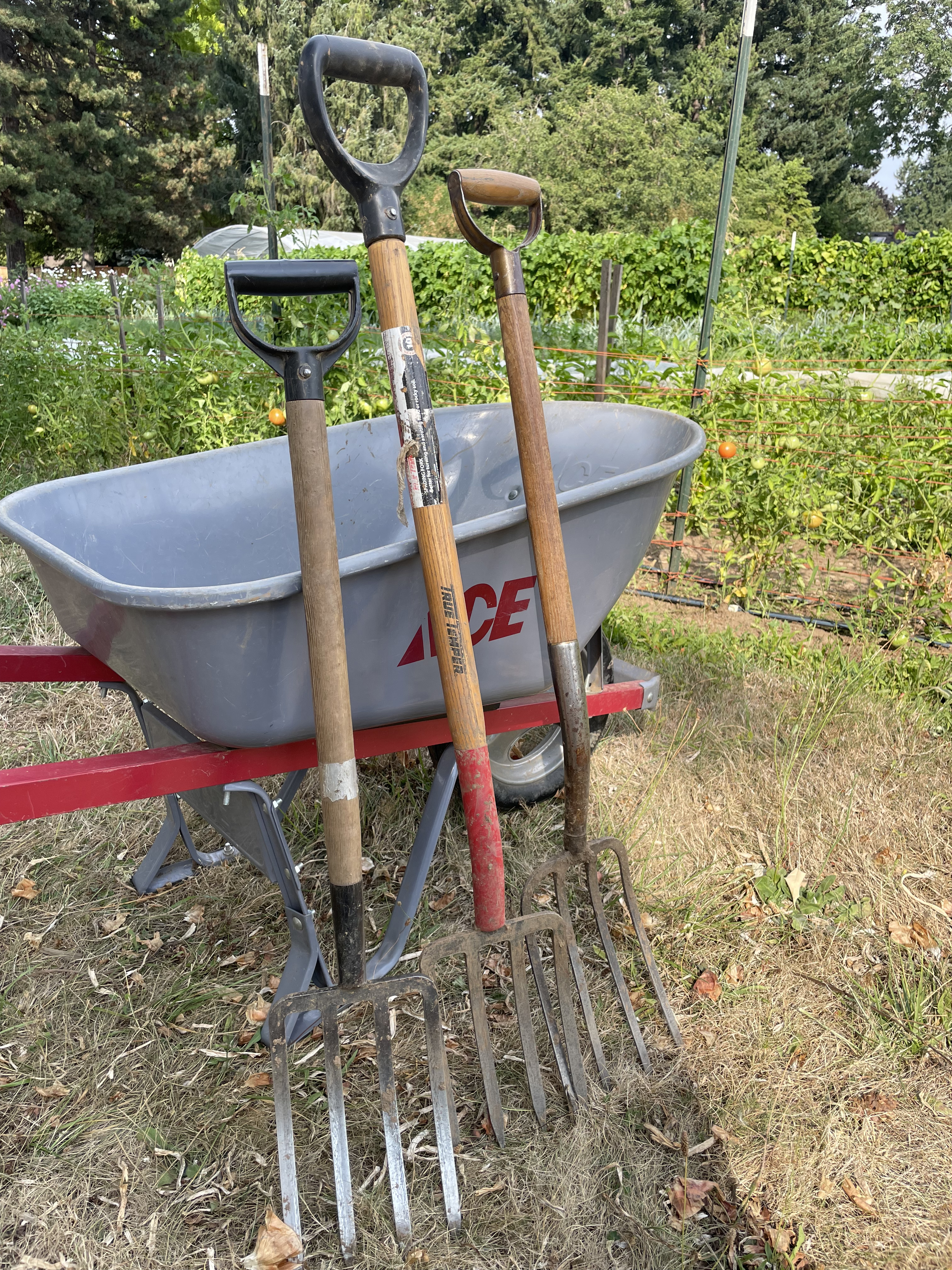
Three different harvest forks, all with similar tines but different length handles. Ideally the user doesn’t have to bend over to reach the handle when using the fork, but it’s also nice if the handle isn’t too tall, allowing the user to push down on the D handle to help them to balance while stepping onto the tines and transferring their body weight to them.
A lot of the less expensive forks you find in hardware stores and garden centers have this flatter tine profile because they’re made from stamped steel instead of forged steel, although I also have one harvest fork of high-quality hand forged steel with that flatter tine profile. I’ve been surprised to find that some of the relatively cheaper, stamped steel forks we have on the farm have held up as well as the more expensive forged ones. I suspect this is partly because users are more gentle with them as you can feel them starting to fail if you put even just a little too much pressure on them whereas the higher quality ones tend to take a lot more abuse because people think they’re indestructible.
All of our digging forks have short D handles, which is typical. You can also get long handled digging forks which do give a bit more leverage for prying, but are a little more awkward to move around and to insert into the soil.
Decades ago I took a workshop from John Jeavons on double digging and the ergonomic, low energy techniques for inserting the fork into soil and loosening with it have stuck with me ever since. Two of the principles that I’ll mention here are when you’re pushing the fork into the soil you’re doing it almost entirely by transferring your body weight to the fork by stepping on it and gently wiggling it into the soil. This requires finesse and balance but takes relatively little energy compared to jumping on it. When pulling the fork out of the soil it’s almost more just dragging it to the next spot, working backwards in the bed. In this way you’re not actually lifting the weight of the fork which saves time and energy.
I find digging forks to be very common tools in market gardens but I don’t see as many pitchforks. On our farm we need both, and the one that gets the most use is actually the pitchfork.
Josh Volk farms in Portland, Oregon, and does consulting and education under the name Slow Hand Farm. He is the author of the books Compact Farms: 15 Proven Plans for Market Farms on 5 Acres or Less, and Build Your Own Farm Tools, Equipment & Systems for the Small-Scale Farm & Market Garden, both available from Growing for Market. He can be found at SlowHandFarm.com.
Copyright Growing For Market Magazine.
All rights reserved. No portion of this article may be copied
in any manner for use other than by the subscriber without
permission from the publisher.