











Office work is critical but rarely a priority
For the first few years at Moonshot Farm in East Windsor, New Jersey, our hiring efforts were focused on physical labor, which translated to more revenue. Tasks like planting and harvesting were a priority for our growing team as they meant more flowers to sell. Administrative tasks — from crop planning and supply ordering to sales tax and payroll — all fell to me.

Our office manager helps make sure we never run out of critical supplies like the rubber bands and Kraft sleeves we need to get flowers to market.
They’re easier to complete than huge field projects and unlike most farm tasks, don’t require daylight hours. I’d often complete admin tasks at night or during the day while simultaneously on childcare duty. Speaking with farmer friends, it sounds like this is the case for many of us. Office work is critical to running our business but rarely the priority. It’s also causing a lot of stress and extra hours. Rather than relaxing at night, many of us are sending out invoices and marketing emails.
As our farm has grown, so has the administrative side along with the consequences of not keeping up with office work. This can mean a small late fee from a supplier or an annoyed customer who didn’t get a prompt email response. But when things got particularly disorganized last year, we started facing some enormous fees and ramifications for falling behind on administrative work. I filed our sales tax reports late every quarter for eight straight quarters, resulting in thousands of dollars of fines. It became clear that we seriously needed help in the office.
Hiring an office manager created incredible changes for us this year. It has freed me up to do more meaningful work and improved our bottom line. My only regret is not hiring one sooner.
Defining the scope of work
For most farms the list of administrative burdens is complex and daunting. At least initially, it seemed unlikely that one part-time person would be able to take it all on. I started out by making a list of all of the different office tasks I do and highlighting those that would be both easiest and most impactful to delegate. I’ll also mention that our farm already has an accountant who handles our annual tax filings. We also have a payroll service that manages paying employees and filing payroll taxes.
Here are some of the key administrative tasks with the ones that felt easiest to delegate in bold.
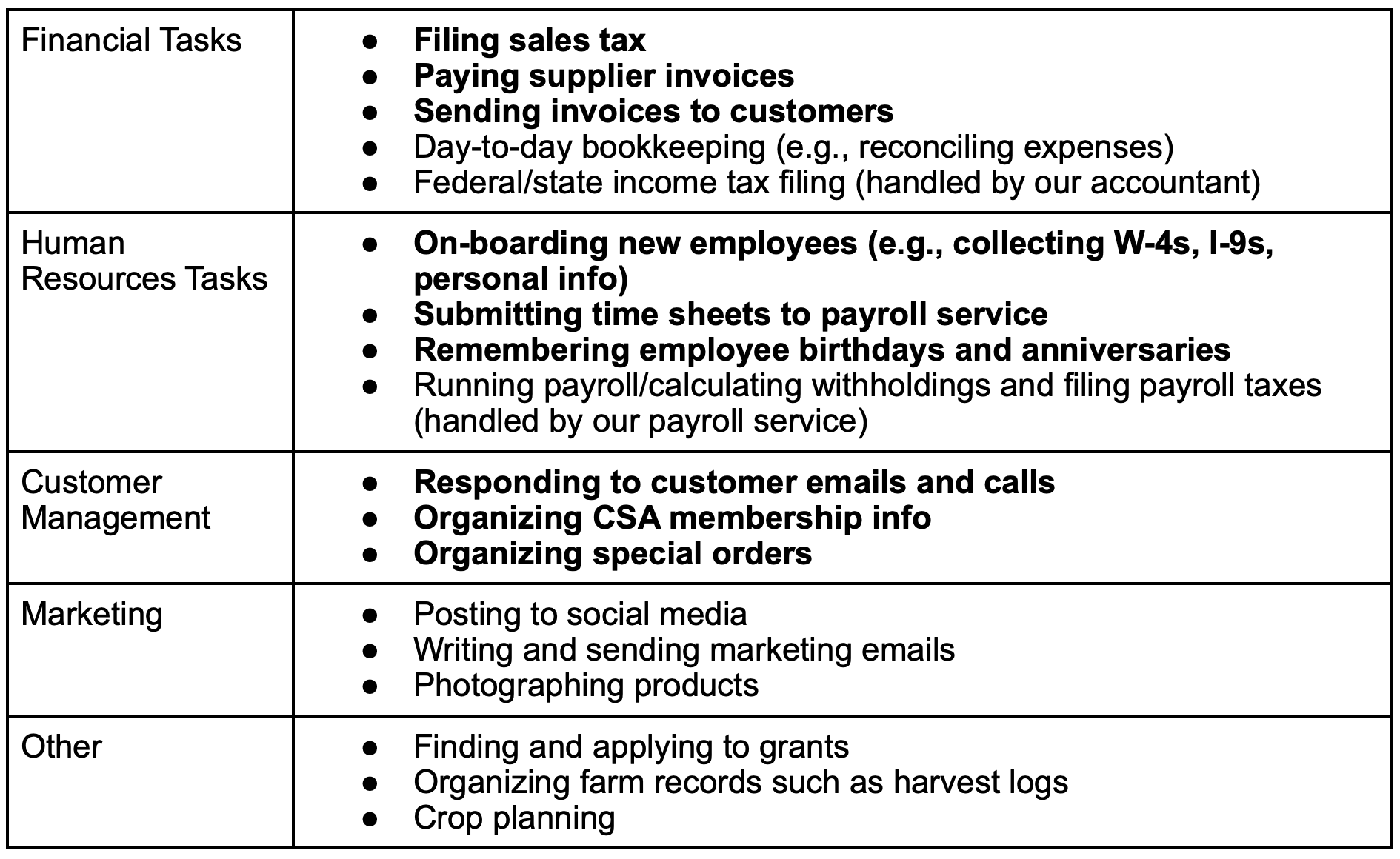
We decided to focus initially on delegating tasks that would have the most financial impact, i.e., areas where we were getting fines or losing money. We also wanted to hire someone to help with the areas we were struggling with or disliked the most — a major one being responding to customer emails. As the farm work piled up, we often responded to emails weeks after they were received, leading to lost sales and disgruntled customers. Getting help with that aspect of my business was a key concern.
I particularly enjoy marketing tasks like writing newsletters and being the voice of my business, but for some farmers that might be a top priority to delegate. I’m also happy to do a lot of the day-to-day bookkeeping work, like recording sales and reconciling expenses, but I know many farmers struggling with that. For them, maybe hiring a bookkeeper makes more sense than an office manager.
Recruiting for the role
Once I defined the main tasks for which I needed help, I created a job description for the Office Manager role. I figured I needed around eight to 12 hours of help a week and that there was no need for the person to be located near my farm or even in New Jersey. I didn’t need someone with extensive bookkeeping experience, just someone relatively proficient in technology like spreadsheets and email and who was organized and good at communicating.
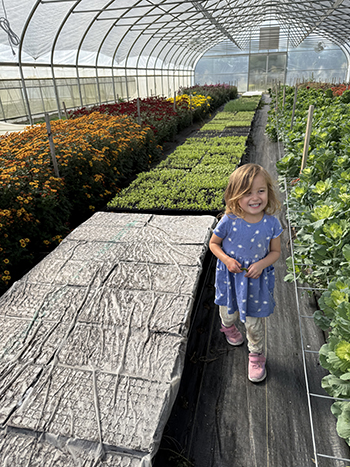
In our early years, I spent a lot of time at night doing office tasks—instead of spending quality time with my kids.
We didn’t have someone already on staff who was a good fit for this role, but I expect many farms do. Maybe you could start by adding three to five hours of office work to an existing staff member’s schedule.
To find the right person, I was wary of posting the job to a general hiring site like Indeed because the role requirements were so broad. A fully remote role with flexible hours was likely to result in hundreds or even thousands of candidates to sort through. I also thought it would be great if the person had some familiarity with farming or cut flowers to lessen the learning curve in our niche industry.
I ended up sharing the position on a couple of farming-related Facebook groups including the Association of Specialty Cut Flower Growers’ page. It turns out that many farmers have backgrounds in bookkeeping, office management, and related tasks. From the targeted post, we got nearly a hundred applicants and dozens of them were highly qualified. After a few rounds of interviews, I ended up hiring Sarah who had previously owned her own flower farm and deeply understood my needs. She was familiar with my business model, many of my suppliers, and even had previously used our bookkeeping software Xero.
While it wasn’t completely necessary to hire someone with a flower farming background, it certainly made for an easier training process. From Day 1, I was able to say things like “Call Ball and pay the ranunculus bill,” and she knew what I meant.
Delegating office tasks
Chatting with farmer friends, many of them feel daunted by the idea of hiring office help as their current systems are a mess and they have no idea how to get started. With thousands of unread emails, piles of overdue invoices, and weird, idiosyncratic organization methods, that’s how I felt, too.
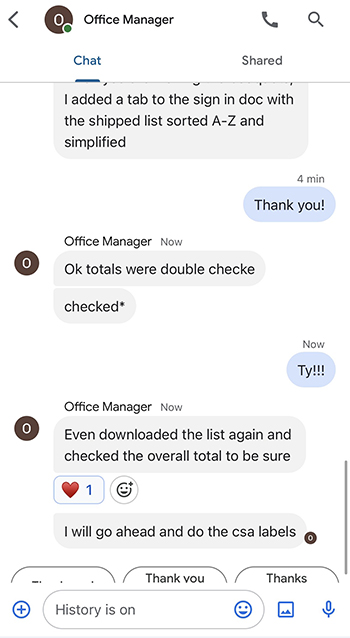
Sarah and I communicate mostly via Google Chat, enabling us to quickly send thoughts and ideas without clogging up our inbox or using texts.
To get started, Sarah and I met once or twice a week to have several “brain downloading” meetings. I basically dumped all kinds of ideas and potential tasks for her to start organizing. We then triaged the most critical jobs, like recurring invoices with our biggest suppliers, and got her up to speed on those first.
Bit by bit, Sarah has taken on more responsibilities and removed a significant amount of office work off of my plate. Because she has more dedicated time to troubleshoot, she’s been able to automate a lot of previously time consuming tasks. For example, we used to handwrite and mail a check each month for rent on one of our farm properties. Our office manager was able to set up automatic payments from our bank account. Simple automations like this, created dozens of different times, have streamlined so much of our office work.
Office systems and resiliency
Farmers know how critical efficient systems are to harvest or planting, and office work is no exception. Before having a dedicated office manager, a lot of our administrative work was disorganized and putting the farm at risk. If I were incapacitated, administrative tasks and bills might pile up to a catastrophic extent.
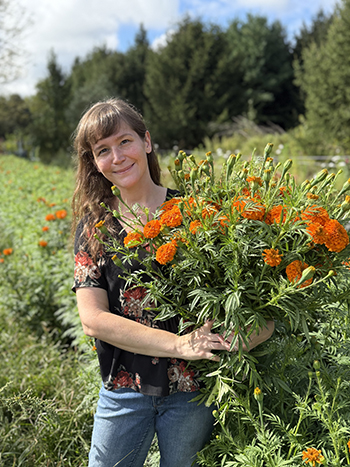
For a long time, our hiring efforts focused on labor for harvest and planting. But having someone in the office has made our operation run so much more smoothly.
Even working very part-time hours, an office manager has added so much resiliency to our operation. Sarah and I both now know how to complete necessary office tasks and keep the farm afloat. She has also spent a lot of time creating Standard Operating Procedures for our common tasks, such as filing that pesky sales tax. This means someone else could quickly jump in to complete this critical work if she or I were unavailable. This has also enabled me to truly unplug during vacations. Where I used to bring my laptop to respond to urgent issues, I now trust Sarah to handle these in my absence.
For day to day work, Sarah and I utilize the Google Chat feature connected to our Gmail account. This appears on our phones similar to text messages, but can be muted when we aren’t working. This system has worked well since we both sometimes work during weird times. I can send Sarah a GChat at 10 p.m. when a random thought pops into my head without the formality of an email and without worrying about bothering her.
Sarah has done a great job organizing our inbox and creating responses to common customer questions. While it used to take us weeks to respond to customers, we’re now able to get back to them within a day. I expect orders and customer satisfaction have increased due to this increase in responsiveness.

While I still spend plenty of time in the office, I’m able to focus on higher level tasks like applying for grants and marketing.
She also has implemented systems for managing our CSA and special orders, ensuring they all get fed into order-tracking spreadsheets. Early in the week, she sends me an email summarizing all of our orders for the week as well as our numbers for CSA bouquets and locations. I used to live in fear of forgetting a wedding order or an anniversary bouquet, but now I have confidence that we’re organized and on top of all of our orders.
We’ve also recently created a new system for ordering supplies after we kept running out of rubber bands during critical moments. A QR code posted in the barn links staff to a Google Sheet where they can quickly select what supplies they’re running low on (everything from rubber bands and paper sleeves to post-harvest solution and compost). The completed form alerts our office manager so that she’s able to quickly order the supplies.
On the back end, we created a cheat sheet listing all the supplies we regularly order, details (like weight of Kraft paper), and where we order from. It’s a relief for me and my team to have the supplies we need always on hand without them relying on me to remember.
Layers of customer support
On the customer side of things, it has been great to have another person handling questions and occasional complaints. Although we receive very few complaints from our farm customers, whenever we do they tend to drag me down. Sarah is now able to filter the negative emails out and respond, often before I even see them. While she can pass along any important messages and feedback themes, I can be a bit shielded from comments that might hurt.
We’ve also worked out a kind of escalation system for customers, as a much larger company might have. Sarah acts as the first point of contact. If there is still an issue, I can swoop in as the owner for a stronger reply. For example, we had a customer pushing back about paying sales tax on an order, even after a detailed explanation. I then stepped in as a “second line” response to provide a firm and final answer.

Paying monthly sales tax for our market sales was a huge pain point that often resulted in huge late fines. Our office manager has paid for herself by avoiding these fees.
As a business where so much of our brand is tied up in us as individuals, it’s great to have someone else to break bad news. This system has worked so well that I joke we should have invented a fake office manager years ago just as a name in an email signature.
Stepping into my new role
No doubt, our office manager paid for herself within the first few months just by saving thousands of dollars in late fees and penalties. Her part-time schedule adds up to less than 5 percent of our total labor budget, but the impact is much larger. And I think the benefits have been broader reaching than just financial.
Hiring an office manager has taken a lot of the more routine administrative work off of my plate and enabled me to focus on more impactful work like marketing and business planning. For the first time ever, I am finally sending out an email newsletter to our customers every week. This has resulted in more engagement and higher sales.
I also have more time to focus on crop planning, enabling us to be more thoughtful and prepared in our crop decisions. Having help in the office has also freed me to spend more time working on grants and grant-related projects. Just this year, we’ve been awarded tens of thousands of dollars in grant funds that we probably wouldn’t have had time to apply for in the past.
Just as I don’t spend much time hand watering plants these days, there are more valuable uses for my limited hours than routine office work. While I don’t necessarily spend less time in front of the computer than I did a year ago, I think my time in the office now is much more impactful. I’ve heard this shift referred to as working on the business versus in the business. Being less bogged down in small details has enabled me to look at our farm from a “30,000 foot view.”
Our office manager also has helped support this shift by helping pull metrics and trends for our business, enabling us to take a hard look at figures like our CSA retention rate or how a particular farmers market is performing compared to past years. Without administrative support, there’s no way I’d be able to regularly pull and analyze this kind of data. Office help has also enabled me to set some boundaries with the farm. I almost never do farm-related work after hours anymore. I actually now take evening time to truly relax.
If you feel like you’re drowning in the office and paying the consequences like I was a year ago, I hope this article helps inspire you to get some help. Even delegating a few hours of office work a week may be a game changer for your farm.
Rebecca Kutzer-Rice owns Moonshot Farm, a specialty cut flower farm in East Windsor, NJ. She grows flowers year-round including in a geothermal greenhouse, for retail markets in and around NYC.
Copyright Growing For Market Magazine.
All rights reserved. No portion of this article may be copied
in any manner for use other than by the subscriber without
permission from the publisher.