










A guy from Iowa talking about corn, what do you know?! Here in Iowa sweet corn is the gateway vegetable to unlock the customer’s pocketbook. And the benchmark for sweet corn success is having it early to market, by July 4th. The main newspaper in the state, the Des Moines Register, even publishes on the front page which farms have corn ready by that date.
Enough growers succeed that it’s not entirely a mystery: conventional chemical seed treatments containing fungicides and insecticides allow seeds planted early to hold in the soil, waiting for the optimal time to germinate. The use of conventional treatments are not allowed in certified organic fields so organic growers face an extra challenge. Let’s explore how folks succeed, and some tips that might also help organic producers get earlier yields wherever they are.
Why early sweet corn matters
Early sweet corn isn’t just a bragging right; it’s a market advantage. Customers pay a premium for those first ears of the season and purchasing declines precipitously after Labor Day. But early harvest means beating cool soils, rot pathogens, pests, unpredictable spring weather, and weeds that wake up faster than corn does.
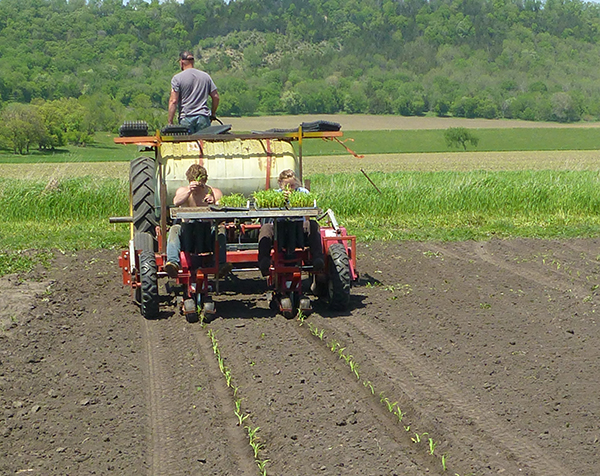
Transplanting sweet corn with an MT5000.
Pick the right seed
Sweet corn varieties aren’t all the same. You’ll want to choose a sweetness and color that aligns with the desires of your customer base. Here in the Midwest, bicolor sweet corn is the default nowadays, but some old timers fondly remember a white sweet corn, “Silver Queen.” A lot of bicolor sweet corn here is marketed as “Peaches and Cream,” even though ‘Peaches and Cream’ is the name of a specific SE cultivar that is rarely planted anymore. I think the name persists because the name is so evocative and sounds delicious! In general, younger customers prefer the sugariness of SH2 supersweets, and older customers lean more towards SE varieties.
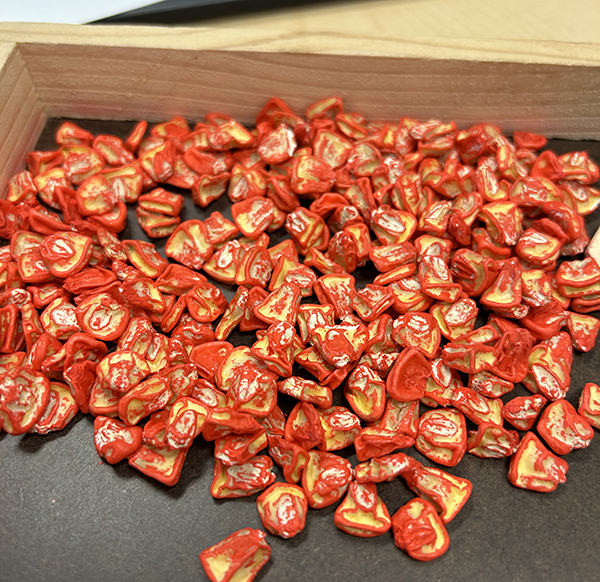
Conventionally Treated, not Flamin’ Hot. All conventionally treated seed is supposed to be dyed an unnatural color to prevent it from being eaten. All photos courtesy of the author except where otherwise noted.
Mind the soil temperature
You’ll often read that most sweet corn types need soil temperatures of at least 50-55°F at planting depth, and Sh2 types prefer closer to 60–65°F. However, growers here in Iowa regularly direct-seed their first plantings in late March or early April when soil temperatures at 4” depth are around 50 degrees, and still a month away from reaching 60 degrees. Moreover, the weather typically takes a turn to the cold and wet within a week after planting, sending soil temps down into the 40s for several days. Traditionally growers have planted a vigorous Se or Syn variety, like ‘Sweetness,’ ‘Latte,’ ‘Temptress,’ or ‘Allure,’ in this slot.
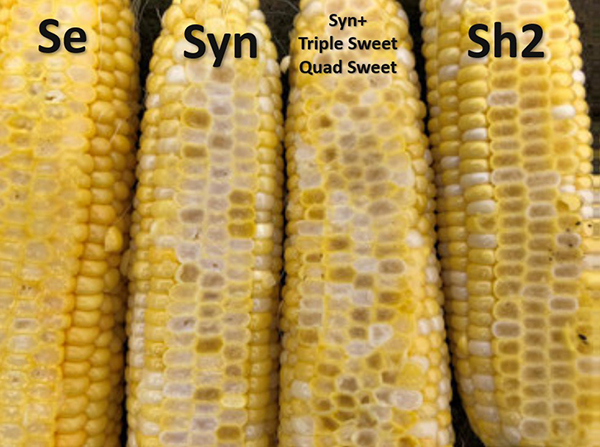
This photo depicts the number and distribution of SH2 kernels on ears of the various types. The darker kernels are SH2. Photo courtesy of Rupp Seeds.
Use a soil thermometer to find the temperature at 2 inches deep to see what your seeds are experiencing. The 4-inch readings available from many publicly managed weather and climate monitoring sites are not as influenced by the warm sun, so your seedbed might be warmer than you think. However, the 4-inch depth is indicative of the thermal buffering capacity that your soil has, and its ability to keep your seedbed warm during a brief spring cold snap. Seeds will experience warmer temperatures during warm, sunny days and also colder temperatures on cold nights. During planting trials, I’ve buried a ~$100 Hobo sensor at 2” to quickly check the soil temperature by connecting my smart phone to the sensor via Bluetooth.
Planting depth and spacing
Like most seeds, sweet corn does well when planted at a depth equal to about 2x it’s longest dimension. That ends up equaling somewhere between 1”-2” deep. Some growers insist on “planting to moisture,” which means planting a little deeper if the surface is dry but deeper soil is moist. Planting too deep can lead to lower germination rates, but planting without moisture has the same result.
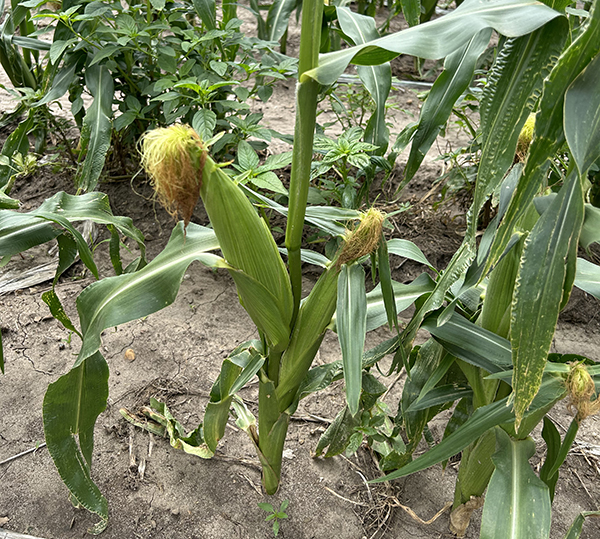
Early sweet corn sets low ears. Sweet corn makes two ears, though only the first is reliably marketable.
A lot of growers direct seed sweet corn with older 4-row corn planters, like the John Deere 7000. Nearly everyone plants their field corn with wider planters now, and the older 4-row units are commonly found on farms out back with retired equipment. They are dependable vacuum seeders that can be quite affordable. They are typically set up with 30” between rows. At this spacing, a population of 20,000 is a rough goal in the main season, and a higher seeding rate of 25,000 is aimed for in the early season, with the understanding that not all seeds will germinate. The goal is for one plant every 7-8”
When transplanting on beds with 6’ centers, we would plant 2 rows and aim for 12-14” between plugs. Our plugs were seeded with 2 seeds each, so that’s equivalent to 6-7” between individuals. This pencils out to being a population of around 25,000 plants per acre.
You gotta keep ‘em separated
Cross-pollination between different sweetness levels can result in corn with the flavor and texture of field corn. For guaranteed success, plant corn from different sweetness levels at least 300 feet from each other and isolate from other corns like popcorn and field corn. One exception to this: SE can cross-pollinate with Syn with no negative consequences. Isolation can also happen by planting different sweetness levels in succession so that pollination occurs at different times.
As mentioned above, many growers in Iowa plant SE or Syn varieties first (for good germination), followed by SH2 varieties in later successions. This works in most years, but early cold followed by hot weather can cause the first and second successions to mature simultaneously and cross-pollinate. Being able to plant SH2 corn into cold soils from the outset would provide needed peace of mind and insurance against crop failure due to cross-pollination. Recent breeding has developed SH2 varieties with improved vigor, allowing growers to experiment with planting SH2 at the beginning.
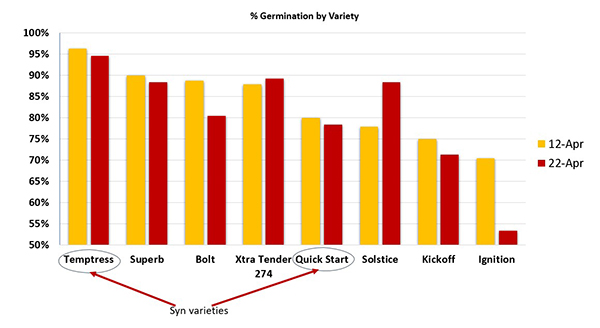
Percent germination by variety.
In my cold soil germination trials here at Iowa State University, three varieties of SH2 had greater than 85% germination when planted on April 12th (conventionally treated seed). Those varieties were Bolt XR, Xtra Tender 274 and Superb. The best germination was seen in the synergistic variety ‘Temptress,’ which had >95% germination in the April 12th planting (conventionally treated seed).
3 ways to early corn: 1. Direct seed on bare ground
Plant conventionally treated seed early, during the first big warm spell. Here in Iowa, we see a 3-4 day stretch in late March or Early April when temperatures rise into the 70s-80s. Farmers begin tillage as soon as it’s dry enough and plant their first sweet corn immediately afterwards. Growers figure that planting early in the warm spell gains seeds extra time in warm soil to begin germinating.

The author, Dan Fillius, with some of Iowa’s finest in the background.
Conventional seed treatments hold the seed through the inevitable cold snap that follows. Conventional seed treatments outperformed organic seed treatments in my cold soil germination trials, with ~70% germination compared to ~45% germination rate (all Kickoff XR, planted on April 12). Organic growers should stick with transplants for a good stand in the first succession. In future trials I plan to home in on when the ideal timing is for organic seed treatments to find success.
2. Planting under or through plastic mulch
Clear plastic warms the soil fastest, but it also wakes up weeds. Black plastic keeps weeds down but doesn’t heat as much. Green may be a happy medium, but all growers I work with in Iowa who use plastic utilize clear mulch. The two options for this system are to direct seed then lay clear plastic over the top; or lay clear plastic beds first, then punch holes and plant seeds through it. In both systems, growers usually use degradable plastic. Those who lay plastic over a seeded bed will typically slit plastic that hasn’t sufficiently broken down by the time the corn is ready to grow through it. Planting through plastic is achieved using a specialized planter, like a Ferris Polyplanter. A walk-behind version is also available, the Polyplanter, Jr.
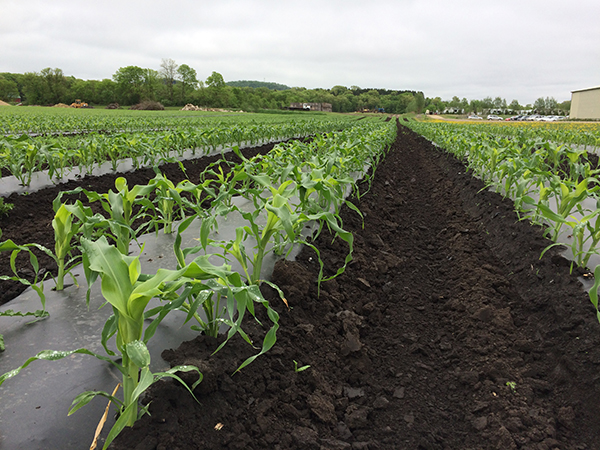
Sweet corn transplanted into black plastic.
Planting under plastic is achieved with one of a few different implements that’s typically a seeder with a mulch layer mounted behind. There are at least two systems that people use when covering a seeded bed. Either seeds are planted into shallow trenches that are covered with plastic, or a ridge of plastic is raised in the middle of the bed to tent the plastic above the sides of the bed where seeds were planted. In both, clear plastic mulch creates a mini greenhouse effect, pushing soil temps up by 5–10°F. Penn State recommends removing plastic when air under the mulch hits 90°F for three days straight.
3. Transplanting
This is reliable for certified organic farms. Start seeds in the greenhouse, and get them in the ground soon after they germinate. Don’t hold them too long, they root up quickly and your harvest date will be delayed if they are held too long. I have had success planting into 128-cell trays, 2 per cell. Starting them in the greenhouse allows you to start with an SH2 variety right away without worrying about germination issues.
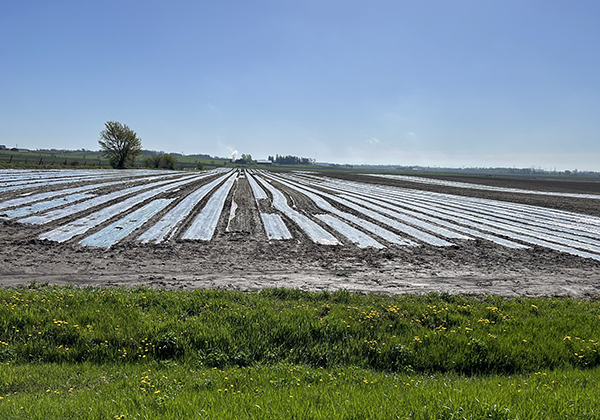
Large scale early direct seeding under clear plastic.
When I worked at Featherstone Farm in Minnesota, we transplanted our first two successions for earlier yield. We planted our first succession into black plastic mulch beds with a waterwheel transplanter. Looking back now, I wonder if it would have yielded earlier with green mulch. The second succession was transplanted with a Mechanical Transplanter 5000 on bare ground.
When organic growers can switch from transplant to direct seed
I don’t have the definitive answer to this, and with more research in future years I hope to arrive at a solid soil temperature for this inflection point. My guess right now is that organic growers could use OMRI-approved seed treatments successfully in the last week of April or first week of May for most of Iowa, and raw seed soon afterwards. That timing gives us a soil temperature at 4” of about 55 degrees, with almost no chance of the soil temperature dropping below that again.
Varieties that shine
From the April 12th planting in my recent trials, Bolt XR and Solstice were the top performers for early maturity among SH2 varieties. Bolt XR was ready on July 4th, while Solstice was ready a few days later. Bolt XR had 87% germination, while Solstice had 77% germination. Superb and Xtra Tender 274 both had germination rates in the 87-90% range but matured 5 days later than Bolt XR.
Temptress, a Synergistic type, had the highest early vigor overall, 96% germination, and matured on the 4th of July. Quick Start, also Synergistic, was also ready on the 4th, but its early germination performance was slightly lower, 80%.
Can you increase planting density?
Some growers may wonder if they can compensate for poor germination rates by seeding more heavily. For example, if a desired variety has 50% germination, can seeding twice as much seed result in the desired population? Maybe, but it’s not guaranteed. The problem is that the in-row spacing will be variable and some plants will germinate right next to each other and compete, while others will have a big gap between them. Non-uniform spacing usually results in non-uniform maturity dates unfortunately.
For growers who aren’t bothered by a prolonged harvest, this wouldn’t be a problem. However, every row foot would need to be walked multiple times, and the labor costs that result, as well as the doubled cost for seed, could quickly make the crop unprofitable.
Harvest
Plants that emerge from the soil at the same time are more likely to be harvest-ready at the same time, important for limiting expensive harvesting trips through the field. When sweet corn begins to shed pollen, your harvest is likely about 20 days away. Warm weather can accelerate that timeline.
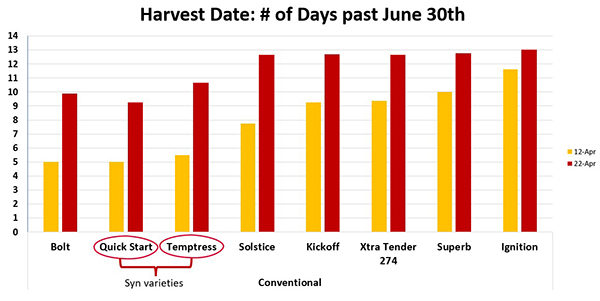
This graph shows the impact of planting date on harvest date for a few popular varieties
While some larger-scale growers use single-row harvesters, like a Pixall, most growers are still harvesting by hand. One grower I know with 40+ acres of sweet corn hires local high schoolers who come pick at 5am. They are paid $25/hour which makes it worth their while and incentivizes showing up at zero dark thirty. Four people each walk ahead of the tractor, picking one row at a time and placing armloads into the bucket loader.
The bucket is dumped onto trailers at the ends of the rows, which are driven to the roadside stand where sales happen. Since no harvest lanes are left blank, the tractor drives over harvested rows as they work across the field. Each row is harvested once. Though sweet corn generally produces 2 ears per plant, only one of the ears is large enough and uniform enough to be marketable. That primary ear is higher on the stalk and matures first.
One last note: first plantings of corn often don’t grow as tall as later ones, so the first harvest is regularly a very stooped-over experience.
Field conditions
Sweet corn, particularly SH2 sweet corn, prefers to be babied. Working soil when it’s too wet results in cloddy soils that prevent the good soil contact that seeds need for uniform germination. For those with heavier soils that dry out slowly, consider fall tillage for the field where you will plant your first successions, with a light field cultivation right before planting. Those planting through plastic may even consider laying those mulch beds in the fall.
Pests of note: seedcorn maggot
The Seedcorn Maggot attacks germinating seed and can be the downfall of sweet corn and many other early crops, such as onions and early brassicas. This is one threat that conventional seed treatments prevent. For organic growers, covering an early crop with row cover can exclude the adult flies from laying their eggs in the soil where your crop is seeded. Crops direct seeded under (not through) plastic mulch could also find protection. Degree Day modeling is fairly robust for this pest. For example, the VDIFN modeling tool from UW Madison shows the first (overwintering) generation peaking at 360 degree days in Wisconsin (often in early to mid-May).
Corn earworm
This is the big bad one, and a major reason why most Iowa sweet corn growers have moved to GMO varieties in the main season which produce their own Bt (not suitable for organic production). The moths don’t overwinter in cold climates, migrating up from the South each summer. Corn earworm in the upper Midwest has historically arrived after the first harvest, but in recent years the pest has arrived earlier.
Organic management is challenging and intermittently successful, despite Bt being a reliable pesticide for caterpillar control. Moths lay eggs on corn silk, and soon after hatching the caterpillars crawl into the ear to feed. The time that the caterpillar would eat that Bt (to therefore be killed) is vanishingly short. Timing sprays well requires trapping the moths to figure out when the caterpillars will likely hatch.
Few universities have invested in maintaining corn earworm trapping networks, so individual farmers with large sweet corn plantings trap independently. Until better systems are developed, consider training your customers to expect a worm in every ear as proof of your organic management, and instruct them to preemptively cut off the tips of the ears which contain the worm.
Raccoons and deer
Raccoons and deer will both eat a small part of a lot of ears, and they do so about 2-3 days before the crop is ready to harvest. Electric fencing is the most surefire way to exclude raccoons from a crop. Raccoons need to have a few low strands of electric line to prevent them from going over, under or between. If you have poultry netting on hand, it can also work as raccoon exclusion.
Deer can jump over most electric fencing, so if you lack deer fencing, a 3-D electric fence is likely to be the most economical option. Some opt to use bait caps on the electric line to entice deer to touch the fence and learn to stay away. Large fields have a lower percentage of crop loss and higher cost for fencing, therefore many larger growers don’t fence and accept the losses. Encouraging hunting in the off-season can make a difference in the pest pressure in following seasons.
Final thoughts
If you want sweet corn by early July or even late June, consider pushing your planting dates earlier, pick varieties bred for cold soil vigor, and consider using plastic mulch and/or transplants for the first round or two. Combining vigorous varieties with proven systems can help you capture early-season markets while managing risk. Early organic sweet corn requires planning and hard work, but nothing says summer like that first bite of sweet corn.
This information is for educational purposes. Any reference to commercial products or trade/brand names is for information only, no endorsement or approval is intended.
Dan Fillius is the statewide field specialist for commercial vegetables and specialty crops with Iowa State University Extension and Outreach. Before joining Extension, Dan grew organic vegetables for 13 years including stints managing the Michigan State University Student Organic Farm and 140 acres of vegetables at Featherstone Farm. Dan can be reached at fillius@iastate.edu, on Instagram @iowa.veg.pro.support, and on the web, extension.iastate.edu/commercialhort/.
Copyright Growing For Market Magazine.
All rights reserved. No portion of this article may be copied
in any manner for use other than by the subscriber without
permission from the publisher.