


In the first three articles of this series (see the Sept, Oct and Nov/Dec issues), we explored growing wedding flowers; assessing your fit for the wedding world, understanding clients, preparing fields and succession planting for specific dates, and building the logistics and tools to pull off a wedding without dissolving into a puddle of horticultural panic. This final installment is about being a farmer, florist, and designer for weddings.
Instead of growing for markets, you’re growing for your own designs. Instead of partnering with a florist, wholesaler or designer, you take back that part of your business. As you establish your business, style and aesthetic, wedding clients come directly to you. You’ve cut out the middleman, and your income will show it.
Growing and designing is not floristry as most people imagine it. It is more intimate, more variable, and sometimes more stressful. Floral classes can absolutely accelerate skill-building, especially in mechanics, bouquet construction, installation engineering, and business operations. But grower-designers bring something that design schools cannot provide: material intuition. You are not a beginner. You are a student of your field.
You already know: how stems hydrate, how quickly blooms open in heat, which varieties bruise easily, vase life, which plants harmonize or clash, how color shifts with maturity, and how weather changes design structures.
The field as design instructor
The flowers inside a wholesale box are uniform. Straight stems. Predictable heads. Consistent color. Standardized length. They’ve been cooled, hydrated, treated, boxed, and shipped across time zones. When a grower walks into the field, every stem carries its own biography. A week of wind arcs a poppy dramatically in a sweeping bow. A dahlia shaded by a taller neighbor stretches sideways, in a natural gesture that wiring can’t imitate. A stem leaning east one morning will reach west the next, chasing light. A celosia may start upright, then prefer a sculptural drape.
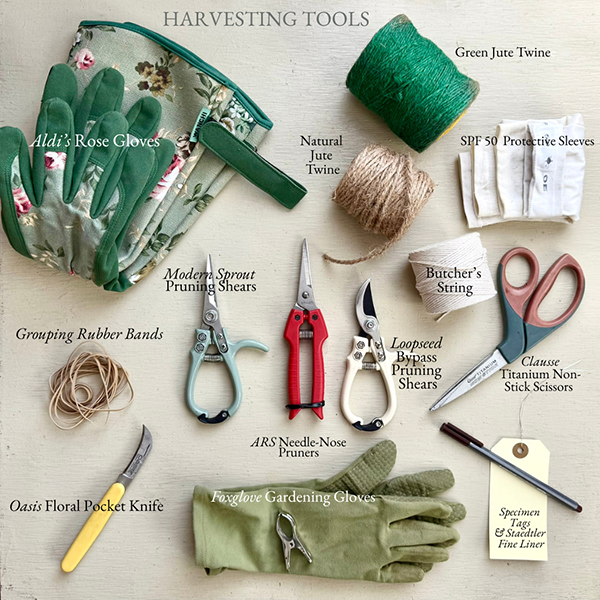
The author’s harvesting tools. All photos courtesy of the author.
These are design opportunities. Imperfections are features. All the things that are natural, random and quirky make your flowers ideal. You become fluent in your flowers stubbornness, grace, stress responses and color evolutions. This instinctive understanding is the inner muscle of a farmer-florist.
The field teaches: Rhythm as plants bud, swell, open, and then languish. Contour of foliage shapes that are not engineered. Weight as delicate looking stems may be hefty, and bold ones may wilt instantly. Light as some petals are translucent, opaque or iridescent depending on the time of day. Memory as some flowers carry past stresses in their shapes.
It’s natural to be inspired by big floral books generated in the Pacific Northwest with impossibly tall cosmos and dahlias that behave like obedient supermodels. But most of these arrangements were created in climates with mild summers and gentle nights, shown in soft, filtered light, after selecting from hundreds of blooms, under photography-specific conditions, with teams, time, and budgets.
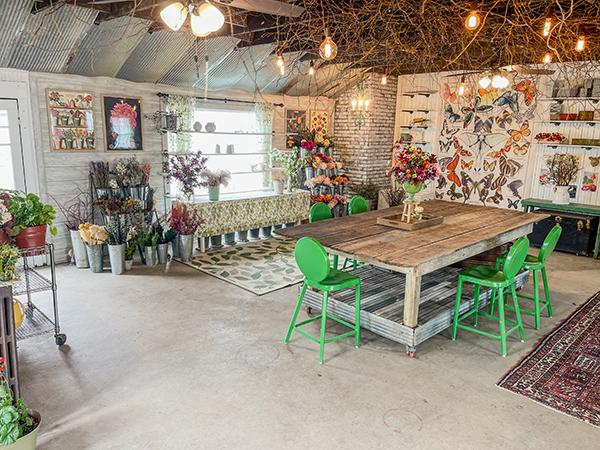
The author’s studio space.
Every farm has its darlings — the crops that perform without complaint. And every farm has its problem children — the ones you grow because they look good in books. If you want to design well, start by identifying the flowers that love you. The ones that thrive in your soil, under your sun, with your schedule. When you design from abundance, your work becomes expansive, experimental, joyful. When you design from struggle, your work becomes tight, anxious, apologetic.
Grow more of what: gives you quantity and quality, doesn’t collapse after a storm, holds color through heat, dries down beautifully when mature, works well with others — texturally and chromatically, and brings you joy when you cut it.
Grow less of: what frustrates you, what refuses to thrive, what you think you “should,” what requires more energy than it returns. Grow none of: plants that feel like a chore or you feel guilty cutting.
Getting practical
Set yourself up for success at the start. Whether you’re making trial arrangements and bouquets or fulfilling design orders, you need a dedicated space. In the beginning it can be whatever space you have available, but the growth of your business is limited by the space. Give yourself plenty of table or counter space, room to navigate, and storage for vessels, vases, supplies, tools, mechanics, buckets, coolers, and packaging materials.
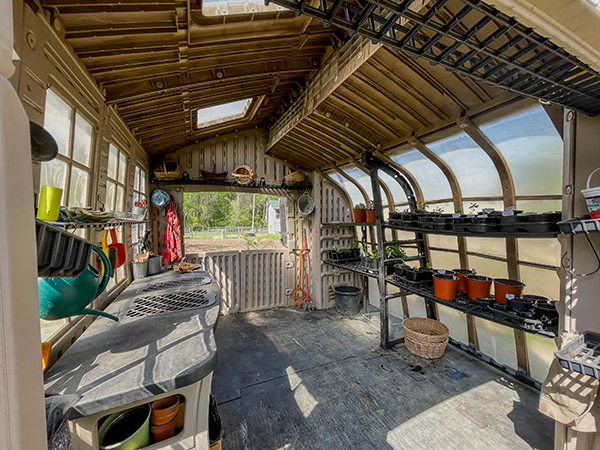
The author’s tiny greenhouse workspace next to her field.
It should be a space you enjoy. I use a tiny greenhouse inherited from neighbors. My main design space is the former potting shed attached to the greenhouse. It’s almost a perfect square. I added a huge scavenged plate glass window for natural light. Good lighting is important to see all the details and potential flaws, and make adjustments.
You may need table space, platform space, or an ability to circle around or look from above. A turntable accomplishes this. I use one with gripped surfaces so it won’t slip on a table and the flower vessel won’t shift. I use it on the floor, on a bucket, low stool, taller stool or table. You can probably buy everything you need at a secondhand store.
Create a well lit spot for photos. It can be a wall, a textured finish, a window, or whatever you choose. If you shoot in this space consistently, that background is part of your brand. So, give that some thought. Erin at Floret uses a handmade rolled painting clipped to a rod behind a tall rustic table. It looks dreamy.
I also use an old farm shed door on top of a big log slicing sawhorse in the middle of a field as the perfect cool and open spot to just practice, try ideas and just create content.
You already have a lot of cutting tools if you’re a grower, but you’ll need to expand your range a bit- see my tool layouts in this article for ideas.
Mechanics
This is what helps hold the shape and form. The goal is to hold select stems without shifting or crowding and provide support for different stem thicknesses. Some of the best mechanics come from your property such as branches, twigs, stems and vines. Vines like clematis or sweet peas create natural nets. Curly willow spirals give structure and motion. Seed heads add punctuation and texture. Even the slight crook of a dahlia stem can become a gestural line that serves as the backbone of the entire arrangement.
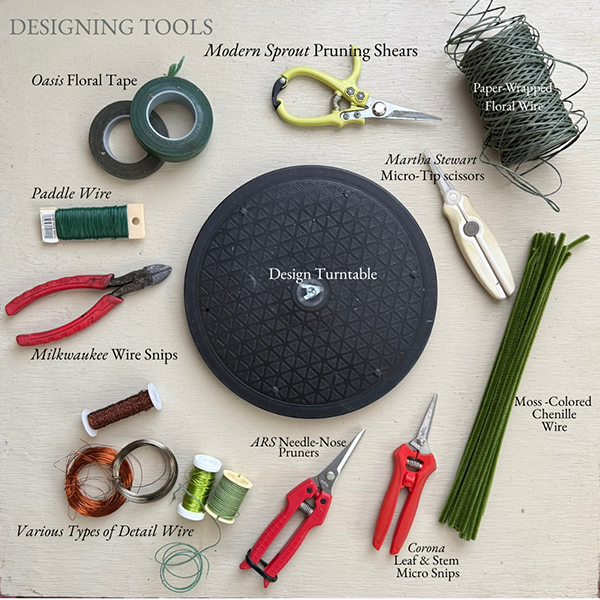
The author’s favorite design tools.
Working with natural mechanics also teaches restraint. You begin to understand how few flowers you actually need when the structure is expressive. Grow or harvest your mechanics from: willow, birch, forsythia, dogwood, viburnum, curly grapevine, broomcorn, millet, grasses and young branches.
Need something specific that you can’t find? Make it. To harvest and transport blooms without bruising and damage, I created circle frames of chicken wire that I can clip to any bucket. Use whatever vase, compote, planter, urn, jar, crock or material container your designs call for. I like a more minimalist rustic earthenware style, but I design for the client’s preferences.
You don’t have to grow everything right away that you might want to use. Use your relationships with other local growers to stay updated on what they are harvesting to exchange with flowers from your fields.
Caring for cut flowers
Have clean, cool water ready when you harvest in the coolest part of the day if your schedule allows. I keep my tools clean and sharp and wipe the blades with alcohol wipes between each use. I have a big box of Germ-X packets on hand everywhere I think I might cut or work with flowers. I cut for long stems knowing I will be making new cuts throughout the process.
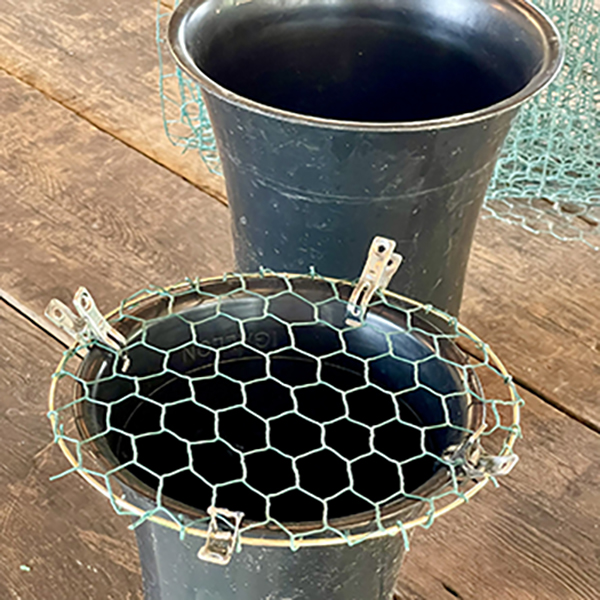
To keep my focal blooms safe from field to design, I created circle frames of chicken wire that I can clip to any bucket to keep flowers from bruising and damaging each other in transport.
As soon as you get out of the field, remove the cut flowers from the bucket and immediately remove the leaves to avoid leaves below the waterline. Bacteria and gunk build up, which leads to rot and decay. Some plants leaves are toxic to the flower when in the same water. Remove leaves as soon as possible and transfer to new, clean, cool treated water.
It is essentially the same protocol as if you were handing them off to a buyer. Again use clean, cold water that has something to feed, prevent shock, extend or boost your blooms. Knowing how different flowers behave in water will dictate the product. Zinnias like to wreck everyone’s water so I am hyper-vigilant about swapping out their water and adding a drop of bleach during transitions. If I drop off a design intended to stay in a location, I always leave packets of flower food. I mist designs lightly before they get delivered or placed.
Design fundamentals
Design isn’t just art, it’s also engineering. Ask these questions at the very beginning: Duration — Will it be carried? Hung? Transported? Standing in heat? Exposed to wind? Environment — Indoor humidity? Outdoor sun? Ballroom AC? Direct afternoon exposure? Purpose — What emotion is the design meant to evoke? What moment does it serve — procession, celebration, remembrance?
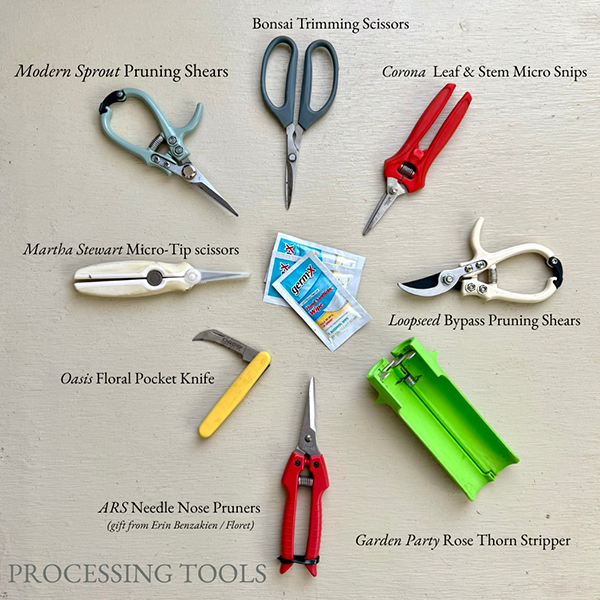
The author’s cutting and processing tools.
Start with your workspace clean and free of debris with all your tools and items close by. Make sure you can manipulate your design to see all the way around. Put your mechanics in place and thoughtfully and purposely begin from the outer edge. I first select a piece that tells a story and continue adding cohesive elements. It’s always okay to remove something.
Color
Color theory is wonderful for people who think in rules and structures. Some designers thrive on wheels, charts, and formulas. If that’s you, there are fantastic books and classes to walk you through the science of hue, value, temperature, and complement. But growers often come to color a different way. You are not selecting theoretical swatches. You are selecting living things — with age, mood, history, and quirks.
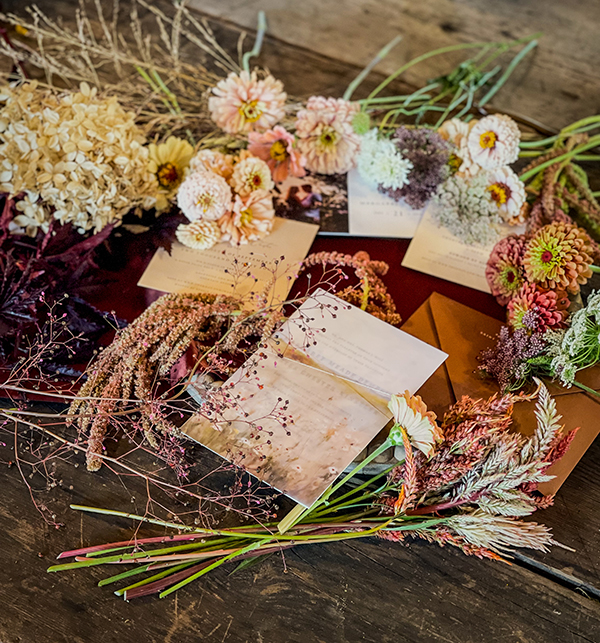
An example of the bride’s color range and style in her invitation suite, matched with the colors and varieties selected to help tell that story.
My own approach has never been analytical. I don’t see a palette as a set of swatches to harmonize. I see it as what’s growing that week and the emotional tone my client wants. Sometimes that aligns with traditional color rules. Sometimes it breaks every rule. Often, the pieces I love most deliberately break those rules.
What many designers call a “bridging element,” I experience as connective tissue — a detail or echo that keeps the composition emotionally coherent. It might be the beard on a rudbeckia that mirrors the undertone in a dahlia, or a celosia curl that matches the gesture of a sprig of fennel. I’m not thinking in formulas. I’m thinking in relationships. If the ingredients speak to each other, the arrangement works.
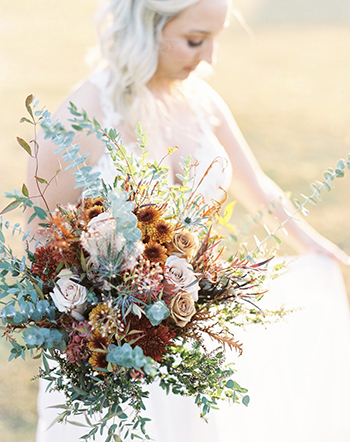
An example of the author’s bridal bouquet work from a recent event.
Color, for me, is not a system to master — it’s a conversation between what’s blooming, what the client loves, and what the piece is trying to express. When I’m designing for someone else, I want to understand: What colors comfort them? What combinations feel nostalgic or joyful? What flower carries a memory they treasure? What tones feel “too much,” and what tones feel just right? Good floral design happens where their preferences meet my instincts.
Fundamental elements
Different designers have different terms, but fundamentally this framework holds true: Structural Foliage — thematically anchors the edges of the design and can support other elements. Supportive Ingredient — An element that is like the structural foliage but is branched to hold blooms and other elements in place. Textural Ingredients — add movement, shape and small details in the repetitive growing elements or tiny blooms. Supportive Flowers —Typically clusters or sprays with a branching habit. The backdrop and anchoring color for the main focus. Focal Flowers — the main central blooms to draw the eye. Airy Accents — Soft and ethereal that add whimsy to balance out other elements.
Design pieces
The Statement Piece is substantial and meant to attract attention with the highest level of blooms, exquisite form and color. Whether viewed straightforward or on a pedestal, this is designing for applause. The Centerpiece is a statement piece in its own right, but scaled more for guest tables at a wedding reception. The Vignette is a display of multiple vessels, possibly different elevations to draw attention to a specific variety while showing its color and range — or, focusing on a tight color range using multiple varieties. The Posy is the perfect compact arrangement with shorter stemmed blooms that let the eye focus on gorgeous tiny details and color shifts. It is perfect for the gift table, guest signing table, bars, or restrooms.
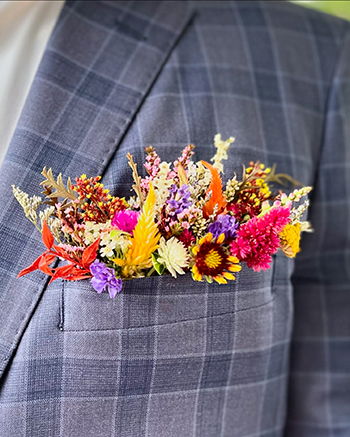
Instead of a boutonniere, sometimes she makes a ‘pocket garden.’
The Bridal Bouquet is the trickiest of all, using long stems and requiring finger dexterity. Using upright sturdy stems to create a loose sphere, with central lush blooms, graduating down to a tapered hold. The long stems can be exposed with a hand-tied ribbon wrap — perhaps long ribbon tails. You must graduate down to a narrow hold for a bride (including structural tape, wire and hidden mechanics, and the ribbon wrap). The client determines the style, while you need to design with durable blooms on strong stems that stay hydrated through photos and the ceremony.
The Personal Flowers and Weareable Flowers are wrist or magnet corsages, boutonnieres, and floral crowns designed from the bridal floral collection. They can be uniform (the boutonnieres all the same design) or different based on personalities.
En masse, I think of it as a massive posy that either features a variety and showcases range, or a tight color range expressed across different varieties. No other elements or filler needed. This is a showstopper.
Floral recipes
Recipes are comforting. If you don’t consider yourself creative just yet, work with a recipe until you can improvise and really let your designs ‘cook.’ The best chefs don’t repeat, they innovate. You’re not a brick and mortar florist who orders “three bunches peach ranunculus, two bunches chocolate cosmos, and one bunch dusty miller” from your wholesale rep. You harvest what the field provides — sometimes an abundance of muted tones, sometimes a riot of color, sometimes all angles and seed heads, sometimes soft and fragrant and pastel.
A recipe can’t tell you what to do when your entire lisianthus crop blue-shifts after a cold snap. A recipe can’t tell you how to design with celosia that is 12 different shapes this season. A recipe can’t teach you how to trust your eye when the field gives you something unexpected. Grower-designing is a collaboration with the week’s weather.
Your “recipes” become intention, alignment, color story, movement, emotional tone, and your available cast of ‘characters.’ Clients don’t come to you because you can replicate a Pinterest picture. They come because your work feels alive.
The growers visual vocabulary includes: The line, where does the eye travel? The shape, what is the silhouette? The tone, color temperature matters more than hue. The texture, rough, smooth, airy or dense. The pace, where does the arrangement breathe? The rest, negative space is as important as flowers.
Looking
Most people think design begins when you bring flowers to the table. Grower-designers know it begins much earlier — with looking. Looking at plants when they are just emerging. Looking at how foliage holds moisture. Looking at how petals shift color as they mature. Looking at the posture of stems in wind.
Looking at what the garden does when you’re not trying to control it. Looking is a discipline. And designing is the art of arranging what you see. The more you observe, the more fluent you become. Not in rules — in relationships.
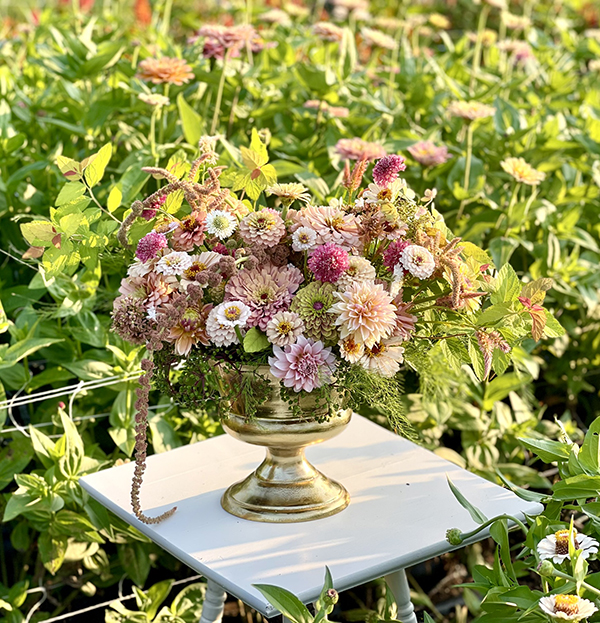
One of my go-to props is this low white table– it goes everywhere.
Celosia taught me everything I know about design. There is always one crop on a farm that becomes your professor. For me, it’s celosia. No other plant shifts its form, posture, color, or texture with such abandon. One week, it’s giving me cathedral spires; the next, coral reefs; the next, folded velvet brains in shades of rose, gold, and apricot I couldn’t mix if I tried. Designing with celosia is like designing with jazz — there is no recipe, only responsiveness. She taught me to trust movement over symmetry, gesture over perfection, curiosity over control. Every flower you grow will teach you something, but one of them will teach you who you are as a designer. Pay attention to that one.
Closing thoughts
At the beginning of this series, we talked about whether growing for weddings was a fit for you — your time, your climate, your temperament, your seasonality. Then, we talked about crop planning, expectations, weather, logistics, and all the unglamorous systems that make wedding work possible. We explored the tools, the timelines, the workflows, and the realities behind the romantic idea of “wedding flowers.”
Once you’ve lived a full season growing for weddings, you realize growing and designing were never separate. Everything you plant, everything you tend, everything you struggle with, everything you celebrate — all inform the creations. Your field has already shaped your eye before you step into your design space. Designing with your own flowers is about relationship.
A relationship with your land. With your seasons. With your failures. With your triumphs. With the weather. With the way your flowers grow. You don’t become a farmer-florist by learning a set of rules. You become a farmer-florist by paying attention — every day, in small ways that accumulate quietly until one afternoon you realize you’re designing with an ease and instinct you didn’t even notice forming.
Wedding work is demanding. Growing for weddings is demanding. Designing with what you grow is demanding. But it is also one of the most rewarding expressions of the whole flower journey — the moment when all the months of care you’ve invested become visible, purposeful, and shared.
Whether you choose to grow for weddings for one season or 20, whether you take on full event design or only sell stems, whether you build a studio or work beside a shed door under a tree — the work will grow you as much as you grow it.
Let the field teach you. Let the flowers change you. Let your designs be an honest expression of what thrives under your care. You do not need to create anything perfect. You only need to create something true. If you do that, I promise — your work will find the people meant to receive it. And if you’re ever unsure where to begin, the field will always show you.
Elizabeth Fichter is a flower farmer, botanical artist and writer who grows flowers as Queen Bee Blooms, and creates floral art as Floral Alchemy in St. Louis, Missouri. She can be found on social media @QueenBeeBlooms. Queen Bee Blooms specializes in helping grow people who grow flowers, with education, resources, support, seed sales and inspiration. Queen Bee Blooms has over 150 seed varieties and bespoke mixes at queenbeeblooms.com/shop-seeds.
Copyright Growing For Market Magazine.
All rights reserved. No portion of this article may be copied
in any manner for use other than by the subscriber without
permission from the publisher.