










Spring is our busiest sales season on our flower farm, Moonshot Farm in East Windsor New Jersey. We can never seem to grow enough. Our spring bread and butter are overwintered crops, which we sow in late summer and plant in the fall for blooms the following spring. There are two spiky spring favorites about which I get a ton of questions from other growers: foxglove and lupine. They can be a little tricky, but benefit from similar techniques. So, once you nail them they can be huge moneymakers. Here’s a deep dive on how we grow these popular, whimsical blooms.
The high tunnel advantage
Many flowers benefit from being grown in the high tunnel, but foxglove and lupine do especially well. Both are prone to rot due to wet roots during the winter, when the soil outside often stays saturated until spring. The high tunnel environment enables them to dry out more readily during the winter and avoid rotten roots.
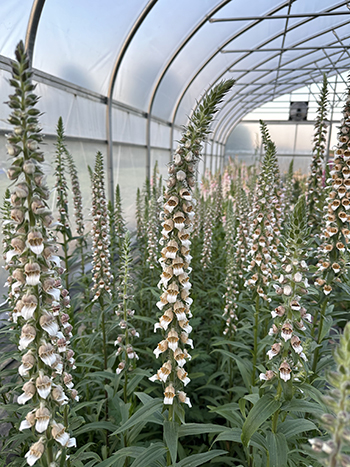
We’ve found that outdoors foxglove and lupine often don’t bloom until late May when the weather is already getting quite warm. The blooms are often quite short and stunted due to the heat and they shut down rapidly as temps rise. In the tunnel, the plants bloom significantly earlier, as much as four to six weeks sooner. This enables them to reach their full potential before temperatures get too high. It also gives us blooms when flowers are scarce and means we can usually hit Mother’s Day (and even Easter) with these flowers.
Lupine is technically a perennial, meaning that it will return and bloom year after year. Our farm is in central New Jersey Zone 7A, which gets quite hot in the summer. We’ve found that lupine plants often die or at least struggle in our summer heat and that it grows best as a fall-planted hardy annual. We transplant one big round usually in mid-October.
Many species of foxglove are biennial, meaning they need to be planted by early fall and then have a cold winter in order to bloom the following spring. There are several modern varieties of foxglove that are “first-year flowering (FYF),” so, they will bloom even without that cold period. We’ve found that all varieties of foxglove do best when fall planted, but we also plant an early spring succession (March transplant). The blooms tend to be smaller on the spring-planted ones but they’re still plenty big for June bouquets and weddings.
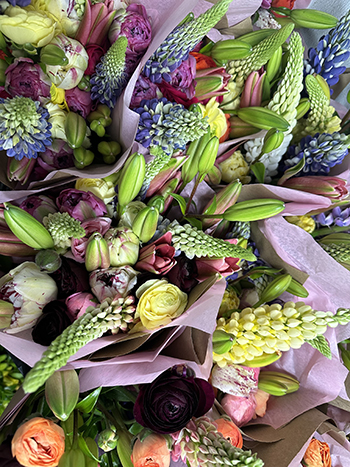
Lupine works great in Mother’s Day bouquets along with ranunculus and tulips.
If you’re in a cooler zone (zone 5 and below), it would be worth experimenting more with spring plantings and perennializing, but the hardy annual approach works well for zones 7 and above.
As soon as the plants are done blooming in the spring, we rip them out and get a summer crop in. On our farm, we do not allow any crops to perennialize in the high tunnel. Even with the added labor and seed costs of re-planting each year, we find it’s much more profitable to grow a separate summer crop than leave plants to bloom the next season. Asters, celosia, and marigolds can all be transplanted in June after the foxglove and lupine are done.
Seeding and transplanting
While we order plugs for many varieties on our farm, we find foxglove and lupine both pretty easy to start from seed. Foxglove has a long plug growth time, around 10-12 weeks. We start it in early August for a mid October transplant. Lupine grows a bit faster, so we start it towards the end of August.
Both are cool weather plants and germination can be a bit tricky during extreme summer heat. We will sometimes place our trays under the benches, where the shade keeps them a bit cooler. We cover seeded trays with frost fabric, a trick I shared in my article about asters in the August 2025 GFM, and water right through it. The fabric retains moisture and lets light in as the seedlings emerge. In the summer, the trays often need to be watered twice a day during germination to prevent drying out.

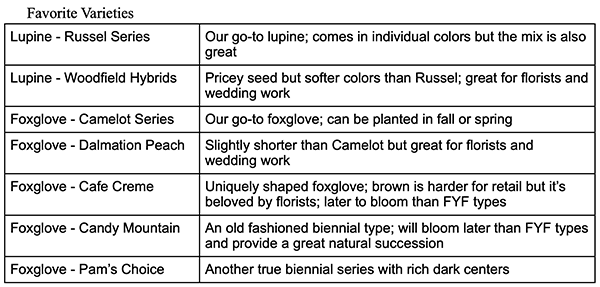
Camelot series is a first-year-flowering foxglove that’s reliable and versatile.
The internet is full of tricks for lupine germination — from freezing seeds to nicking them with a nail file or soaking. We’ve found all of this is unnecessary as long as the seed is fresh, so we simply purchase new seed each summer. Both lupine and foxglove suffer from being rootbound, so it’s critical to transplant as soon as the plug holds a shape.
Neither crop is a particularly heavy feeder. We prep our beds with a basic nitrogen rich fertilizer before planting, then don’t give any additional feed. As a big bonus, lupine is a legume with a nitrogen-fixing and compaction-helping taproot.
In our warm climate, foxglove produces one large central stem and then a few smaller side shoots before the plants peter out due to the heat. We transplant them just 6 inches apart to maximize stems per square foot.
On the other hand, lupine is a true cut and come again flower that will make around four to six stems per plant over several weeks. We transplant it 9 inches apart to give it plenty of space to bloom. Lupine is invasive in some regions, especially in zones colder than ours, so keep an eye on it. We have never had any issues with unwanted plants and find it can be terminated easily in our warm climate.
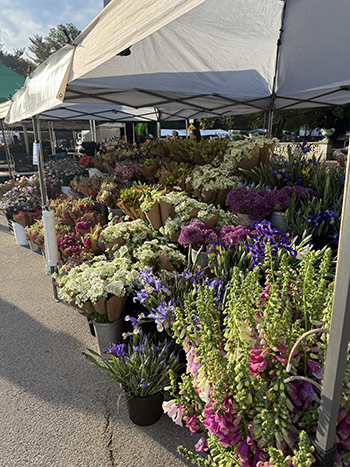
A May market display showing foxglove, which we don’t wrap in paper to best show off its flowers.
Our farm has heavy weed pressure, so we plant almost everything into black landscape fabric. This year we’ve been experimenting with a new white-on-black fabric. I’m excited to try this for our hardy annuals as it’s a bit less hot than the black fabric.
By transplanting in mid-October into the high tunnel, the plants have around a month to get well established before temperatures get quite cold. We keep them very well watered via drip irrigation during this time, but only have to water once or twice from November through February. If growing them in the tunnel, be sure to ventilate well during sunny days.
Both foxglove and lupine are quite hardy (down to zones 3 to 4), and we don’t provide any extra protection like frost cloth. We also plant them on the colder outer rows of our tunnels, saving the toastier interior rows for more tender plants like scabiosa.
If field planting, the danger is less cold weather and more wet feet. I think raised beds could be a great option for these plants, and I’d also plant a bit earlier (mid-to-late September) to allow them more time to establish in the field.
With the landscape fabric, we do not need to weed either crop as they have bulky leaves that quickly shade out the bed. While many crops overwintered in the tunnel do need netting for support, we find that neither foxglove or lupine needs it. Overall, they are very low labor crops on our farm.
Harvest and post-harvest care
Lupine is one of our earliest hardy annuals to bloom, typically beginning as early as late March. First-year-flowering foxglove varieties start for us in mid-April, with old-fashioned true biennial types blooming later in late May. Both lupine and foxglove ripen rapidly on sunny days and require near daily harvest. They’re also popular with bumblebees so it’s important to harvest early in the day as their ripening will be sped by pollination. Like other spike flowers, we like to harvest them when they’re around a third to half open for our retail sales channels.
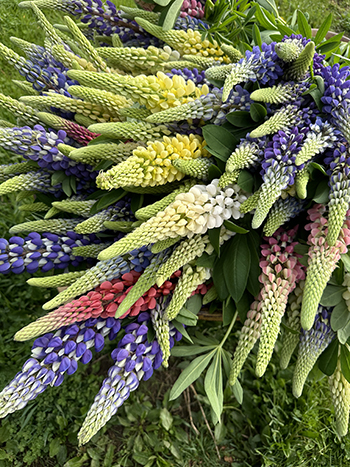
Russel series lupines blooming in the unheated high tunnel. All images courtesy of the author.
Also like other spike flowers, both are geotropic — they will bend against gravity post-harvest. It’s critical to keep them upright. We wrap stems loosely in kraft paper to ensure they stay straight in the buckets. We store both varieties in Chrysal Professional 2 (holding solution), which keeps them fresh and helps open remaining buds on the stems.
Lupine sometimes gets a bad reputation as a cut flower as it can be prone to shattering. We find around 10 to 20 percent of the stems will shatter no matter what. To combat this, we keep them in the cooler for 24 hours then do a “shake test.” Any stems starting to shatter are discarded before we bunch them for market. Lupine also has a relatively short vase life (around four to six days). We try not to hold it for more than 48 hours in the cooler as it can deteriorate after this time.
Foxglove is a bit more forgiving and seems to hold well up to five days in the cooler then lasting around five to seven days in the vase.
Pests and issues
Our biggest pest for both foxglove and lupine are aphids. Aphids thrive in the unheated high tunnel and take over before beneficial insects are active. Because foxglove and lupine both contain toxic compounds, the aphids sucking on them can become poisonous themselves. As a result we’ve found that introducing beneficial insects is less effective on these species. Both species also have a specialist aphid just for them (the lupine aphid and the foxglove aphid), which we’ve found difficult to control.
Good sanitation has been critical for early spring aphid control. In the fall, we try to give our tunnels at least two to three weeks without any plants to prevent any straggler pests. We clean tunnels out and close them up to allow them to get extremely hot and kill pests. This step has greatly reduced the amount of aphids we see, but regular scouting is critical. Each week we look under the leaves of plants to monitor for any signs of aphids.
Because beneficials are less effective on foxglove and lupine, we will sometimes resort to organic sprays. A rotation we have found quite effective for them is a mix of an azadirachtin-based spray (like Azagard) plus a bio-pesticide (like No Fly). Spraying every six days for several weeks has worked well to interrupt the aphid lifecycle, which can be explosive in early spring. It’s important to spray at the first sign of aphids, as once their populations rise they’re nearly impossible to eradicate.
Our only other issue with foxglove has been bud blast — essentially the flowers will fall off the plant before they ever open. Dr. Alicain Carlson of Syngenta Flowers, who breeds the Camelot foxglove series, visited the farm and explained that this is due to high heat and extreme temperature fluctuations. In the future, we’ll be more careful about ventilating houses and also think the white fabric may help.
Marketing
In early spring, customers are hungry for flowers and it’s not much effort to sell them. We find lupine is particularly popular and extremely nostalgic for many folks. We do like to warn customers about its short vase life and propensity to shatter, but we still sell every single stem we can grow.
Foxglove has a well-earned reputation for its toxicity and indeed both the seeds and the stems are extremely poisonous. Many cut flowers are poisonous, but foxglove is especially so, and we will sometimes warn customers with young kids or pets against it. It’s worth noting that lupine is also poisonous, but not as much as foxglove.
We use compostable kraft paper sleeves for flowers on our farm, but they don’t work great for foxglove and lupine whose top buds are closed. Sometimes we will display them without any wraps at the market for the best color and show. Large glass vases can work well for this. Early on when stems are both in short supply and massive, we will occasionally sell them by the single stem. Just a handful of blooms can make an incredible display. Both flowers also work beautifully in mixed bouquets with other early spring flowers like ranunculus, poppies, and lilies.
Although our farm is retail-focused, florists love both blooms and they’re great for wedding work. For bridal bouquets, their hollow stems will benefit from being wired to prevent breakage. If you’re looking for some whimsical fairy flowers to round out spring production, I hope you’ll consider trying both foxglove and lupine.
Rebecca Kutzer-Rice owns Moonshot Farm, a specialty cut flower farm in East Windsor, NJ. She grows flowers year-round including in a geothermal greenhouse, for retail markets in and around NYC.
Copyright Growing For Market Magazine.
All rights reserved. No portion of this article may be copied
in any manner for use other than by the subscriber without
permission from the publisher.