






Have you ever been frustrated by (or heard farmers complain about) a technical assistance (TA) provider who is not helpful, not interested in organic production, or not responsive? TA offered by cooperative extension or local non-profits is meant to be a useful resource for farmers, but one bad experience can sour a farmer’s enthusiasm for taking full advantage of it. On the other hand, there are many darlings in the TA world who are kind, knowledgeable, practical, and accessible. It can be an invaluable resource.
As TA providers at two farmer-serving organizations in Kentucky, we’ll make our case for the value of strong relationships in the TA realm. We’ll draw on our own past and present experiences on both sides of the technical assistance relationship, as well as those of farmers and colleagues we’ve talked to. We’ll offer strategies for farmers to build and strengthen their relationships with TA providers to help lighten the load of farming, optimize farm operations, and enjoy some quality professional community.
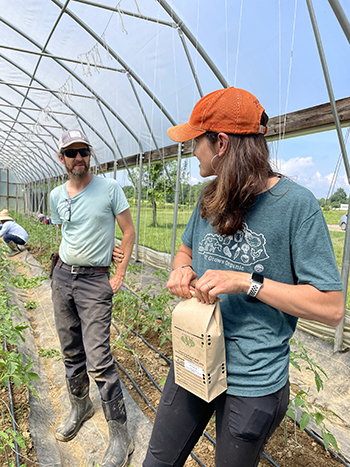
Sarah came to the Barr Farms to show the protocol for tomato tissue sample collection to farmer Adam Barr when he inquired about a strategy to dial in high tunnel tomato fertility.
‘TA providers’ is the broad term we’ll use for a spectrum of ‘folks who help farmers.’ These can come from cooperative extension, Natural Resources Conservation Service (NRCS), conservation districts, or local nonprofits. While all of the points we make may not be appropriate for all types of TA providers, they can all ideally be part of a scaffold of support for producers who are busy running a complex operation.
An initial connection
If you are new to farming, just haven’t reached out to a TA provider before, or want to make new connections, there are several ways to find a TA provider and make the initial connection to put your farm on their radar:
Ask around. Ask your farming peers to introduce you to the resources and people that have been most helpful. Inquire through social media groups or listservs specific to your crop, state, or region. These are often coordinated — or contributed to — by TA providers. Local Cooperative Extension Service, Farm Service Agency, or Farm Bureau offices often partner with universities, associations and organizations that have TA providers. They can refer you or point you in the direction of relevant in-person events coordinated by TA providers.
Do in-person stuff. Take full advantage of educational events by also meeting and learning about the TA provider services that are available to you. Introduce yourself, your farm, and your needs to the folks you meet.
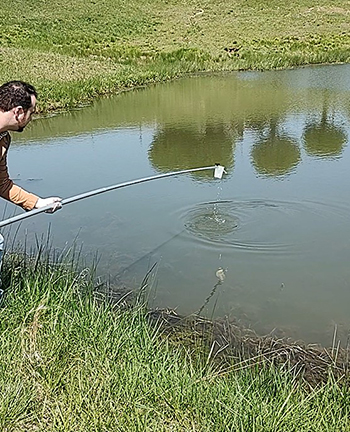
A grower made an initial connection with Dakota by requesting that his irrigation pond water be sampled. Dakota has since been a go-to resource for that grower.
Keep up with the news. Newsletters geared towards your region or enterprise often feature contributions by TA providers whose services are relevant to you (like this great magazine). Besides alerting you to TA providers, keeping up to date with this type of information can make your work with them more productive, saving you both the time they’d spend getting you up to speed.
Find the right fit. Be clear and transparent about the scale and stage of your farm when you connect with a TA provider because some are funded to help specific types of farmers. Someone tasked with helping commercial farms is not the right person to help a farmer who isn’t producing or selling any products yet, but they can usually make an appropriate referral. Once you get to a commercial level, reach back out to that original TA provider, they’ll be happy to see your growth and jump into helping you.
When a TA provider is just not a good fit, whether in communication style or personality, those differences can keep you both from success. If getting an answer from a TA provider feels like pulling teeth, look for help elsewhere.
Learn how they work. Be mindful of a TA provider’s workload, communication preferences, and boundaries. They are likely helping many farmers, coordinating events, and (sometimes) teaching courses. Reach out during business hours when possible, and learn how they communicate best. An 8:30 p.m. phone call or a 1 a.m. email may be buried by ones that come during the workday. Don’t hesitate to give them a nudge if a question has gone unanswered for a bit.
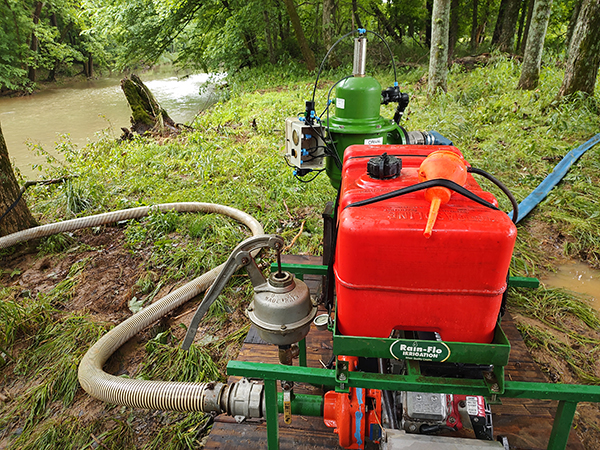
A farmer got this brand new irrigation pump back in working order after it was under five feet of flood water the week before. The farmer shared his plans with Dakota to use a deer stand to keep it from being flooded again. This idea was immediately helpful to another grower Dakota was assisting. All photos courtesy of the authors.
Understand their context and share yours. Learn what the TA provider is great at, but also what they don’t have experience in. They might be experts in greenhouse infrastructure but when it comes to insects they wouldn’t know a flea beetle if it bit them in the… kohlrabi. This is good to know so you don’t expect more than they can give. It’s also good for the TA provider to know your strengths and weaknesses so they know where you need the most help. Maybe you can grow perfect produce but have trouble selling it. This can help put your entire operation into context and direct their focus.
Be flexible. Having some degree of flexibility is a prerequisite in agriculture. You may have previous experiences with TA providers who have signaled skepticism about your production system, or you may (reasonably) be skeptical that a TA provider who typically recommends conventional methods can help you on your organic farm. We suggest keeping an open mind and being open to TA providers who don’t share all your opinions or preferences.
While they might not be able to tell you about the latest organic method to tackle your issue, they can help in other ways: referring you to a specialist, pointing out grant opportunities, or helping you optimize your packshed efficiency or up your food safety game. Plus, people can adapt and learn, and they are more likely to stretch outside of their comfort zone if you also are willing. Give the free TA services that are available to you a try, and take full advantage of ones that are a good fit. This is all in service of your own growth and becoming the best farmer you can.
Develop the relationship
Once you’ve made an initial connection with a TA provider, having quick access to them when you need it might take an initial time investment before you need it. Here are a handful of low-lift ways to do this, best practices for a positive outcome, and general principles that could help:
Get their butt out of the office. Invite them to see your farm. This can help them better understand your operation and goals. Depending on their availability or expertise, you could get a lot out of an in-season visit when the farm is in full production. They might spot early signs of a pest that can be managed before it gets out of hand, point out a tweak in your cultivation equipment that will achieve a better weed-kill, or snag a sample of a crop with a mystery disease for diagnosis. If services like plant, tissue, soil, or water sampling are in their wheelhouse, you can take advantage of those, too.
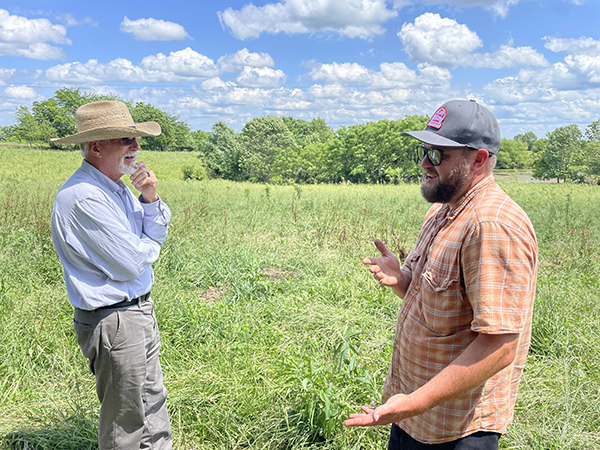
Joseph and Abbie Monroe at Valley Spirit Farm grow vegetables and raise beef cattle. Pasture management is a gap in Sarah’s ag knowledge, so OAK contracted with grazing expert Greg Brann to join her on a farm visit and offer technical advice for the beef side of the operation. Sarah learned a ton about rotational grazing and crop livestock integration from this visit, and the Monroes got great advice for both of their enterprises.
If an in-season stand alone visit feels overwhelming (everyone is busy), an invitation to an upcoming field day or farm event you are hosting might be a lower lift. Alternatively, the off-season can allow for a longer visit that’s easier to schedule. Extra time can keep the visit more relaxed and informative for both of you. Even if you don’t have any big questions the first time they visit, or if they don’t have any groundbreaking insights right away, having a new set of eyes on the farm while you talk through the systems, successes, challenges, and evolution of your farm can give you a fresh perspective and new ideas.
Share your wins. TA providers love to hear about farmers’ successes: cobbled together equipment that turned out to be a brilliant solution, a huge harvest of a crop they helped you troubleshoot, a game changing piece of equipment you invested in. A great TA provider knows there is a lot to learn from farmers. Your great ideas, systems, and knowledge are often some of the most interesting things they learn about and the most useful insights they will share with other farmers.
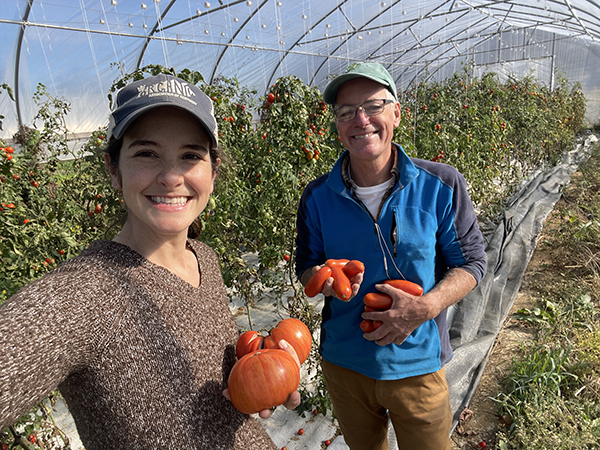
In a mid-season visit to Idylwild Farm, Sarah showed Mike Hass how to collect plant samples for the University of Kentucky diagnostic lab and tissue samples for nutrient analysis.
Beginner’s mindset can be an asset. Don’t be discouraged if their background, experience, and values don’t immediately align with yours. There is a lot of value in a beginner’s mindset, and it could lead to solutions or opportunities you wouldn’t have thought of. The TA providers who are now most beloved and valued also started out green. Ideally, the beginners are in this for the long haul alongside you. If you’re an experienced grower, invest in your TA provider by providing reading recommendations, asking them to join you at conferences, or suggesting skills they could learn that will empower them to better serve other farms in the future.
Collateral benefit. Farming is multidisciplinary, and no single person will have every answer you need. Many TA providers are generalists. Rather than possessing all knowledge, a great TA provider has access to a diverse network of experts and specialists. Their job is to help you find the best possible advice from the smartest people on the topic.
They often have connections you would not otherwise have access to. A referral to a specialist is not an unwillingness to help, but it is entirely reasonable for you to ask the TA provider to do the legwork of reaching out and explaining your context and query. In some cases, that would be the specialist’s preference. Keeping the TA provider looped into your continued communications with the specialist enables them to translate the recommendations you get into steps that are appropriate for your farm system. It will also help them provide answers to similar farmer queries more quickly in the future.
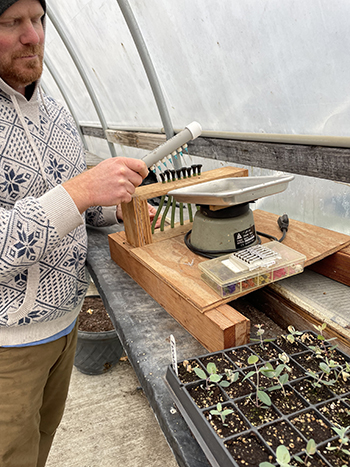
In Sarah’s first farm visit to Lazy Eight Stock Farm, Bryce Baumann showed Sarah around his farm systems. Pictured, Bryce is explaining the seeder he put together using parts from a Blackmore Can-Duit seeder, otoscope speculums, dosing needles, and a dental lab vibrator to efficiently seed multiple varieties of a crop in the same tray. With Bryce’s permission, Sarah was able to share this system through OAK’s social media highlights for other farmers to learn from.
Stay in touch. Over time as you work together, you’ll have new opportunities to share more information. A good advisor will remember (much of) your conversations and reach back out with relevant and useful resources as they come across them. Having some background on your farm will also make it easier for them to quickly assist with an emergency production challenge that you bring to them during the busy season. While you don’t need to build a deep working relationship with every TA provider you meet, keeping in touch regularly with one or two will keep you connected to the large network of resources in your region.
There is no finish line to the process of building a working relationship with a TA provider, and new ones are always coming on the scene. Be patient and open-minded. No one TA provider will perfectly meet all your needs, just as you won’t always get everything right on your farm. The learning happens in those gaps in knowledge and the particularities of each farming operation. Your connections with quality advisors who are actively improving — and on your team — will take a significant mental and emotional load off your farm management journey.
Sarah Geurkink provides production support for commercial organic farms with the Organic Association of Kentucky. She is entering her third year in the job. Before that she managed vegetable farms for 13 seasons. Dakota Moore is the Grower Outreach Coordinator for the Kentucky Horticulture Council. He loves getting out to farms to talk produce safety, crop insurance, irrigation management, and anything cut flower related. Dakota previously worked in ornamental greenhouse management, arboretum management, and floral design.
Copyright Growing For Market Magazine.
All rights reserved. No portion of this article may be copied
in any manner for use other than by the subscriber without
permission from the publisher.