







In 2006, my husband, Casey, and I started our farm, Oakhill Organics, in Dayton, Oregon. From the beginning, we have been a two-person operation. The only labor on our farm besides our own is one or two friends who help out one morning a week during the main summer season.
We’ve chosen to not hire employees in order to simplify our farm’s overall management and ensure greater stability and predictability during our crucial start-up years.
However, relying on just the two of us for physical labor has been challenging, especially as our farm has grown larger. Our bodies take the brunt of every farm task — transplanting, weeding, harvesting, washing, loading the van, etc. Despite being young and fit, we realized quickly that our farm’s long-term sustainability depends on easing the burden on our bodies, especially our backs.
To lighten our load, we’ve researched and selected solutions that seem most useful for our farm’s scale and needs. As a result, we have intentionally mechanized at a level that might seem out of proportion with our farm’s scale.
Our choice to not hire employees has thus determined many aspects of our operation today. Our young farm has evolved quickly under the strong incentive of avoiding pain and being happier, healthier farmers. And, without a payroll to worry about, we’ve had the added financial flexibility to make needed purchases quickly.
Our choices are unique to our situation, of course. But we frequently hear farmer friends fretting over related issues: the high cost of unpredictable off-farm labor, or concern for their bodies or those of their most valuable employees.
Since our decisions seem potentially relevant to others pondering these challenges, I thought I’d share our experience purchasing and using three different machines over the last three years. Each of these machines has eased our back pain significantly and also increased our farm’s overall efficiency, thus allowing us to farm on a scale we did not imagine possible for only two laborers.
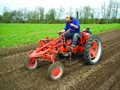
Allis-Chalmers cultivating tractor
Even before we found land to grow on in 2006, we purchased a restored 1946 Allis-Chalmers model-G from Jim Corliss in Corvallis, Oregon (through an article in the Growing for Market archives from 2001).
The farm we trained at had a cultivating tractor, a Farmall Cub. In the two seasons we worked there, the Cub sometimes broke down, and we knew from experience that we were much happier farm workers when it was in full operation.
So, even though we only farmed a little over one acre of rented ground in that first year, we used a cultivating tractor as our primary weed control method — which worked well enough that we infrequently used a hoe or our hands to weed.
The G cleans up a bed much faster than we could ever do with a hoe. Our first year of using the G, we found ourselves with extra hours and physical energy every week, which we used to spend more time transplanting, harvesting, and marketing our produce — the parts of farming that actually make money! Our success that year was modest but more than paid off the G’s purchase price of $6,000.
Although we feel the G’s weeding prowess alone justifies its presence on our farm, we prefer every piece of equipment to serve more than one function. Our farm is not big enough to warrant purchasing very specialized equipment.
As many other growers have found before, the G is a very flexible tool. For example, in addition to using it to weed, we use the G to mark our beds. We switch out the G’s cultivators for a simple set of vertical rods set at our row width. By dropping the markers while driving over the bed we can draw parallel lines for planting that match our cultivator set-up.
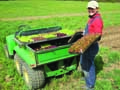
John Deere Gator
Our first year farming, available space was what limited our production abilities; we maxed out our rented ground with vegetables for our 48-family CSA and farmers market booth. In 2007, we moved to a larger 17-acre property that we purchased in late 2006.
On the new land, we increased our CSA to 75 families, doubled our presence at market, and added several wholesale clients. To meet this higher sales volume, we expanded from just over one acre to over four acres of planted ground.
At the time, we were still relying exclusively on two garden carts for hauling everything, including produce, in and out of our fields. It is almost a quarter of a mile from the far end of our field to our wash station — not surprisingly, harvesting and hauling that much produce wore us out. By the end of July, our CSA members were saying, “You look tired.” We were.
So, we purchased a used diesel, 6-wheel John Deere Gator for $6,000 and put it immediately to work on the farm. The difference for our bodies was like night and day — our ability to keep up with our ambitious production scale felt possible again.
We specifically chose a Gator over a small cheap truck for several reasons. For one, we wanted a diesel vehicle built with the durability of a tractor. We appreciate the lifespan diesel engines offer and the ability to run them on biodiesel. Finding a good quality diesel truck for $6,000, however, is impossible where we live.
Also, we appreciate the scale of a Gator; it’s scaled for the human body rather than the road. The step up to the seats is short and the lip of the bed is at hip height, allowing us to load and unload bins without straining to lift beyond our natural arm bend position. Even though the bed is relatively small, we can securely carry two to three layers of five produce bins in the bed. The Gator’s small stature and relative gentleness on the ground allows us to go anywhere we need to on the farm.
In addition, we harvest year round and wanted a vehicle that could perform in Oregon’s wet winters. Even during the worst rainstorms, the Gator’s six fat tires are wide enough that we can get in and out of our fields without leaving ruts or getting stuck — something we know we couldn’t do with a truck.
Since purchasing the Gator, we’ve used it almost every single day. For our back’s sake, we avoid lifting and carrying anything heavy more than a few feet now. Instead, we use the Gator to haul everything around the farm: vegetable starts, row cover, soil amendments, tools, etc. We even use the Gator to tow our rolling hen house (a modified airport luggage trailer) to new pasture every other week.
.jpg)
Drängen
By the end of 2007, we still had one big source of whole body pain in our routine: transplanting starts into the fields, a task we completed by hand.
From March through late September, we plant about once a week. An average half-day transplanting session on our farm covers two to ten beds, ranging from 1,000 to 3,500 or so plants. When each of those plants is secured into the bed by hand, that adds up to a lot of bending, kneeling, and back pain.
We considered buying a mechanical transplanter but dismissed the idea as impractical for our system. With our relatively short beds (200’) and varied row spacings, it’d be inefficient for us to constantly turn and fiddle with equipment. Plus, most transplanters require one person to drive the tractor and at least two people to pull plugs — that’s one more person than we have working on our farm.
We looked at how we could rig up a planting platform, something we’d seen utilized at other farms. Last year we even hung a sample platform off the back of the model-G, but the G couldn’t go slow enough to accommodate our planting needs.
This spring we found our solution: a Drängen. The Swedish-built Drängen works on the principle that hands are the best tools for doing much of farm work (‘Drängen’ is Swedish for ‘farm hand’). As such, it is simply a self-propelled tracked vehicle that puts the rider in a relaxed, back-saving position — semi-prone, facedown over the bed. The rider kneels/lies on a series of comfortable pads and uses foot pedals to control the hydraulically powered tracks, leaving hands free to work.
Every piece on the Drängen is adjustable to accommodate different bed widths, body types, and such. By attaching a bin-carrying platform, we can use it for harvesting, weeding, transplanting, etc — a truly multi-purpose machine. It’s also possible to add additional rider platforms and have more than one laborer working the fields at once.
We bought a used Drängen from another farm for $4,000 this spring and employed it to great success for transplanting our large early plantings. We found that it’s fastest for us to still pull our plugs and drop them on the bed while walking in the paths, but, after a bed or two are laid out, we can then simply ride over the bed in the Drängen and plant without straining our backs. The difference in our planting productivity (and attitude) is astounding when we’re not wearing ourselves out with every bed.
We’re still working through the Drängen’s best applications this year. It has some quirks: the slow moving speed makes trips between covered storage and our fields slower even than on foot. Also, the larger farm from which we purchased our Drängen found that their strawberry picking crews never embraced the concept.
Lying over a bed is certainly an odd position that takes some getting used to, but we’re grateful to have the Drängen on our farm. In addition to using it to transplant, we’ve found the Drängen increases our overall comfort and efficiency in other detailed hand tasks such as thinning beets or hand weeding.
(You can contact the Drängen’s designer Mats Andersson: maproprojekt@telia.com. A similar machine, called a ‘Crawler,’ is made by a Finnish company Elomestari: http://www.elomestari.fi/. An American company, Naber’s Ag Equipment, also offers a self-propelled working platform: http://www.nabersequipment.com/.)
Environmental impact?
In closing, I want to address the obvious question of environmental impact. All three of these machines run on fossil fuels and emit greenhouse gases, which doesn’t sound immediately consistent with our goals as organic farmers. However, based on our analysis, we feel good about our choices.
First, all our machines have been purchased used and employed on other farms before us. By extending each machine’s life span through maintenance and continued use, we feel that we are increasing the efficiency of the materials’ embodied energy.
Also, we’ve calculated that the fuel used by all our machines adds up to only a fraction of the fuel we use transporting produce 13 miles twice a week to town in our 1987 diesel E350 van. If we did not employ our back-saving machines, we would need to hire at least two or three laborers to sustain our current production level. Since we don’t have on-farm employee housing, our laborers would have to travel from home to farm daily — likely the 13 miles to the nearby large town but possibly further. Even in a fuel-efficient vehicle getting 30 mpg, a 13 mile commute adds up to over four gallons of gasoline per employee in a five-day workweek — more fuel for one commuting employee than we use in our machines in an average week.
Additionally, Americans’ lives are filled with consumer goods — which all carry their own environmental cost — so human labor is not necessarily less fuel consumptive than mechanical labor.
However, even taking those numbers and justifications into account, we acknowledge that we are running our machines on non-renewable fuels. Thus, in addition to conservative use, we have switched to using cleaner sources of energy, including the earlier mentioned biodiesel. Last year we ran our van and tractors on a B20 blend, which reduces polluting emissions by 80%. This year, we’ve switch to B99 for our on-farm vehicles.
We also plan to convert the Drängen from the current Honda gas engine to a battery-powered electric motor (an option available on new models) so that we can power it with the ‘green’ electricity we purchase from our utility company.
Even though they’re not a perfect environmental solution, these three machines and our PTO tractor make our two-person farm possible. Of course, as important as mechanization has been for our bodies, machines are not the only key to running an efficient two-person farm. We’ve made countless other decisions that also support our endeavor, including simplifying our CSA distribution and limiting delivery options for wholesale clients.
We’re in our third season now and still glad to be farming without employees. For now, it still feels more stable for us, especially now that we’re no longer in pain at the end of the day. But we also cannot further expand production without hiring help. As the demand for locally grown vegetables increases, we have begun to consider adding employees in future years.
When we do hire employees, we’ll rest easy knowing that they won’t break their backs working on our farm either!
Katie Kulla and her husband Casey operate Oakhill Organics in Dayton, Oregon. You can read more about their adventures in two-person farming on their farm blog: www.oakhillorganics.org/blog.html. Katie can be reached via email: farm@oakhillorganics.org.
Copyright Growing For Market Magazine.
All rights reserved. No portion of this article may be copied
in any manner for use other than by the subscriber without
permission from the publisher.