











Growing in winter. What would cause a market grower to even THINK about growing in winter? After all, one of the “perks” of market growing is having the “off season” to rest up, rejuvenate, read a book or something.
But in late December 1993, something made me think about growing out of season. In my parents’ greenhouse, which they used for growing mostly bedding plants and vegetable transplants, I found a tomato plant growing in the greenhouse floor. Probably, it was from a seed that was dropped in the spring when we were seeding trays. It was healthy, green and growing exuberantly. And, in December, we had had some pretty nasty weather and the greenhouse was not heated except in the spring. Hmmmm…
Fast forward to late summer 1994 when a Wal-Mart store was having an auction of equipment because it had closed. One of the items that interested me was a heap of steel that I knew was one of those “greenhouses” they built on their parking lots to sell plants in the spring. I bought it, not even knowing if it was complete, for a very reasonable $750. My plan was to build it on my farm for the purpose of having early tomatoes at market. After all, if a tomato could survive in an unheated greenhouse until late December, it made sense that it could be planted much earlier in the spring in one. In January 1995, my Dad and I built it, and on March 15, I transplanted in my first tomatoes. That year, I had fully ripe tomatoes at the end of May – a full 4 weeks earlier than field. And what tomatoes!! Perfect, large, delicious red beauties.
Being a fairly typical grower, I HAD to take some of those beautiful ripe tomatoes to a steering committee meeting for Kentucky Organic Growers. Paul Wiediger was one of the committee members, and was duly impressed with me having ripe tomatoes that early. And they say that the path to a man’s heart is through his stomach… For him, it was wanting to know more about growing early tomatoes.
So by late fall of that year, Paul and I had joined forces on my, now our, farm. He was intrigued by the unheated greenhouse structure we were then calling a cold frame. Having read Eliot Coleman’s writing about growing through the winter, he suggested we should try to do the same. It made perfect sense to me. After all, if Eliot Coleman could grow during the winter in an unheated structure in Maine, how much more was possible in Kentucky, several hundred miles farther south? We began experimenting.
The first year, we grew everything that resembled a green that we had seed for on hand, and thought might work. Some things did, some didn’t. But we ate a lot of fresh greens all winter, and learned a lot. We spent the next three winters fine-tuning our crop selection. Because Paul had the vision to utilize the structure for more than just spring tomatoes, we moved forward a little more each year.
In 1999, we decided we were ready to grow winter crops commercially. We built another high tunnel, using an Atlas cold frame kit, and expanded our growing enough to be able to sell produce to the public. At that time, we also started talking to others about this really exciting method of growing produce in the winter without using fossil fuels. To us, the idea of having cash flow during the winter was too exciting to keep to ourselves.
Once we had plenty of produce, our biggest challenge was finding customers. People are very accustomed to buying produce at farmers markets in the summer, but finding those people in the winter took some ingenuity. While attending a “Women in Ag” conference, I heard a restaurateur talk about email as an excellent way to do business with chefs. A light bulb came on, and we decided to try the same technique with our families. It was a good decision. People loved being sent a weekly list of what produce was available from us, and being able to order at their leisure. Email is only one method of reaching a large number of customers, but it has worked well for us.
Growing in winter has been a wonderful experience for us as well. It goes way beyond the obvious reasons of cash flow and customer retention. For those of us who love to grow, the dark, cold days of mid-winter can be, well, depressing. In a high tunnel, especially if the sun is shining, it can always feel a little like spring. There are beautiful green crops growing, the air is warm and moist, and it just plain smells wonderful.
Winter growing takes a hefty amount of management, patience, and willingness to suspend the idea that crops just don’t grow in unheated spaces in cold weather. We often have crops freeze. The first few times it happened, it seemed that we might have made a mistake. But, with experience, we found that most crops can freeze, thaw, and continue growing.
For us, here in zone 6b or 7a, we have many crops to choose from. Most lettuces do really well. We love romaines and bibbs, but all of the leaf lettuces are wonderful too. And, unlike in spring, when a head of lettuce ready to cut can go from prime to “too bitter to eat” in a matter of days, in winter they can stay sweet for weeks. Many Asian greens seem almost made for high tunnel winter production. Since most are brassicas, outside production usually has to deal with flea beetles and lots of caterpillars. In winter production, those pest worries go away.
Many root crops also do well in a winter tunnel – at least in our section of the country. We never had sweet carrots in outside production. In spring, by the time we can actually get into our fields and plant, there just aren’t enough cool days to produce a sweet carrot. But in winter, in the high tunnels, they thrive. They are so sweet that they taste like candy. Children just LOVE them. The same thing happens with, for instance, radishes. Lots of good radishy flavor, but only nicely peppery, rather than the heat that can happen almost overnight in our springs. And scallions! “Spring” scallions for months rather than a few short weeks.
Probably the heart of our winter season is our salad greens – mesclun and spinach. These drive our business. Our mesclun is always good, but in winter, it has a special sweetness. And the spinach! So good and sweet, even large leaves. Good enough to eat as salad, or wonderful just sautéed lightly, or baked into a delicious quiche.
Many other greens do well, too. If it is something that loves early spring or fall, it is a good crop to try in a winter tunnel. No, it won’t grow as quickly in the short dark days of winter as it does outdoors in spring or fall, but it most likely will grow. If no one in your area is already growing this way, you may need to spend a season or two figuring out just what grows best for you. If your market is restaurants rather than families, it will affect what you decide to grow.
The important thing is to decide TO grow! It is a wonderful time to be a market grower. Communities all over the nation are getting involved in local food. That’s US!! We as market growers provide a lot of that local food. And, if we can provide it during the winter, whatever that crop mix that works for us is, we help our bottom line, and we help our community to eat better.
So, WHAT would tempt a market grower to give up his/her winter rest and rejuvenation time? Money? Maybe not. Dealing with customers year round? Not for a lot of us. How about this? The opportunity to grow wonderful, good tasting crops when the rest of the operation is in stasis? The opportunity to have the warm sun on my face, working in a T-shirt, smelling the fragrance of a fertile soil in January, when the outside temperature is below freezing. Yes, that would, for us, be a powerful temptation, and has kept us growing in winter for 17 winters, and probably will for many more.
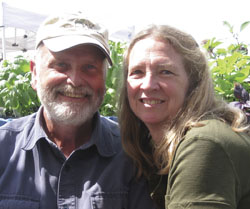
Alison and Paul Wiediger are the owners of Au Naturel Farm in south-central Kentucky. They produce vegetables on about 2 acres of their 84-acre farm and also raise pastured chicken, grass-finished beef, and eggs. They have four 20×96 unheated high tunnels and they sell 52 weeks a year.
They provide complete details of their high tunnel production in Walking to Spring, a 100-page book available from www.growingformarket.com/store or by phoning 800-307-8949. Or send a check for $20 to GFM, PO Box 3747, Lawrence, KS 66046.
Copyright Growing For Market Magazine.
All rights reserved. No portion of this article may be copied
in any manner for use other than by the subscriber without
permission from the publisher.