









Sweet potatoes are an easy, frost-tender crop. They thrive in hot weather and are fairly drought-tolerant once established. They do not require a lot of organic matter in the soil, nor high fertility levels.
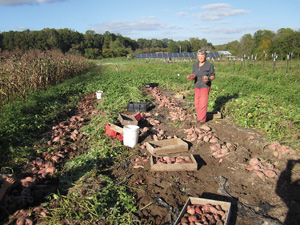
Sweet potatoes fit easily into the timing of growing other crops. Started after the first spring flush of seed-starting, the slips (young plants) grow with little attention. Planting out comes later than most spring crops—there is time before planting them to grow a good winter cover crop mix, including legumes, to the flowering stage. After the vines cover the ground, they need little care during the summer (apart from irrigation) until harvest. They leave you free when there’s plenty to do elsewhere.
Sweet potatoes provide a long-keeping crop of delicious roots for filling those CSA bags at the end of the year, or for sale in late fall and winter. At Twin Oaks we aim to supply ourselves from November to early May. One baked sweet potato of 114gm (4oz) has 185% the RDA of vitamin A, 28% the RDA of Vitamin C, 100% of vitamin E, lots of anti-oxidants, and 160 calories, none from fat.
Sweet potatoes are related to morning glory, in the genus Ipomoea. They are not yams, even though they are often called yams! True yams are a tropical species of tuber (genus Dioscorea). Sweet potatoes are roots, not tubers, and will not even cross with yams. So forget yams. Fitting sweet potatoes into a rotation is easy because it is unlikely that you are growing anything else in that family.
Varieties
There are modern varieties that grow to a good size in as little as 90 days, so sweet potatoes are not just for the South! There are purple, yellow and white ones as well as the traditional orange. There are ornamental kinds used for city beautification. Some have fancy-cut or heart-shaped leaves. There is the Bunch Porto Rico which has short vines, ideal for those with not much space.
We grow Georgia Jet, Beauregard and a white one we don’t know the name of. It is less sweet than the orange varieties, and could be an alternative to “Irish” potatoes for people seeking food self-reliance in the south, where Irish potatoes are prone to diseases, and it is not recommended to replant ones you’ve grown.
Georgia Jet is a reliable fast-growing, high-yielding orange variety I’d recommend to anyone new to growing sweet potatoes, as well as those with short seasons. It is also relatively cold-tolerant. Beauregard is another reliable orange variety, slightly slower-growing or lower-yielding, depending how you look at it.
Sweet potato slips
In February 2007, I wrote in GFM about growing your own sweet potato slips. Sweet potatoes are not grown from seed or from replanted roots, but from “slips,” which are pieces of stem with a few leaves, grown from a mother root. We used to buy bare-root sweet potato slips, believing growing our own would be very tricky. It isn’t! Now we have a system we really like, and we’ve found several advantages of home-grown slips over purchased ones. With homegrown slips we can delay planting if that seems wise; we can plant them in stages rather than all at once. The transplants don’t wilt. We can grow them big and plant them with 3-5 nodes underground, giving more chance of survival in heat or frost. We can keep some spares on hand to replace casualties. The sturdy plants get off to a strong start—this could be an even bigger advantage farther north where the season of warm-enough weather is on the short side. And we are self-reliant: we never have to spend money on slips. In addition, growing slips for sale at market could bring in some extra spring income.
Planning ahead
Decide how much space you want to devote to sweet potatoes, or how many pounds (tons?) you want to grow. One slip will produce a cluster of 4–10 roots, each weighing 3–17 oz. The yield range is 276–805 lb/1,000 sq ft, or 6–17.5 tons/acre. Yield depends on climate, spacing and length of growing season. Planting space is 6-18” in the row (wide spacing gives more jumbo roots, mostly out of favor these days as families are small). 12” would be a good spacing to start with your first year. The space between rows could be 32-60”. The vines are rampant once they get going.
Seed roots are selected from high-yielding plants at harvest. See my September 2007 GFM article for more about harvest and seed selection. Or the sweet potato chapter in my book, Sustainable Market Farming, where I spell out how to do this step-by-step. Each mother root can produce 10-30 slips, depending how much time you allow. It takes eight weeks to grow the slips, and the roots produce more slips if conditioned for two to four weeks, before you start to grow slips. Field planting is usually done about two weeks after the last frost. The soil temperature should reach at least 65°F at 4” deep on four consecutive days. For us, that’s around May 12. So, if growing your own slips, start 10-12 weeks before your planting date. You will need a place at 75°F–85°F with light, humidity, ventilation and about 12″ of headroom.
Crop requirements
Enough potassium (K) is important for drought-resistance, but too much K makes produce bitter. Sweet potatoes are light feeders for nitrogen (N), and get plenty from high-biomass cover crops, organic mulch, and soil life. The main requirements for good sweet potatoes are sunshine and heat. It is the accumulated heat units (growing degree days) that bring good yields, not the simple number of days since planting, or your winter hardiness plant zone. According to Sandhill Preservation Society, it takes early varieties about 1200 heat units (calculated on a base temperature of 55°F) to make a good harvest. Black plastic mulch, row cover or a hoophouse can help increase those heat units. Daytime temperatures of 90°F, with nights at 70°F are ideal.
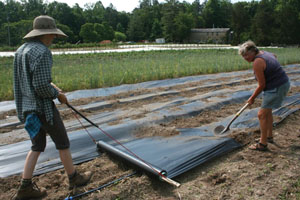 A member of the garden crew pulls biodegradable plastic mulch over the bed.
Field planting
I think it’s better to wait for the slips to grow four leaves or more in the greenhouse before planting, rather than rush them outside. For big potatoes, plant the slip vertically. For average size roots but larger yields, plant horizontally 2-3” deep. Have 3-5 leaf nodes underground and only the tips above the ground – this gives the plants a second chance if frost strikes. If, on the other hand, you are planting in hot dry weather, water the soil first, and keep the roots enclosed in damp compost as you plant. Sweet potatoes are often hilled, to reduce flood damage. Hills can be formed before planting, or after the plants are established. In colder areas, black plastic mulch can be used to warm the pre-formed ridges for about three weeks before you plant, and increase the rate of growth and the yield.
Previously, we planted on the flat in bare soil, with overhead irrigation. We sometimes had bad weeds. Since becoming greater fans of drip tape, we use that, and have adjusted our in-row planting distance from 15” to 16” (every other emitter on our preferred type of drip tape). Fewer weeds! Next, after a wet year, we tried ridging before planting, to reduce our losses to flooding. It was a bit hard to keep the drip tape on the ridges – we planted on alternate sides of the tape, so it couldn’t slide sown. Nowadays we use biodegradable plastic mulch over the drip tape (even fewer weeds!). We run the irrigation while planting, so we can nudge the drip tape to be where we want it, relative to the plants.
Biodegradable plastic mulch
In April’s Growing for Market, I wrote about various mulching materials we use, including the biodegradable plastic mulches. Since then, I researched the two main kinds a bit more, and wrote about that in my blog “Qualified praise for biodegradable plastic mulch” on May 21, 2014. I followed that up with more details about laying plastic mulch by hand. Next I wrote a blog post for Mother Earth News entitled How to Lay Biodegradable Plastic Mulch by Hand (motherearthnews.com//organic-gardening/how-to-lay-biodegradable-plastic-mulch-zbcz1406.aspx#axzz34dxYDsGi).
We like biodegradable plastic mulch because it warms the soil, and we can harvest sooner. It also keeps the weeds down for a few months, and then it falls apart, so we don’t have to remove it and cause heaps of agricultural plastic trash. It’s particularly good for vining crops like sweet potatoes and watermelons, because by the time the plastic disintegrates, the vines cover the ground and weeds have little chance of growing.
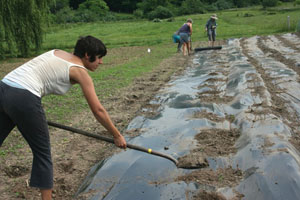
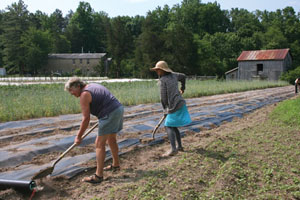
The “forward shovelers” anchor the edges of the plastic while crew members coming along behind finish burying the mulch edges.
Laying by hand is a team project, and fairly energetic. Our newest method involves a simple tool, a stick that goes through the mulch roll and has rope attached to its ends, so the roll can be pulled along the ground by someone standing upright. Much easier than crouching down, pushing the roll down the row! One problem was that the rope would sometimes get twisted round the ends of the stick. This year’s improvement is to have the rope attached to the ends of the stick with swivel clips. This allows us to unclip to take the stick out, rather than struggle to untie knots! We also threaded a piece of bicycle inner-tube over the rope to make a more comfortable handle. In my April article I described how a team shovels soil onto the edges of the plastic as we unroll.
Stages of development
Don’t be concerned that your plants don’t seem to be growing much during the first month after transplanting. This is the root development stage. Roots can go 8’ deep in 40 days. Give 1” water/week as needed, and remove weeds. If you have grown your own slips, you get a chance to replace any casualties.
The second month or so is the vine growth stage. The roots begin to store starch and sugar close to the stem base. Once the vines cover the ground very little weeding will be needed. We have sometimes done one walkthrough to pull or clip pigweed. Do not worry about secondary rooting from vines – it does not affect yield, although you may have heard otherwise.
During the third or fourth month of growth, the potatoes develop and the vines slow down their growth. Unlike white potatoes, which have a natural end to tuber growth when the tops die, sweet potatoes have no pre-programmed finish date, so you can choose when to dig them up, ahead of cold weather. The longer you wait, the bigger the potatoes, but you are gambling with the weather. Just make sure you get them up before the soil temperature gets down to 55°F.
Pests and diseases
Deer are the main pests of sweet potatoes, although if you have lots of voles, they can also do a sizeable amount ofdamage. The successful ways to deal with deer are guns, dogs and fences, not necessarily in that order. Voles eat the roots directly, while deer eat the leaves, and diminish the yield of roots indirectly. Root Knot Nematodes (Meloidogyne spp.) can cause root splitting. Galls may be visible on the fibrous secondary roots or inside rat-tail roots. Organic controls involve long crop rotations and use of nematode-inhibiting cover crops and food crops for several years. Some varieties are more resistant – Evangeline, Bienville, Jewel, Topaz, Nemagold, Pelican Processor and Hernandez show resistance to most strains; Porto Rico and Excel are susceptible to some strains but not others. Beauregard and Centennial are highly susceptible to many kinds of RKN.
Sweet potatoes are often relatively problem-free, but here are troubles you could come across, and the reasons they happen, so you know what to do differently next year.
Physiological disorders
Round chunky roots, low yield, purple color: Planted too early, when it was too cold.
Rough irregular shaped roots: Heavy clay soils or organic matter above 2%.
Low yield: Flooded or crusted soil 6-7 weeks after planting.
Souring: Tissue breakdown caused by poor soil aeration – flooding for instance.
Water blisters: Small whitish raised bumps around the lenticels (breathing holes), caused by wet soil.
Cracking: Uneven water supply or too much water late in the season.
Pithy dark flesh: Cold damage due to exposure below 55°F.
Blister: Small raised bumps appearing several months into storage – boron deficiency.
Fine hairline cracks: Also a boron deficiency symptom.
Long, slender malformed roots, reduced yield: Potassium deficiency.
Diseases
Dying transplant with black stem: Bacterial Stem Rot, Erwinia chrysanthemi. Favored by high temperatures and humidity.
Summer wilting, with bronzing of leaves: Cotton Root Rot, Phymatotrichum omnivorum, (only found in the alkaline soils of the Southwest). Affected plants die within a few days. Bronze-colored wooly fungal strands can often be seen on the roots.
Late summer browning of stem base, with reduced yield: Foot Rot Fungus, Plenodomus destruens. If symptoms are seen, early harvest will reduce crop losses.
Stunted yellow vines with blue stems at soil line. Hard, dry, black, sunken spots developing in harvest wounds of roots: Stem Rot Fungus, Fusarium oxysporum f. sp. batatas. Spots may become larger than 2” diameter, but damage is not deep.
Roots small and misshapen, with rough scabby sunken spots: Pitting, caused by Soil Rot (Soil Pox) fungus in the presence of water stress. Streptomyces ipomoea Root Rot bacterium causes a similar rot.
Metallic black round spots on the root surface: Black Rot Fungus, Certocystis fimbriata. Spots may cover most of the root surface. Internal decay is not deep, but the fungus may impart a bitter flavor.
Brownish surface blotches: Scurf, Monilochaetes infuscans fungus, more likely to occur if compost applications were too generous. Worse in wet years; superficial damage initially, but roots shrivel in storage.
Sunken brown lesions that sometimes encircle the root: Ring Rot, Pythium fungus.
Sunken lesions that dry and may fall out: Circular Spot, Sclerotium rolfsii. The underlying tissue may taste bitter.
Numerous fine or coarse irregular cracks and browning of the surface; dry, corky, dark-colored clumps of tissue scattered throughout the flesh: Russet Crack/Internal Cork, feathery mottle virus, spread by aphids. Leaves may yellow in a feathery pattern, or may have purple ring spots. The problem becomes worse if roots are stored at temperatures higher than 60°F. Do not use as seed stock.
Flesh of roots in storage is light brown and watery: Bacterial Stem Rot, Erwinia chrysanthemi. Favored by high temperatures and humidity.
Storage Rots: Several fungi can attack roots in storage, but good sanitation and gentle handling will keep these to a minimum.
See the North Carolina Sweet Potato Commission, ncsweetpotatoes.com. The commercial growing page (under the Industry tab) has lots of information and photos, good for helping you identify problems.
The Texas Plant Disease Handbook is also helpful: plantdiseasehandbook.tamu.edu/food-crops/vegetable-crops/sweet-potato also has photos.
Harvest
In the September 2007 GFM, I wrote about harvesting, curing and storing your crop. You can also read all about those important topics in Sustainable Market Farming. Here’s a short version, so you know what you are getting into. You have time to figure out the details. About 90-120 days from planting out will be long enough to give a good yield.
Aim to harvest in the week of your average first frost, on a mild day – above 50°F – to avoid chilling the potatoes. Don’t wait till soil temperatures go below 55°F. If frost does strike before you have harvested, harvest within a few days. If the days are warm, a couple of light frosts will not harm your crop. Contrary to myth, there is no toxin that moves from frozen leaves down into the roots. On the other hand, cold injury can ruin the crop, and roots without leaf cover are exposed to cold air temperatures, and have lost their method of pulling water up out of the soil. Cold wet soil can quickly rot sweet potatoes – I know; it’s happened here.
Snip and roll back the vines from the area to be harvested that day. Carefully dig up the roots, which grow in the ground in a bunch-of-bananas shape. If you want to grow your own slips next year, select seed potatoes when crating the roots in the field. Save about one root per 10 slips wanted. Do not save diseased roots for seed. Choose plants with a high yield of roots with typical appearance and no string (rat-tail) roots. Each potato produces about the same number of slips regardless of size, so choose small-medium sized potatoes, not jumbos for seed.
Curing and storage
Cure the sweet potatoes immediately after harvest, to allow the skin to thicken, cuts to heal over, and some of the starches to convert to sugars. Ideal conditions are 85-90°F, and 80-95% humidity for 7-14 days. There also needs to be some air flow and ventilation. To test if curing is complete, rub two sweet potatoes together. If the skins scratch, they need to cure longer. Once sufficiently cured, the roots can be stored until needed.
Ideal storage conditions for sweet potatoes are 55-60°F, 85-90% humidity, with one air change each day. Above 60°F, shrinking and sprouting may occur. Below 55°F, permanent chilling injury can happen – the potatoes remain hard no matter how long you cook them, and are useless. As far as I can tell, sweet potatoes don’t need to be stored in the dark.
Suppliers, resources
Sand Hill Preservation Center, Iowa. Heirlooms, 198 different varieties, small quantities (3-25), Organic certification. sandhillpreservation.com/pages/sweetpotato_catalog.html
Steele Plant Co, Tennessee. 10 varieties in quantities of 25-500 slips, good prices, great service. Certified disease-free. www.sweetpotatoplant.com
Southern Exposure Seed Exchange, Virginia. 10 varieties in bunches of 6-100 slips, Organically grown. southernexposure.com.
ATTRA Sweetpotato Organic Production is a good introduction: attra.ncat.org.
Pam Dawling is the garden manager at Twin Oaks Community in central Virginia. Some of this material is from her book, Sustainable Market Farming: Intensive Vegetable Production on a Few Acres, © Pamela Dawling and New Society Publishers, 2013. The book is available at www.sustainablemarketfarming.com, or by mail order from Sustainable Market Farming, 138 Twin Oaks Road, Louisa, Virginia 23093. Enclose a check (payable to Twin Oaks) for $40.45 including shipping. Pam’s blog is also on facebook.com/SustainableMarketFarming
Copyright Growing For Market Magazine.
All rights reserved. No portion of this article may be copied
in any manner for use other than by the subscriber without
permission from the publisher.