











Fundraising, partnering and sliding scales to reach them
As farmers, our customer base is limited to the number of people within our sales range who can afford what we grow. To increase our customer base, we are used to thinking about tempting more people to put what we grow at the top of their weekly grocery list, or figuring out how to expand the geographic sales boundaries toward larger population centers. Here, we’ll think through increasing sales by reaching customers with minimal food budgets. (See the related article “Serving the underserved” in the August 2018 GFM.)
In my region of northwest Connecticut only about 62 percent of households are in a financial position to purchase vegetables at the prices I need to charge (see Figure 1). Households experiencing poverty comprise 12 percent of the population and ALICE households (a United Way term that refers to those who earn just above the federal poverty level but less than what it costs to make ends meet) comprise 26 percent. These numbers track fairly closely to national averages (unitedforalice.org).
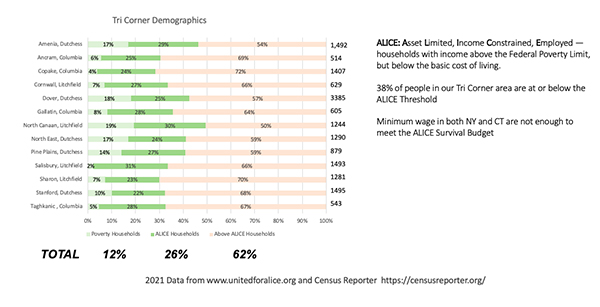
Figure 1- Data on Adamah Farm’s Regional Demographics from United for Alice, Compiled by Tricorner FEED.
At Adamah Farm, where I manage three acres of organic vegetables for direct market sales, we’ve gotten creative with how to expand our customer base into the 38 percent of households in our community that would struggle to afford our produce. We recoup the equivalent of our full wholesale pricing on everything we grow for distribution to that demographic thanks to a combination of foundation grants, individual donations, and sliding-scale pricing.
We have so much on our plates as farmers (pun intended). It feels a bit unfair to write an article that suggests farmers add the task of addressing income inequality in our marketing plans. For me though, fundraising isn’t any more cumbersome than other types of marketing. I’d much rather write a grant application in the winter than negotiate and track restaurant accounts in the summer. I’ll share a little about our process below, as well as additional opportunities beyond the scope of our particular farm to give you a sense of the options.
Adamah Food Access Fund
In 2020, a time when food insecurity skyrocketed due to the pandemic and was front of mind for many of us, we launched our Adamah Food Access Fund. Every year since then, we fundraise to fill that fund with enough money (most years about $12,000 which is 15 percent of our gross sales) to pay ourselves the value of everything that goes out to our local food access partners. We track the weight and wholesale value of those distributions to balance the quantities against what we’ve brought into the fund.
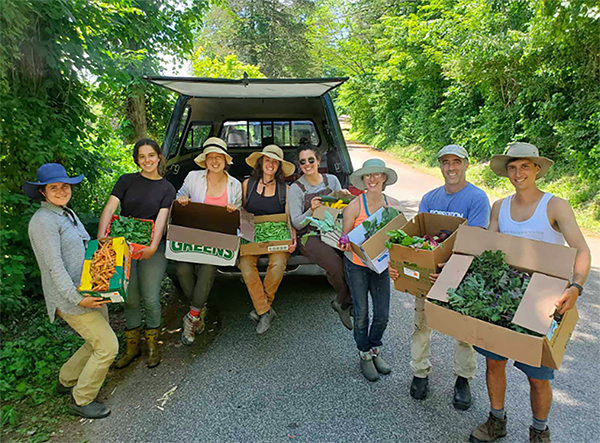
Adamah produce on the way to the food pantry.
We have long had relationships with local food pantries (small charitable organizations that distribute groceries to community members in need) and senior centers, having donated our excess for years. We would bring crates of slightly bolted bok choi, post-CSA pickup produce left behind by members who were on vacation or eat-these-today-or-they’ll-sauce-themselves super ripe August tomatoes with nowhere else to go.
It is common for market growers to find ourselves in these relationships with hunger relief organizations. We hate to see gorgeous food wasted and we want customers who can’t afford our prices to have access to our food. Pantries are a great resource for distributing donated excess to people who appreciate it, but our Food Access Fund has now allowed us to develop the relationships much further. We are now able to bring higher quantities, better quality, and more culturally appropriate foods.
We plan for the weekly distributions to food access partners in our field plan and in our weekly harvest list, but they remain much more flexible than other sales avenues — a huge advantage. We still bring extra produce that has nowhere to go for one reason or another, but we are also able to consistently bring the items our partner organizations tell us clients are looking for.
A good example is cilantro. One of the food pantries we work with serves a high percentage of people who’ve immigrated from Mexico. Their clients use cilantro less as an herb for seasoning, the way I usually think of for our CSA, and more like a salad or cooking green as the flavor and nutritional basis of dishes. Most of the pantry’s clients have little to no access to cilantro as it is expensive, low quality, and inconsistently available at grocery stores.
Understanding this situation motivates me to stay on top of biweekly cilantro plantings so we can bring plenty of large bunches as a focal point of our deliveries to the pantry. I don’t find it any harder to grow than other greens, and we are recouping the same value for those bunches as we would if we were selling them to a restaurant or other wholesale account.
Something went wrong with one of our cilantro plantings this summer, and it was a total flop (rain at the wrong time, hasty planting without watering properly, you know how it goes). Rather than losing a customer, as we might with a finicky wholesale account, we simply delivered parsley for a couple of weeks rather than cilantro. We were bummed to be a little off of our field plan, but the relationship with our pantry clients is more like the relationship between CSA farm and shareholder. Imperfection is part of the process and a little variation in output is forgiven as long as the overall product is consistent and high quality.
When I compare our food pantry and senior center accounts to our other sales avenues, they are consistently more efficient for us. The volume, flexibility, and ease of delivery make the wholesale prices work for us. If we were to sell our produce at a significant markup at a farmers market, we would have to sink hours of labor into packing, driving, and staffing the stand.
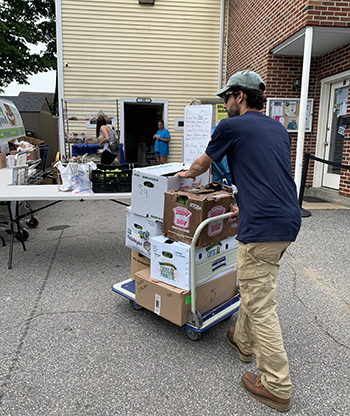
Adam Dropping off fresh lettuce and cilantro at Friendly Hands Food Pantry in Torrington
If we were anywhere other than the top markets, which there aren’t many of in our area, we would have a good percentage of shrink that would go unsold at the end of the day (especially if the weather kept market customers low). We’d have to grow some of everything to make the display full and gorgeous, rather than the items we know pantry clients are particularly looking for.
CSA and some farm-to-institution accounts are still lucrative centerpieces of our business, as they offer their own advantages and I haven’t been able to fundraise enough to sell everything we grow wholesale to food access partners. Still our subsidized “sales” are an important part of our business rather than an afterthought.
In addition to the Food Access Fund, sliding-scale CSA pricing has expanded our customer base, especially into that ALICE demographic of households described above. In our CSA marketing, we list the cost of production for a twenty-two week share at $830, asking that members reflect on their financial capacity and pay what they can, including a higher rate if budget allows.
Explaining a sliding scale can be tricky — most of us aren’t used to reflecting on our assets and savings and expendable income in relation to that of others when whipping out our credit cards. But CSAs are unique economic models already, and I’ve found that people are willing to take the time to read through our explanation and be thoughtful in determining their payment amount. Members are generous and honest, and they seem to very much want to support the farm, so we consistently bring in an average of at least $830 per share, putting any excess into the Food Access Fund. In years where we come up short, we cover anyone who can’t afford the full CSA price with money from the fund.
Of course, sliding scale CSAs, or similar structures at pay-what-you-can farm stands, have their limitations. They only reach people with the ability to come to the point of sale, and you have to be operating among a pool of customers that includes those with enough financial means to contribute at higher rates. The realities of wealth disparity are such that people of differing financial capacity might not live in the same area as one another, and a farm might need to include multiple sites in different places if they are trying to reach different financial demographics.
Nutrition Insecurity
While many Americans experience food insecurity and hunger, many more have access to enough calories, thanks to the availability of cheap processed foods and hunger relief efforts, but don’t have access to good nutrition. For all the reasons we are familiar with as market farmers, (lack of subsidies, cost of production, challenges of marketing perishable items) accessing the necessary nutrition from fresh produce is particularly cost prohibitive to many.
Raising funds for food access
When I explain the Food Access Fund to potential funders they are often particularly interested in the double impact of addressing nutrition insecurity while supporting local farm viability.
It takes leg work to figure out where to apply. Some foundations may only give to non-profits, so an LLC or other farm business entity without 501c3 status would need a fiscal sponsor to accept those grants. Other foundations will give grants directly to any business entity as long as the project meets their eligibility requirements.
You can start with a simple google search for community foundations in your region or go the analog route and ask around. Find nonprofits in your area doing good work and ask where they get their funding. Foundations have specific areas of focus, so look for ones working on health or strengthening local economies. Most have program managers whose job it is to talk to potential recipients about whether a grant might be possible.
It’s worth taking time with those conversations so you don’t waste effort on an application that won’t go anywhere. We never receive every grant I apply for, but the more I’ve gone through the process, the more I’ve developed a narrative I can repeat without reinventing each application.
Food pantries themselves are also a great resource for finding funding. Most are operated by a community organization like a church, mosque, synagogue, health center, or other small nonprofit. They fund their budgets via public and private grants as well as financial donations from individuals.
Pantries usually purchase food, almost exclusively nonperishable items, at low cost from food banks, a term that usually refers to organizations like Feeding America that aggregate food donated by, or cheaply purchased from, the industrial food system. If pantries are able to offer any fresh produce or animal protein, they are usually purchasing it separately and not through their food bank orders.
Pantry operators in my region often travel half an hour away to purchase produce at retail prices from discount grocery chains. Considering this reality, it is worth figuring out what your price point would be for selling bulk to pantries. Then, determine whether the pantry’s budget, perhaps with extra support from donors, might accommodate direct purchasing from your farm. Soup kitchens (charitable nonprofits that prepare meals rather than distribute groceries) and other community projects may also be in a similar position to purchase directly from you rather than their regular sources.
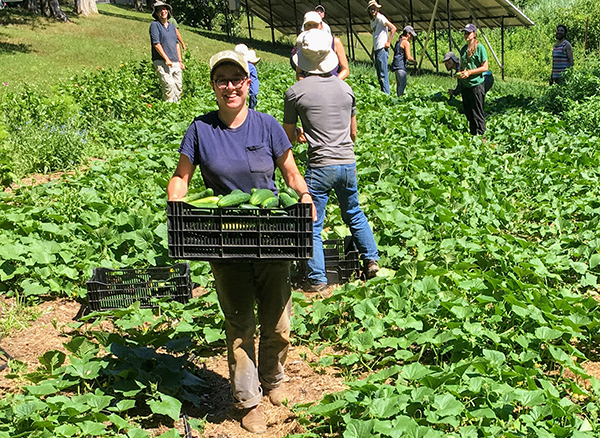
Adamah apprentices and volunteers harvesting cucumbers for food pantry delivery.
At Adamah, we also fundraise from individuals in our community with a button on our website and occasional email appeals. We have CSA members who regularly make holiday gifts of donations to the Food Access Fund, and others who are generous throughout the season when we send out an email campaign.
Local farmer support organizations can also be good funding sources for food access work. Four farmer support organizations in our region — CTNOFA, Berkshire Grown, Berkshire Agricultural Ventures, and Tri Corner FEED — offer grants to farmers to subsidize food grown for nutrition insecure households.
If your region doesn’t have community foundations, individual donors, or farmer support nonprofits that are already funding food access work, don’t despair. Most of the organizations described in this article were not offering food access funding five years ago, so there may be a slow and steady process afoot by simply putting feelers out, asking questions, and remaining open to the possibility that opportunities might present themselves over time.
Partnerships with nonprofits
Farmers tend to be a self-sufficient bunch, but wealth disparity doesn’t exist in a vacuum and so the solutions don’t either. Here are a few examples of organizations that are partnering with one another, with farmers, and with government agencies to address food access issues. These might inspire you to think about what’s possible in your region.
The Food Sovereignty Fund: The Glynwood Center for Regional Food and Farming, a nonprofit in New York’s Hudson Valley, raises money to match farmers with food access partners and pays them for the deliveries. The Food Sovereignty Fund distributes $300,000 among 23 farms and is overseen by Glynwood staff along with an accountability council made up of farmers, community organization operators, and other experts.
Megan Larmer, who works with the fund for Glynwood, had some advice for farmers looking to get involved in similar projects: “It is important to make a good match between the capacities and needs of the farm and the partner organization. If there is a food pantry serving groceries to 800 families a week, we match it with a higher volume farm. If there is a soup kitchen looking for a few ingredients for 100 weekly lunches, we can match it with a very small farm.”
“The charitable food system, or emergency food system, or however you want to name it — food pantries, mutual aid networks — they are all spending money on food. There is this expectation that they’re getting their food for free but that’s not the case, so it’s worth going to them directly and asking how to partner. The cost of buying wholesale from farms is rarely significantly higher than retail from grocery stores. Reliable partners are hard for pantries to find. If you can be counted upon, that is super valuable so don’t undersell your farm.
“I’d recommend having a formal planning meeting between the farm and the food access organization to establish pricing, delivery locations, timing, contact info, record-keeping expectations, seasonal availability, and what to do in the case of a crop failure or a pantry closure. Relationship building is key, it is the mycelial network that is the basis of partnerships working in the long term.”
The Northwest Connecticut Food Hub: Renee Giroux, who runs the nonprofit NWCT Food Hub, describes it as a place that lifts the region’s farms together by expanding access to customers rather than putting them in competition with one another. The hub is a physical distribution center where farms drop off orders to be aggregated and then delivered to customers including restaurants and other wholesale accounts. It also delivers subsidized orders to food access organizations like food pantries, hospitals, and schools. The 30 or so participating farms list their availability each week online for buyers before the delivery deadline.
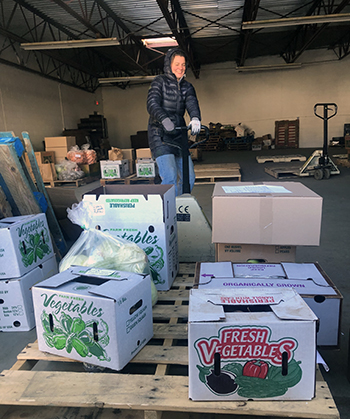
Northwest Connecticut Food Hub Director Renee Giroux moving a pallet of regionally grown produce dropped off by farmers, agregated, and prepared for outgoing delivery to food access organizations.
Food Hub board member, Jocelyn Ayer, explains that the goals of supporting farms while improving food security in the region are funded through a hodgepodge of sources. “The farm to school funding comes through a contract the school districts have with an education focused non-profit; the funding for food as medicine distributions to diabetes patients at the hospital comes through a healthcare community fund; food pantry subsidies come through the USDA.
“It’s all much more complicated than anyone wants it to be, but dedicated volunteers cobble together the grants, along with staff at partner organizations like the hospital. It would be too hard for individual farmers to access these types of grants, so that’s the purpose of the hub. We can funnel grant money into the food system and do the quick turnaround needed for applications and reporting.”
Tri Corner FEED and the Northeast Community Center (NECC): A nonprofit started by retired farmers who understand the particular challenges of farming and the need for farmers to charge fair prices, Tri Corner FEED’s mission is to promote food equity. Founder Linda Quella describes it as “the ability of people to get high-quality, nutrient-dense food whenever they need it.” The organization makes grants to farmers who produce for food access organizations.
It is launching a study to evaluate the feasibility of a fair pricing program where people pay for locally produced food based on their financial capacity. The study is being done in partnership with NECC, a local community center, and with the financial support of a USDA Local Food Promotion Planning Grant.
NECC’s food program director, Jordan Schmidt, this winter is deep into the process of surveying farmers and consumers and reviewing other food equity solutions that are already up and running. The main thing she’s learned so far about fair pricing program models is that context really matters. One model might include preloading a regional EBT-style card for consumers to use at farm stands and markets, such as is used in the ADK Action program in the very rural Adirondack mountains of New York.
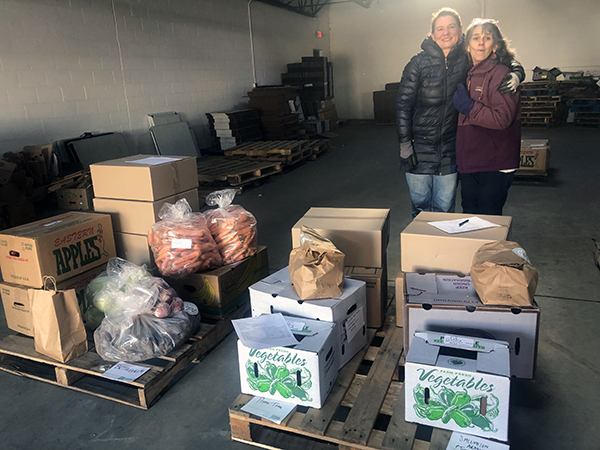
Renee Giroux and Susan Zappulla-Peters with pallets of produce aggregated from different regional farms and prepared for deliveries to local food access organizations.
In other cases, having an aggregator component, like the NWCT Food Hub described above, might be more important. In still other cases, having a grocery retail storefront is most appropriate, as with the Hudson, New York, based Rolling Grocer 19.
So far the Tri Corner FEED/NECC study has found that most farmers are excited about the potential of a fair pricing program. They are open to accepting wholesale prices, but not lower and would need systems to be smooth and easy to use in order to participate. On the consumer side, Schmidt is finding — from study results and her own experience running a food pantry at NECC — that consumer choice is really important.
Outside of the survey itself, NECC gathers local farmers, chefs, and staff members of food access organizations on a monthly call called the Tri Corner Nutrition Security Coalition. The coalition has thus far been a useful forum among people working toward solutions from different angles, and will only be more so if and when a fair pricing program gets off the ground here.
Federal, state, and local funding
Advocates have long seen the resilience-building opportunities in connecting local farmers with an expansive range of customers, including those experiencing financial insecurity, through government programs. Below is an attempted overview of the kinds of options that exist. The details of each vary considerably by location, so if you want to know more about what is available to you, your best bet is to ask for advice from local agencies (USDA, state departments of agriculture, local health and human services offices, municipalities).
Farmers who have navigated government grants, incentives, or technical assistance — perhaps via NRCS for a high tunnel or conservation incentive or via FSA for COVID relief — know the process can be confusing and that not every opportunity is a match for every farm. When they are the right fit, however, government programs can also be worth the effort, so it is worth knowing what’s out there.
Much gratitude to Hannah Quigley of the National Sustainable Agriculture Coalition, Brent Ling of Wholesome Wave, and Ben Feldman of the Farmers Market Coalition for helping me understand the programs listed below well enough to describe them to you.
SNAP: The Supplemental Nutrition Assistance Program allows income-eligible Americans to purchase food with monthly benefits loaded onto EBT cards that are issued to each recipient. There is an app currently under development that would allow farmers to accept SNAP without an EBT reader, but for now you, or the market you sell at, will need to have one. If your farm doesn’t already accept SNAP benefits, you can contact your local extension office to get connected to a SNAP educator who can set you, or the market you sell at, up with FNS (USDA’s Food and Nutrition Service) as a SNAP vendor.
FMNP: The Farmers Market Nutrition Program offers additional farm-fresh food purchasing benefits to recipients of WIC (the Women Infants and Children supplemental nutrition program) and to income-eligible seniors. Your local health and human services agency can help set you, or the market you sell at, up with the ability to accept these benefits.
Doubled Nutrition Benefits: There are a myriad of public and private efforts to increase the spending capacity of SNAP and WIC recipients who buy fresh food directly from farmers, including the popular Double Up Food Bucks program. If you or the market you sell at don’t already partner with one of these efforts, consider asking local health agencies about how to get tapped in.
LFPA: The Local Food Purchase Assistance Program uses federal money to buy food directly from farmers, often at close to retail prices, for distribution to food access distributors. LFPA is usually administered through state departments of agriculture, education, or health, so those are the agencies to inquire with if you are interested in learning more about the program.
GUSNIP: There are two programs within the Gus Schumacher Nutrition Incentives Program, both of which are aimed at connecting the food system and the health care system toward improved resiliency for both. The GUSNIP Produce Prescription Program treats fresh produce as a kind of medicine, awarding grants to healthcare organizations that can then prescribe subsidized produce to eligible patients.
The GUSNIP Nutrition Incentive Program awards grants to farmers markets, community health organizations, and the like for point of sale incentives for consumers. The GUSNIP Nutrition Incentive Hub is a resource that can help with that application process. For either grant, you could work with an eligible nonprofit or government agency that wants to apply and develop a plan they could rely on to buy from you with the award.
Farm to School: Is there anything more satisfying than watching a child eat a vegetable you grew? School food procurement is a complicated matrix, but there are resources to help schools buy directly from farms. Many states and municipalities have their own programs, and there is federal money as well. So, it could be worth asking your school district about the options or encouraging them to apply for funding.
Regional Food Business Centers: Many of us are accustomed to working with cooperative extensions to support our agronomic and horticultural practices. USDA has newly launched regional food business centers to support local food systems and marketing with technical assistance and capacity building grants for things like food safety, processing, and packaging. While their focus is to support farmers in navigating the supply chain in general, the centers could be a good resource for the specific question of how to connect to the food access opportunities described above in your area.
Janna Siller is the Farm Director at Adamah, an organic production farm and educational program in Falls Village, CT. She also represents the nonprofit organization, Hazon, as a member of the National Sustainable Agriculture Coalition.
Copyright Growing For Market Magazine.
All rights reserved. No portion of this article may be copied
in any manner for use other than by the subscriber without
permission from the publisher.