











Lush crops among solar arrays at Sprout City Farms site at Jack’s Solar Garden in Longmont, Colorado, show how crops and solar panels can be good bedfellows in arid climates. The microclimate created by the panels helps retain moisture and protects plants from too much sun. Meanwhile, vegetation transpiration cools the panels making them more efficient.
Small-scale solar systems seem well-suited to produce energy for farm operations. Newer technologies fit nicely with this, including cells that let more light through (traditional panels are opaque) and can be fitted on greenhouses. Bifacial panels (absorbing light from both sides) are being set vertically between hoop houses for added light reflected off the plastic.
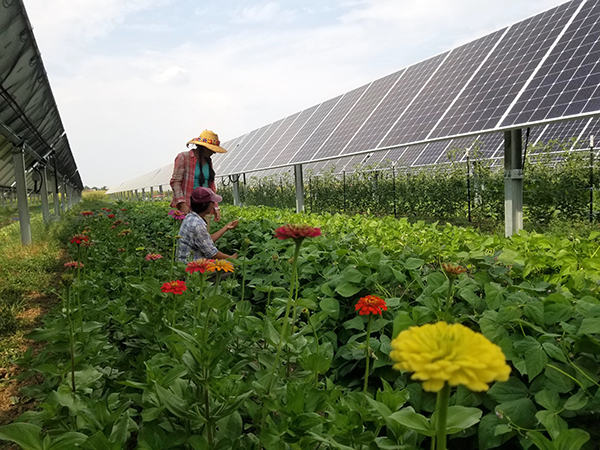 Crops grown among the solar arrays at Sprout City Farms site at Jack’s Solar Garden in Longmont, Colorado Photo courtesy of Sprout City Farms.
Large-scale agrivoltaics (agriculture combined with photovoltaics) is young. Yet, sold as a “win-win” dual use, it’s being pushed in wetter regions with less sun and is threatening good crop land and yields before the farming side is proven. Today, researchers are analyzing which crops do best in different climates, combined with different solar hardware configurations and under various panel transparencies.
Mike Ghia, a farm consultant and Vermont field agent with Land for Good, advocates for better overall planning to put energy directly where it’s needed while carefully analyzing lands to generally avoid solar arrays on prime agricultural soils. Like others, he’d like to see solar installations prioritized on developed and disturbed sites. When solar arrays are built on farmland, Ghia would like to see their development prioritized on poorer soils suitable only for pasture.
This article looks at: Ongoing crop agrivoltaics in Colorado and Arizona that offer lessons for farmers beyond those climates and regions. Small-scale solar to fill farms’ energy needs. Pushback in Massachusetts where ratepayer funded incentives/subsidies are accelerating agrivoltaics on cropland. Rooftop agrivoltaics research. And, pollinator habitats as an alternative to the scorched earth often found around solar arrays.
Research in Colorado and Arizona
With buried sensors and other data-gathering tools, researchers are studying moisture, light, crop yields and other elements of agrivoltaics at several sites in Tucson and near Boulder at Sprout City Farms. The research is led by Greg Barron-Gafford, a biogeographer (science at the nexus of environmental and human factors), at University of Arizona.
In arid, sunny climates the shade and cover from solar panels reduce moisture evaporation from plants and soil. Water conservation is vital in places like these where farmers are losing part or all of their water allotments while facing extreme heat and drought. At the agrivoltaic project at Biosphere 2 outside of Tucson, the squash, red beans, tomatoes and basil are watered every other day instead of twice a day as needed there for field crops, Barron-Gafford said.
Many plants — especially food crops not adapted to arid and semi-arid environments — benefit from some shade. Plants use limited sunlight for photosynthesis; once the light saturation point is reached, additional sun just dries them out.
The cooler microclimate isn’t just good for crops. Laser guns measured skin temperatures under solar array shade and found it’s about 20 degrees cooler than skin in direct sun. “It’s 100 degrees here all day long so that has huge implications for farmer health,” said Meg Caley, Sprout City Farms Co-Founder and Executive Director. “It’s more comfortable, you can work longer.” As the solar panels tilt and shift tracking the sun, they maximize work time in the shade.
Liza McConnell, the research farm manager there, and staff easily walk a few paces for a shaded break under the panels in the middle of the day. “That’s a big deal,” Liza said. “On other farms you have to walk half a mile.”
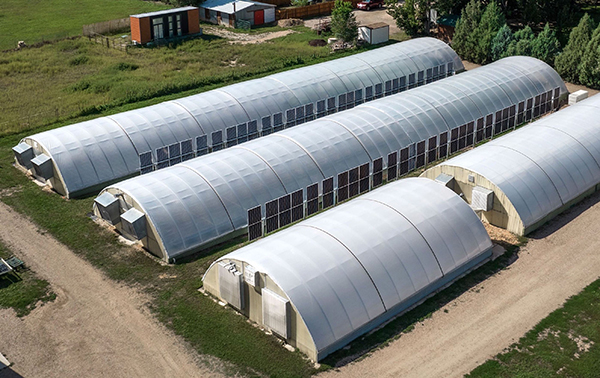 Vertical bifacial solar panels set between greenhouses at Summit Plant Labs in Fort Collins, Colorado, are being studied to see how much extra energy is created by light reflected off the greenhouse plastic. Photo by Aidan Muir.
The agrivoltaic research at Jack’s Solar Garden came about after Byron Kominek decided that growing hay on his family’s 24-acre Longmont farm no longer made economic sense. The more than 3,200 solar panels there create 1.2 MW, enough to power over 300 homes. Community members subscribe to Jack’s through a power company and receive credits through their utility bills.
Kominek wanted to keep the land in agriculture and linked up with the National Renewable Energy Laboratory (NREL), Colorado State University, and University of Arizona to conduct research on microclimates created by a megawatt size solar array and how it impacted crops and other vegetation. They also are studying solar infrastructure effects on grazing animals and pollinator habitats.
Sprout City Farms is a good partner for the 2.5-acre agrivoltaics research. As a nonprofit, they have other funding sources. They give half their produce to underserved community members. “The amount of extra work and attention to detail needed to run a research farm is not super appealing to a regular for-profit farmer,” Meg said. It’s also risky since there’s no extensive data yet on what crops will thrive or fail, and the solar hardware (set up to maximize energy production, not farming) creates obstacles during farm tasks and adds labor time. “We really wanted to help trail-blaze agrivoltaics so then we can open the doors to the entrepreneurs,” Meg said.
They initially used a small John Deere tractor to shape the beds and loosen compaction from constructing the arrays, said Brittany Staie, the first farm manager who still participates in the research as a graduate student. Initially, rain and morning dew coming off panel edges was hitting the same spots and compacting the soil and causing fungus on cucurbits, she said. This year, they configured it so the panel drip edges line up with pathways, not crops. Since creating the beds, they’ve used no-till practices with broadforks and hand tools with the exception of a power harrow and flail mower for cover crops.
What they’ve shared about crops comes with the caveat that the research is in early stages and they made changes for the 2023 season. “We’re not ready to write a white paper on growing vegetables under solar,” Liza mused. Anecdotally, however, they see positive results, especially with greens, lettuces, arugula, chard and cabbages. The shade and microclimates allowed them to extend these cool season crops, along with radishes and beets, into the summer.
The lettuces, mustard greens and arugula resisted bolting much longer under the panels, with better quality flavor than in fully sun exposed control beds. In their climate, summer lettuce normally is small, tough and quickly bolts. Instead, it was sweet and tasty even in July.
“We’re noticing some things do well but might take longer,” Liza said, adding French breakfast radishes took five instead of three weeks to mature but were fantastic instead of pithy and soft.
Kale leaves were waist high and “our chard was insane with still tasty enormous leaves,” Liza said. “It grew well in all three beds under solar.”
Three 30-inch beds are set between the 17-foot post-to-post spacing of the solar arrays with 1 to 2 foot pathways. Conventionally, panels are set just 3 feet off the ground, but to grow crops Sprout City’s arrays are 6 feet high in one area and 8 feet in another. Elevating the panels increases the costs; every foot higher above ground requires an additional foot underground.
NREL light studies at Sprout City Farms shows the eastern and western beds get between 52 to 57 percent sunlight while the center beds get about 63 to 70 percent sun. Under the 6-foot panels the shading is very uneven but more uniform under the 8-foot, Meg said.
This year, Liza plans to save the center bed for crops that need more sun and trellising, like tomatoes. They focus on leafy vegetables, root and fruiting crops, along with dry beans and potatoes suited to Colorado. Each crop is planted in each of the three beds to test how they do with various levels of sun. They also are testing moisture needs by watering some sets of crops regularly and withholding half that amount of water elsewhere on the same crops. There is a full sun control plot for comparisons.
We’ll revisit them once more results are in. They’re also studying perennials, such as raspberry, blackberries and service berries. Last year, a neglected area under panels was hardly irrigated, yet still produced plenty of berries.
On the down side, they’ve had more pest pressure from grasshoppers that thrive in 2-foot-wide grass strips that run post to post in the middle of the arrays. The tilting panels make it hard to walk or move there, so most crops wouldn’t work. They’ll try perennials, mushrooms or cover crops, Meg said.
Cumbersome movement around the arrays adds to labor costs, the largest expense in farming. “Basically you can’t just walk wherever you want,” Meg said. “You’re going to hit your head. Access to the field is a time suck.” At the low tilt points east and west the panels are only a few feet off the ground.
While Jack’s Solar Garden is designed to maximize energy production, Brittany helped a farm near Denver design an agrivoltaic set up with more pathways and driveways to make it easier for the farmer. She says it is possible to cut out much of the extra labor in agrivoltaics.
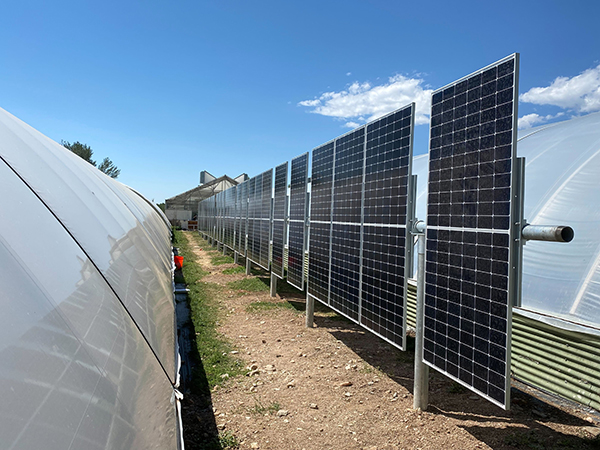 A solar fence, vertical bifacial panels set between greenhouses, are being studied by Sandbox Solar and Colorado State University to see how much extra energy is created by light reflected off the greenhouse plastic Photo by Aidan Muir.
A key point overall that keeps coming up: If the solar system is not designed to enhance farming and produce robust crops, then don’t try to sell it as a “win-win” for agriculture and energy. My review is showing that solar arrays need to be higher with more space between them than conventional solar set ups, cells that allow more light produce better yields in many climates, and layouts should allow farm staff and equipment to move efficiently. Also, it’s worth waiting to see what research shows before rushing large-scale “dual-use” agrivoltaics.
Farmers in Germany and Denmark, where it’s cooler and sunlight is limited, are using a lower density of panels and spacing them farther apart for more sun.
Saffron grew well in aisles and around the perimeters of fixed, tilted solar arrays, especially when grown in raised beds as opposed to directly in the soil. Directly under the panels, yields were lower. That’s according to research in Burlington, Vermont, by the University of Vermont’s North American Center for Saffron Research and Development. Saffron is low growing, and the corms are left in the ground for three to five years after planting. The arrays created obstacles during tending to the plants, but the harvest period is just two to three weeks.
A 10-acre raspberry pilot in the Netherlands by a subsidiary of the German BayWa Group, so far shows the shade tolerant crop did as well or better than a test crop under the conventionally used plastic and saved on the higher labor cost plastic cover requires. The raspberries also fared well in a hail storm that destroyed the berries under plastic.
The German Fraunhofer Institute for Solar Energy study results mimic what has been discussed here: During wet, cold years, agrivoltaic crops produced poorer yields than control field crops (25 percent less), while during drought years the crops under the panels did better.
Farm-scale solar
Colorado State University is studying three levels of light penetration in solar cells. I chatted about it with Thomas Hickey, a research assistant at CSU and Sandbox Solar, a Fort Collins solar company. In the test plots, the least sun comes through completely opaque conventional panels, although the shade moves as the sun crosses the fixed test panels. The next level is bifacial panels that let 5 percent of the sun through. The most penetration is thin-filmed frameless cadmium telluride (CdTe) solar cells that are 40 percent transparent.
Hickey likened these latter panels to growing under shade cloth. They’ve found the best crop results under them. Yet, it takes 2.5 of them to match conventional cell energy production. No surprise, leafy greens, cilantro, spinach and other cool weather crops did better under the conventional panels, while tomatoes, peppers, yellow straight neck squash did best under the most transparent cells.
Hickey expects greater production of the bifacial and thin-filmed cells since the recent Inflation Reduction Act earmarked $400 billion for renewable technologies and offers tax breaks and subsidies for U.S. solar manufacturers. In Europe many manufactures are already producing them with farmers using the thin-filmed cells as solar roofs on greenhouses, he said.
As part of Hickey’s research, Sandbox Solar installed bifacial panels between greenhouses at Summit Plant Laboratories, a specialty micropropagation and seed testing company in Colorado. The upright panels are most efficient when sun directly hits the front and back faces, and they get added energy production from light reflected off greenhouse plastic. “We will be actively monitoring the production data to quantify just how much added output the array gets from the reflectance of the high tunnels,” Hickey said.
Sandbox Solar and NREL are developing agrivoltaic design and modeling software called Spade to provide users a rough idea about crops, solar configurations, costs and profits in local settings. It’s in the early stages.
“The current web application represents a front-end Beta or Minimum Viable Product,” Hickey explained. “There are currently 30 climate files, locations available on the front end. On the back end (closed server) we can run just about any location and any PV configuration in the world. We will need more funding, grants, partnerships to fully develop the front end. We are open to feedback from ag personnel so we can be sure to bring the correct aspects to the front-end.”
In the meantime, he points to an NREL calculator to help suss out economic considerations: https://openei.org/wiki/InSPIRE/Financial_Calculator .
Some GFM farmers already are integrating solar, but on buildings rather than over crops. Steve O’Shea at 3 Porch Farm in Comer, Georgia, brings his dedication to sustainability to the flower and fruit farm. There are solar panels on all of 3 Porch’s working buildings: the design/processing studio, walk-in coolers, barn, workshop, and a huge parking shed.
“That last one was just an excuse to have more roof space for panels,” Steve said. “but we can fit two moving trucks and two vans under it. We definitely utilize solar panels not only for their renewable energy production, but for their ability to shade the roof of our flower studio and two walk-in coolers. The less sun that hits your building, the less electricity you need to use to cool the facilities.”
Push back in Massachusetts
There’s strong push back in Massachusetts against the incentives/subsidies for dual-use agriculture and solar driven by the state’s energy agency. The Solar Massachusetts Renewable Target (SMART) program — funded by special utility ratepayer fees — already is resulting in farm land being converted into agrivoltaic projects. It’s dressed as green energy, but isn’t truly green, says farmer Fred Beddall, among the outspoken opponents. He and his wife grow strawberries, blueberries and dahlias along with vegetable, flower and herb starts on their 8-acre Pie in the Sky farm close to North Hampton.
“This program is not about keeping land in agriculture, but taking land out of agriculture,” Fred told me. “The value of generating energy is so much higher the farming is window dressing or a vestige of itself. There’s no logical sense to grow vegetables, instead just run some sheep under it.”
There’s very little prime irrigated crop land in the state, Fred said, and the incentives don’t distinguish between ruminants or crops, so local food production is reduced. The first big SMART agrivoltaic project is converting cropland into solar combined with sheep pasture.
Many Massachusetts farmers aren’t growing crops on their own land, but leasing. So enticing landowners to large-scale solar results in shutting out young farmers and existing farmers who want to expand, Fred said. “Solar throws in a big monkey wrench, a competing use.” He talked about potential dangers over the lifespan of large solar installations to soil and water from battery storage and 10-foot fencing around the installations that are wildlife barriers.
Fred and others dispute a selling point energy companies use, that solar arrays could be removed and natural areas restored decades later. “These are not flimsy structures that would easily be pulled out to return to nature,” Fred said.
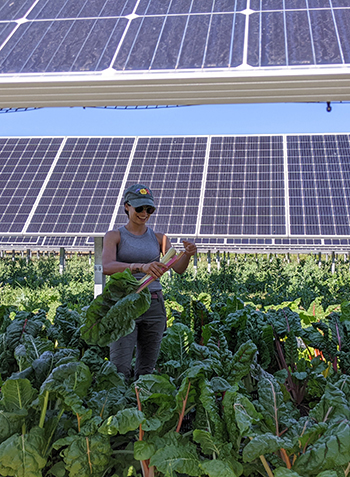 Harvesting large leaf, still tasty chard under the solar panels at Sprout City Farms site at Jack’s Solar Garden in Longmont, Colorado Photo courtesy of Sprout City Farms.
The Massachusetts Audubon Society and others want to steer solar projects away from prime farmland to areas where natural resources are already compromised such as parking lot and mall roofs until agricultural uses are proven in that region. “We would like to wait to have something that actually works for farmers,” Fred said.
Research is just getting underway at University of Massachusetts. “There are a lot of open questions and limited science to make recommendations,” said Zara Dowling, a UMass research fellow specializing in environmental and wildlife issues related to renewable energy. “There’s not published science on what crops do well or how well they do, what amount of shading affects yield and disease, and how air flow, humidity, temperature could have negative or positive effects.”
Rooftop crops and solar
We’ve written about rooftop farms producing robust crops, but none has combined them with solar panels. Many think rooftop agrivoltaics will be an important solution to higher population concentrations in cities, a growing need for local food producers and a greater demand for cleaner energy. A United Nations study projects that by 2050 two-thirds of the world population will live in cities.
This spring trials of solar combined with leafy greens and medicinal herbs will be underway on Denver rooftops. You might be asking why so much is centered in Colorado? Well, that’s where the sun is. “We’ve got some of the highest solar suitability ratings in the U.S.,” said Jennifer Bousselot, Colorado State University assistant professor of horticulture who is heading the rooftop agrivoltaic research. “There’s an ethic here in Colorado about focusing on a combination of environmental stewardship and technology. You could say the culture here is ripe for it.”
Bousselot is seeking funding to include more vegetable crops. “Eventually I’d even like to try small fruits as I see them as a high value crop with a short shelf life that would be ideal to be produced close to consumers,” she added. “The growing environment under panels is proving to be similar to high tunnels and that could mean better overwintering of the canes/shrubs and their buds.”
Solar installations on rooftops are more expensive and the conditions are more extreme than on the ground. So, we plan to revisit this research as it evolves. Bousselot said there’s little research on rooftop agrivoltaics in Europe and other countries. She’s fielding calls from researchers there.
Pollinator habitats
Around the United States and Canada, pollinator habitats are an increasingly popular option to desolate solar array sites. Since 2015, Mike Kiernan and his wife, Tanya, both physicians, have been helping create pollinator habitat meadows in otherwise unproductive land at solar sites throughout Vermont through their organization Bee the Change (beethechange.earth).
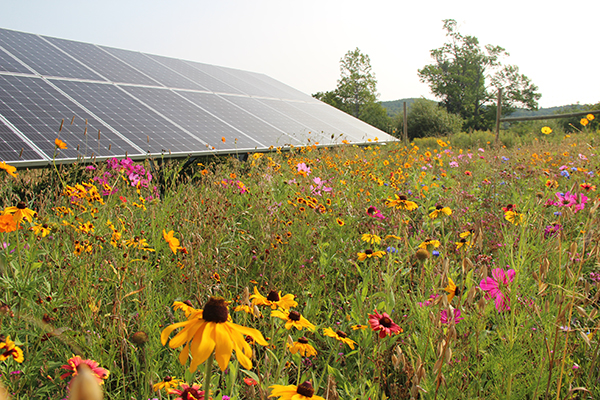 Bee the Change is establishing and maintaining pollinator meadows among solar arrays throughout Vermont , this one in Hinesburg, Vermont. Photo courtesy of Bee the Change.
It’s not a matter of throwing out seeds. There’s a lot of effort the first five years before a self-sustaining meadow is established. The soil disturbance of putting in solar arrays can unleash dormant seeds, like curly dock weed and invasive species that will wreck a planned pollinator habitat, Kiernan said.
They plant low growing plants like clover where panels are the lowest and areas that will be mowed. They put in taller plants like asters, goldenrod, mountain mint, milkweed, daisies, and rudbeckia where they can thrive, depending on the amount of full sun and shade.
Their goal is to help diverse insect species survive in the face of the looming food security crisis and pollinator species disappearing.
Jane Tanner grew cut flowers and specialty crops at Windcrest Farm and Commonwealth Farms in North Carolina, and helped manage the biodynamic gardens at Spikenard Farm in Virginia.
Copyright Growing For Market Magazine.
All rights reserved. No portion of this article may be copied
in any manner for use other than by the subscriber without
permission from the publisher.