











If any cut flower has made a comeback in recent years, it’s the chrysanthemum. This flower, once relegated to boring imports at the grocery store, has taken off in recent years and for good reason. There is so much to love about mums.
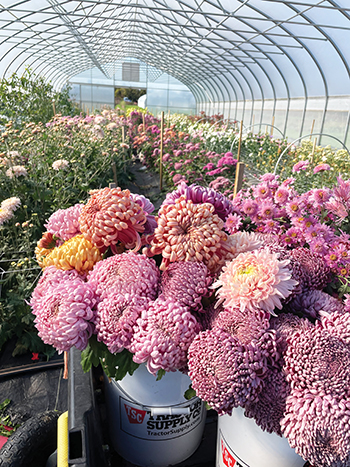
Mums in bloom, with large disbudded varieties in the front.
They bloom late in the season, usually from mid-October well into November. For growers in most zones, they fill in the gap after frost has destroyed the field flowers. Because they bloom during this time when local flowers are scarce, we can always sell every last stem. Mums also can be planted quite late, into June and even July, so they rotate well with spring crops like ranunculus. Many mums have huge dahlia-like flowers, but with a much longer vase life, often two weeks or more.
Here at our farm, Moonshot Farm in East Windsor, New Jersey, we grow thousands of chrysanthemum plants each year. We find them to be profitable, reliable, and a lot of fun.
Mum types and where to get them
Mums were once commonly grown in greenhouses across the United States. After the domestic cut flower industry shifted to using largely cheap imported flowers, domestic mum production dropped, and many varieties were lost. Gardeners have maintained some of those varieties, now known as heirloom mums.
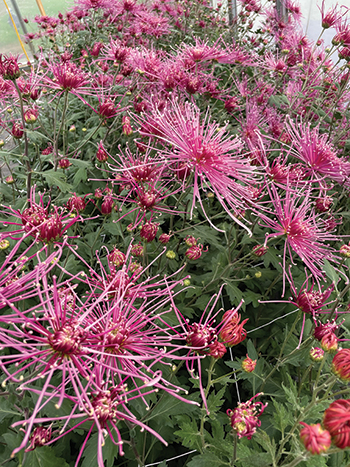
Fleur de Lis mums in bloom. All photos courtesy of the author.
U.S. mum production was further limited by USDA regulations prohibiting imports of chrysanthemum plant stock due to disease. This means there are limited sources and varieties for mum plants. Farmers abroad have access to many more mum varieties, created by breeders in Europe. All chrysanthemums are grown from vegetatively propagated cuttings or tissue culture, not from seed.
Heirloom chrysanthemums come in a wide range of sizes, colors, and shapes. They’re so unique that our customers often don’t recognize that they’re chrysanthemums. As these are heirloom-style plants, rather than varieties coming from modern plant breeding techniques, they have varying productivity, habits, uniformity and disease resistance.
The main source for heirloom mum cuttings is King’s Mums, which offers the largest selection of varieties and reputable, inspected stock. King’s has had high demand in recent years and usually sells out fast after opening for orders in January. Several other sellers have started offering mum cuttings, but growers should be cautious — as mums are live plants, disease can quickly spread.
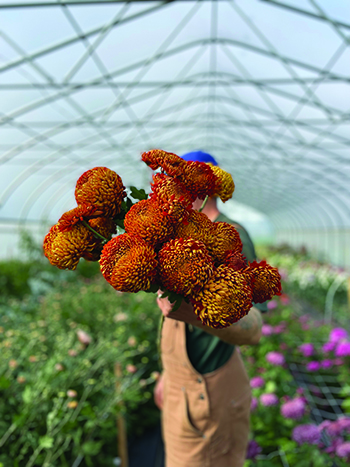
Heather James mums are one of our first to bloom.
We only purchase mums from suppliers who are inspected through their state’s nursery inspection channels. A few suppliers to check out are 3 Porch Farm (now selling through Farmer Bailey) and Harmony Harvest. Local chrysanthemum clubs can also be a place to find rare varieties, but again be careful with disease.
A few years ago, the plant breeder Syngenta started marketing its pot mums to cut flower growers. These mums are now available as rooted and unrooted cuttings from several plug brokers, including Ball Seed and Farmer Bailey. The pot mums offer many of the modern qualities the heirloom varieties lack. They are highly uniform, disease-free, and extremely productive. On the other hand, the pot mums have a more commercial mum look and can be a bit boring.
We like to grow a mix of both heirloom and modern pot mums. The heirloom mums provide so much beauty and interest, while the pot mums add bulk and color to late season bouquets.
It’s worth noting that the USDA has recently proposed changes to its chrysanthemum import regulations. If these regulations do loosen, U.S. growers may soon have access to the incredible modern cut flower chrysanthemums that are grown around the world.
Getting started with cuttings
We like to get heirloom mums shipped to us as early as possible, usually in early March depending on the supplier. Immediately upon arrival, we pot them up into 4-inch pots. Once the plants are around 6 inches tall, we start taking cuttings to increase our number of plants.
For cuttings:
1. Cut a stem into a small section with two sets of leaves. The top of the plant (“terminal node”) will root more quickly than lower down on the stem, but we find that stem cuttings work well, too.
2. Remove the bottom set of leaves as this is where the roots will grow. Leave the top leaves.
3. Dip the stem into rooting hormone and then push into damp soil.
4. Cover tray with a dome and put it somewhere shady but warm. Underneath benches in the greenhouse works well.
5. Mist leaves daily until roots appear, usually within 7 to 10 days.
6. Once plants have roots, move to a sunnier spot and water as you would any other seedlings.
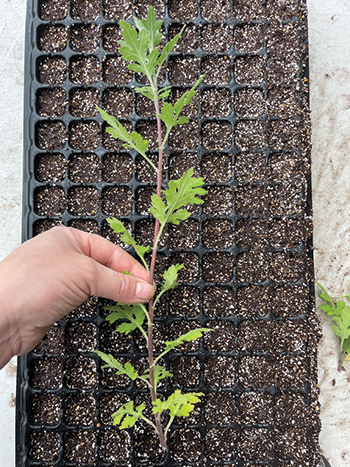
One long stem can be chopped up into multiple cuttings.
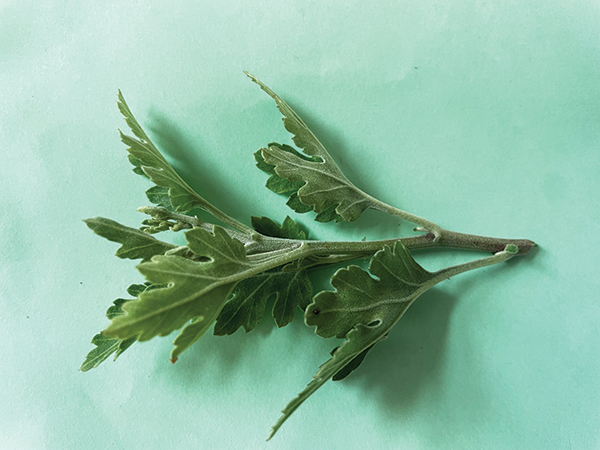
A mum cutting prior to stripping.
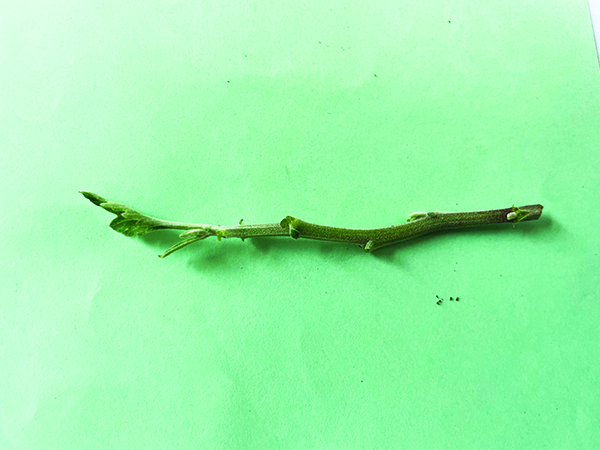
The same cutting, stripped and ready to put into soil.
Once cuttings fill their cells, we transplant them up into 4-inch pots and then take cuttings off the cuttings. In this way, one mum plant can create a dozen or more plants over the course of the spring. We find it can be efficient to let a mum plant get quite tall — 18 inches or even more — before taking cuttings. A tall stem with lots of leaves can be chopped up into multiple cuttings, so you end up spending less overall time making cuttings in the greenhouse. Mums are heavy feeders, and we fertilize them weekly with a balanced seedling fertilizer.
As the modern pot mum varieties are patented and can’t be propagated further, we skip potting them up. We get them delivered when we’re ready to plant them right into the ground, usually in late May or early June.
Pinching, planting, and supporting
One of my favorite qualities about mums is how late you can plant them and still get a beautiful crop. In the spring when there are so many tasks to complete, it’s nice to have a crop that can be put on the back burner. Here in 6B, we try to get ours planted by mid- to late June.
Pinching mums results in more branches which equates to more flowers. We pinch as many times as we can until early July — usually at least twice and hopefully three times. We usually pinch the plants as they grow in the greenhouse, and then again when planting out.
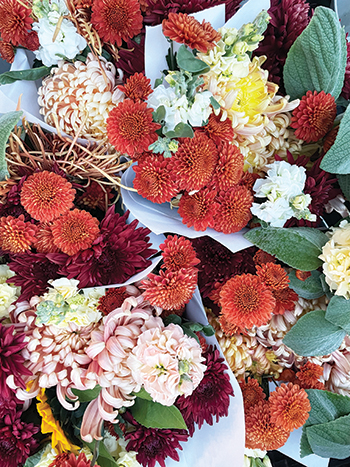
Bouquets with mums, eucalyptus, plectranthus and stock.
Mums are triggered to bloom by short days and flower very late in the season — usually in late October to early November — so having some frost protection is helpful. While the plants themselves are pretty hardy, the blooms can get frost damage. You can manipulate bloom time using blackout curtains, but I don’t think this would be profitable on a market garden scale. And for us, a big appeal of mums is that they arrive after most of our other flowers are done for the season.
If you’re growing in a cold zone, seek out early-blooming varieties such as “Prom King,” “Matchsticks,” and “Honeyglow.” Planting in low tunnels in the field can be an option, especially for shorter varieties and the pot mums. However, a high tunnel is even better to protect the plants. Best is a heated tunnel, where you won’t have to worry about frost damage.
Mums can be sensitive to artificial light like greenhouse lights, street lamps, etc., so keep that in mind when choosing a planting spot.
In years past, we planted all our mums at 12-inch spacing but ended up with a lot of empty space in between plants. This year, we are seeing success with 9-inch spacing on spray varieties and 6-inch spacing on larger disbud varieties (see discussion below), which tend to make fewer stems.
Mums like a lot of fertility and water. We give them nitrogen-rich fertilizer until they start to bud, and plenty of water delivered via drip. Although they bloom in late fall, they handle the heat of the summer just fine.
When happy and nourished, many mum varieties will grow 3 to 4 feet and even taller. Support is key. In past years we have tried corralling with twine or using plastic hortonova netting with limited success. Tall large flowers would still flop over, creating a mess at harvest time and a lot of wasted, bent stems. This year we’ve invested in cattle panels, held up with wooden stakes and zip ties. The rigid metal is doing a great job of keeping the plants upright.
Pests and disease
By far our worst pest of mums are aphids, who love to suck the sweet new growth on the plants. Aphid populations can be readily controlled with beneficial insects throughout the growing season. Lacewings are excellent general predators and parasitic wasps are also highly effective at control.
Closer to bloom time, once day length is below 10 or 11 hours and the temperatures are cooling, beneficial insects start going dormant and aphid populations can rapidly increase. We try to scout for them during this time and will spray organically, if necessary. M-Pede, Azagaurd, and Mycotrol have all been effective for us for aphid control.
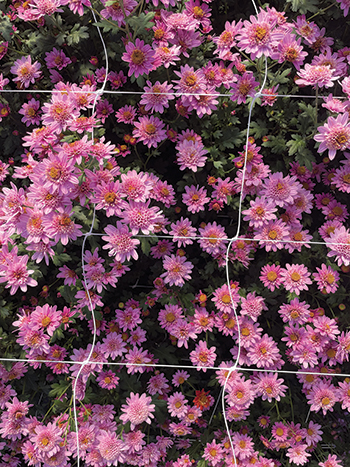
Pink Fleece spray mums.
Thrips can also damage chrysanthemums, although their populations tend to dissipate in the late fall. We manage thrips through bi-weekly applications of beneficial nematodes and predatory mites. The predatory mites also keep spider mites at bay.
Finally, tarnished plant bugs can be an issue, causing deformed blooms much like they do on dahlias. Hand-picking, insect netting, and weed management can help keep tarnished plant bug populations down.
A few diseases have popped up for us on the mums. Botrytis can be a concern, leaving telltale spots on the flowers and invading an entire greenhouse overnight. Good airflow, HAF fans, and managing condensation are key in botrytis prevention. While mums do fine in an unheated caterpillar tunnel, adding heat can help reduce condensation and disease. BotryStop is an effective biological fungicide in managing botrytis. We spray it on our buds before they open.
Fusarium can also be an issue with chrysanthemums, especially if there is poor drainage. Previously healthy plants will suddenly wilt and die. We run another biological fungicide, Rootshield, through our drip irrigation lines once a month or so to prevent it.
Finally, an article all about chrysanthemums would be incomplete without mentioning chrysanthemum white rust (CWR). This disease is a quarantinable disease by the USDA — meaning if you have it on your farm, you may have to destroy your mum plants. Although this disease is uncommon, it’s a good idea to be aware of what CWR looks like and to scout for it regularly. Buying inspected, disease-free plants is the best way to prevent it.
Disbudding
Disbudding mums is the process of removing all but one bud from the stem. Disbudding sends the plant’s energy to that one flower, resulting in a much larger bloom. By thinning the stem, the singular bloom also isn’t crowded by other flowers and can open completely. Depending on the variety, a disbudded chrysanthemum can have a spectacular bloom that is 12 inches or more across.
Disbudding is time-consuming, tedious work. Only do it if your market can support the price of the added labor. Non-disbudded stems will still be beautiful and potentially even more useful in some markets.
Most mum varieties begin to bud in late August and September. As soon as buds are visible, you can begin disbudding. Buds can be removed by simply rolling them off with your fingers. Personally, I find disbudding to be relaxing work. I pour a drink, turn on a podcast, and try to spend at least half an hour every day disbudding mums in early fall. With thousands of flowers planted, I never disbud every single one. But it’s great to have a mix of disbudded and non-disbudded blooms.
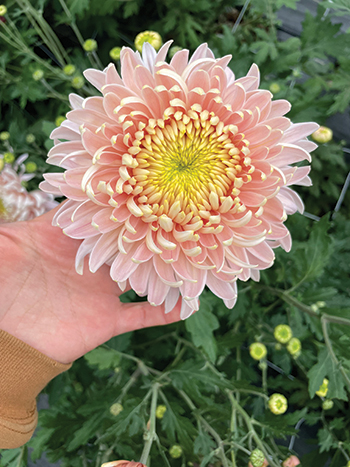
Seaton’s Je’Dore disbudded mum.
Not all mum varieties should be disbudded. King’s Mums has an excellent library of mum varieties and which ones should be disbudded versus grown as sprays. Some mums we don’t disbud include “Pink” and “Bronze Fleece” and “King’s Choice.” We also don’t disbud any of the modern pot mums as we prefer to keep them bulky. We plant mums for sprays and for disbuds in separate sections of the greenhouse so that we don’t mix them up.
Sometimes mum guides will instruct to disbud to a crown bud or terminal bud, or to a second crown bud. When growing for market (not to display flowers at mum shows), I don’t find this distinction matters. The more buds you remove, and the sooner you do so, the bigger the remaining blossoms will be.
If you have heavy tarnished plant bug pressure, I suggest avoiding disbudding as there’s a higher risk of damaged flowers. Once the flowers bloom, you can remove any blooms deformed by the plant bugs and still be left with a nice stem.
Harvest and post-harvest
Yield on mums is highly variable. The more times you pinch your plants and the earlier you root cuttings, the more stems they will yield. Certain varieties, especially spray mums, will yield more stems than others. A large variety rooted late may yield just one or two stems. Meanwhile, our “Pink Fleece” mums, one of our favorite spray varieties, yielded on average 25 to 30 stems per plant last season.
Mums do not continue to open much after harvest, so we typically harvest them when fully open. If we intend to store mums in our cooler for an extended period, we will sometimes cut them when slightly more tight, around 85 percent open. We hoard mums leading up to Thanksgiving and find that they keep for up to three weeks in a 40°F cooler. We use Chrysal holding solution in our buckets and swap the water out every few days. Mums have an awesome vase life for customers, usually two weeks or more.
Saving “Mother” plants
Much like with dahlias, before cutting all of one variety, we label it using flagging tape at the base of the plant. Once all the flowers are harvested, they would be indistinguishable without the labels.
The week after Thanksgiving, we dig our mums, usually saving just four to six “mother” plants per variety. We plant these into 6-inch pots and store them in bulb crates in the greenhouse for the winter. The plants can handle a light frost, but most varieties will die if exposed to hard freezes for extended periods.
We water our mother plants very little during the winter, usually just if they wilt. The mums will start growing actively again once the days lengthen — usually in early March. You can also add supplemental lighting or night interruption lighting to get them to grow sooner.
Year-old mother plants make many more cuttings than newly purchased rooted cuttings. From each mother plant, we usually get 50 or more new cuttings. After propagation season is over and the newly planted stock looks good, we toss our mother plants to avoid keeping any disease on the farm.
Some favorite varieties
River City: huge terracotta blooms (best as a disbud)
Heather James: early-blooming, large orange flowers
Seaton’s Je’Dore: blush flowers, a favorite of wedding florists
Saffina: extra tall and productive “quill” mum with unique shape
Bronze and Pink Fleece: adorable anemone mums – grow as sprays for bouquet fillers
Fleur de Lis: enormous “spider” mum in vibrant pink-purple
Marketing
We’re a retail-focused farm, selling mostly at farmers markets and through a direct-to-consumer flower CSA. The mums bloom when little else is flowering, and they practically sell themselves. Customers love their long vase life and bright colors. In the fall, orange and yellow mums sell better than pinks. We sell large, disbudded mums by the single stem, and do bunches of spray mums as bouquets. When grown as a spray, mums are very bulky and just five stems or so makes a generous bunch.
If you have a more difficult market or are selling primarily to florists, I would stick with the more exotic heirloom mums. Imported mums are extremely cheap from floral wholesalers (just a few dollars a bunch), so growing more unusual varieties is key.
For mixed bouquets, we will combine mums with eucalyptus, fall stock and snapdragons, late flushes of lisianthus, and cut flower cabbages as well as woody branches like curly willow and winterberry.
As I’m finishing writing this article in early October, our first frost is predicted in just a few days and this morning our first chrysanthemum bloomed. It’s so exciting to have a fresh crop to look forward to as the rest of the field dies back. I hope you will give mums a try next season.
Rebecca Kutzer-Rice owns Moonshot Farm, a specialty cut flower farm in East Windsor, NJ. She grows flowers year-round including in a geothermal greenhouse, for retail markets in and around NYC.
Copyright Growing For Market Magazine.
All rights reserved. No portion of this article may be copied
in any manner for use other than by the subscriber without
permission from the publisher.