








This is the third of four quarterly articles on the many members of the onion family that can provide allium flavor year-round. In the early winter months at Twin Oaks Community in central Virginia, we plant garlic and potato onions; sow bulb onions to overwinter under protection and plant out in early spring; harvest winter-hardy leeks and hoophouse scallions; use stored alliums; and plan for next year’s crops, including ordering seeds.
Cold-tolerance of alliums
Alliums are more cold-tolerant than many people think. Here are my observations of killing temperatures for outdoor crops. If well-mulched, elephant garlic has been known to survive down to −20°F (−7°C), and regular garlic down to as low as −30°F (−35°C). In the hoophouse, crops often survive night-time lows that would kill them outdoors.
• 12°F (−11°C): garlic tops if fairly large, most fall or summer varieties of leeks (‘Lincoln,’
‘King Richard’), large tops of potato onions
• 10°F (−12°C): some leeks (‘American Flag’ aka ‘Giant Musselburgh’ and ‘Scottish Flag’; ‘Jaune du Poitou’ )
• 5°F (−15°C): garlic tops if still small, some leeks (‘Bulgarian Giant,’ ‘Tadorna,’
‘Bandit’), some bulb onions, potato onions and other multiplier onions
• 0°F (−18°C): chives, garlic tops, a few leeks (‘Alaska,’ ‘Durabel’); yellow potato onions, some onion scallions (‘Evergreen Hardy White,’ ‘White Lisbon’), Walla Walla onions sown in late summer (with row cover for winter).
Planting garlic and garlic scallions
I wrote about garlic planting in Growing for Market’s October 2020 issue — details of garlic types, crop requirements, separating the cloves for planting, specific pre-plant clove treatments to reduce diseases, mites and bloat nematodes, planting depth, spacing, mulching, and using your small cloves to grow garlic scallions. You can plant those at the same time you plant your main garlic or at many other times of year.
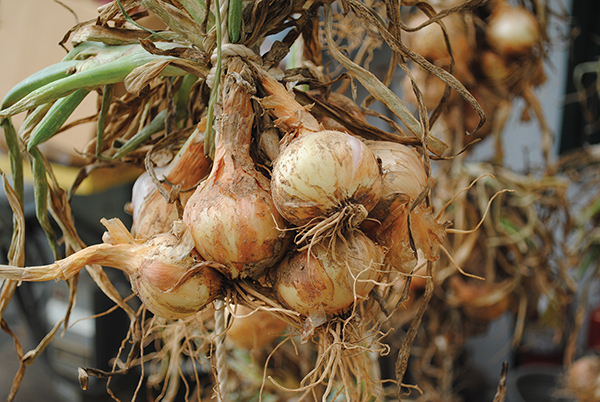 Yellow potato onions hanging to cure. Photo by Southern Exposure Seed Exchange.
Plant garlic with the goal of getting a good amount of root growth before winter has a firm grip and in zones 7 and warmer, some sturdy leaf growth. If the fall is particularly warm, wait a week later than usual. Grey Duck Garlic (greyduckgarlic.com) has a helpful chart by USDA winter-hardiness zone. (The most recent official version of the USDA Winter-hardiness zone map is 2012.) I’ve combined their information with that I gathered previously.
• In zones 0-3, if no permafrost, plant garlic in September.
• In zones 3b-5, plant late-September to early-October. Plant two to three weeks after the first frost but before the ground freezes solid. Another way of counting is six weeks before the ground freezes.
• In zones 5-7, plant in the second half of October. If your area does not normally get seasonally frozen ground, you could plant later.
• In zones 7-9, plant in early-mid November; up till late November in zone 9. In zone 7a, we plant in early November, when the soil temperature at 4 inches (10 cm) deep is 50°F (10°C) at 9 a.m. Planting deeper helps keep the garlic at a steadier temperature (milder during the winter, cooler once spring heats up)
• In zones 9 and 10, look for soil to be less than 85°F (29°C) at 2 inches (5 cm) deep. Garlic can be planted in December or even as late as February if you have vernalized the planting stock. (Vernalization for hardneck garlic is six weeks of cold temperature below 40-45°F/4-7°C; softneck is less demanding) Without sufficient vernalization, the bulbs will not differentiate (divide into separate cloves).
• In zones 11-13, plant in January or February after vernalization. Check with local growers or your Extension Service, as there’s very little information out there. Also, see the section below on growing garlic in the tropics. See Grey Duck Farm’s Southern Garlic Grower’s Guide by Susan Fluegel at their website.
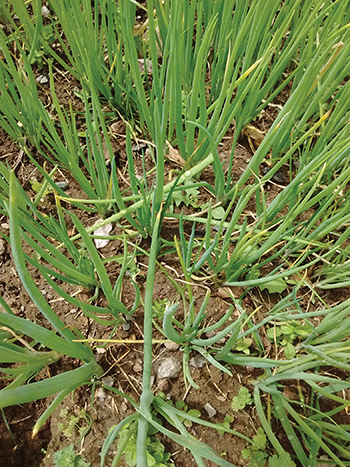 Scallions grown in clumps outdoors in late May, transplanted from a January sowing. Photo by Pam Dawling.
Pre-plant garlic treatments
A general treatment to deal with nematodes, mites and fungal diseases is to soak the separated cloves for 30 minutes in water at 100°F (38°C) with 0.1 percent soap, then cool in plain water, and soak overnight (up to 16 hours). Drain the cloves in the morning and cover with rubbing alcohol for three to five minutes, long enough for the alcohol to penetrate the clove skins and kill any mites inside. Plant right away. Even if you are not aware of any problems, this might be worthwhile.
Fusarium can be kept down by adding wood ashes when planting or soaking the cloves in a 10 percent bleach solution, then rolling them in wood ash (wear gloves). The wood ash soaks up the dampness of the bleach and provides a source of potassium. More details are at the Garlic Seed Foundation.
Plant your garlic
Raised beds help prevent the garlic drowning if it rains heavily. Cover the cloves with soil and mulch immediately. Garlic plants are capable of growing up through 3 inches (7.5cm) of mulch without difficulty.
Keep an eye on your mulched garlic beds when the shoots start to emerge. Choose the moment to free any trapped shoots by working along the rows and investigating each spot where you expect a garlic plant to be but see nothing. Your goal is simply to let the shoot see the daylight. Don’t over-work this. As soon as any part of a shoot is visible, leave that plant alone and move on to the thousands of others. It isn’t necessary to make all the leaves visible.
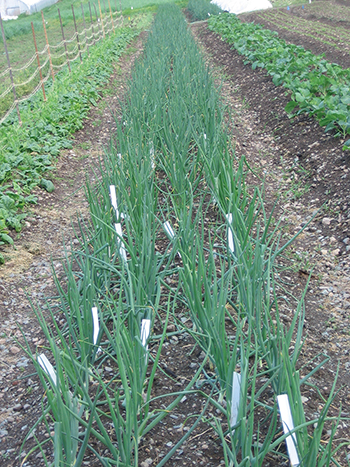 Onions transplanted in early spring from the hoophouse. Photo by Kathryn Simmons.
Choosing the right time can be tricky. I used to say when half or more of the shoots are visible, but one year we were having a crop disaster, and we waited too long. We were never going to have half visible. Usually, most emerge at the same time.
Elephant garlic
This is botanically a leek (A. ampeloprasum var. ampeloprasum). It can be planted in late fall in zones 3 to 9, and survive temperatures as low as -20°F (-7°C). Although the leaves may die back in winter, bulbs that have been generously mulched should survive. We have had poor results in zone 7 and stopped growing it the year we harvested fewer than we had planted. Elephant garlic is slower to develop than true garlic and has a milder flavor (but stronger than most leeks). Because the plants are bigger, give elephant garlic more space.
Onion starts in the hoophouse
We developed a system of growing onion starts in our hoophouse over the winter and transplanting them bare-rooted outdoors in early March. I wrote about choosing onion varieties for your latitude in August 2022 GFM. There, I explained that to grow big onions we need to have large transplants on March 1 so we can get them in the ground at the first opportunity and have big vegetative plants before bulbing is triggered by the day-length (which depends on the variety).
Our method involves making two sowings of onions, each enough for the whole planting, providing insurance in case one date turns out better than the other. We follow this up with a smaller third sowing to make up numbers if any varieties didn’t germinate well. We make our first sowing November 10, our second November 20, and our third on December 5. Our formula is: divide the number of onion plants wanted by 20 to give minimum length of row to sow in feet. Sow this amount twice, 10 days apart. The onions will be planted out at 4 inches (10 cm) apart. We add 20 percent to provide plenty of slack. We sow three seeds per inch (approx. 1 cm apart). Any leftover transplants can be used as scallions.
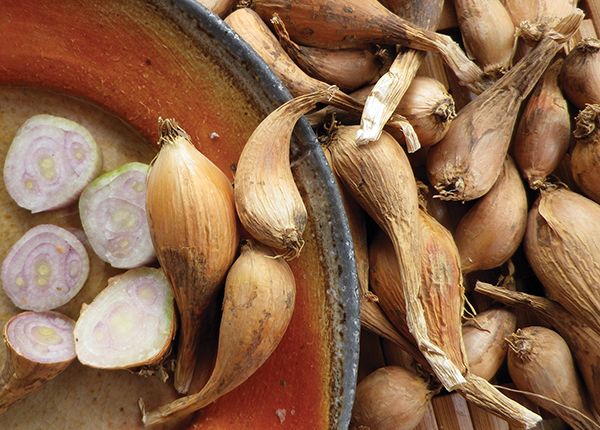 Grey Griselle shallots, unattractive but delicious and prized by foodies. Photo by Southern Exposure Seed Exchange.
See my book The Year-Round Hoophouse for more on growing onions this way. We have also transplanted them in early March in a single row along the south edge of hoophouse beds, for an early crop. We got good onions but they dwarfed the pepper plants behind them. The timing can’t be altered. We transplant peppers on April 1, as early as we dare, and the onions are already getting large, so we can’t delay. Maybe planting them on the north side of the bed is better? Or maybe planting a “gappy” row, leaving out one onion whenever it would be directly to the south of a pepper?
Potato onions
In late November to early December in zone 7, plant medium-sized (1½” to 2”, 4-5 cm) potato onions at 6 inches (15cm) spacing. See part one of this series from the May 2022 GFM and part two from August 2022 for more about this crop and planting the large ones. One pound (500 gm) = 8 medium bulbs. Add up to 20 percent spare. Cover with ½-1” (1-2 cm) soil, and add 4”-8” (10-20 cm) mulch.
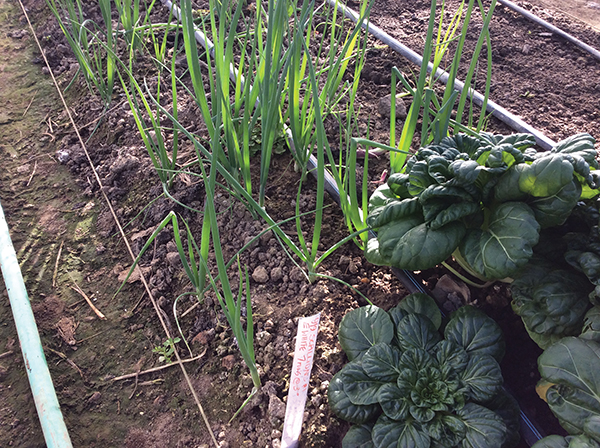 September-sown scallions in the hoophouse in November. Photo by Pam Dawling.
Save the small ones (smaller than 1.5”/4 cm) to plant in late January, as they won’t survive the winter well in the ground. They store really well indoors, unlike the large ones. We prefer to prepare this bed at the same time as the November bed, and mulch with hay (you could tarp the bed instead). In late January or early February, remove the mulch, make deep furrows, plant the small onions on 4” (10 cm) centers, cover with ½”-1” (1-3 cm) soil, tamp down, and replace 4”-8” (10-20 cm) of mulch. One pound (500 gm) = 20 to 33 small bulbs. Keep some spare, but the rate of loss to rots is much less in the small onions.
Perennial leeks and walking onions
Finish dividing and replanting perennial leeks and Egyptian walking onions in November in zone 7, or wait until early March and April. Harvest the larger perennial leeks from September to February, replant the smaller ones with more space to increase your harvest.
Ira Wallace of Southern Exposure Seed Exchange says, “If divided and left to grow for nine to 12 months, perennial leeks really make decent-sized leeks you harvest in October [or so]. This gives you something more like early traditional leeks plus an assortment of smaller leeks to divide and let grow. [If you are] starting with only a few, it’s best to just divide and let them grow larger for at least a year to get up to a decent quantity and size.”
Shallots and scallions
Between late January and mid-February, sow shallot seeds. Transplant in late March. Shallots from seed will be ready for harvest between July 4 and the 30th, about a month later than harvests from replanted bulbs. Plant shallot bulbs January to February, after refrigerated storage over the winter.
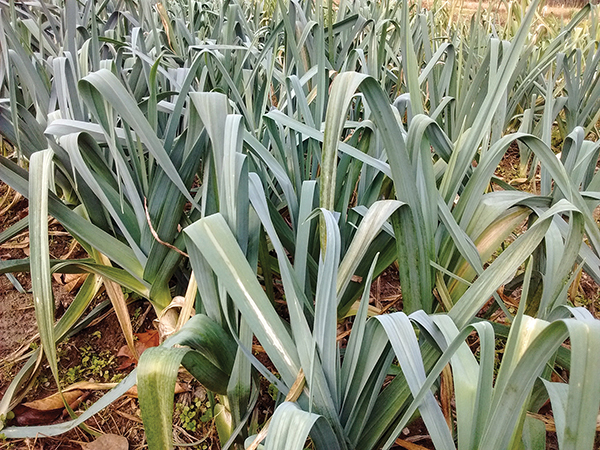 Tadorna winter-hardy leeks in December. Photo by Pam Dawling.
In January, one of the first crops we sow is scallions, (spring onions, escallions or salad onions) for transplant. We sow in 200-cell plug flats, on January 17, aiming to get four to six seeds per cell. It takes 4 gm of seed for 200 cells. We transplant these clumps on March 21, with 3” (7 cm) space between plugs. We need about 50 row feet (15 m). This grows scallions already in bunches and makes excellent use of space. We make a second sowing of the same amount on February 17 and transplant April 14. We harvest these after we clear the hoophouse ones.
We also grow three sowings of scallions in the hoophouse in winter, short rows 3” (7.5cm) apart. ‘Early Lisbon’ and ‘Evergreen Hardy White’ are very hardy varieties. We make our first sowing September 6 (the date of our first fall hoophouse sowings, along with radishes, tatsoi and Bull’s Blood beets). We harvest those scallions mid-November to mid-February. Our second sowing is October 20 for harvest from mid-February to the end of March or later. Our third is November 18, in the space where the first radishes were sown September 6. They take 14 days to germinate in November, and we can harvest them from the beginning of April to about May 15. The dates vary quite a bit, depending on the temperatures.
Cipollini, mini and pickling onions
Cipollini (mini-onions) (A. cepa var. cepa) are small bulb onions used whole for kebabs, pickles, casseroles, and stews. Depending on your latitude and the variety’s adaptation, these will provide bulbs from the size of large cherries to ping-pong balls. White varieties get sunburn here, so we stopped growing those. Red Marble (F1 95d or OP 75d, adapted to 38°–55° latitude) dries down nicely, and stores very well. At higher latitudes, these can grow 2-3” (5-7.5cm) onions if given the space. Purplette (OP 60d) doesn’t store well. Gold Coin (OP 80d) didn’t dry down well enough at our latitude (thick necks) and doesn’t store well. Eclipse (OP 60d) and Pompeii (OP 64d) make attractive pickling onions when grown at 40°N and higher.
Mini-onions are viewed as a gourmet item, so the prices you can get may justify giving them greenhouse bench space, seeding January 17 to 25th, transplanting March 10 to the 21st,, leading to harvest July 1 through the 17th. They can also be grown in a hoophouse.
Harvesting alliums in early winter
Winter leeks can be harvested whenever the ground is not frozen, well into spring, if you have planted that many. In November we are still harvesting fall leek varieties as those grow bigger faster, and we want to save the hardy ones for colder weather.
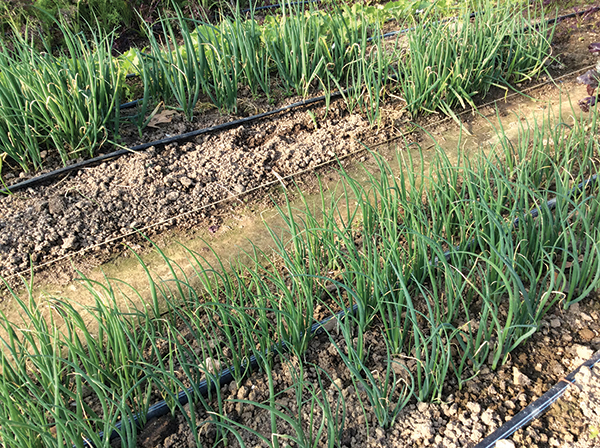 October- and November-sown scallions in the hoophouse in March. Photo by Pam Dawling.
Egyptian onion bulbils, if you harvested some in September, can be used during the winter. They store well. Onions and garlic in storage should be checked regularly and brought out as needed.
The larger perennial leeks can be dug and used from September to February. Dividing and replanting provides some harvest and prepares the bed for bigger future harvests.
Leaves of Egyptian onions and perennial leeks: Cut and use these September to April, as long as they are still green and in good shape. Chives are hardy to 0°F (−18°C), and can be harvested if they have grown enough since you last harvested. Hoophouse scallions can be harvested all winter from November to spring.
Storing leeks
See my article “Leeks: A guide to the versatile winter workhorse” in GFM March 2022, for everything else about leeks. Storing them enables you to extend the season. In zone 7 we leave our winter-hardy varieties in the ground till we need them. In colder zones, harvested leeks can be stored in a root cellar or basement for about six weeks, close-packed upright in a crate with soil covering the roots.
Unusual alliums
While you are perusing seed catalogs this winter, consider trying some less common alliums. You’ll find many names for the same plant and some different crops with the same name. The Clove Garden has lots of information on all types of allium, with good photos. The Backyard Larder: Ali’s Alliums is another great resource. There are over 700 pictures of Stephen Barstow’s allium collection on Facebook. Most have no caption, but you could post a question.
Pearl onions (Allium ampeloprasum var. sectivum), also known as button or baby onions in the U.K., or creamers in the U.S., have thin skins and a mild, sweet flavor. They grow up to 1” (2.5 cm) in diameter. Unlike bulb onions, they do not have layers but only a single corm, like non-layered garlic cloves. The Clove Garden says true pearl onions take two years to form a mature bulb. They are mostly used for pickling. Most onions grown for pickling today are simply small crowded (layered) bulb onions.
Perennial Rakkyo (aka as true pearl onions, Japanese scallions, Vietnamese leeks) are Allium Chinense. The plant has rose pink flowers. The small onion bulbs are generally pickled. Onion grass or wild garlic in Virginia, is Allium vineale (crow garlic). The leaves of onion grass are hollow and round. Canada onion (aka Wild onion) (Allium canadense) is a perennial with flat ‘solid’ leaves.
Kurrat (A. kurrat), is a Middle-Eastern cultivated leek, used mainly for the greens, which may be cut from the plant repeatedly. Field garlic Allium oleraceum is native to most of Europe, where it is a wild perennial, growing tall leaves (the part that is used). Ramsons, Allium ursinum, buckrams, wild garlic, broad-leaved garlic, wood garlic, bear leek, or bear’s garlic, is common in Europe. The broad flat leaves are the part used. It looks like Ramps, (Allium tricoccum) but is not the same species.
Japanese bunching onions or Welsh onions (native to Siberia or China, not Wales) are Allium fistulosum. They are sometimes used as scallions, as are some bulbing onions. Young plants of Welsh onions and bulb onions look very similar, but can be distinguished by their leaves, which are circular in cross-section in Welsh onions rather than flattened on one side. Welsh onions have hollow leaves, scapes and do not develop bulbs. The leaves are the part that is eaten.
Growing garlic in the tropics
Softneck garlic varieties are more heat tolerant than hard-neck varieties. If you are buying seed stock of known varieties, ‘Therador’ or Lorz Italian softnecks are recommended. Rancho Delicioso, a permaculture farm in Costa Rica, recommends Creole or Artichoke types. ‘Turban’ and ‘Asian Tempest’ also do well in the tropics. But you can start with whatever you can get
Deciding when to plant in tropical areas is complicated. Garlic is day-length sensitive. Because you can’t change when the sun rises and sets, work back from the date root and leaf growing stops and bulbing starts, which happens when the day-length first exceeds 13 hours. In Jamaica that is May 27. Air temperatures above 68°F (20°C) and soil temperatures over 60°F (15.5°C) are secondary triggers for bulbing to start. In the tropics, temperatures are going to be hotter than that all the time, so the day-length is the factor to pay attention to. But that doesn’t vary much in the tropics either.
Garden Gate in tropical northern Australia says it takes 17 to 25 weeks in total to grow garlic. The Jamaican Ministry of Agriculture says garlic takes 21 weeks to grow. Jamaican sources have suggested that garlic should be planted between October and January on the island.
In Virginia ours takes about six weeks from the start of bulbing to maturity. If that period is the same in Jamaica as in Virginia, subtracting six weeks from 17 to 25 weeks suggests planting 11 to 19 weeks before May 27, that is, January 7 through March 7. In areas where traditional garlic planting indications — temperature and day length — don’t vary much, there may be some trial and error involved in finding the correct planting dates if you don’t have neighbors who can tell you when they plant theirs.
Once you’ve decided your planting date, got your garlic, refrigerated the cloves for 10 to 12 weeks to ensure the bulbs will be able to differentiate (divide into cloves), and prepared your rich, well-drained soil, plant the cloves 6-8” (15-20cm) deep, where the soil will be cooler. Mulch with light-colored straw or hay.
For more resources on growing garlic in warm climates, see:
Rob Bob, www.youtube.com How to Grow Garlic in Warm Climates Using Vernalization.
How to Plant Garlic YouTube from Livity Jamaica Farm.
Rancho Delicioso in Costa Rica has written from their experience. www.ranchodelicioso.com/growing-garlic-in-the-tropics but be sure to read down the page – it starts with a method that didn’t work. They have a video on their website.
Pam Dawling works in the 3.5 acres of vegetable gardens at Twin Oaks Community in central Virginia. Her books, Sustainable Market Farming: Intensive Vegetable Production on a Few Acres, and The Year-Round Hoophouse, are available from Growing for Market. Her weekly blog is on her website and on facebook.com/SustainableMarketFarming.
Copyright Growing For Market Magazine.
All rights reserved. No portion of this article may be copied
in any manner for use other than by the subscriber without
permission from the publisher.