











Back in 2023 I wrote an article on my budgeting method for my farm, the way I compare actual expense against the budget on a monthly basis, and some of the analysis I do at the end of the year. (“Farm bookkeeping and budgeting” from the April 2023 GFM.) One thing I skipped over in that article was how I handle depreciation, and how the concept of depreciation can be useful in understanding profitability from year to year and in making sure that you’re budgeting for maintenance and eventual replacement of “fixed assets.”
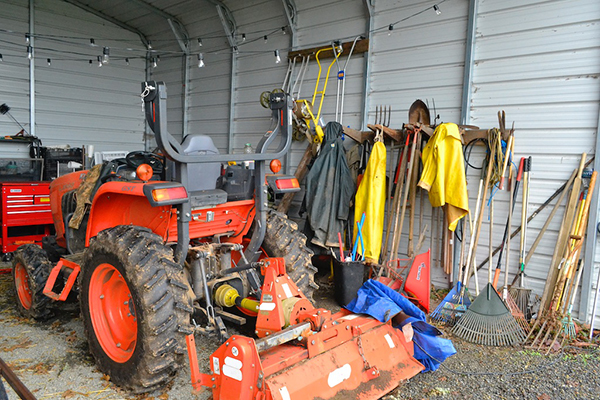
A tractor and a rototiller are obvious fixed assets, as is the structure they are stored in. The hand tools hanging on the wall are fixed assets in the sense that they will be used for more than one year, but they may not be worth tracking in your depreciation schedule if the amount you spend on them doesn’t vary much from year to year.
This article is all about using depreciation as a tool within your annual budgeting to help you better understand your farm’s profitability and to be prepared for occasional large purchases of infrastructure and equipment. When you’re first starting a farm you’re making a ton of “investments” in tools and infrastructure that you’re expecting to help you eventually turn a profit (or put another way, to make a return on your investment), and to last more than a year (meaning you’ll continue using them for multiple years). In financial speak any purchases or acquisitions that will be used for more than one year are “fixed assets.”
When you make a budget you’re typically doing it for a specified timeframe. The timeframe that most people use for their primary budget is 1 year. In the simplest budget, you’ll project how much income you’ll have in a year and how much expense. The difference between those two numbers will be the net profit.
Even though purchases of fixed assets are an “expense” in the common English sense, you can probably see that if you include them as an expense in the year that you purchase them, they can easily make it look like your business was not “profitable” that year. In a cash flow sense, this is true, but the following year if you are still using that big tool purchase and you have exactly the same income, and the same expenses – minus the fixed asset purchase – you can suddenly look very profitable! It can feel good to be so profitable on paper after such an unprofitable year, and even for a few years after.
Farms that base their perceived profitability on this kind of accounting are “living off of depreciation,” and there is a tendency to feel like all is well during the years where the budget looks good because there is no large equipment or infrastructure purchase. Eventually when that fixed asset wears out and you need to do a major repair or to replace it, you’ll be back to a very unprofitable year, needing to make a big purchase that probably wasn’t well accounted for and will potentially cause a major cash flow problem.
To avoid this problem and to better reflect annual profitability in budgeting the common method is to track fixed assets separately from expenses and to use a “depreciation expense” to distribute large fixed asset expenditures over the course of multiple years.
Tax depreciation
Tax depreciation, the kind that you report to the IRS, is not what I’m talking about here, but it is similar. Tax depreciation has strict rules around how to track and report it and it is designed to even out your tax liabilities from year to year and to ultimately reduce the amount of tax you have to pay. Fortunately, when you use depreciation in budgeting you don’t have to use the IRS’s rules. You can figure out a system that works best for you and use that instead.
Straight line depreciation
The easiest kind of depreciation to calculate and to use is called straight line depreciation. When using straight line depreciation, you just take the full cost of the purchase and divide it by the number of years you think you’ll use it. If you think you’ll sell it at the end of that time you subtract the expected salvage cost (price you’ll sell it for) before you divide by the number of years you’ll use it. This gives an estimate of the cost per year of use of the purchase.
Depreciation expenses
When keeping track of this in your bookkeeping, purchases of assets are kept separately from expenses and don’t show up on the P&L. The value of the asset (purchase price) shows up as a reduction in one of your “current” accounts (like cash, or a bank account) and that balances out the increase in a fixed asset account. This shows up on your Balance Sheet. Instead of entering the purchase price as an expense, typically you enter the depreciation expense on the final day of the year (or whenever you want it to show up), and you “balance” that expense by subtracting it from the value of the asset on the Balance Sheet. Even though the balance sheet isn’t typically a part of annual budgeting, it is something that is useful for assessing the financial health of your business and that is why you need one when applying for many loans, as well as understanding your cash flow.
Leases and loans
I lease almost all of the equipment on my farm and pay an annual lease rate. Because I don’t own any of that equipment or infrastructure my costs are just an annual expense, no need to depreciate asset on my books since I don’t own the assets. In a sense, you might think of depreciation expenses as a way to lease yourself the equipment you own.
If you take out a loan to buy a piece of equipment like a tractor, which is pretty typical, when you receive the money for the loan it is not income, it is a cash asset (cash on hand). That cash asset is balanced by a liability – meaning you have that cash in your hands, but you also owe that same amount to the lender. The asset minus the liability is $0, thus they “balance”.
When you buy the tractor, you trade the cash asset for a fixed asset. The total value of your assets is still the same and you still have the liability, so everything is still in balance. When you make loan payments your liability goes down. The portion of that payment that is “principle” is not an expense; this is taking cash assets you have on hand and trading it for a reduction in your liability. Your cash assets go down by the same amount that your liability goes down, everything is still balanced. Part of your loan payment is typically fees and interest – that part is an expense. Neither of these changes the way you depreciate the fixed asset.
When you depreciate the fixed asset (enter a depreciation expense), the value of the asset goes down and to balance that your expenses go up. Even though no actual cash moved you are acknowledging that your asset is not worth as much as it was and that reduction in the value of what you own is reflected in your reduced net profit for the year. Depreciating a fixed asset instead of expensing it reduces your annual net profit number by a smaller amount for multiple years by only considering part of the purchase price an expense each year.
Tracking assets and depreciation
The easiest way to keep track of assets and depreciation is to keep a spreadsheet list of the assets along with their depreciation schedule. The depreciation schedule is the list of anticipated depreciation expenses and the dates where they will be applied.

In this sample depreciation schedule you can see columns for the typical types of information tracked for each asset. The total depreciation expense to be taken each year is in columns J to N. You can see that the BCS tractor and Cultivator were both only owned for a few years before being “disposed” and the “salvage amount” balances the “current depreciated value.” To make those two numbers balance, the annual depreciation in the year they were sold is adjusted and thus is different than the straight line depreciation or “annualized value.”
If you sell an asset before it has been fully depreciated, you will compare that sale price to the current asset value (initial asset value minus the total of depreciation expenses taken to date). If you sell it for more than the current value the difference is income, or you can record it as a negative expense which mathematically is the same thing and it just depends on which side of your P&L you want it to show up. If you sell it for less the difference is an expense (or negative income).
Where to draw the line
Not all fixed assets are worth tracking with depreciation. A lot of the hand tools I own I don’t bother tracking with depreciation even though I’ll use them for many years. If I were to purchase them all in one year I might reconsider that approach, but it is more typical for me to purchase fewer than a handful of small tools every year, so I just record those purchases as an expense. Because that expense is relatively even for me from year to year, and relatively small compared to the net profit number for my farm, it’s not worth the extra effort of tracking depreciation for them. I don’t have a strict cut off, but for my budget the price of a tool would have to be at least $500 hundred dollars for me to consider adding it to a depreciation schedule.
Many businesses will use a dollar amount well above $1,000 before they consider a purchase a fixed asset. Something like a new tractor, or a new walk-in cooler would definitely fit the definition, but for a large farm, buying a small tractor implement for $1,500 might not. What you want to consider here is whether or not the purchase is large enough that it will significantly skew the way your net profit looks from year to year. If it will, you probably want to spread the expense out over multiple years by considering it a fixed asset and using depreciation expenses.
The goal here is to give yourself a better understanding of how profitable your business is from year to year. At the same time, you’re setting yourself up to be able to afford the cost of major repair or replacement when the time comes because your annual net profits already reflect the annualized cost of anticipated large purchases. When you’ve only been farming for a few years, it can feel like equipment will last forever, but farm a few more years and you start to see those big ticket items wear out and you need to be budgeting for that if you want the farm to be able to continue.
Josh Volk farms in Portland, Oregon, and does consulting and education under the name Slow Hand Farm. He is the author of the books Compact Farms: 15 Proven Plans for Market Farms on 5 Acres or Less, and Build Your Own Farm Tools, Equipment & Systems for the Small-Scale Farm & Market Garden, both available from Growing for Market. He can be found at SlowHandFarm.com.
Copyright Growing For Market Magazine.
All rights reserved. No portion of this article may be copied
in any manner for use other than by the subscriber without
permission from the publisher.