











Diverse materials, color contrast, the simple and sublime
Time spent arranging dried flower bouquets can be enjoyable and rewarding as you create with materials you labored all season to produce. Or it can be like pulling teeth. If you simply don’t like arranging flowers, yes, you should adjust your business model. But if you are faltering because of a lack of confidence in your arranging abilities, don’t. Here are pointers to keep in mind when arranging dried flowers and tips of importance during the preparatory steps leading up to this crowning act.
Prepare to succeed
Your work to create beautiful dried arrangements begins well before you are at your workbench with your raw materials. Planting time, in fact, is the first staging area for future success. Be sure to raise a nice variety of flowers. Include plenty of colors and shapes. Colorful petals and unique seed pods. Focal and filler flowers. Even the almost gaudy and almost plain have a place when you are arranging.
It is a very good idea to have annuals and perennials in your drying garden, not only because this naturally means you will be including a greater variety, but also in the face of changeable weather patterns it is wise to take advantage of a diversity of growth cycles and spread the risk.
It must be emphasized that when working with dried materials as opposed to fresh-cut ones, you are working not just with color but structure and texture to an important degree when arranging an attractive bouquet. Fresh-cut flowers have that touchable appearance and vitality — part of their attraction is that they are alive. Lacking that, dried flowers must look like works of art because looks are what they have to offer — and they will be sticking around for a while.
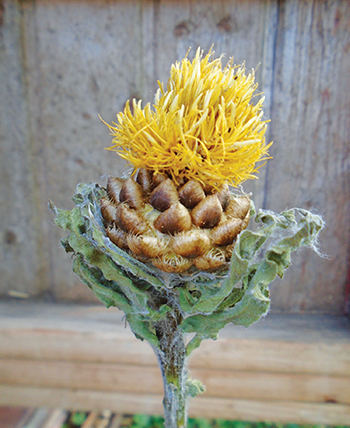 Basketflower is an intriguing dried flower that adds yellow color and unique texture.
When you are in the market for structure and texture, you frequently can look to Mother Nature for help. Foraging from the wild, or indeed, from perennial planting on your property, often will offer many opportunities to add visual appeal. Sedge and grass seed heads, opened milkweed pods, mature teasel heads, cleaned lunaria seed pods, columbines that have gone to seed, these wild and perennial bed individuals are terrific additions.
These found treasures allow you to take advantage of the fourth stage of floral beauty: fall and winter stages of plants. I always remember reading about wildflower seed pods — that plants should not be ignored once they have shed their petals. Although not as showy as their floral stages of growth, there is intricacy and delicacy of form in the reproductive structures of many plants.
Beauty achieved with great subtlety is what the Japanese call shibui, which means “restrained elegance.” Appreciation should be allotted for the subtle as well as the bold when arranging dried flowers. Wild foraging is an excellent way to add to this part of your palette.
Flowers must be harvested at the correct time for optimum drying quality, a time which varies from plant to plant. Premature harvesting of some flowers (e.g., yarrow, Gomphrena haageana globe amaranth) leaves them with droopy, unusable heads. Yarrow must be mature enough to produce pollen, and the G. haageana stem must be stiffened directly below the flower. Love-lies-bleeding amaranth must begin to set seed before it is picked, and astilbe and safflower must be fully open for the best display of color.
Spike flowers have ideal timing as well. Liatris should have three-fourths of its flowers open, while larkspur should have all open. And globe-thistle requires even more precision; it should be picked before the tiny florets that make up its flowerhead open, but after the flowerhead has turned blue, giving it the best color.
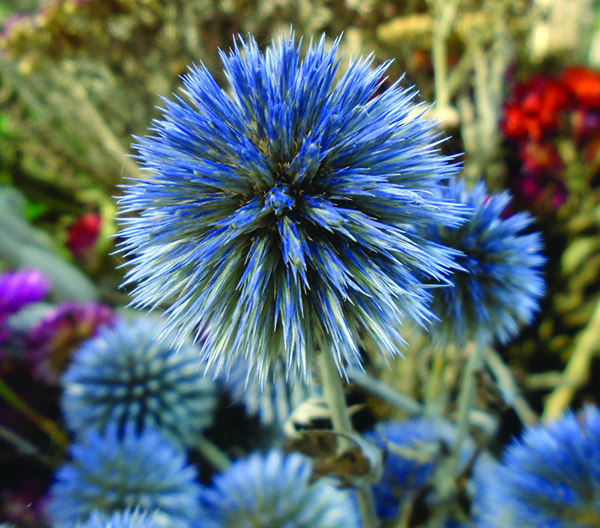 Globethistle adds a great shape and a touch of blue. It is well worth the effort; get stem strippers to help with removing the prickly leaves.
In fact, with each flower you are looking for retention of the correct structure with the maximum display of color. The best color is a balance between flowers sufficiently opened and matured but not so mature that the petals have become overshadowed by the expansion of the fruiting and seeding components. If you cannot find guidelines for a particular flower you wish to use, just be ready to experiment.
For some plants, the speed at which its flowers are dried is key to the best color retention. For example, cornflower, astilbe, larkspur, and peony all benefit from a rapidly paced drying time in a warm, dark location. Also, it is often necessary to strip the leaves off of your stems prior to drying. Many leaves dry unattractively. Some will interfere with arranging by taking up too much room. Frequently extra foliage provides fodder for molding. Naturally, leaves such as those on lambs’ ears that add to the appeal of the dried flower should be kept. Harvested materials, once dried, must be stored out of direct sunlight and in low humidity so they keep their color and do not mold.
Finally, when it is time to begin arranging, give yourself a well-lit, spacious area free of distractions and clutter. Have your plant materials separated into piles and not in a confused jumble. Make sure you have many containers at hand in case you need a temporary holder, especially if you always prefer to arrange in a vase. At the very least, finishing touches are best done with two hands free for placement. And if there are photos or pictures of arrangements created by you or another that can serve as inspiration for you, definitely have those within eyeshot.
The rule of no rules
It seems a rather meaningless statement to say that when it comes to flower arranging there are no rules. However, what it means is that the world of well-arranged bouquets embraces a number of different styles. Pleasingly arranged bouquets may be harmonious or or a little incongruous, sumptuous or spare, symmetrical or asymmetrical. Often arranging involves using a wide variety of materials, but sometimes a bouquet of a single variety can make a better statement. Variation is welcome and you should feel free to experiment. The unexpected can often happen when plant materials actually get side by side.
There are a few points to keep in mind, though. As I alluded to earlier, the appeal of fresh-cut bouquets can be derived from scent and touch as well as appearance (color and texture). With dry arrangements, neither scent nor touch figure in (or do in comparatively small ways), so it really is the appearance created by color, texture and shape that is important. You must pay close attention to all of them.
Your approach to arranging will be different if you are designing for a specific vessel or a bouquet to be tied and wrapped. For the vessel, you will be able to create a mixture of colors and structure suited to it perfectly. Your wrapped bouquets will be more of the hit-and-miss fashion in terms of whether customers can make them fit in their homes (hopefully you will get hits). Also, the size of your finished product affects your approach. With smaller-end products, you have to “get to the point” with very minimal filler and must obviously resist the desire to use everything on you work table. Any little mismatches of flowers that you might be able to get away with in a larger arrangement will be fairly plain to see.
Practically speaking, you should begin assembling the long-stemmed and/or sturdy and/or structurally supportive materials for a bouquet first, which is primarily the fillers and some principal focal flowers. You are creating your color scheme here. Then, add highlights (same color but a different and/or muted shade), contrasts and/or neutrals, and secondary (complementary) color accents.
Some materials will have shorter stems, which are easier to work in. Of course, you can always cut stems shorter as long as pieces are held in place. Then it is time for your “framing” materials (see below), or other final touches on the face of the bouquet for which we typically use lunaria, scabiosa, sedges and/or grasses, poppy pods, or a few additional pieces of the “framing” material that was used.
Broad appeal
As I said, a variety of arrangements can be deemed well assembled, and there are no rules so absolute that a bouquet that fails to follow one or more of them is automatically without merit. However, there are some generalizations that can be made about what will appeal to the most individuals. Generally speaking, the greatest attraction is created with symmetrical arrangements in terms of both overall shape and composition. Accents can be individual flowers or in groupings, both of which should be odd in number, probably more than one but not always. (How does an autumnal bouquet arranged around one largish dried sunflower sound?) We often add a border or ring of a single variety of flowers around the edge of many of our bouquets; it acts to frame it in and pull it all together, a final touch suggesting it is ready to go. We usually do this with German statice, baby’s breath, lamb’s ears, sweet Annie, or a silvery Artemisia of some kind.
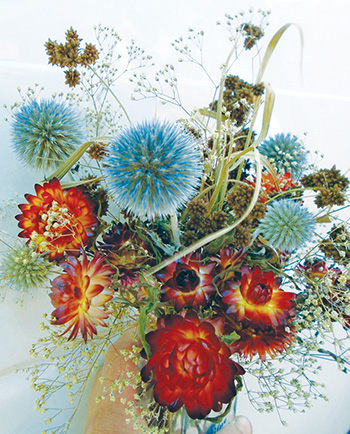 A bouquet arranged with baby’s breath and sedge.
A colorful account
Don’t think that I am saying color isn’t important in your dried flower arrangements, because it is. I have written in the past about the need for pink in bouquets to make them good sellers, and this applies to many dry bouquets as well as fresh ones. Probably 95 percent of the time there will be a shade of pink in our dried bouquets; if it is not present as one of the primary colors used, it is almost certain to be one of secondary importance. And though it is the subtle shapes and textural touches that will put an arrangement over the top, people requesting an arrangement or looking for one amongst a collection of bouquets will be identifying and sorting them by color first and foremost.
In your arranging, you will probably find yourself repeating some color and materials combinations from time to time. Though it is easy enough to make no two bouquets the same when you get down to the minute details, some color combinations are so appealing you will undoubtably be repeating them over and over because they work so well. For example, pink and yellow pair up nicely, as do purple and white. Another striking duo (when you can manage it) is red and blue. Of course, you could do pink and white or purple and yellow or pink and yellow and white … you get the picture. Generally, a darker color and a lighter color are required because they help one another to look their best by contrasting with one another.
Background, foreground, up and down
Let’s talk a bit about some of the specific plants you can use for dried bouquet arranging. People often discuss fresh-cut flower arranging in terms of “filler, spiller, and thriller” materials. These are designations, respectively, for the not-too-striking, architecturally unique, and visually stunning bouquet components.
If you translate these concepts to dried flowers, you have: the neutral color and/or less dramatic flowers (filler); the texturally and structurally interesting seed pods (e.g., grass and sedge seed heads, amaranths, other seed pods like nigella and poppy) and/or unassuming flowers with prominent stem orientations (spiller); and those flowers which really add color and drama to arrangements (thriller), of which I think there is little more thrilling than dried peonies.
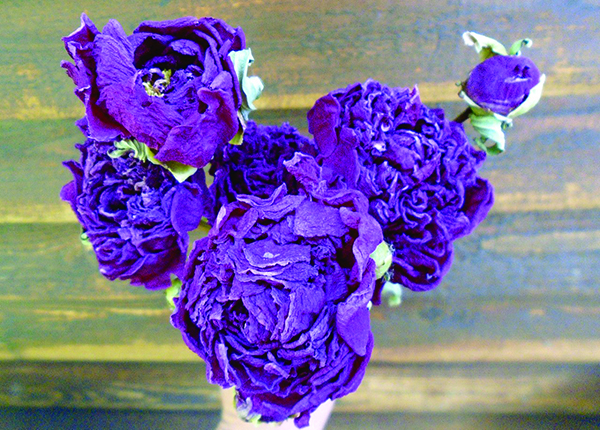 Peonies are seldom raised expressly for drying, though when dried there are few flowers more grand in appearance.
But these classifications are even less definite with dried flowers than they can sometimes be with fresh-cut ones. The importance of texture and structure in dried arrangements can make some texture-emphasizing “spillers” of thriller-type importance, such as scabiosa, the seed pods of false blue indigo, or even an abundance of flax seed heads. And though fillers in fresh bouquets are, by definition, rather part of the background, in dried arrangements some structurally supportive flowers (statice and cockscomb celosia are perfect examples) take the lead in determining the color scheme and tone of a bouquet.
Here is a very brief assortment of some useful dried flower arrangement candidates (with scientific names included for special clarification). They range from the ubiquitous to the unique, those that are in almost each bouquet to those that are less prevalent and therefore help to really define with their presence.
Baby’s Breath—an easy way to add visually (and charmingly) to an arrangement without distracting from the components already at work, airy and delicate.
Basket Flower—very intriguing dried flower that adds yellow color and unique texture.
Cornflower—gives delicate touches of lovely color in deep purple, bright pink, and the rare blue, amongst other variants.
Globe Amaranth—colors are vivid and its round flowers are eye-catching. G. globosa can display erect or pendulous heads (the latter adding structure as well as color and shape), while G. haageana has only the large, erect heads. They collectively offer white, purple, red, orange, and various shades of pink.
Globe Thistle—a great shape and a touch of blue, it is well worth the effort; get stem strippers to help with removing the prickly leaves.
Lavender—fresh or dry, for potpourri or arrangements (or baking), lavender does it all; though a comparatively small dried flower, its presence is always noticed in an arrangement as a colorful little “spike” of white, pink, or a purple/blue/lavender shade.
Lunaria—the perfect final touch to a bouquet, lunaria brightens and lightens, providing a distinct shape and an excellent polished look.
Nigella—so appealing, it is probably one of the only pod-type materials that is occasionally bundled (and successfully sold) as a single-species bouquet.
Paper Daisy (Helipterum roseum)—a deceptively simple flower, its vibrancy of color increases its value to the level of other more ornate options.
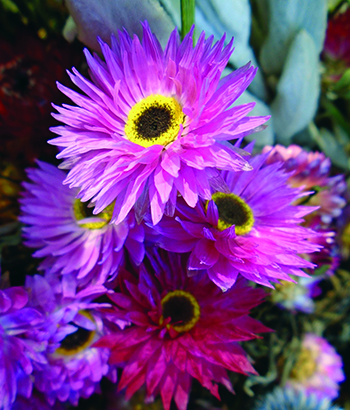 Paperdaisy is a deceptively simple flower, its vibrancy of color increases its value to the level of other more ornate options.
Peony—seldom raised expressly for drying, when it is dried there are few flowers more grand in appearance.
Poppy—a popular pod that can be a real “wow” if your poppies grow large enough!
Statice—requires no explanation, great colors and several of them, sturdy stems that help to really make the bouquet; an arrangement with no statice is a rarity.
Strawflower (Helichrysum bracteatum)—flowers with the rare quality of shininess, they come in a variety of beautiful colors and add a great deal to arranged bouquets.
Tansy—a useful yellow filler, but one with a truly singular eye-catching appearance.
Yarrow—a filler with a number of options for offering a soft touch of understated color.
Focusing the focal
Part of the appearance of a dried flower arrangement is simply how the components are being combined together. Was it done with a heavy or a light touch? Has the bouquet been arranged in a very wild and loose manner with plenty of room to showcase individual flowers, or is it very tight and compact with much of the bouquet’s impact deriving from the mass of the flowers pressed together? How does the bouquet seem? Too little, too much, or just right?
You could say that an arrangement is not only the materials in it but the negative space that is amongst the flowers (or not). Not surprisingly, somewhere in the middle of the spectrum of bouquet density is usually the ground to occupy to showcase the flowers best. Bouquets that are full of material give you plenty to look at, but it is a mistake to have them so crowded that you cannot see the trees for the forest, so to speak — that your focal flowers get lost and end up being not such a focus.
Contrapuntal posies
A diversity of flowers is often important because it helps to create the uniqueness of an arrangement. And with diversity, flowers are well positioned to stand apart from one another visually as well. This can be done with the use of dark and light shades of a single color, dark and light differing colors that complement each other, and the use of both petals and pods that offer both color and neutrals to set each other off. Frequently it is these contrasts that really make arrangements pop.
For several years, I have created a large arrangement (annually) for a customer who loves purple. The first year I made her bouquet, she stressed that she wanted it to be purple, purple, purple. I was thinking that because she loves purple a nothing-but-purple bouquet would be perfect. But flowers gain meaning from the other flowers around them.
What makes purple really stand out as purple is having a few pockets of really deep red, or little highlights of white, or some orange or green to show off the purples by contrast. She was thrilled with her initial bouquet. Every year I know that her wishes are the same, that purple should be the featured color. I know it is how I work in the other non-purple materials that will make the arrangement stand apart from the others of the past and that will make the purple really pop.
Diversity of materials. Contrast of colors. The simple and the sublime. Variety is both the spice of life and a good principle to follow when arranging the most (generally) enticing dried bouquets.
Leah Smith is a freelance writer and home and market gardener. She works on her family’s farm in mid-Michigan called Nodding Thistle (certified organic 1984-2009, principally by Organic Growers of Michigan). A graduate of Michigan State University, she can be reached at noddingthistle@gmail.com.
Copyright Growing For Market Magazine.
All rights reserved. No portion of this article may be copied
in any manner for use other than by the subscriber without
permission from the publisher.