











In the last issue I surveyed a number of farmers I know and asked them what pieces of equipment were important to their farms’ growth up to and past 10 acres. I’m always curious to see what equipment a farm has — and what they actually use — when I visit. Even with different mixes of equipment, farms seem to develop systems that fit what they have and build around key pieces. I thought it would be interesting to profile a few farms, looking specifically at the mix of equipment they are using in their production systems.
I’ll start with a farm that I’ve worked with for the past 10 years and have frequently used as an example in my articles. Sauvie Island Organics, located just outside of Portland, Oregon, farms a wide mix of vegetables and annual herbs for a 400-member CSA and direct sales to restaurant accounts. The farm broke ground in 1993 and has grown over the years, moving to its current location in 2004 where they now cultivate 16 acres of a much larger piece that is leased. There are six year-round and eight seasonal workers.
Field equipment
SIO, as the farm is frequently called, owns four tractors: a Kubota 5700 DTN, which is a narrow vineyard tractor allowing single beds to be worked and a creeper gear for spading; a Kubota 2800 utility tractor with a bucket loader for smaller jobs and maintenance around the farm; and two Allis Chalmers G tractors for cultivating and spreading amendments. Both of the Gs have Kubota diesel motors replacing the original gas motors, making them very reliable.
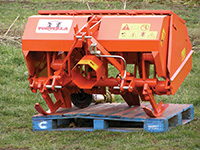
There are two distinct soil types on the farm, a lighter, well drained sandy loam, and a heavier, poorly drained silt loam. For incorporation of residue and primary tillage, a heavy 4’ Tortella 205 spader is used in most situations. The farm has a lighter 4’ Tortella 005 spader used for a shallow bedding up pass on the lighter fields. Currently they are using a 5’ rotary mower to mow down cover crop and remaining residue before spading, although it is somewhat problematic because it doesn’t chop the material finely, and it windrows somewhat. The farm also has a light, 6’ three-point disk that is used sometimes for rough preparation of potato and broccoli fields in the early season after a winter kill cover crop, or for working in cover crop seed later in the season.
Two new tools that the farm started using last season are a 4’ rototiller and a chisel plow. Both were purchased to try to speed up field preparation. The tiller is used to help break up clods in the heavy field that are left by the initial spading. It doesn’t fluff up the soil as much as a spader so the spader is still used for a final pass before planting. With lush cover crop growth last season the chisel had trouble clogging with trash so it wasn’t used as much as they had wanted, but the intention is to take some of the pressure off the heavy spader and to speed up primary tillage operations.
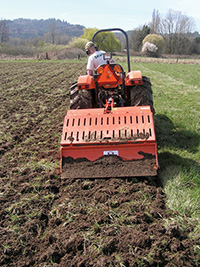
The farm does not use compost in the fields, but does spread organic amendments using a 3’ Gandy lawn drop spreader, which is belly mounted on one of the Gs. In some situations a backpack flame weeder is used to kill germinating weeds either before or just after seeding. The farm also has a set of Cultipacker ring rollers that it uses to mark salad beds and roll in cover crop seed. Most beds are marked with a custom bed marker that is belly mounted on a G (GFM May 2009). A basic furrower is used to pull furrows for potato beds and leek beds.
Planting tools
For direct seeding, the farm uses either an AP1 precision walk-behind seeder, or an Earthway Precision seeder. Most transplanting is done by hand, sometimes with a trowel. There are a few crops — alliums, sweet corn and cut lettuce — that are transplanted with a Japanese hand pulled “paper pot” transplanter (more on that in an upcoming article). The covering with the planter is inconsistent so they use a Glaser wheel hoe with double front wheels and double furrowers to help fill in around the string of transplants.
Cultivation tools
The Allis Chalmers G tractors are used for spreading and marking beds and, primarily, cultivating. The Gs are set up with sweeps to follow the wheel paths and a center sweep in the back that can be dropped for two row crops. The primary cultivation tool is a custom Lely tine rake that belly mounts on the G (slowhandfarm.com/supplemental/lelyforg.pdf). For single-row crops the farm also has a tool bar with spring hoes that reach under foliage and push a small hill into the row, burying weeds. The one cultivation tool that is used on the Kubota 2800, and not the G, is a set of double disk hillers for cultivating potatoes. Some crops also need to be hoed and the farm uses a mix of Glaser colinear and scuffle hoes, a wheel hoe, and eye hoes in certain spots.
Harvest tools
Most harvest is done entirely by hand, using lettuce knives, bypass pruners, grape knives, spades, spading forks and broadforks, depending on the crop. Custom garden carts (GFM October 2010), garden carts, and pickup trucks are all used for moving produce out of the field and into the barn. A broccoli harvest backpack from Vegetable Grower Supply in Salinas is used for broccoli harvests, sweet corn, and peppers. For bulky harvests like winter squash, farm-built fruit bins are filled in the field and picked up with pallet forks on the tractor to be moved to the barn (GFM September 2009). Potatoes are dug with a Cecchi and Magli potato digger and picked up by hand.
Irrigation
SIO irrigates from two wells on the property. A variable-speed pump allows small or large areas to be watered without overworking the pump. A 3” buried main line feeds all of the fields and risers come up every 160’ with both hose bibs and 2” camlock fittings.
SIO uses both overhead water, distributed through 40-foot 2” aluminum hand line with Rain Bird heads, and T-Tape drip tape, with pressure regulators and filters at the distribution manifolds. Fields are close enough to the barn and the farm has enough pipe that they have gotten away without a pipe trailer, but there is a small, custom built pipe mover that allows an individual to move six to eight pipes at a time. T-tape is collected at the end of the season with a hand winder that makes tight bales for storage and reuse (GFM November 2009).
Propagation equipment
The farm has one 20’ x 78’ heated house, half filled with heated tables for germinating. The rest of the house hasunheated tables and all of the house is watered with hanging Netafim heads that are turned on manually but shut off automatically with a timer. The house is heated with propane forced air, and the heat tables have circulating hot water from a household propane water heater. There is a second unheated house that is used for hardening off and then later in the season becomes a space for in-ground crops. That house is watered with Mini-wobbler sprinkler heads.
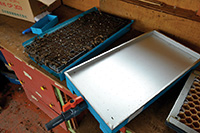
Seeding trays in the greenhouse is done both by hand and using an EZ Seeder vacuum seeder. The vacuum seeder has different plates for different trays and seeds. Most transplants are seeded into 1020 plug trays that are either 200, 128 or 38 cells. The paper pot transplanter has its own trays and seeder that allow it to transplant at either 2”, 4” or 6” spacing in the field.
Packing out
SIO uses a variety of plastic stack and nest totes both for harvest and for storing vegetables in the cooler. They use rubbermaid totes for packing CSA boxes, and wax boxes for restaurant deliveries. 5-gallon buckets are also used for harvest of some crops.
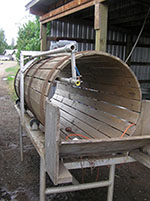
Potatoes are cleaned in a Willsie batch washer (GFM March 2010) and that washer is also used for topped beets. Simple wire mesh tables with overhead hoses and pistol spray heads are used for cleaning and sorting other crops. Salad greens are dunked in large rubbermaid livestock watering troughs and are then spun dry using nylon mesh bags in a washing machine on spin. Mixes are tossed in a custom salad mixer. The farm uses an electric power washer to clean out the plastic totes.
Storage space is limited on the farm and there is one 16‘ x 16’ walk-in cooler as well as some covered barn space for dry storage. Onions and garlic are cured on stacking racks. There is also a small insulated room with a modified air conditioner for potato storage at the original farm site down the road.
Convertible hand trucks are used extensively for moving totes around the barn, into and out of storage spaces. The farm also built a number of small “bin bottoms” to keep the plastic totes off the ground in the barn and cooler, and to make it easier to get the nose of the hand truck under stacks.
Delivery
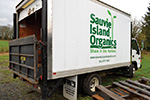
The farm has two delivery vehicles, a 10’ cube van and a 14’ box truck. The box truck has a lift gate for loading and unloading. There is a farm-built ramp for the cube van loading.
That’s a bit of a laundry list, without much explanation, but I hope it gives you an idea of the range of equipment that one established farm has invested in over the years. This is also a snapshot in time, and doesn’t really acknowledge the evolutionary nature of the farm’s equipment selection. I probably missed a few things (like the sound system in the barn, or the computers in the office), but you should at least get a sense for the farm from that. In coming issues I’ll try to profile a few more farms and contrast them with what is being used at Sauvie Island Organics. I also want to say a big thank you to Shari Raider, Tanya Murray, Heidi Noordijk, and Brian Wood, all from SIO, who helped me understand the equipment they’re using these days.
Josh Volk, a regular contributor to GFM on tools and equipment, farms at the edge of Portland, Oregon. He also helps farmers around the country improve their systems. Visit www.slowhandfarm.com
Copyright Growing For Market Magazine.
All rights reserved. No portion of this article may be copied
in any manner for use other than by the subscriber without
permission from the publisher.