











In the March issue of GFM, I talked about a spacing change in my tomato hoophouse, which allowed me to plant 60 percent more plants than the previous year. Yet I was able to increase yield by 100 percent over the previous year. Now, I’m going to report on the improvements that led to the other 40 percent of my yield increase. Many of the principles can be applied to the field as well as the hoophouse, and crops besides tomatoes.
Learning from yield data
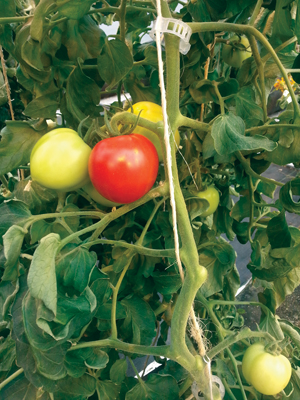
One of the biggest changes I made between the 2011 and 2012 growing seasons, besides increasing planting density, was to eliminate a few varieties that did not perform well for me in 2011. I got rid of the underperforming varieties and played with a tomato all-star team in 2012. The only way for you to figure out who your all-stars are is to do what any coach would do — keep statistics. Then make the time to analyze them once the season is over.
This doesn’t have to be a time-consuming endeavor. What we do on One Drop Farm is to repurpose our springtime plant propagation house (a 12’ by 20’ double wall polycarbonate lean-to off our garage) into the summertime tomato packing house. We throw a white tarp over the structure so it is still light inside when the sun is out, but the heat doesn’t build up as it does when it’s in greenhouse mode.
A ventilation fan runs constantly during the daytime to keep air flowing over the tomatoes, to dry out any moisture and reduce post-harvest rot. As tomatoes are picked and brought into the tomato packing house, they are weighed in and noted on a pad that lives right next to the scale. At the end of the season, we put all the numbers into an Excel spreadsheet set to auto sum and we can see how each variety did for us.
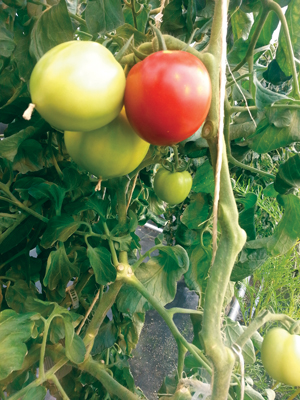
The differences can be significant and surprising. In 2011, I grew a bunch of different heirlooms (all of them grafted), and some of them did much better than others. So I eliminated the under-performers, and landed on four varieties that seemed to work the best for me: German Johnson, Cherokee Purple, Striped German, and Valencia.
Last year, I noticed something about Valencia that I had seen the previous year, but worse this time. The plants got excessively vegetative early in the season. Essentially, they were putting all their energy into vines and leaves and not putting much into flowers and fruit. The vines were as big around as the fat part of my thumb, and the new growth was so curled and twisted, it looked like herbicide damage! At the end of the season, I could look back at my yield data and see that that excessively vegetative condition cost me earliness and yield.
Now, this excessively vegetative condition is a combination of the plant being young and naturally vegetative, and being grafted to a vigorous rootstock. This is significant for Valencia because none of the other three grafted heirlooms I was growing reacted as vegetatively. Being convinced of the benefits of grafting as I am, I’m not going to stop grafting, but I am going to drop Valencia and try to find another orange tomato that performs better UNDER MY CONDITIONS.
I emphasize the last part because this is why the yield data is so important. It’s not that I think Valencia is a bad tomato. In fact, I think that for an orange tomato, it is remarkably uniform and unblemished, especially for an heirloom. But under my conditions it doesn’t perform the way that I would like it to, and I would rather fill the space with something that can be more productive.
If I didn’t graft or lived in another part of the country with different weather conditions it might perform differently for me. Getting the hot new variety or finding out what other growers in your area have success with may get you half the way to good production, but there’s no guarantee unless you take the yield data and verify for yourself that what you are doing under your conditions is working. Knowing which varieties produce best is worth way more than the time that it takes to get the data.
Your yield data may really surprise you. I know it surprised me this past winter to find out that I was only getting one third the yield off my grafted heirlooms than off my grafted hybrids. I was shocked! All the plants looked vigorous and healthy. You would never think the yield difference was that pronounced just by looking at them. It is always said that heirlooms are not as high yielding, besides not having the disease resistance of hybrids. I would have guessed maybe a half or so of the hybrid production but a third!?! This is an example of something I never would have known if I didn’t have the data.
So, what does this mean to me? The way I think about it, my grafted hybrid beefsteaks yield about 30 pounds per leader, or since they’re double leader plants, 60 pounds per plant. I try never to take less than $2.50/pound for my red beefsteaks, and we sell a significant amount of them for more than that at the farmers market, so a grafted two leader hybrid beefsteak tomato plant is worth at least $150 gross to me.
The heirlooms, on the other hand are yielding closer to 10 pounds per leader or 20 pounds per plant. I didn’t sell any heirlooms for less than $3/pound, and sold a significant amount for more at the farmers market, so I can say that a grafted two-leader heirloom plant is worth at least $60 dollars to me. But even that doesn’t tell the whole story. It probably takes me twice as long to maintain a row of heirlooms as it does a row of hybrids. This isn’t a coincidence; greenhouse hybrids are bred to be lower maintenance. The opposite of this are the heirlooms, which have more double heads, dead heads, excessively large flower clusters, and generally weird and unruly growth habits that make them interesting to work on but time consuming.
In case you’re wondering about the raw data, I averaged 31.44 pounds per leader off my hybrid beefsteak plants, which were Rebelski grafted onto Colosus. On the heirlooms, which were all grafted onto Maxifort, I averaged 10.25 pounds per leader from German Johnson, 9.84 pounds per leader from Cherokee Purple, 9.7 pounds from Striped German, and 7.25 pounds from Valencia. Due to their excessively vegetative condition, the Valencias were also more than two weeks later to start bearing than the other heirlooms. And I only count marketable yield, since I leave the unsalable tomatoes in the hoophouse to be picked up with the other plant debris. Though the hoophouse does such a good job of protecting the fruit from the elements, I would say that I pack out somewhere in the high 90 percent range of the fruit that I grow.
And why did I use Maxifort for the heirlooms and Colosus for the Rebelski? I botched my first round of grafting with the heirlooms and by the time I started over again, Colosus was sold out. Most heirlooms seem to germinate and emerge in a much less even manner than most of the hybrids, taking a week or more for them all to come up, whereas the hybrids seem to all germinate over the space of a few days. When you need perfectly matching stems for grafting success, it can be advantageous to start four times the number of heirlooms than you really need to plant. The seed is cheap, and that should give you enough to match to your rootstock variety, which is more expensive and you could overplant by only 20% (or more, depending on how good you are at grafting).
Whether it is “worth it” or not to grow heirlooms is up to the individual grower. I plan to continue growing them, though on paper it seems that I should consider doing otherwise. If I didn’t grow some I would miss them. Another consideration is that our top-quality early season heirlooms set us apart and give us something to offer to suppliers that might otherwise not do business with us because we are selling what everyone else is selling. Another thing I keep in mind is that not everyone wants to buy a red tomato and we would surely lose some farmers market customers if we only had reds.
I figure as long as we can get 4,000 pounds of tomatoes at $2.50/pound minimum price out of a 30 by 48 structure that probably cost less than $10,000 to build, we are making the cost of the structure back every summer season. To my mind, that seems like a pretty good return, even though some varieties are more profitable than others. And knowing what different varieties are producing for you is golden when it comes to figuring out whether to continue with a variety, or even switch to another crop altogether.
Leaf and cluster pruning
One other thing that probably helped out my yields last year was that I kept up on leaf and cluster pruning. By leaf pruning, I mean removing the leaves below the cluster of tomatoes that is ripening. This is important to do for several reasons. When the leaves are allowed to remain below the ripening cluster, it keeps the truss cooler and that makes the tomatoes ripen more slowly. So, taking them off can speed up the ripening process. Also, the cluster microclimate caused by leaf cover on all sides traps more moisture close to the ripening fruit. This increases the possibility of botrytis developing on the calyx or fruit, and russeting or micro-cracking, which is made worse by free moisture sitting on the surface of the fruit. I have found fruits that are in perfect condition except for some russeting where a leaf was touching the fruit and keeping the fruit wet. This is particularly a problem late in the season in an unheated hoophouse, when cold night temperatures cause a lot of condensation on everything including the fruit. The fall is really the only time of year that I cull fruit because of russeting.
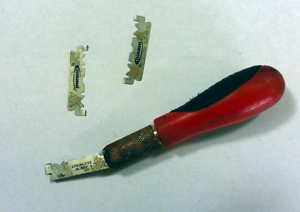
The leaves below the fruit cluster are too shaded to contribute much to the plant, and as the oldest leaves they are the most prone to diseases. When you take them off it opens up a lot more air circulation at the bottom of the plants. Otherwise, this is an area that tends to stay cool and damp and build up diseases like botrytis that like those conditions. The best way to remove these leaves is to cut them off flush with the stem with an x-acto knife, or I have come to prefer an old-fashioned razor blade snapped in half lengthwise and inserted into a woodworking blade holder. Do not snap leaves off or in any manner leave a stub of petiole attached to the stem. Stubs are very prone to botrytis infection that can move into the stem and possibly kill the plant.
As far as cluster pruning goes, it helps the plant remain vigorous and keep fruit size up to thin the cluster back to the desired number of fruits. Every flower that becomes a fruit is essentially a growing point, not unlike a shoot, which makes a demand on the plant to put energy into developing the fruit. One of the ways that greenhouse hybrids are easier to maintain than heirlooms is that they produce a more reasonable number of blossoms than some heirlooms do. I have seen a large-fruited variety like Brandywine throw 15 or 20 blossoms in a cluster!
A variety like that with fruit size from a half pound to a pound is obviously not going to develop all those fruits and have a 10-20 pound truss! Help it out and cut it down to a more realistic number. Most people prune beefsteaks to 3-4 flowers, cluster tomatoes to 5-6 flowers, and cherry tomatoes very lightly or not at all. Cherries can be tricky because the number of fruits set varies so much by variety. But if you look at the plant and many of the clusters have undersized, undeveloped fruit that never ripen at the end, you could nip that number off the future clusters to save the plant from putting energy into fruits that are never going to develop.
This is also a way to influence fruit size. If you have a really large variety that you would like to be a little smaller, you could leave four flowers and you will get four, smaller fruit than if you had pruned to three. If you have a variety that is a little smaller than you would like it, you could prune to 3 fruits and the plant’s energy for that truss will only be divided in 3, resulting in slightly larger fruit.
When to actually do the pruning is another question. If fruit is setting really well, it is common to do the pruning early on with flowers before the fruit is set. This keeps the plant from putting any energy into flowers and fruit that you don’t want. On the other hand, sometimes fruit setting is poor and not every flower is turning into a fruit, due to excessively hot temperatures or inadequate pollination. In these instances it might be better to wait until the fruits have become the size of a small marble to thin, so you can see which ones will actually develop.
These last two techniques of leaf and cluster pruning probably require too much labor to make sense in the field. But they really do make a difference in the high-labor, high-yield environment of the hoophouse and greenhouse.
Andrew Mefferd and his wife, Ann, own One Drop Farm in Cornville, Maine. Andrew also is a trial technician for tomatoes at Johnny’s Selected Seeds research farm.
Copyright Growing For Market Magazine.
All rights reserved. No portion of this article may be copied
in any manner for use other than by the subscriber without
permission from the publisher.