











Chris Blanchard
September is a great time to get started on your plans for next year. The ground is still in working condition, so you can set the stage for increased or improved production. With everything coming into its fullness, you’ve got product to share with prospective customers, setting the stage for selling more product to more people. And with the reality of your farm staring you in the face, you’ve also got the reality check you need to decide if it’s time to get bigger, get better, or do a little bit of both.
A lot of food and agriculture professionals – including yours truly – talk about the advantages of increased efficiencies and scaling up. But the first step to getting bigger should be an honest assessment of where you’re at, not just where you’re going. If you are thinking about planting more acres next year, take a hard look at your farm’s – and your own – performance this year. Are you harvesting what you planted? Have your crops come out of the field in orderly successions – and now that things are slowing down, are your crops still meeting their potential? Are the weeds under control, and your plants healthy, strong, and not lacking for water? How are your workers doing – burned out and grumpy, or just tired in a healthy way, and still smiling?
And how about you? Are you already exhausted, or are you still finding smiles and feeling energy at the prospect of your work every day?
If you aren’t succeeding at the fundamentals this year, you don’t have the foundation for expanding production next year – at least not by expanding the numbers of acres you are farming. You should be able to plan on succeeding with the vast majority of your plantings every year. The really successful farmers I know don’t plan on, and don’t often deal with, crop failures. It doesn’t matter whether they ended up farming on five acres or a hundred: before getting bigger, they got better.
If you can do better on the acres you’re already farming, that’s a surer path to success than an ever-expanding number of acres. That’s not to say that you have to plant more intensively – more production per acre doesn’t necessarily lead to an increase in per-acre profits. But it is about increasing the utilization of the assets you have invested into production: when you plant, you should harvest; and when you harvest, you should be getting optimal yields of quality produce from your plants without being slowed down by having your face in those prickly pigweed seedheads. If you aren’t getting results, look at what you can do to increase the output from the resources you’ve already got in play.
Preparing your markets
It’s easier to sell your vegetables when you have product. Clean carrots, crisp lettuce, and ripe tomatoes are just figments of the imagination in the middle of winter. Whether you want to expand your sales to stores and restaurants, or increase membership in your CSA program, now is the time to show your prospective customers examples of what you can provide for them.
For stores and restaurants, or even wholesale distributors, product samples can set the stage for serious talks over the winter. Demonstrating your ability to produce quality vegetables and fruits at any time of year lets prospects know that you are capable of doing that throughout the growing season – perfect broccoli in September implies the ability to produce perfect asparagus in May.
For buyers already dealing in local products, August and September can be tremendously busy times as they juggle orders and deliveries from a dozen different vendors. You don’t need to close the sale now – just getting your foot in the door and showing your capabilities can set the stage for a more in-depth conversation in December. Call ahead to ask if you can stop in to provide a sample, and when you stop in, let them set the pace for how long the conversation should last. Bring a full case of produce, so that they can see that you are serious about providing the quantities and packs that they are used to seeing; if possible, stop by during your deliveries, and you can even show them the products you are taking to other stores.
Keep in mind, you want to provide a sample at this point – give your product away. If you can, supply crops with a high wow-factor and easy accessibility, so that when they share samples with the rest of the department or the store management, people are eating the salad greens or the carrots right on the spot.
Use the same approach to expand your CSA program. Use September’s bounty to pack up some extra boxes, and give them away. Farmers market customers often make a good source for new CSA members, and the sales you would lose by giving a customer a box a week should be more than offset by the profits you’ll reap from having that person as a CSA member.
Offer extra CSA shares to current members who want to share the experience with friends and neighbors. You can make this offer in your newsletter, or, better yet, approach the members you know to be your biggest fans, and ask them if they’d like a box to give to a friend, relative, or co-worker who they think might be interested in your program.
Remember, CSA shares are meant to be sold before you start your production season – ideally before you open up your greenhouse to start transplant production. You don’t want to be trying to sell CSA shares with a June 1 start date when you arrive at farmers market on May 15.
Crop planning
Now is the time to take land out of perennials if you want to use it for annual production next year. Killing the perennial crop now and seeding to a winter-killed cover crop – most farmers I know in zones 5 and north use oats or barley and field peas – provides a huge jump on trying to turn an alfalfa field or pasture into crop ground in the spring – especially if the spring turns out cold and muddy.
I highly recommend cover cropping any land you plan to expand into for a full season, if at all possible. An intensive cover crop rotation – barley and peas to buckwheat to either winter rye and hairy vetch or barley and peas again – is just the ticket for getting the nutrient cycle ramped up, building organic matter, and reducing the weed load. But killing the perennial crops at the end of summer is still a huge jump on trying to do it in the spring when you want to plant right there.
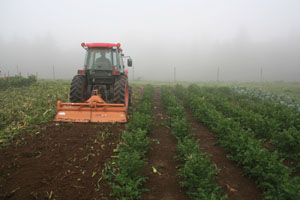
While many farmers like a moldboard plow to bury alfalfa or perennial grasses, plowing takes some real skill, and many smaller farms don’t own either a moldboard plow or a tractor with the horsepower to use the neighbor’s plow. I prefer to use a tractor-mounted rototiller to kill grasses and alfalfa. Set the depth to about four inches, and open the rear gate as far as you can. At this depth, the blades will cut off the taproots of the plants that have them, and uproot the root ball of those that don’t; leaving the rear gate open allows them to be thrown into the air by the tiller, leaving them on the soil surface where they will start drying out and dying. When the field starts to green up, take an additional shallow pass with the tiller or use a field cultivator. A cover crop of oats and peas or barley and peas planted by mid-September in zone 4 will still provide some cover for the winter.
Especially for farms with diverse crops, such as CSA operations, it’s important to assess your rotation if you plan to expand. Can you really support more of all of the crops you are already growing? If you expand your production, will you be able to avoid putting crop families back on the land where you’ve got them now for a suitable period of time?
If you are expanding your acreage, think hard about the kind of land you are expanding into. When we decided to expand beyond our original five acres – a beautiful, flat silt-loam – the fields available to us were heavy, clay soils up on the ridge that laid wet despite their immodest slope. We had to adjust our crop rotations and selections accordingly.
To support an expanded customer base in the spring, you need to consider expanding any crops you plant this fall. For crops like garlic where seed and culture are expensive, it may pay to be conservative in your planning. But if you overwinter crops like spinach, where the seed is relatively inexpensive and weed control in the fall can be relatively straightforward, it doesn’t hurt to plant far more than you need – you can always till it in the spring to make room for other crops in your rotation.
Capture key points
In the headlong rush of the market farming season, we often don’t have time or excess mental capacity to figure out solutions to the bigger issues that need to be solved to make operational improvements for the future.
Unfortunately, our brains have a mechanism for purging information that we don’t need anymore – or at least that our brains think that we don’t need any more! As circumstances change, your brain dumps the information it had been keeping immediately accessible, making room for new, now-relevant information. And while this may have been great for avoiding saber-tooth tigers back on the savannah, it doesn’t work so well when it comes to making an accurate assessment of the growing season when there’s two feet of snow on the ground.
Sadly, the problems that created the most stress and misfortune during the growing season – whether it was the challenge of getting transplants out ahead of the rain, or the inability of employees to properly cull tomatoes – fade by the time you really have time to implement long-term solutions.
That doesn’t mean you have to solve the problems while they’re staring you in the face. You just need to capture the problem now, and put it in a place where you can come back to it after the crops and the work slow down. If you want to do better next year, take the time now to get some notes on paper or in an email to yourself, and file it where you can find it easily when the season has drawn to a close – I recommend a file folder labeled, “Painful Things to remember in November.” You don’t need long explanations at this point – “tomato culling issues” will provide an adequate jog to dislodge memories of the errors workers made and why.
Manage now
Better results don’t usually result from doing a “better” job of weeding or repairing the drip tape. They come from better management of the resources you have available. On my own farm, and in my work with farmers around the country, the key to successful management has been to spend time managing – not weeding, not planting, not telling employees what needs to be done, just observing and noting what needs to be done, and making a plan to do it.
In my experience, the weekly field walk is the key black-belt move that makes the difference between managing and reacting. Every week, every field and every greenhouse should get a visit for the sole purpose of observation and recording the work that needs to be done. By observing with intention, you increase the opportunities to catch problems before they get out of control, to monitor the results of the choices you made previously, and to plan the appropriate actions in response.
Whether you decide to get bigger, get better, or do a little of each, preparing your markets, preparing your ground, and improving your management practices now will help you set the stage for a successful growing season in the coming year.
Chris Blanchard assists farmers, food businesses, and non-profits to improve, create, and implement systems to improve profitability and quality of life. He has worked in farming for the past 24 years, managing farms and other operations around the country. As the owner and operator of Rock Spring Farm since 1999, Chris raised twenty acres of vegetables, herbs, and greenhouse crops, marketed through a 200-member year-round CSA, food stores, and farmers markets. Learn more at www.flyingrutabagaworks.com
Copyright Growing For Market Magazine.
All rights reserved. No portion of this article may be copied
in any manner for use other than by the subscriber without
permission from the publisher.