











In the January 2020 issue of Growing for Market, Spencer Nietmann shared the numbers for Moose Meadow Farm to “inspire others to lay their balance sheets bare, as uncomfortable though it may be, so that we can all learn and grow.” Initially, we thought his invitation was a great idea. On further reflection, we were concerned that only growers who were more profitable than Spencer and Katherine would have the courage to go public with their farm income and expenses, possibly creating too rosy an impression of the financial health of the market farming community.
To provide a reality check, we decided to share our 2017 report from the Pasa Sustainable Agriculture (Pasa) Diversified Vegetable Farms Financial Benchmark Study. You may remember Pasa as the Pennsylvania Association for Sustainable Agriculture (PASA). In May, PASA changed its name to Pasa Sustainable Agriculture, or Pasa for short.
Pasa started this research project for exactly the same reasons Spencer stated in his article. Comparing numbers with farmer peers has the potential to improve everyone’s bottom line. As noted in the report, this “data can be a helpful tool in guiding decisions about production scale and intensity, labor, payroll and other expenses, and capital investments.”
Franklin Egan, Pasa education director, and Sarah Bay Nawa, research coordinator, have organized workshops, conference calls, and webinars to discuss the results of the study and provide opportunities for growers to learn from each other.
The 36 farms involved in the research project represented a wide range of acreage and experience, with a number of small-scale start-up operations joining the study in 2017. Since many of the farms manage multiple enterprises, including vegetables, livestock, fruit, and resale of products from other farms, the report provides, “benchmarks for each farm’s vegetable enterprise as well as the farm business as a whole.”
The farms are located in three mid-Atlantic states (Pennsylvania, Maryland and West Virginia) and “sell all or some of their vegetables through direct market outlets, including farmers markets, CSA programs, on-farm stores, as well as wholesale to retailers, restaurants, and institutions.”
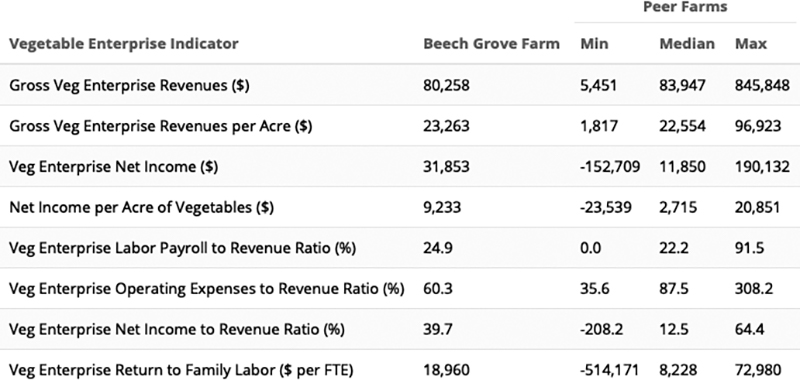
for Beech Grove Farm, and compares them with the median, minimum, and maximum 2017 benchmarks for the full cohort of Mid-Atlantic farms.
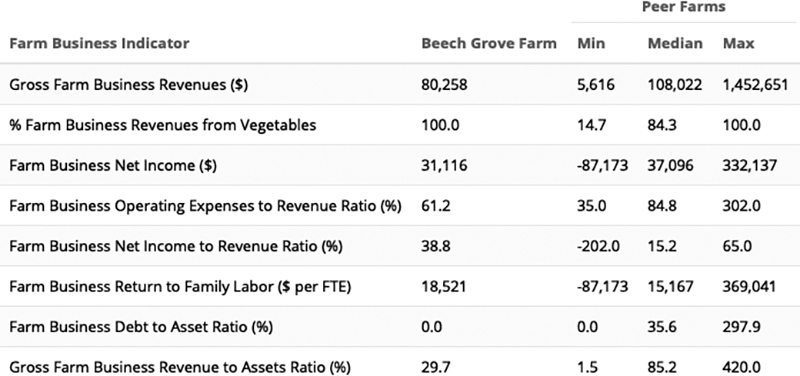
compared with the median, minimum and maximum 2017 benchmarks for the cohort of Mid-Atlantic farms.
All tables and charts provided by authors and Pasa.
The Pasa benchmark report shows that the net income from our 36th growing season at Beech Grove Farm was $31,853- $23,000 less than Katherine and Spencer’s third year of production! Even more sobering, the median of the PASA farms was only $12,416. That is, half of the vegetable operations netted over $12,416, and half under $12,416. Keep in mind that the Pasa study also documented that vegetable production can be very profitable as seven of the farms netted between $55,000 and $192,000.
In addition, the median overall farm business net income was $37,253 with a dozen farms ranging from $58,000 to $332,000. According to the insights section of the benchmark report, “the most common enterprise other than vegetables in our cohort was reselling products grown or raised on other farms, suggesting that reselling can be a valuable tool for increasing farm business net income.”
Ironically, our farm business net income was a little lower than our vegetable enterprise because most of the eggs from our small laying flock go to household use, employee perks, or barter with neighbors for doing our chores when we need to leave the farm.
Although the median farm business net income was well below the Pennsylvania median household income of $56,950, “most farms with ten years or more of experience had considerably more equity in their business than the median 2017 Pennsylvania household net worth of $105,590.” For this study, farm equity was based on the estimated market value of assets, including land, buildings, livestock and equipment.
The median farm business revenue-to-assets ratio of 85 percent also indicates many of the mid-Atlantic farms were generating a lot of sales from their equity. By this measure, our small business, with a ratio of under 30 percent is not performing very well, probably due to a relatively large investment in land, buildings, and delivery and farm vehicles compared with our production area. In 2017, we had 3.45 acres in vegetables (including movable hoop houses), 3 acres in cover crops, and 16 acres of pasture for the work horses.
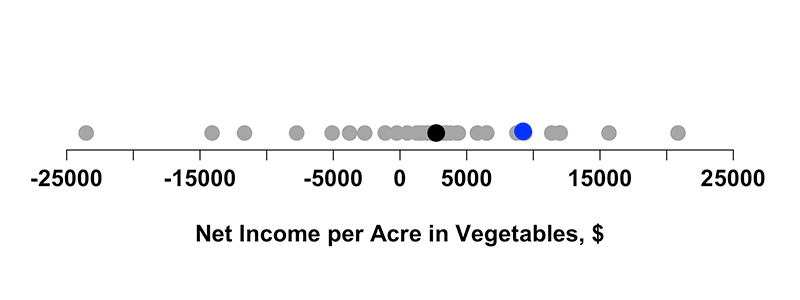
while the median value in their sample of mid-Atlantic farms was $2,980.
In all charts, the bold black circle represents the median value and the blue circle is Beech Grove Farm.
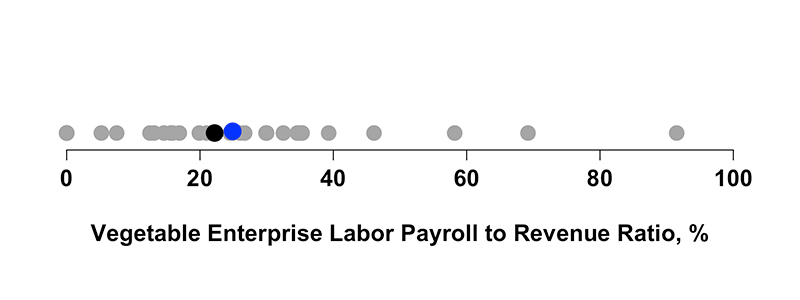
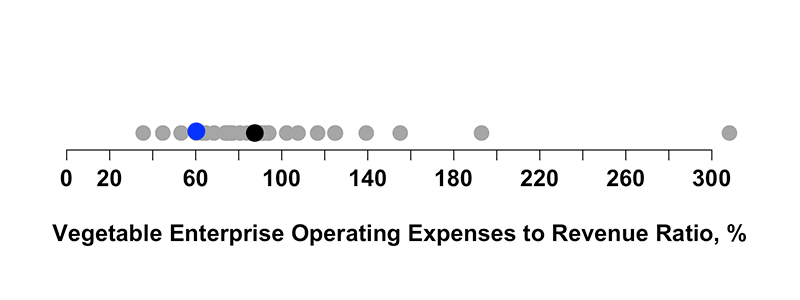
while the median value in their sample of Mid-Atlantic farms was 86.4.
On the plus side, our net income per acre of vegetable production ($9,233) was well above the median ($2,980). This surprised us because we only grow one crop per year planted in single rows 34 inches apart and do not use irrigation. (For more about our production, see the Farmer to Farmer Profile of Beech Grove Farm in the March 2019 GFM.)
The exception is high tunnel production, containing 4,000 square feet of irrigated beds, which are double-cropped and produced 23 percent of our revenue. We grow all the standard fresh market crops, other than melons, microgreens, and sweet corn. Due to our relatively cool location we focus on leafy greens and root crops, sold through a Saturday farmers market (86 percent) and a few restaurants from mid-May through mid-November.
Our vegetable operation also had the fourth highest net income-to-revenue ratio (39.7 percent). This ratio is an indicator of profit potential and farm viability. “Scores well above 20 percent are probably necessary for most farms to be in a position to appropriately compensate family labor.” The median vegetable enterprise net income-to-revenue ratio was 13.6 percent and the farm business median 16 percent.
The operating expenses-to-revenue ratio is another measure banks use to evaluate the financial health of an enterprise. “A ratio over 100% indicates that expenses are exceeding revenues, and that the enterprise is likely losing money on a cash flow basis. A ratio between 75% and 100% is a risky zone, because it suggests that that after covering operating expenses there will be little net income available for investments and to compensate family labor.” The median operating expenses-to-revenue ratio for the 36 vegetable enterprises was 86.4 percent; 83.9 percent for the farm businesses.
The ratio for our market garden, 60.3 percent, was one of the lowest in the study. Note that compensation for farm family labor was not included in the calculation for operating costs in order to compare the rate of return on grower hours across all of the farms in the research project. The median of the vegetable enterprises was $8,824 of net income per full time equivalent. A full time equivalent (FTE) is 2,080 hours per year. To put this rate of return on farm family labor in everyday terms, the median was $4.24 an hour, and $7.72 an hour ($16,054 per FTE) for the farm businesses.
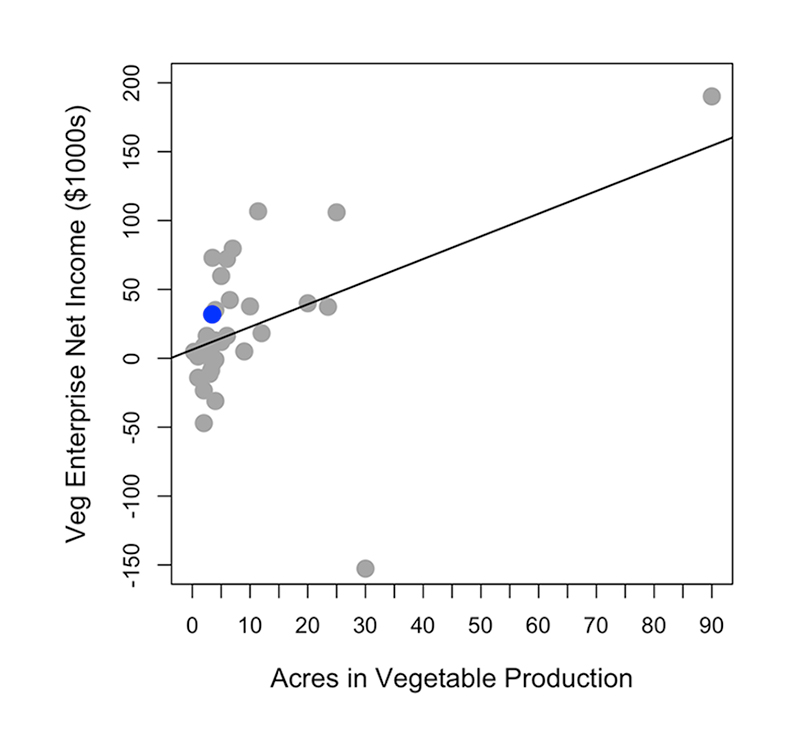
Participants in this study were growing vegetables across a wide range of scales, from less than 1/3 of an acre to 90 acres.
There was a clear correlation between the number of vegetable acres in production and vegetable enterprise net income.
Although there was also considerable variation in this pattern, the trend line suggests that for larger farms,
the farm and partners were able to draw a larger income from their vegetable enterprise.
Our return of $9.10 per hour ($18,960 per FTE) is based on an estimate of the time (3,500 hours, 1.68 FTE) the two of us put in to the vegetable enterprise in 2017, including work horse care, manure and compost management, and pasture maintenance. This “wage” was significantly lower than our part-time, on-farm employee. Each year we have increased Naomi’s hourly rate by a dollar. In 2020 she will be earning $15 per hour plus lunch, vegetables and eggs. The crew of two to four that helps Anne at market receive $10 per hour and vegetables. Our employees worked 1,735 hours (.83 FTE) in 2017.
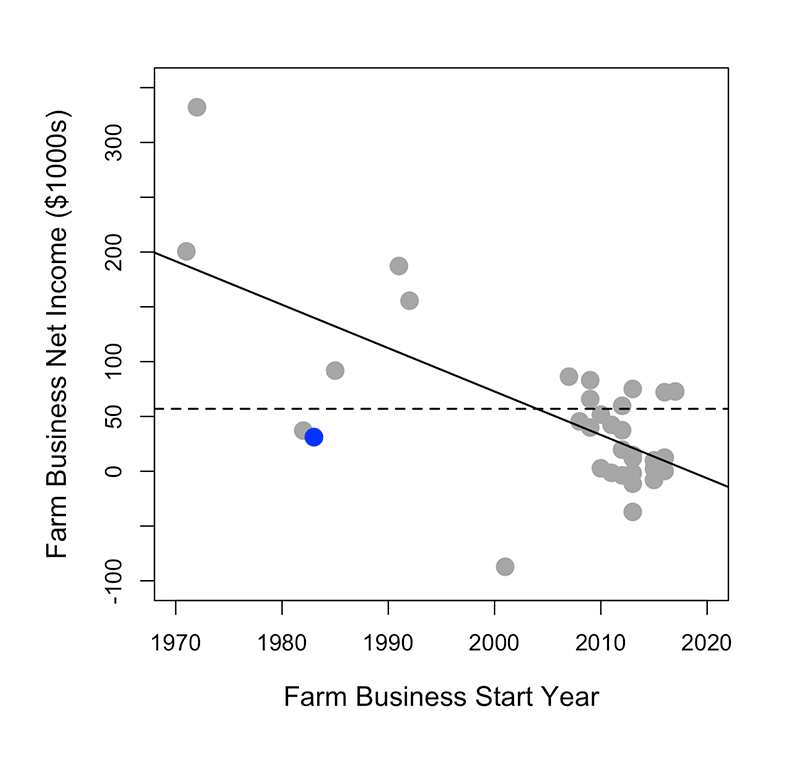
Although there is considerable variation around this trend, the trend line in black suggests
that it can take approximately 10 years for a farm business to achieve a net farm business income
equal to the 2017 Pennsylvania median household income of $56,951 (shown on the dotted horizontal line).
Our labor payroll-to-revenue ratio was higher than the Pasa median and reflects a major departure from our original goal of a two-person operation. At the 20-year mark, we took on an employee to help 12 hours a week in the packing shed. This deviation from our two-person goal allowed us to increase sales and made our lives easier. Then in 2014, we added a full-time intern with work horse experience while Eric recovered from a debilitating illness.
Fortunately by 2017, Eric was well enough to do all of the field work but not much else. Naomi helped Ann with picking, packing, planting and hoop house management, averaging 30 hours a week from April through November. Because our cover crop system has dramatically reduced weed pressure, we have not needed to hire help for weeding, a cost that would significantly reduce our income.
In conclusion, our small-scale, seasonal vegetable operation is relatively profitable compared to our Pasa peers, but our overall farm business net income is below the median, and the lowest of the farms that have been in business over 25 years. We assume this outcome is due to sticking to a scale that the two of us were able to handle for many years, and choosing not to add winter production or resale of produce. Although we have netted more in the past, $32,000 is enough to cover our living expenses and make farm improvements.
We hope that sharing the Pasa financial benchmark report and our minimalist farm story will give others the courage “to lay their balance sheets bare.” For more information about this study and other Pasa research, go to the Pasa website, www.pasafarming.org. The 2018 and 2019 financial benchmark reports should be posted next winter. Anyone interested in joining the project, contact Sarah Bay Nawa, sarah@pasafarming.org, 814-349-9856.
Anne and Eric Nordell have been growing vegetables, small fruits and herbs in north-central Pennsylvania since 1983. They have self-published a booklet ($10 plus $3 shipping and handling) and DVD ($15 plus $3 shipping and handling) which describe how their integrated farm system has virtually eliminated weed pressure. Please send payment to 3410 Rt. 184, Trout Run, PA 17771.
Copyright Growing For Market Magazine.
All rights reserved. No portion of this article may be copied
in any manner for use other than by the subscriber without
permission from the publisher.