











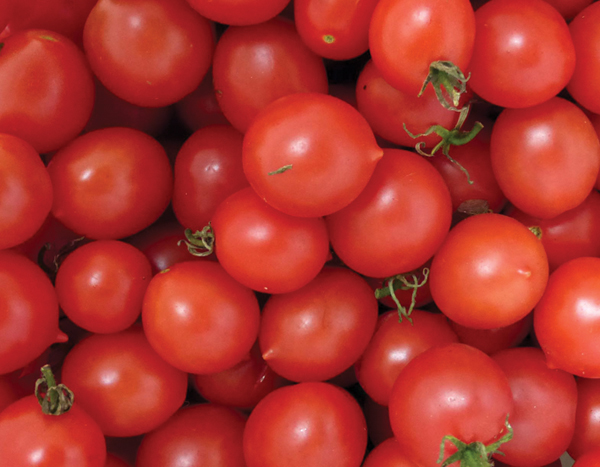
Below: Amy’s Sugar Gem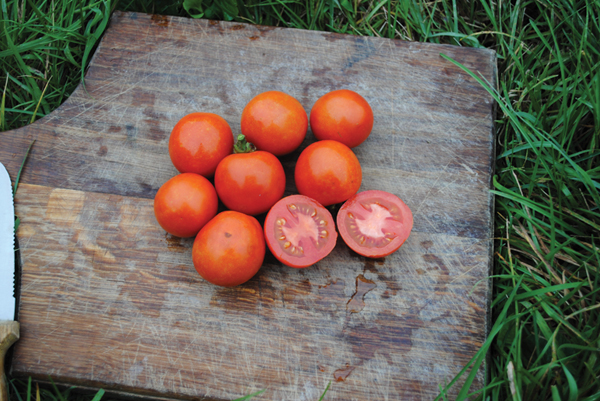
One of the crops we grow in our hoophouse in spring and early summer is a range of heirloom and other open-pollinated tomatoes. Because we use drip irrigation and it doesn’t rain in there, our plants don’t get water falling on the leaves. Naturally, they have some dew in the mornings, but this dries up early. So there is less fungal disease pressure than outdoors. Also, we do a better job of monitoring the indoor crops than those in the field. So the hoophouse is a good place to “audition” varieties we haven’t grown before, and to grow those delicious but temperamental ones that we no longer grow outside. This year we grew 20 varieties, with at least two plants of each. We included a few F1 Hybrids, but most are open pollinated (OP).
We can justify as research growing some promising-sounding varieties without a lot of initial attention to whether they would be a commercial success or not. But there comes a point (usually in the heat and busyness of summer!) when we want to know which varieties are productive and disease-resistant, as well as delicious. We haven’t time to cosset the losers. We want to invest our time wisely and get good results. And we want to boot the worst to make way for trying some other varieties next year. We do also grow some OP and heirloom varieties outdoors later in the season, but out there and by then we are more focused on reliable production, quantity and disease-resistance, and less on novelty-value.
Below: Cherokee Purple 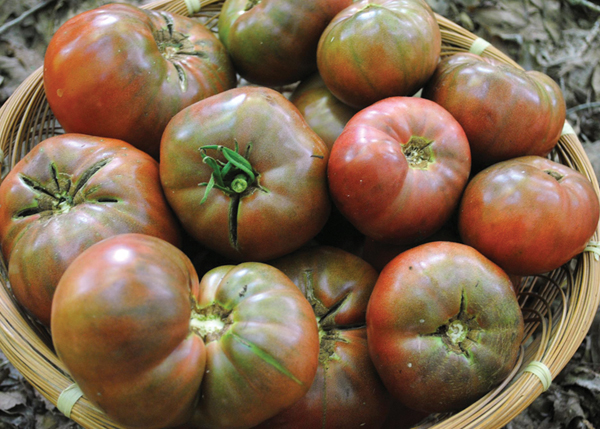
Balancing needs and types of tomatoes
We don’t worry about disease-resistance for Stupice or Glacier. We grow these two because they are reliable early-producing varieties in the standard round red shape. They are fast and have pretty good flavor for early varieties. We don’t plan to keep them long-term. (I had high hopes of Moskvich, for an early, but it wasn’t outstanding for us.) As soon as we can have bigger slicing varieties and ones without green shoulders, we’re on to them! We grow Tropic, usually much more disease-resistant than it was this year. We used to like Celebrity F1, until it was bought by Monsanto. We don’t buy from Monsanto because we don’t want to provide any support for GMOs. We tried Heather as a replacement for Celebrity, but were underwhelmed by lackluster flavor and tough skins. Tropic is a good variety for hot conditions. Nepal is quite productive and tasty, but too disease-prone for our climate.
Below: Garden Peach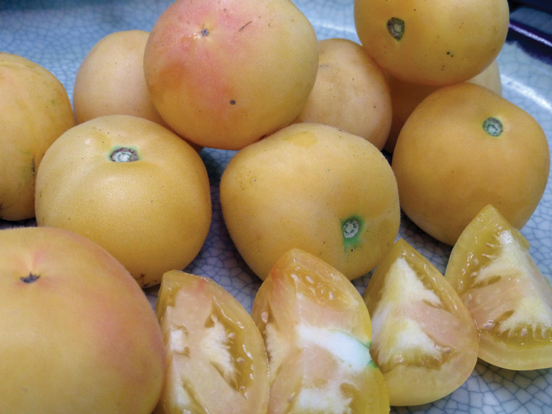
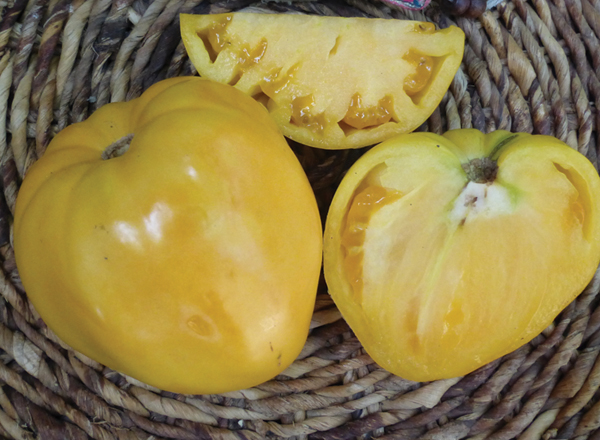
As well as large round reds, we like large round orange tomatoes. Jubilee has usually done well for us. It’s a good size tomato that is pretty and generally blemish-free. Jubilee has been more reliable than Valencia in my experience. Jubilee is very similar to Golden Boy, the one we used to grow. Yellow Oxheart is a large yellow, heart-shaped tomato (anatomically speaking, not Valentine’s Day shape), meaty with good flavor. It is a false myth that orange and yellow tomatoes are low acid. All tomatoes have similar acid levels. Some are sweeter than others, which can mask the acidity. People who claim to be able to tolerate orange tomatoes but not red ones are reacting not to the acid level but to something else. Craig LeHoullier explains this well in his lovely book Epic Tomatoes (available from Growing for Market.) Apparently a USDA test over 20 years ago determined that there are no low-acid tomatoes. It’s true that there can be slight differences in acidity from one variety to another, but the difference is not much, and yellow varieties are not necessarily lower in acidity than red varieties. None are actually low in acidity.
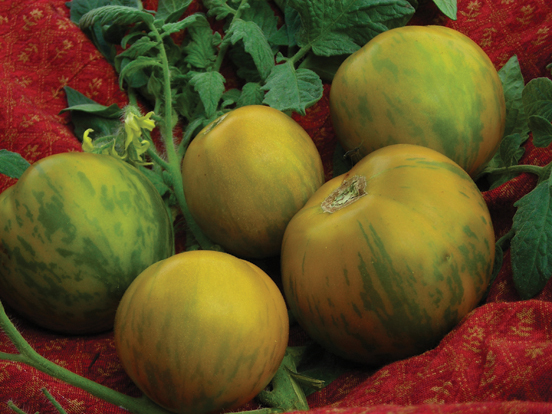
Below: Green Zebra
We also like some smaller two-bite tomatoes. Amy’s Sugar Gem has long been a favorite, and Mountain Magic F1 is a favorite from now on. Both have attractive red fruits and good flavor.
We make sure not to grow too many cherry tomatoes, as they take so long to pick. Everyone loves Sun Gold for its fantastic flavor, but not for its tendency to split. The controlled irrigation in the hoophouse can reduce the splitting to some extent. We always grow two Sun Gold, and two Black Cherry plants. Black Cherry has a delicious complex flavor, is a very beautiful purple-brown color, large for a cherry, and it isn’t prone to splitting. We also like Riesentruabe a small oval red cherry with a nipple. Amy’s Apricot is a newly rediscovered cherry with a similar color to Sun Gold, a bit smaller, and a different but also delicious taste. We were surprised how much we like the taste of Five Star Grape (F1). It looks just too glossy and perfect to have much flavor, but it’s really good. Outdoors, we liked Beam’s Yellow Pear (from Seed Savers Exchange), which has more flavor than the generic Yellow Pear. It doesn’t split much (a big plus for outdoor tomatoes), is great eye candy, and has real taste.
Below: Riesentraube
In the realm of strange colored fruit, we like Green Zebra, which has green stripes on a gold-green background when ripe, and Striped German, a very large tomato in marbled red/orange/yellow tones. Cherokee Purple is another favorite – large, purple-brown and delicious. Garden Peach has a special place in our hearts. The medium sized yellow fruit is fuzzy like a peach, and shows a pink blush at the blossom end when it’s ripe. It’s productive, blemish-free, tasty and interesting. A less-advertised claim to worthiness is that it stores well and ripens off the vine at the end of the season, performing better than some named long-keeping varieties.
Here are some notes on the varieties we have grown in recent years, in terms of productivity and disease resistance. Flavor is very important and more subjective. All of these were tasty.
Below: Striped German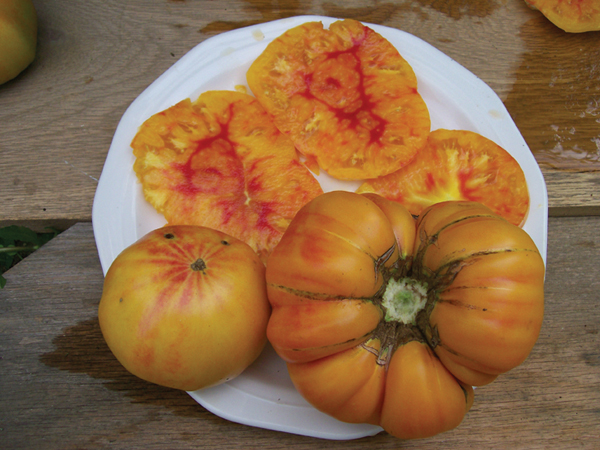
Productivity: This year’s most productive among the ones we grew in our hoophouse include Amy’s Apricot, Amy’s Sugar Gem, Five Star Grape (F1 hybrid), Garden Peach, Glacier, Mountain Magic (F1 hybrid), Stupice, Sun Gold (F1 hybrid) and TC Jones. Reasonably productive for us were Black Cherry, Green Zebra, Nepal, Riesentraube, Tropic and Yellow Oxheart. We got poor yields from Cherokee Purple, Jubilee, Moskvich, Striped German and Valencia. Now, in all fairness to tomato plant breeders, I should say our productivity records sometimes cause me to wonder if the plants have been “browsed” by my fellow community members. Black Cherry, Cherokee Purple, Jubilee and Striped German are well-known for exceptional flavor. It could be that the yield was much higher than I saw!
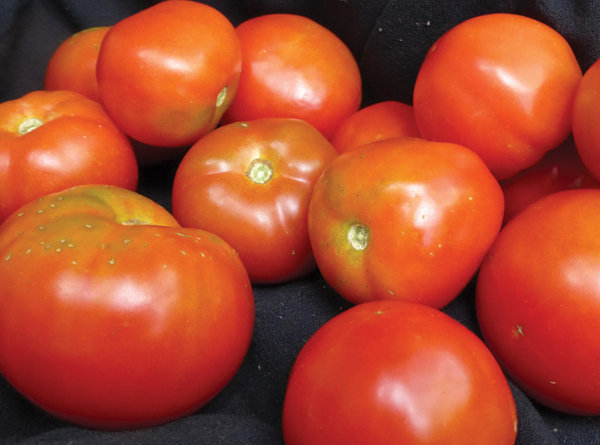
Below: Stupice
Disease resistance
In terms of disease, we got some early blight and Septoria leaf spot. Most disease-resistant were Amy’s Apricot, Amy’s Sugar Gem, Black Cherry, Five Star Grape, Jubilee, Mountain Magic, Riesentraube and Sun Gold. We usually get good disease-resistance from Tropic but it was only so-so this year. Other so-so varieties we grew were Cherokee Purple, Garden Peach, Striped German and TC Jones. More prone to diseases were Green Zebra, Moskvich, Nepal, Valencia and Yellow Oxheart. After bad disease problems in previous years with Black Prince and Mountain Princess we decided to ban any more royalty from our tomato beds!
The Cornell Vegetable MD Online has a wonderful chart of disease-resistance in tomato varieties at http://vegetablemdonline.ppath.cornell.edu/Tables/TomatoTable.html. 38 diseases, 7 physiological disorders and almost 300 varieties listed. The list is a few years old, so really new varieties won’t be there, but the heirlooms and the standard F1s are there.
Below: Yellow Oxheart
Another great resource on tomato diseases (with good photos) is the Alabama Extenion publication 0895 Tomato Disease Identification http://www.aces.edu/pubs/docs/A/ANR-0895/index2.tmpl . Identify the diseases you do have and look for resistance to those.
Best of both worlds
So, looking at both productivity and disease-resistance, next year we’ll likely grow these:
Amy’s Apricot, 75 days, indeterminate orange cherry from Southern Exposure Seed Exchange;
Amy’s Sugar Gem, 75 days, indeterminate red 1.5” fruit from Southern Exposure Seed Exchange;
Black Cherry, 72 days, indeterminate purple 0.5-1oz cherry from Fedco Seeds or Johnnys Seeds;
Five-Star Grape F1, 62 days indeterminate red 0.5-1oz grape from Johnny’s Seeds, who bred it themselves;
Garden Peach, 72 days indeterminate fuzzy yellow 2-3oz fruit from Southern Exposure Seed Exchange or Fedco Seeds;
Glacier, 56 days determinate red 1.5-2.0” red fruit from Southern Exposure Seed Exchange or Fedco Seeds;
Jubilee, 80 days indeterminate 8oz orange fruit from Fedco Seeds;
Mountain Magic F1, 67 days indeterminate 2oz red fruit from Fedco Seeds or Johnnys Seeds;
Riesentraube, 70 days indeterminate red cherry from Southern Exposure Seed Exchange;
Stupice, 62 days indeterminate 3-4oz red fruit from Southern Exposure Seed Exchange ;
Sun Gold F1, 57 days indeterminate orange cherry from Fedco Seeds or Johnnys Seeds;
Tropic. 80 days indeterminate 8-9oz red fruit from Southern Exposure Seed Exchange.
We might not grow Cherokee Purple (80 days indeterminate 8-12oz purple fruit) or Striped German (78 days indeterminate 12+oz yellow and red fruit) unless some people fess up to surreptitious private harvesting. And maybe not Green Zebra, Moskvich, Nepal, TC Jones, Valencia or Yellow Oxheart.
Another possibility is to graft tops of disease-prone heirloom varieties onto disease-resistant rootstocks. These days the usually recommended way of grafting (top grafting) involves sticking the cut top directly on the cut-off stem of the root stock. To make this survive, it is necessary to have a misting chamber and supportive clips to hold the two pieces together. Years ago I had success with side-grafting, which involves potting up a rootstock seedling beside the top variety, and once they have started making new roots, slicing diagonally into the top variety (without cutting all the way through). The rootstock plant is cut off at a similar diagonal, with enough length to fit the cut surface into the cut in the top variety. Then a simple piece of clear sticky tape holds the two together. It is easier for plants grafted this way to recover without much special treatment. The challenge is having both varieties with similar thickness stems. Making several sowings of the cheaper seeded one on different dates gets around this problem.
More opinions
Research at Penn State Extension provides this list of “Best Tunnel Tomatoes”:
BHN 589, Scarlet Red, Primo Red, Red Mountain, Red Deuce, Rally, Charger, Finishline, Rocky Top, BrandyBoy, Conestoga, Carolina Gold, BHN 876, and Big Dena. Mostly they focused on red determinate slicers.
Craig LeHoullier lists his 10 tastiest as Nepal, Yellow Oxheart, Polish, Green Giant, Sun Gold, Lucky Cross, Lillian’s Yellow Heirloom, Brandywine, Cherokee Purple, Mexican Midget. Read his book to see why he chooses these. For commercial growers, taste isn’t the only factor, of course. Craig has several more lists too, as well as a mine of tomato information of all kinds. He explains the components of flavor, and recommends 250 varieties in 10 color categories.
Andrew Mefford, in Growing for Market February 2012, listed his favorite varieties. Flavor, disease-resistance and yield are all important factors to him. He is growing for the full season in a hoophouse (we only grow early tomato crops in ours, then switch to legume seed crops for the summer). Andrew’s list includes Rose, German Johnson, Sakura F1 red cherry, Black Krim and Gold Medal among others.
Height considerations
Our “Tomato Rampancy Rating List” is a height chart which we use to plan for the shortest plants at the east end and tallest on the west end of the row (for best lighting along the rows). If you grow lots of different tomato varieties, especially if you use a string-weaving method to train them, you might like to plant the varieties in order of increased height, so that when you string weave the row you can do partial rows of weaving to take care of the tall ones, and not waste time string-weaving between stakes with only small plants. But how do you find out the relative heights of the tomato varieties you have?
Seed catalogs and websites can help, with notes like “compact” or “relatively short”, but one catalog’s “fairly tall’ might be another’s “moderate height”. We keep a “Tomato Rampancy Rating List” and each year we take notes, updating the list in light of how the varieties grew that year. We have noticed that results vary. Some years a variety ends up taller than the year before. So – no promises – here’s our list, starting with compact ones and ending with very tall ones. The names in bold are the ones we really like. The others are ones we tried and decided not to repeat.
A Taxi (Compact, very short)
B Orange Blossom
C Barnes Mountain Orange, Indigo Rose
D Illini Star, Polbig, Sweet Tangerine, Washington Cherry
E Yellow Bell
F Abe Lincoln
G BHN 968 Cherry, Cherokee Purple, Glacier, Green Zebra, Jubilee, Nepal, Ozark Pink, Tropic
H New Girl, Rutgers Improved, Striped German, Stupice, TC Jones, Valencia
I Amy’s Sugar Gem, Aunt Ruby, Garden Peach, German Johnson, Heather, Mountain Magic, Riesentraube
J Honeydrop, Striped Roman
K Black Cherry, Favorita cherry, Sun Gold, Wow, Yellow Oxheart
L Amy’s Apricot, Five Star Grape (Tallest)
Thumbs down
When choosing ones to grow after their initial trial year, we look for delicious flavor, high yields and good disease resistance. Where a variety was noticeably lacking in one aspect, we’ve noted that in our crop record. Where it was simply an all-round “doesn’t make the grade”, the variety is in our Thumbs Down list with no particular comment. Remember that your results may vary. We’ve grown insipid Tippy’s Finest and Carolyn Male, while others have loved the flavors of these two. I expect the soil makes a difference in flavor.
Aunt Ruby’s German Green: large messy fruit.
Barnes Mountain Orange: bad splits, not very productive.
Big Rainbow: big mess, split a lot.
Black Prince: very disease-prone.
Black Plum: We like Black Cherry better.
Chocolate Cherry: We like Black Cherry better.
Favorita cherry.
German Red Strawberry: looks the shape of a strawberry, but unexciting.
Hazelfield Gold.
Heather: tough skin, unexciting flavor.
Honeydrop cherry: I liked this one but was out-voted.
Hugh’s: slow 89 days to maturity. Large yellow fruit but we weren’t wowed.
Illini Gold.
Iron Lady: the black stage is immature. The mature stage isn’t very tasty.
Japanese Black Trifele: neither productive nor tasty, although beautiful.
Mountain Princess: didn’t do well. We decided “royal” names were a bad omen. (See Black Prince)
New Girl: productive but tough-skinned and unexciting.
Orange Blossom: very short, early. Used to grow well for us, but went downhill.
Ozark Pink: not very productive.
Polbig.
Rose de Berne: not very productive.
Rutger’s Improved.
Striped Roman: beautiful but not very productive and not very disease-resistant.
Sweet Tangerine.
Taxi: a very early 64d determinate yellow. Not very productive.
Washington Cherry.
White Wonder: slow 84d indeterminate. Pale yellow, unexciting.
Pam Dawling manages 3.5 acres of vegetable gardens at Twin Oaks Community in central Virginia. Her book, Sustainable Market Farming: Intensive Vegetable Production on a Few Acres, is widely available, including at www.sustainablemarketfarming.com, or by mail order from Sustainable Market Farming, 138 Twin Oaks Road, Louisa, Virginia 23093. Enclose a check (payable to Twin Oaks) for $40.45 including shipping. Pam’s blog is on her website and also on facebook.com/SustainableMarketFarming.
Copyright Growing For Market Magazine.
All rights reserved. No portion of this article may be copied
in any manner for use other than by the subscriber without
permission from the publisher.