


When GFM was looking for someone to write about flower farming, I jumped at the opportunity. A farmer for more than 20 years — also vegetables but now mostly flowers — I have a lot to offer readers. I will describe all the mistakes we have made and show all the successes, too. Currently on sabbatical in the Netherlands, I hope to bring some ideas and information about the flower scene in Europe. First, though, a brief introduction to our farm.
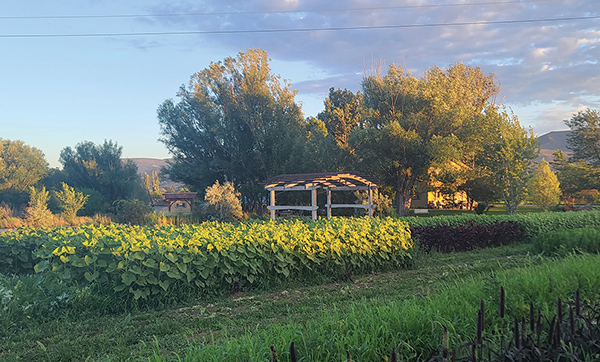
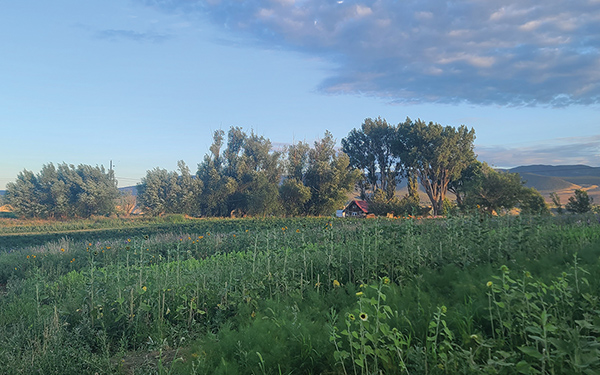
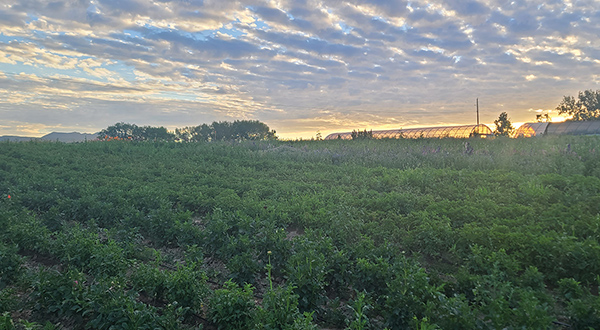
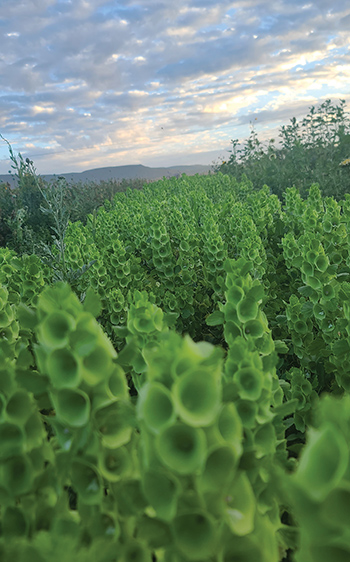
The author’s farm, Zephyros Farm and Garden, in Paonia, Colorado. All photos courtesy of the author.
When we first started Zephyros Farm and Garden my wife, Daphne, and I thought we could do it all. We had moved with a small flock of dairy sheep, quickly got some goats, planted an acre of vegetables and flowers, had a 100 laying hens, a toddler and a baby on the way. It makes me exhausted to think about all that we were trying to do and all that we did not know and learned the hard way.
For instance, the third time we lost all 100 chickens to bobcats, coons, skunks, dogs, hawks, owls, and disease, we were done with layers. Realizing we really just wanted some eggs for the family and did not want to be egg farmers was the type of realization we had again and again over the first years of our farm with many different enterprises.
The many difficult lessons taught us to focus on the nexus of what we loved, what we did well, and what the market demanded. That was the plants, not the animals. Daphne in particular had worked in large and small nurseries in the United States and Europe. She had a knack for getting difficult perennials to germinate and was a master at digging and dividing plants, taking cuttings, and managing greenhouses.
As we started to go to a farmers market, we focused on perennials that could be sold in our fledgling nursery and also as cut flowers that added interest to a sunflower or zinnia.
The first years we were spread thin as we continued to do a little bit of everything. People ask if you could tell your younger self something what would it be? And we would firmly say to focus on a few aspects of the farm, and then add elements as they make sense. But of course there are the economic realities of trying to make a living off the farm. They also determine what works. No matter how well we grew kale, we went home with it at the end of the market. But the flowers were all gone.
So each year we dived deeper and deeper into cut flower seed catalogs, trying many different flowers, varieties, colors, shapes and sizes. Some loved our desert environment, and some did not perform for one reason or another. We learned which ones could do four or five successions and which could only do one or two.
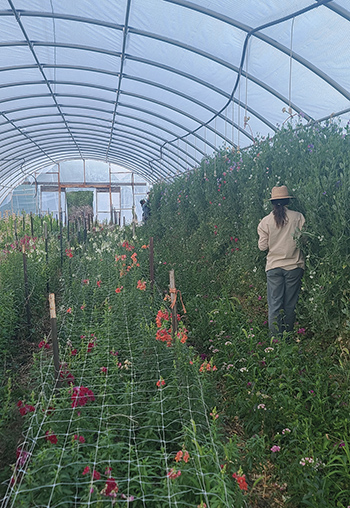
We did a specialty crops grant to see if we could hit Mother’s Day with blooms and that is how our first high tunnel came to the farm. Now, there are four. We have flowers by Mother’s Day in our zone 5 farm in western Colorado at the base of the Rocky Mountains and edge of the desert.
Learning to grow flowers in high tunnels has been a game changer. We consistently get ripping winds each spring that often start in April and do not end until June, and now sometimes July. In the intense sun at 5,600 feet and desert climate, as a survival mechanism flowers generally do not grow tall. Yet, in the high tunnel we can get the heights that are expected by the flower market. Of course, tomatoes love the high tunnel, too, and for many years the flowers and vegetables fought for that real estate.
The flowers won the right to be planted first in the high tunnels with a great showing at the first farmers markets in June. Although tomatoes get a couple of rows in our four tunnels, and hot peppers sometimes get in when the earliest of flowers are done. Mostly, our four high tunnels are full of flowers.
We do successions of snapdragons, bupleurum, lilies, godetia, bells of Ireland, and an assortment of others. Sunflowers get a row along with many small patches of orlaya, ‘Dara’ ammi, and calendula. Any free spot gets seeded with bachelor buttons, gypsophila or saponaria. In late summer, greens are planted which are usually all harvested by Christmas to give us a few weeks rest, time for a cover crop and turning the beds over.
The market’s response led us to becoming flower farmers. Only so many market booths can sell lettuce or kale. Our success with flowers in that first high tunnel left our market tables vacant of flowers while kale bunches went to the worms. Yet, for many more years kale, fava beans, spinach, and bok choy were also part of our high tunnel rotation.
We still grow many of these but now for specific wholesale markets. We found the burgeoning food hub movement — restaurants and other CSAs — need crops like this in bulk, whereas the farmers markets were overloaded. So, our niche was determined.
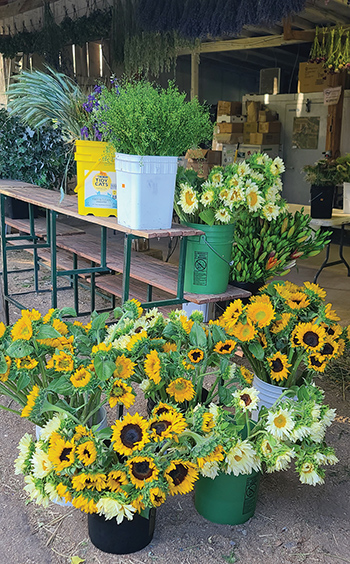
The other important piece of the puzzle is that we love the forms, shapes, and colors of the huge diversity of flowers. We loved playing with buckets of flowers to make designs, bouquets and people happy. People began asking if we did weddings or parties, so we did.
Selling bouquets allowed us to use all the flowers we could harvest with very few stems going to the compost pile. A love of perennials led us deeper into the lure of flowers. Peonies, echinacea, basket flower, baptisia, yarrow, daisies, grasses, we had to try them all. They make bouquets unique and come back for a couple or many years. They made playing with flowers even more fun — from seed catalogues to bouquet making.
Our first bouquets were cringe worthy: flowers smashed together with no eye for space, light, or color palette. Some flowers stuck way too far above the rest with no purpose. In the end, flowers speak for themselves and usually someone will love any design. I bet in those early days people took them home and remade them into their own creations.
We knew they needed improvement. My wife found books and workshops and improved our designs. She taught the rest of us to make each flower sing in the bouquet, to give each flower its own space, how to use greenery, how to use color, shapes and textures to lead the eyes around the arrangement.
This art of design can be taught, but a passion for form, color and texture through plants and natural talent help. Not everyone is allowed to make bouquets in our ‘flower den’ as our bouquet making area is affectionately called. Many of the skills, or enough, are teachable, so three times a week we make hundreds of bouquets for farmers markets, CSA, florists, and high-end customers. Above all, the diversity of unique flowers and an eye for design allow our flowers to stand out.
We started at an acre and now are almost to eight. Usually about 60 percent of that is in flowers. We are a mixed farm despite being well known for our flowers. People seek out our tomatoes; we grow upwards of 50 varieties each year. We also have cultivated a connection to many florists, designers, food hubs, and restaurants over the years to give us a solid wholesale market.
When we learned to specifically grow for one market or another, it helped set us apart from other growers simply trying to wholesale an overabundance of product from time to time. We became reliable producers of specific crops, both vegetables and flowers. We also sell organic dahlia tubers online, a market which suited our climate and seasonality well.
Our vegetables have been Certified Organic from day one, the flowers only after about five years. We certify our flowers, not because our florists demand it, but because we want to demonstrate it is possible. We believe in organic farming as a system regardless the crop.
The certification process makes life more difficult, but it has led us to push the flower industry for more organic choices, non-treated choices, and it is something our customers are beginning to appreciate and understand. Just because you do not eat a plant does not mean that being organic does not have a positive effect on the soil, the people working the land, and the markets.
We are blessed to live in a dry region where most years fungal disease are rare. Taking advantage of this is part of a strategy. When we set up our intensive irrigation system every year and weigh the persistent drought in the West, we would consider trading irrigation for fungal diseases. Farming is never easy. I plan to write more on this topic.
Over the last decade we realized that we were tired of bringing in interns, apprentices, teenagers, part-time employees and constantly training people only to watch them leave. Although we have many dear friends from those days and it made establishing the farm more affordable, I often think if we just started paying people well from the beginning it would have happened faster.
In the end that is what we did; paid the people we trained well and encouraged them to come back year after year. Now, we seek people with specific experience where we are lacking. For example, we wanted to go full mechanical cultivation, so we found people with that experience to help develop that aspect of the farm. Now it is the primary way we control weeds in flowers and vegetables.
Essentially, we have become a farm of farmers. Some deal with markets, other with wholesale vegetables, wholesale flowers, tillage, irrigation, and mechanical cultivation, and others bookkeeping. We all help each other and have our own areas of responsibility. We are a team of managers, and yet all still farm workers. This has allowed our farm to become successful on a new level.
Over the almost 20 years of farming, we have learned many lessons about being flower farmers that I hope to share with those of you interested in this pursuit. I am honored to be among the many amazing farmers whose words have inspired me to try new things, learn new crops, methods, and sparked my own new ideas.
I will be writing about how we do what we do and sharing successes and failures. I also will profile heroes of the flower farming movement and what has made their farms successful. There is certainly no one way of doing things, but there are themes upon which farms can be built for success. I plan to explore those themes.
Currently, I am taking a sabbatical in the Netherlands getting a master’s degree in Organic Agriculture. I have had the opportunity to deeply study farming systems, plant production, crop science, regenerative agriculture and sustainable food systems. Zephyros is being run by the team of farmers, with my help by checking in from time to time. This sabbatical took years of planning, something I will share.
To be sure, the flower industry of the Netherlands affects all the flower markets of the world, so I will be sharing what I learn here from the home of the tulip. I look forward to connecting with the many GFM readers and hearing the suggestions you may have. Hope summer is treating you all well. Hang in there as the days get shorter.
Don Lareau has been farming flowers organically for 20 years on the western slope of Colorado with his wife, Daphne Yannakakis, and an amazing crew of farmers. Currently on sabbatical in the Netherlands, he is studying agroforestry, agrovoltaics and agroecology while pursuing a Masters in Organic Agriculture. He has been on the board of the Organic Farming Research Foundation (OFRF).
Copyright Growing For Market Magazine.
All rights reserved. No portion of this article may be copied
in any manner for use other than by the subscriber without
permission from the publisher.