










Working toward measurements of ecological health
Many of our readers already support and encourage biodiversity on their farms. They notice insects and other wildlife as they move around tackling farm work. Many already have adopted biodiversity enhancing practices that we’ve written about in GFM: no (or reduced) tillage, hedgerows, alley cropping, cover crops, along with other agroforestry and conservation approaches.
However, there aren’t standardized measures for farm biodiversity — yet. Dickinson College Professor Maggie Douglas and campus farm Director Jenn Halpin are working toward specific benchmarks for biodiversity on farms. They presented an early phase of their work at the Pasa Sustainable Agriculture Conference this winter. While I didn’t attend, I connected with them afterwards to learn about the ongoing work.
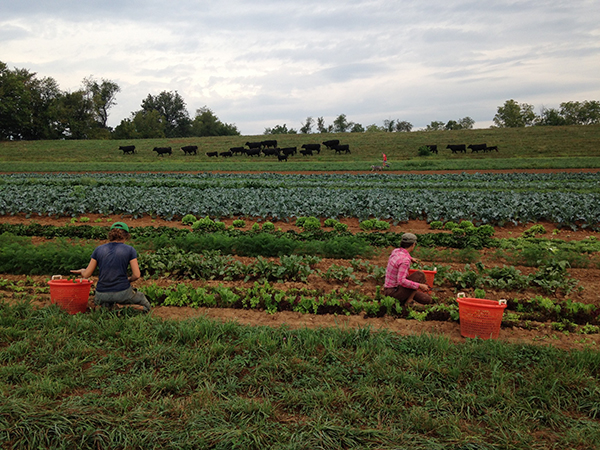 Grass strips between production fields at Dickinson College Farm provide habitat for ground dwelling organisms like ground beetles. Photo by Matt Steiman.
First let’s breakdown what ecosystem biodiversity means. The Wild Farm Alliance, which aims to “bring nature back to the farm,” offers this definition: “Variety in all forms of life, from bacteria and fungi to grasses, ferns, trees, insects, amphibians, reptiles, birds, and mammals. It encompasses the diversity found at all levels of organization, from genetic differences between individuals and populations to the types of natural communities (groups of interacting species) found in a particular area. Biodiversity also includes the full range of natural processes upon which life depends, such as pollination, nutrient cycling, carbon and nitrogen fixation, predation, and the recolonization of areas by native plants.”
Professor Douglas adds a two-category concept for farmland: The “planned biodiversity,” that is, crops, livestock species, seeding pastures — any plants and creatures farmers are directly cultivating. The “associated biodiversity,” the biodiversity that arrives on its own, for instance, wild bees and earthworms.
Farmers largely focus on planned biodiversity because their livelihoods depend on the crops they grow and sell. This planned biodiversity has a big impact on the associated biodiversity that shows up. A farm map offers important information about how the layout impacts biodiversity. The size of cultivated fields, the spaces between crop areas, and nearby semi-natural or natural areas are critical. “The non-crop area is really important to support biodiversity, extensive corridors for movements for many species,” Douglas said.
There is good evidence that farms with smaller crop fields tend to have greater biodiversity, she added, because smaller fields lead to increased field edges, providing habitat for breeding and refuge. Smaller fields also typically mean better corridors around and between fields, so species can move and disperse in the landscape, she said.
The amount of crop diversity, adding organic matter to soil, tilling or not tilling, cover crops, reduced pesticides (even OMRI approved), and other farm management decisions affect biodiversity. “Many of the practices they are adopting for other reasons, they may not be thinking of those practices as biodiversity,” Douglas said.
That’s where the benchmarking project will come in. “The development of a systematic way to hold up a mirror for a farmer to see how the sum total of design and management impact biodiversity,” Douglas said. Even though the project is in its early stages, it’s worthwhile to get farmers orienting toward ecosystem biodiversity.
Douglas, an entomologist, said there’s already a huge amount of research on biodiversity. She and her team want to find better ways to link that research with what’s happening on farms.
At the Pasa talk, Douglas and Halpin explained how laborious scientific measurements can be. They described a three-mile agricultural transect sample in Switzerland where researchers found more than 2,000 species of insects, spiders and plants, which took experts 5,000 hours to sort and identify.
“By extension, it could easily take an entomologist hundreds to thousands of hours to collect and identify all of the creatures on a single farm,” Douglas told me. “All of this explains why there has been a lot of interest in identifying ‘bioindicator’ groups — sub-groups of biodiversity that can provide a good estimate of total biodiversity. For example, the diversity of insects tends to increase with the diversity of plants, which are easier to measure, for one thing, they don’t move and there are fewer species.”
Even still, scrutinizing the biodiversity on their land likely is asking too much of most farmers on top of daily work. However, farms with organic certification already are engaged in record-keeping about crops and practices that apply to biodiversity. Also, certification includes a Biodiversity Compliance Assessment, where farmers document (and inspectors should verify) efforts to support biodiversity, such as water and soil improvements, presence of at-risk species, native plants and other elements. Non-certified farms that nonetheless document and track their practices, use tests such as the Cornell Soil Health test or do other sampling, probably have more information than they realize.
The Dickinson College campus farm (certified organic) with its 10 acres of diversified vegetable production is similar to many GFM farms. They also have pasture and livestock. The campus farm has an advantage of tapping into cohorts of students and professors for biodiversity research and enhancements.
Focus on the big levers
So how would the average farmer without extra labor or experts start evaluating farm biodiversity? Douglas advises farmers first to reflect on features with big impacts — crop diversity, non-crop areas, and habitat that is not being tilled up. Are non-crop areas growing or shrinking? She recognizes that business decisions may dictate crop over non-crop uses.
Big lever management practices include reducing tillage, keeping soil covered as much of the year as possible, and reducing pesticide use. “How are those practices changing over time?” Douglas asks. If farmers are interested in going further, she suggests keeping records related to those aspects of the farm.
Activate curiosity
Scientific field observations would be challenging for most farms. Meaningful results across farms require uniform sampling methods taken repeatedly across the farm over time to capture biodiversity changes through a season. Then, as noted, species IDs are difficult. All of it is time consuming.
On the other hand, farmers are in their fields a lot and can observe quite a bit without too much rigor. “If you’re noticing a pest outbreak, learn about the creatures that keep it in check,” Douglas said. “Pest predators take awhile to find.”
For instance, squash bugs are sometimes heavily parasitized by tiny wasps, but farmers often overlook parasitized eggs or don’t know what they look like. If aphids are a problem, look for the funny looking lacewings eggs and lady beetle eggs. Cellphones make it easy to snap photos. As a starting place, farmers can use apps such as Seek by iNaturalist for identifications and to keep a running record.
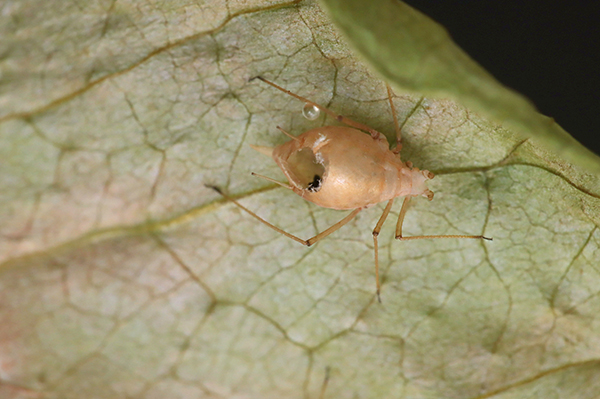 A cabbage ‘aphid mummy’ eaten from within by a parasitoid. Photo by Ian Grettenberger at UC Davis.
Douglas points to the Xerces Society for information on insect lifecycles. Perennial grasses allow ground beetles and other insects to overwinter and Douglas suggests letting some crops go to flower or planting flowers among crops to provide nectar, for instance, for the adult wasps that took care of squash bugs at an earlier life stage.
Campus farm as a biodiversity lab
The site of the Dickinson College Farm was a conventional corn and soy farm. Over the past decade and a half, it has been transformed into a diversified crop farm that supplies the college dining hall, a campus CSA, a producer-only farmers market, and farm store on the edge of campus.
From the outset, integrating biodiversity into the design and management was a priority. Halpin and Matt Steinman, the farm’s Livestock and Energy Projects Manager, have been avid students of the research of agroecologists Miguel Altieri and Stephen Gleissman. Transforming the convention grain farmland was an opportunity to incorporate those concepts.
Starting in 2007, through a series of grants they added 300 trees (among them honey locust, black locust, crab apple, hazelnut and red bud) and shrubs for biodiversity habitat. Self-seeded wild fence lines are made up of red bud, mulberry, and service berry trees. The habitat drew catbirds, bluebirds, redwing black birds, king fishers and ravens.
A natural history professor created a class project to build and install bluebird boxes around the campus farm. Eastern bluebirds feast on squash and cucumber beetles and grasshoppers. An ecology professor and students are studying an integrated pest strategy involving beneficial American toads. They created seven small hub ponds in the vegetable production fields and populated them with native plants to lure the toads to migrate across the farm. They did, and the class microchipped the toads to track their movements.
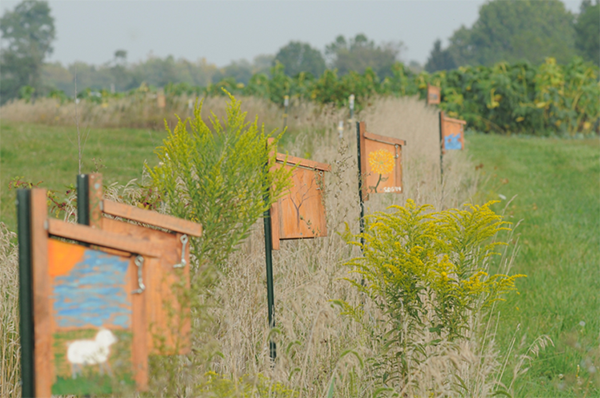 Two bluebird boxes along fence lines and field edges at Dickinson College Farm. Photo by Pierce Bounds.
An overall reduction of squash bugs and potato beetles, for instance, will be studied in the next level of research to examine what among a multitude of possible factors affected it.
Corrugated metal was put down to create warm and cozy habitats for snakes. Students are tracking the snakes that congregate there.
In addition to the trees, wild fence lines and hedgerows, Halpin says they plant flowers (such as alyssum and wildflower mixes) among the vegetables in production fields. “We’re letting dill and cilantro go to flower if we don’t need the field space,” Halpin said.
Crop fields are 1/4 of an acre to 3/4 of an acre and surrounded by two-tractor-width grass strips, that’s two passes with a Kubota M7040 with a 7.5′ flail mower to maintain the grass corridors, Halpin said. The grass areas are habitat for ground beetles and other critters.
Crop diversity enhances biodiversity and the campus farm grows about 50 types of fruits and vegetables, including 10 varieties of tomatoes — hauling more than 1,000 pounds to the college’s food services each week when they are in season. They grow potatoes, melons, squash, beets, carrots, turnips, radishes, eggplant, kohlrabi, peas, herbs and more. Douglas suggested that ballpark somewhere between 20 to 50 crop species emulate natural ecosystems.
Halpin teaches food studies courses and oversees a food studies certificate that involves hands-on farm work, including making observations and collecting samples. “We scout on a regular basis,” she said. “Once a week, one or two people go out to crop fields when we know they are most susceptible to predation.”
For instance, scouts randomly walk through the half an acre of garlic looking at leaves for evidence of allium leaf miner, such as spots and streaks or, when I talked to Halpin in April, eggs. “We’re not seeing a lot and not spraying,” she said. They log what they observe into an app, which informs the next steps and decide on acceptable levels of insects and disease. “Scouting is an important component.”
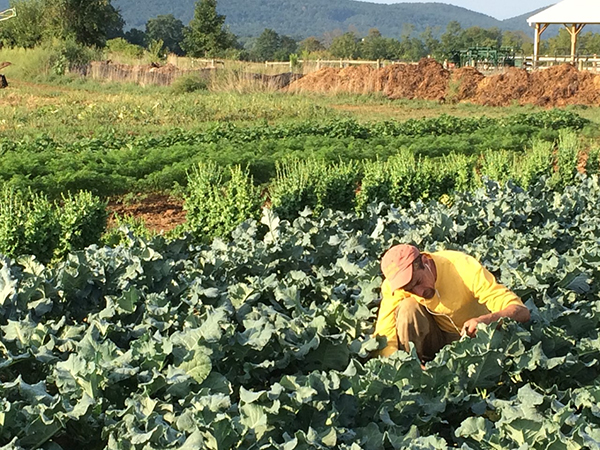 Scouting brassicas for imported cabbage worms. Photo by Jenn Halpin.
They use FarmData, a web farm records database system developed by Dickinson College faculty, students and farm staff in 2013. It was being merged with FarmOS when this article was written.
By carefully tracking pesticide products and spraying, they reduced use of Neem, which was driving up honeybee toxicity. Overall, they’ve continued to reduce use of pesticides.
As part of evaluating biodiversity at Dickinson, every other year students sample invertebrates using pitfall traps in late summer and earthworm extraction in the fall when the insects and worms are most active. They samples in all areas of the farm — annual crop fields, perennial pastures, the grassy strips between fields, hedgerows and so on. Four pitfall traps are placed in each area, filled with about an inch of soapy water and left open for 72 hours, capturing the invertebrates that walk through.
For the earthworms, they frame a series of four 1-square-foot areas and slowly pour in a mustard solution (40 grams of typical culinary mustard powder per 1 gallon of water) to force earthworms to the surface to be counted and weighed. “Both of these methods are fairly farmer-friendly as they can be performed using easily found materials,” Douglas said.
Halpin offers an overall perspective on what it has meant to make biodiversity a priority on the farm. “It takes commitment and consistency,” she said. “We’ve had to be mindful of integrating that as part of our producing season.” The paradigm shift means less space for crops to make room for the grass corridors and assigning labor time to scouting and weaving that into the schedule and training people to scout and observe changes.
“Biodiversity is a crop we are growing, so it makes sense to be willing to dedicate farm time,” Halpin said. “The aesthetic of our farm has changed. It’s really beautiful, a beautiful place to work in.”
Resources for biodiversity
The Inflation Reduction Act provides USDA’s Natural Resources Conservation Service (NRCS) with an additional $19.5 billion over five years for programs, including the Environmental Quality Incentives Program (EQIP), Conservation Stewardship Program (CSP), and the Agricultural Conservation Easement Program (ACEP).
The National Invasive Species Information Center provides information and pictures of invasive species found in the United States (invasivespeciesinfo.gov).
Nature Serve has a list of the federally endangered and threatened species present in any U.S. watershed (natureserve.org/explorer/).
The Wild Farm Alliance (wildfarmalliance.org) has loads of resources and tools, including a booklet on supporting beneficial birds and managing pest birds, barn owl box designs and more.
Professor Maggie Douglas at Dickinson recommends: WFA Biodiversity Guide, Xerces Beneficial Insect Scouting Guide, Xerces Organic Pesticides Guide, Xerces Soil Scouting Guide, and the Xerces Habitat Assessment Guide.
Jane Tanner grew cut flowers and specialty crops at Windcrest Farm and Commonwealth Farms in North Carolina, and helped manage the biodynamic gardens at Spikenard Farm in Virginia.
Copyright Growing For Market Magazine.
All rights reserved. No portion of this article may be copied
in any manner for use other than by the subscriber without
permission from the publisher.