







Our workers are in college or a few years out. They live at the farm. When not working, they cook and house-keep cooperatively. This tribal experience — living where you work, working where you live — has many good effects.
Although a temporary, seasonal grouping, they form a community more quickly than if everyone dispersed at the end of the day. Once work is done, all that remains is hanging out in the village compound. If it was a good, interesting day, they talk about it. If it was miserable, boring, they talk about that. And then there’s the rest of life. College with no papers. That everyone has to get along as both housemate and colleague is two-edged: More opportunities for conflict, perhaps, but also more points for compatibilities to show. This can help the farm, too: A lackluster picker may be a boffo cook, or simply a cheerful presence, and thus more tolerable (even to us) in his slow procedure down the row.
That workers arrive and leave raggedly — two to three in April, five to 10 May thru early June, a sequence reversed in the fall — strengthens and enriches the bonds. Often an early core will set the tone, everybody looks forward to the new arrivals (perhaps a legendary returner), late summer departures and hires shuffle alliances, and fall settles around the new kernel of finishers. A diverse, elastic little society has come and gone in seven short months.
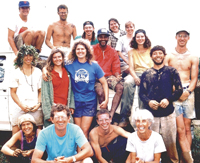
In reflection of this evolution, we take group photos several times a season. In a droughty summer one back-drop might be the pumped-out pond. After massive hale damage, we might stand before a huge pile of culled tomatoes. The inevitable eggplant bonanza provides a common prop at another stage. “My Year”.
Susan and I live 150 feet from the worker kitchen and bath house. We cross paths with everyone many times a day. We meet at the start of morning and afternoon work, we most often work with everyone, every week or two we eat together, potluck. They are in and out of our house to record their hours, make up sign boxes for market, use the washing machine, or display alarming bug bites. On late-loading Friday and Saturday nights, when we can’t stop to cook, the pitying workers often invite us to their dinner.
As managers, we are manic explainers of what we do and why at daily meetings and in the field. Still, there is much about our practices for curious workers to ask more about over a meal, when there’s no time-table and we are sitting down: Why, again, do we do X? What did we do before? What do other farmers do?
But much more happens here than one-way informal shop-talk. As guests, our separation by age and authority is further reduced. We ask and learn as much about them as they ask about us and the operation. We have many good friends from among our workers.
Twenty four hour proximity also helps in difficult spots: We may be pushing people too hard, or a few slobs are dragging down worker kitchen morale, and the group wants to talk it out. These exchanges are usually on their turf, the tensions eased by the fellow-feeling when a common meal follows. (Oxytocin, the “hormone of love,” flows not just during private activities, but during the sharing of food.)
The ongoing sleep-over at the farm makes special gatherings easier. Susan and I always offer voluntary off-the-clock sessions on topics like farm accounting, mechanics, and welding, which people can sacrifice nap time to attend. Occasionally someone organizes an evening of reading from favorite books. Or someone will give a talk on their specialty —astrology, Ecuador. Every season there are talented musicians, whose sounds drift to our kitchen or draw us to theirs. This doesn’t make Wheatland Vegetable Farms a Chautauqua. Mainly we pick, sort, and sell, and get clean and rested for another round. There are worker cars, and people go in town. But we are all mostly around and available if something interesting is offered up.
From this varied daily contact, I know anyone who ever worked here for more than a few weeks better than I ever did any students in my years of college teaching. And my guess is they know more about us than of prior employers. Our interactions are of whole persons. Add to this setting two practices unrelated to on-farm living: We always tell our crew what we spend and make on the farm, and we trust them to take vegetables to market and bring the money home, on their own. This puts us all in it together even more.
At the peak of summer is The Show. For 21 years, farmers and workers from our counterparts in the area have driven miles to our place on a Sunday afternoon after expending themselves in the weekend market binge. Inquisitive pickers check out the farm, there’s a grand potluck, and then everyone sits in a kind of amphitheater formed by the lawn. Against the backdrop of a 10’ X 20’ white market tarp turned right angles, people perform. Maybe half the acts are standard talent show: singing, playing, declamation. But the other are original skits and songs of the farming life, including employer roasts. Well, not the farming life, but this farming life: Market gardening carried out by this collection of people, with these practices, for these quirky customers, in this season and place. In a few months, groups like ours have been forged here and there over the region, and we gather to celebrate (and mock!) our culture.
I left this account in the present tense, not yet nostalgic, even though this coming season, for the first time since 1973, we won’t be hiring workers as described. Having put the farm facilities and most of our land under conservation easement, for sale to another farmer, we are retiring.
Chip Planck is the owner, with his wife, Susan, of Wheatland Vegetable Farms in Loudon County, Virginia.
Copyright Growing For Market Magazine.
All rights reserved. No portion of this article may be copied
in any manner for use other than by the subscriber without
permission from the publisher.