








#toolsforgrowingformarket
I’m a bit of a reluctant tarp and insect netting user, largely because I hate handling the stuff. Back in March of 2021 Jonathan Leiss of Spring Forth Farm wrote an article on his folding method for tarps, with nice details on little tricks to really make that system work for them. I have a slightly different method I wanted to share, and we also use it for the insect netting that we have on the farm, which is different than most insect netting I’ve seen available to growers, and in my experience it’s far superior, handling a bit more like a tarp.
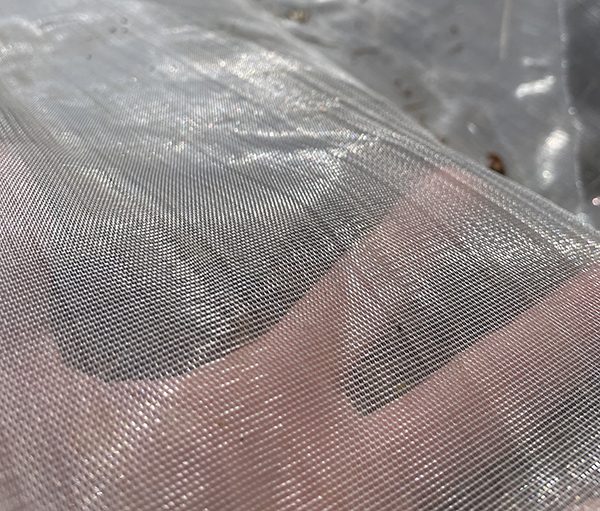
Close-up of the woven mesh insect netting.
The insect netting we use is a bit heavier and stiffer than what I’ve gotten from Johnny’s and have seen from other North American suppliers. The typical stuff I see available is light weight and knit, making it a little stretchy, which kind of seems nice if you want to get that tight look on hoops, but I’ve also found that it seems to shrink over time and it’s so light that we can’t seem to go more than a season without getting holes in ours.
The heavier stuff that I prefer I first got when Chris Jagger of Blue Fox Farm in southern Oregon put together a group order direct from China back in 2016. I’ve been using that same netting ever since and last season, after six years of regular use, was the first time I ever put even a small tear in it. While it’s stiffer and a bit heavier, plants seem to have no trouble pushing up on it even if it sits directly on top of them. We also use it with hoops successfully, but it’s never super tight like the knit stuff. The stiffness and weight seem to make it a little less prone to blow off, certainly less prone to blowing off than row cover.
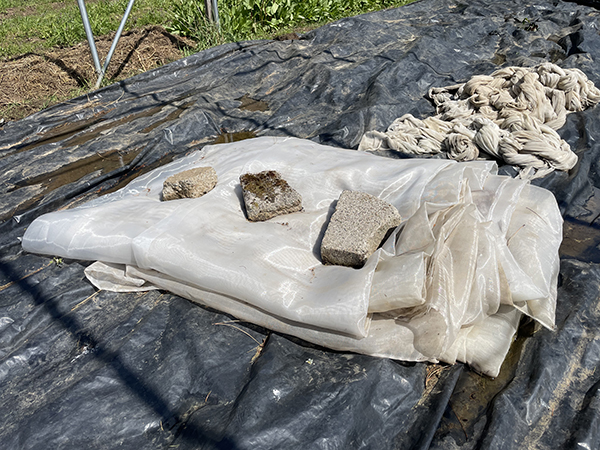
Stacked insect netting with a few rocks holding it down for storage. In the background is row cover that we store by chain stitching to keep it from getting tangled and blowing away.
Like other insect netting, and unlike even light weight row cover, it doesn’t seem to hold in any heat at all. This is a great thing in the summer, but it means that it offers zero frost protection. Another great use for it is as a place to pile dry seed crops temporarily. I grow a little chard and collards for seed, and I’ve used it for both. It’s strong enough and fine enough mesh to keep the seed from falling through, and the surface is smooth enough to not stick to the dry plant material, and because it’s porous it lets heavy, moist air fall through, unlike regular tarps.
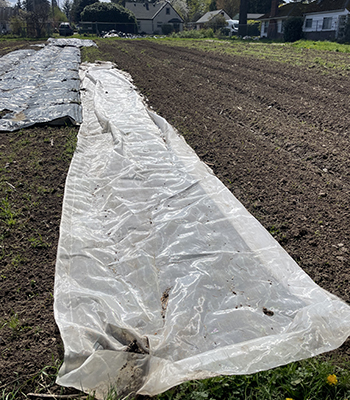
Netting laid directly on germinating carrots to prevent carrot rust fly damage. It also helps with germination a little, keeping rain from washing the seed away and holding a little humidity close to the surface. This mesh is already a season old.
After years of hearing about the mythical special order insect mesh but not having access to it, some growers here in Oregon went through a lot of effort to do another special order which resulted in Grower’s Nursery Supply in Salem, Oregon, starting to carry it. I bought more with that special order, and it seems to be the same stuff as the original – which I’m also still using.
Because the insect netting is heavier and stiffer than row cover or knit netting we handle it more like tarps.
Instead of repeatedly folding large sheets in half, we “stack” our tarps and insect netting to make them easier to pull back out into the fields. Another way to think about this method is as an accordion style fold.
This method works best with two people and goes pretty quickly. Our biggest tarp is 20’ x 80’, but the method works with any tarp size that two people can drag ten feet and we also use it for our single bed tarps which are 4’ x 80’.
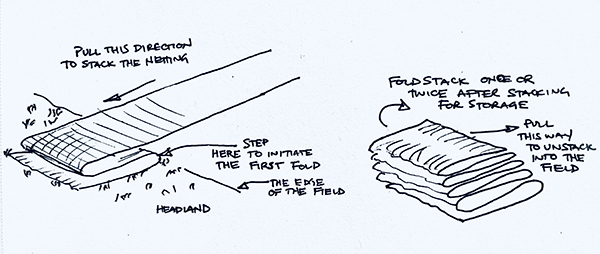
How to fold and unfold materials accordian-style. When folded this way, bulky materials like tarps and insect netting stack for a compact footprint in storage, and can be re-deployed by one person. All images courtesy of the author.
The first step is always to make sure the entire tarp is free, with any standing water, dirt, rocks or sandbags removed. Then we drag the tarp about 3-4’ into the headland from the end of the bed. With one person on each corner of the end we’re dragging (that’s two people if you’re keeping count) we each put a foot on the edge of the tarp where it crosses the field edge to create a point to fold over, grab the edge of the tarp about 3-4’ past that point and then drag the tarp back over itself creating the first set of folds.
Now there are three layers, with the first two layers being about 3-4’ long. Rinse and repeat until the entire thing is folded accordion style and you have a stack that’s about 3-4’ long and as wide as your tarp. To finish we usually fold it over a couple of times, width wise, which helps hold the accordion folds for storage and put a couple of river rocks on it to keep it from blowing.
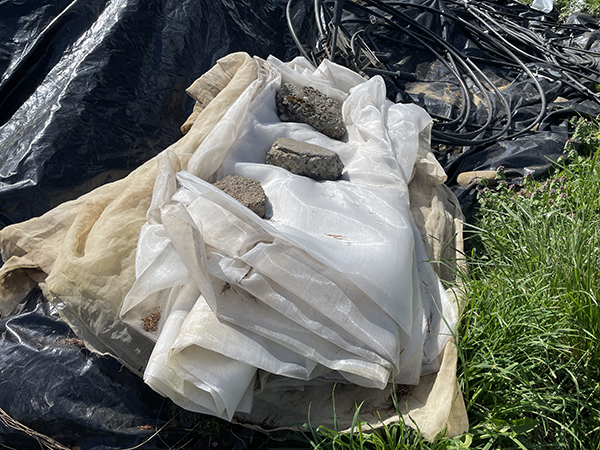
A couple of pieces of stored insect mesh. The stuff on top is one season old, the pile below which is yellowing a bit is six or seven seasons old.
To put it back into the field we simply undo the last couple of folds at the end of the bed and then pull from one end. It unstacks itself easily if you did it right, and typically just one person can do it, but it’s easier and cleaner with two.
This method isn’t quite as obvious when you’re putting the tarp away, but once you’ve done it a few times it goes pretty quickly, with minimal walking. It’s by far the fastest way to get one back out into the field, and the least likely to catch any wind as we’re pulling it back out.
Josh Volk farms in Portland, Oregon, and does consulting and education under the name Slow Hand Farm. He is the author of the books Compact Farms: 15 Proven Plans for Market Farms on 5 Acres or Less, and Build Your Own Farm Tools, Equipment & Systems for the Small-Scale Farm & Market Garden, both available from Growing for Market. He can be found at SlowHandFarm.com.
Copyright Growing For Market Magazine.
All rights reserved. No portion of this article may be copied
in any manner for use other than by the subscriber without
permission from the publisher.