










The longer we have been farming, the more I have learned about specific varieties of flowers that I want, as well as which colors and varieties sell best in our market. In order to reserve those varieties, it is important to get the orders in on time. But what exactly does that mean? Basically, you need to order for the following year as soon as this year’s crop is done blooming. Sounds crazy to plan that far ahead, especially if you do your crop planning in the winter as we used to. But not only is it best to get your order in as soon as you can, it’s also best to order when the crop is fresh in your mind. The most important crops to order on time in our production are tulips, ranunculus, anemones, peony roots, and lilies.
Tulips
Each year, I keep a record of the tulips in the order of bloom so I can refer back to it for next year’s order. Then I know if we had enough of each kind or color throughout the season. We pull tulips with the bulb when harvesting so they can be stored in the cooler, extending our tulip season, but also meaning that they are grown as annuals. While I am attracted to the darker colors, we also need to have some lighter colors mixed in that work for Easter or Mother’s Day. We try to grow mainly specialty tulips, as they are the biggest moneymakers: French tulips, parrots, doubles. Any standard tulips we grow are used in bouquets.
Tulips are a great crop if you have an early sales outlet. If you are growing mainly for farmers markets that don’t start until May, then only the later ones may be of use to you, depending on your zone. In the fall, we have plenty of field space for them and they don’t take a lot of input. When it comes time to harvest, though, they may need to be harvested twice a day if it’s hot. The tulips that don’t come up with the bulb get used first, and then we pull the others from storage as we need them, cut the bulb off, and put in hydrator. Typically they can store for about 2 weeks in the cooler dry, bulb on, standing upright in buckets. The longer they have been stored, the quicker they blow open when pulled out of the cooler.
To protect our tulips from becoming deer candy, we put up an electric fence once they start sprouting. We use the two-dimensional fence design in Richard Wiswall’s book the Organic Farmer’s Business Handbook, available from GFM. There are lots of sources for tulip bulbs, and they can be ordered by the 100 or by the crate, which is typically about 600 bulbs. We order ours from Leo Berbee and Ednie Flower Bulb, but any company that sells or imports Dutch bulbs will work.
Ranunculus & anemones
With the popularity of ranunculus and anemones on the rise, colors sell out fast. We could perennialize them or save corms, but we have decided it is best for us to purchase new corms each year. We have always gotten them from Gloeckner in the past, but there is a new company called Onnings Holland that is hybridizing their own lines of ranunculus and anemones, so we are going to try them out this year too. The Super Greens line of ranunculus from Gloeckner is pretty amazing, and were the tallest and largest blooms for us, especially in the heated space.
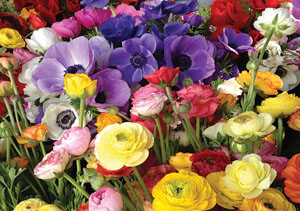 These buckets are a colorful mix of ‘Labelle’ ranunculus, ‘Galilee’ pastel mix anemone, and ‘Carmel’ white and blue anemone.
The series Galilee and Jerusalem, are good for smaller blooms, with more flowers per plant. Meron and Carmel are better for fewer, larger blooms. We grow mainly Meron and Carmel because we like the bigger blooms for sales to florists. We try to grow a variety of colors, but we sell the most of the colorful ones, especially blue. Whites sell well too, but our florists don’t like too much candy red in the spring, so we do the fewest of those. We try not to order mixes of ranunculus or anemones since we sell by color, except for the pastel mix of anemones, which we sell as a mix.
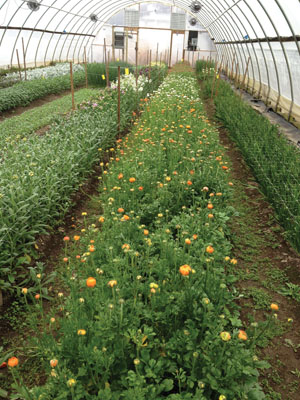
We get our first shipment of ranunculus and anemones November 1, soak for the appropriate time according to the instructions given for presprouting, and then plant them into 50-cell flats to grow on in the heated greenhouse before planting them out. They don’t need to have much foliage growth; they are plantable as soon as they have sprouted. We seem to lose a higher percentage of anemones in the sprouting process than ranunculus, so we just try not to over water them, which can cause rot. From the first shipment, half the ranunculus get planted into our heated house and half into the unheated space, to give us a succession of blooms. This year we are going to try half of the first shipment of anemones heated too since the succession worked. We get a second shipment of ranunculus and anemones December 1. They get the same presprouting treatment and then are all planted into the unheated tunnels for later blooms. This year, we are going to try a third succession arriving January 1 to see how late into wedding season we can get these blooms.
Peonies
Each year I get earlier and earlier with my peony order, but it still never seems early enough as varieties sell out fast. Especially if there is a good deal, or a certain variety that as gained notoriety like Coral Charm, they go quick. We try to buy the bigger root divisions (3-5 eye), so we don’t have to wait as long for blooms. Peonies take a few years to be really productive, so we should have started planting them a lot sooner than we did, but better late than never. If you plan on going big with peonies, make sure you have cooler space for the blooms. They are another flower that may need to be harvested twice a day, as you want to make sure you get them at their perfect “marshmallow” stage, especially if you are trying to store them for future sales. Good sources for roots are Oregon Perennial Company or Klehm’s Song Sparrow (ask for their wholesale price list for larger orders). We fall plant peonies so we don’t have to care for them all through the summer, they just need to be put in so they have time to root before the deep freeze comes, so we plant them in October. To help decrease weed pressure, we put them in black, woven landscape fabric, which seemed to work this year. We did have to go through and check the holes we cut, to make sure they were big enough for the peony sprouts.
Lilies
If you grow lilies as annuals as we do with prechilled bulbs, just think about when the perennial lilies outside are in bloom when timing your order. Zabo Plant says July is when the order should be placed, and they will allow you to make minor adjustments to your order, so you can always reassess later in the season. Most suppliers list availability by the week of the year — Week 1 being the first week of January and so on. We use an LA hybrid lily in every one of our bouquets, so lilies are a big part of our production. For the summer, our bouquet lilies are planted in the ground when we can, which is typically the shipments we get from Weeks 17-27. Otherwise, our lilies are planted into crates and inside some type of structure, heated or unheated depending on the time of year. We start getting our lilies Week 51 of the previous year for Easter blooms, and then get them shipped in every two weeks through the season until Week 35, which are our Thanksgiving lilies.
We grow all our Orientals in crates so they get the most particular care, especially since the bulbs are the mostexpensive. These we don’t produce for as long in the year, so start getting them Week 9 and then go through Week 29, planting every other week. As far as cost goes, these are the highest-dollar input crop we grow, but they are also quite valuable sold as cuts, so we just have to be willing to make that investment. None of our lilies get perennialized, so they have to be a part of our budgeting for the winter’s cash flow to ensure we will be able to pay for them when they start arriving in December.
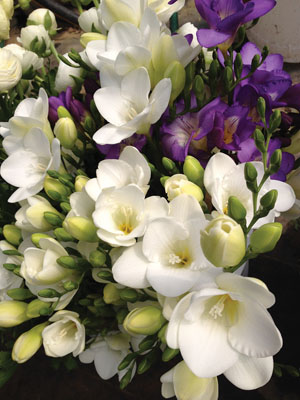 ‘Inzell’, a single white freesia from Leo Berbee.
Other bulbs
There are lots of other bulbs to consider, and all should be ordered sooner rather than later. Freesia and irises are both crops we buy for our winter production. The irises we get prechilled so we can have them bloom on our schedule. This means the bulb company has put them through a treatment that mimics winter, so they bloom on a timed bulb-forcing schedule. We start to get those in November for our heated greenhouse production, and then switch into unheated tunnel space with the shipment we get Week 6. We get both irises and freesia from Leo Berbee. We have found we like the double freesia the best, as they don’t bruise as easily as the single ones. Growing freesia takes heated greenhouse space, but they can be grown through the winter for spring bloom, and are one of my favorite scents on the farm. Next year we will presprout bulbs before planting, as we always have one variety that doesn’t come up, and the real estate is too expensive in the heated house to have a gap in the bed.
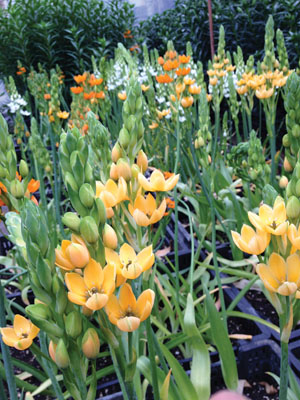
Ornithogalum grown in crates in the minimally heated greenhouse.
Ornithogalum was new for us this year, but we plan to add a lot more after its success. We did a small trial patch in crates in our heated space, but for next year will be planting it into the ground in our heated greenhouse where we have bed space. These are ordered from Gloeckner. These are what florists call Star of Bethlehem, but they come in more colors than white. These flowers last about two weeks as cuts, and will look much better than the ones florists are used to getting in, so we charge $2/stem, making them worth the heated greenhouse space.
Old-fashioned flowers are making a comeback, so be prepared for trending fritillaria and bearded iris. Bearded irises need to get established before the cold of winter; Schreiner’s suggests planting in August so they have plenty of time to grow roots before winter. There are lots of other bulbs to consider: gladiolus, allium, amaryllis, callas, dahlias, crocosmia, eremurus, and hyacinths, among others.
Where to order
Finding the right company for you may depend on your location. Bulbs and root stock are expensive to ship because they are heavy, so check to see if there is a supplier nearby. The supplier should be able to help you with questions as well as be responsive if there is a problem. We always keep our packing slips and write down lot numbers in our planting log for reference. If you are organic, you may have to check with your certifier to see what the protocol is since there aren’t a lot of organic sources for bulbs yet, other than Ecotulips in Virginia.
Although you may still be able to order bulbs for next year, your choices may be more limited than if you had done so sooner. So mark your calendars for ordering in the future —tulips in May, ranunculus and anemones in June, lilies and peonies in July. This year, we had to map out our whole greenhouse plan before ordering ranunculus and anemones, to make sure we would have space for them. It does take extra time during the busy season to sit down and plan, but it is worth it to know that you will be able to get the blooms that you and your customers want.
Gretel and Steve Adams own Sunny Meadows Flower Farm in Columbus, Ohio.
Copyright Growing For Market Magazine.
All rights reserved. No portion of this article may be copied
in any manner for use other than by the subscriber without
permission from the publisher.