











Entries accepted until November 15!
Farmers are great innovators and for a lot of us the challenge of finding or creating better tools and methods is part of the fun of farming. It’s probably obvious to anyone who has been reading my articles and books that I’m someone who both loves the tinkering, seeing what other people are doing, and sharing those ideas with other farmers. Last year I had the opportunity to sit on a judging panel for the Small Farm Innovation Challenge put on by CAFF (Community Alliance with Family Farmers). CAFF is a California based organization that has been working with farmers since the 1970’s, and the Small Farm Innovation Challenge is a competition designed to highlight innovative tools farmers have developed and to encourage companies to design and develop more scale appropriate tools for small farms.
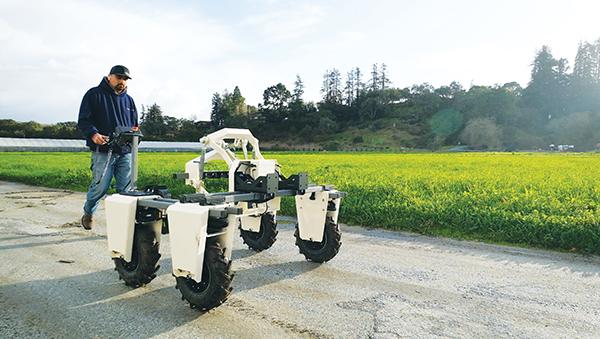 The Amiga electric tractor won the hardware category of the 2022 CAFF Small Farm Innovation Challenge.
Despite the challenge being based in California the entries into last year’s competition came from all around the globe. The competition has three categories, and two of the three winners were from outside of California.
In the “DIY” category Sena Daniel Ahiabor from the Carver Integrative Sustainability Center at the Tuskegee University College of Agriculture, Environment & Nutrition Sciences and Cooperative Extension won for a simple-to-build and well documented elbow operated portable hand washing station.
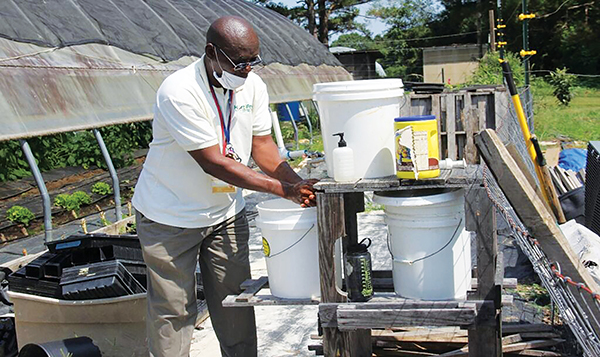 The elbow-operated hand washing station that won the DIY category of the 2022 CAFF Small Farm Innovation Challenge.
The hand washing station was a simple bucket to bucket type, with clean water in the top bucket, running through a little tap on the bottom when washing hands, and falling into a bucket below to capture the dirty water. There were two “innovations” with the station, one being a modification to the ball valve coming out of the upper bucket, essentially an extension to the valve handle made from a couple of pieces of pipe which allow it to be opened and closed with your elbow instead of your hands, thus keeping it and your hands cleaner. The second innovation was the well documented instructions for putting the whole station together with minimal effort, purchased materials, and cost, making it accessible to a wider audience. I loved how simple and complete this entry was, nothing flashy or mind blowing, just practical, complete, and useful to a wide audience.
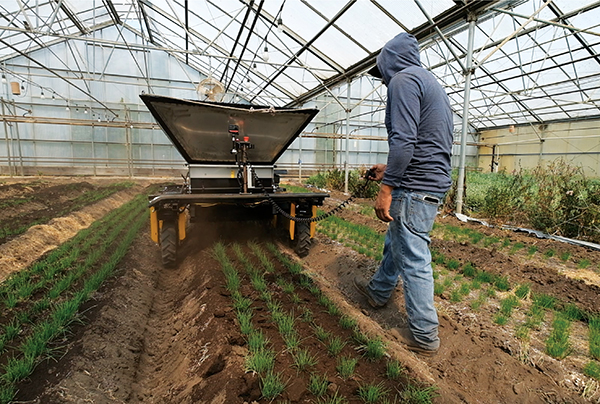 The Amiga electric tractor spreading compost.
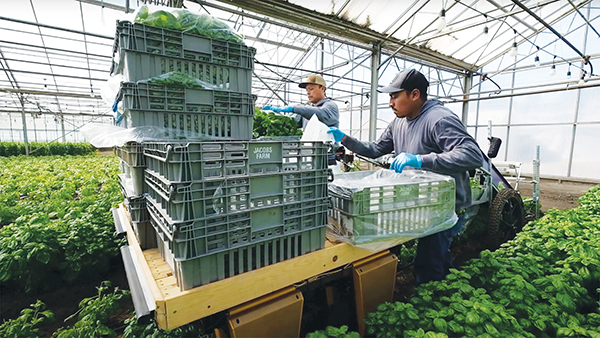
In the “Hardware” category a little modular electric tractor called the Amiga from farm-ng stood out. This was actually the third time in the competition’s short history that a small electric tractor won and each one has felt a bit like the next step in the rapid evolution of small electric work platforms for farmers. The Amiga is a tractor in the sense that it is a powered, wheeled vehicle designed to drive in the field and to be capable of both carrying loads and pulling implements, but its small size, modularity and slick robotics control technology really set it apart. I’ve been dreaming of a vehicle like this for many years now and I’m glad to see one finally getting out there in the world – not that I had anything to do with it.
The third category is for “Software” and last year that went to Farm Generations Cooperative for development of software and working to make it possible for CSA farms to accept EBT/SNAP when processing orders online. Farm Generations Cooperative is the developer of the Grownby sales platform which was featured in two articles in the March 2023 issue of GFM.
Once again, this year I’ll be sitting on the judging panel for the competition and currently the competition is open to entries until November 15. The competition winners are highlighted at California Small Farm Conference and there are cash prizes. I’ll be working to highlight not just the winners but also all of the other great entries that deserve honorable mentions. Honestly, last year it was close in all of the categories, but there was also a lot of room for more quality entries. I’m looking forward to seeing even more innovations this year.
Josh Volk farms in Portland, Oregon, and does consulting and education under the name Slow Hand Farm. He is the author of the books Compact Farms: 15 Proven Plans for Market Farms on 5 Acres or Less, and Build Your Own Farm Tools, Equipment & Systems for the Small-Scale Farm & Market Garden, both available from Growing for Market. He can be found at SlowHandFarm.com.
Copyright Growing For Market Magazine.
All rights reserved. No portion of this article may be copied
in any manner for use other than by the subscriber without
permission from the publisher.