











Kristen Efurd Osgood and her partner Joe Balooshi established Beyond Description Farm last year on 30 acres in Arkansas’ Ouachita Mountains region. With extensive backgrounds in sustainability, farming and permaculture, they are trialing crops to see what will thrive in their temperate climate, now hit with hotter summers, extreme temperature swings, and excessive rains. When Kristen and I exchanged emails in July, they were prepping for a 107°F degree day by making ice in rubber feed pans to give to their chickens, guineas, ducks and geese during the hottest part of the day.
The farm plan includes signature annual crops such as ‘Candy Roaster’ squash, heirloom pumpkins and micro-melons. They plan to trial garlic varieties, perennial onions and heirloom okras. The blueprint includes elderberry, serviceberry, blackberries, pawpaws, pecans, hazelnuts and black walnuts, along with endangered forest crops such as ginseng and goldenseal on seven acres of forested land. A small section of land is designated for future agrovoltaics, combining solar panels with crops and animals.
Even more, a central feature of Beyond Description Farm is restoration of the woodland-grassland savanna that historically covered the property. Giant oaks at least 100 to 150 years old remain on the property. Today, they are planting a variety of trees along the contours of the land to establish silvopastures for grazing sheep and eventually cows. While the trees will shade the animals, produce nut fodder and improve the grass forage in the open pastures, they also will help manage water from heavy rains and provide wildlife habitat.
At the same time, carbon stored in the maturing trees will be another cash crop. Kristen and Joe are among landowners enrolling smaller acreages in carbon markets. They also are participating in the expanding afforestry area of carbon markets, that is, establishing trees where they don’t currently exist.
They signed a contract with Working Trees (workingtrees.com) enrolling 260 trees (mostly black locust, along with Shumard oaks and sycamores) that will be planted out along the contours of two pastures that comprise about 15 acres. So far, they’ve planted 150 trees with more going in this fall and next year. They hit snags with a delayed nursery delivery, heat, and lack of rain that killed some transplants that will be replaced. As the trees mature in five years or so, Kristen and Joe will reinvest the money from carbon sales back into enrolling more trees.
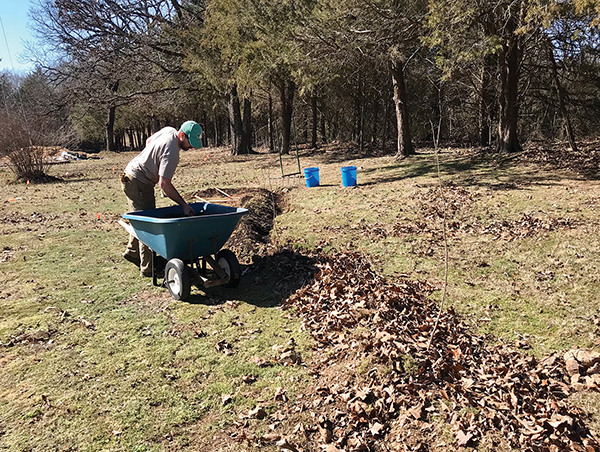 Joe Balooshi of Beyond Description Farm planting trees on the contour of a pasture to create a silvopasture. The farm enrolled 260 trees with Working Trees to sell sequestered carbon as the trees mature. Photos courtesy of Beyond Description Farm.
Working Trees is currently focusing on landowners — including small-scale — across the eastern United States who integrate trees into silvopastures and alley cropping. Forest carbon programs also are reaching down to smaller parcels. The Family Forest Carbon Program (familyforestcarbon.org), a collaboration between the American Forest Foundation and The Nature Conservancy, is enrolling as few as 30 forested acres. Rather than paying directly for sequestered carbon, they pay landowners to implement land management practices with proven environmental benefits.
While most carbon credit programs work with thousands of acres of forest, and more recently large-scale commodity farms, the programs mentioned here may fit some of our readers with smaller pastures or adjacent forests that would qualify.
“A goal from the start has been to make it work for 1000, 100, 10, or even 1 acre,” said John Foye, one of two Stanford University graduate students (Aakash Ahamed, the other) who created Working Trees at Stanford Climate Ventures and entered it into Elon Musk’s carbon removal XPRIZE competition, a $100 million purse to be awarded on Earth Day in 2025.
Smaller acreage is now included because new technology makes it easier and cheaper to measure carbon. Specifically for Working Trees, it’s smartphone LiDAR technology (pulsed laser light detection and ranging that create 3D representations of environments used in agriculture and land management), satellite remote sensing data, and machine learning models, which make it cost-effective and simple for landowners to assess and quantify carbon on their land. “We’re using the phone application to do what previously required calipers or a tape measure, a clipboard, and boots-on-the-ground,” Foye said.
Right now, less than 1 percent of the voluntary carbon market is related to agriculture and only 3 percent is in reforestation, Foye said. Before European colonizers, the United States from New England down to Florida and west into the Great Plains prairies was largely covered in deciduous forests. That’s why Foye and Ahamed see vast potential for trees “where the interests of farmers and the climate overlap.”
Kristen concurs: “I love that farmers can reap financial benefits from positive ecological farming practices. I truly appreciate their work to compensate farmers for afforestation projects. I believe silvopasture systems will be vital in grass-fed livestock systems as our summers continue to break records.”
Yet, she worries people will simply plant trees to monetize carbon without a thoughtful plan for the trees’ survival. She points to forests of fast-growing, genetically modified pine trees (popular in carbon programs) that are creating monocultures that don’t support a diversity of wildlife. Ideally, new forests would be diverse with trees of different ages and types.
Beyond Description Farm chose to be paid as the carbon is drawn down into the trees. Working Trees also has offered some landowners an option to receive 50 percent of the money upfront to help cover expenses. The costs of planning, purchasing trees, prepping and planting is too high an obstacle for many farms and landowners. Some benefit from programs such as the Natural Resources Conservation Service’s Environmental Quality Incentives Program (EQIP), which offers grants to help farmers establish silvopastures, alley cropping and other forest and riparian conservation projects.
Working Trees helps landowners quantify carbon, access carbon credit buyers and links them to a growing network of technical support partners. To participate, land must have been pasture or even relatively unmanaged grasses for at least a decade to avoid enrolling recently clearcut land. Farmers can input their address or geographic shapefile at workingtrees.com/landanalysis for an assessment and connect with Working Trees.
An upcoming episode of the Grazing Grass podcast with Cal Hardage will feature Lick Skillet Farm in Tennessee and Working Trees describing implementing the silvopasture plan on the farm’s 700 acres of pasture.
Last February, I noticed a workshop in Pittsboro, North Carolina, introducing landowners to earning money from carbon in their forests. I was curious to learn what might be available for smaller-scale landowners. Among the speakers was Tatiana (Tots) Height, Southern Director of the Family Forest Carbon Program. I called her afterward.
“I want forest owners to know there are other options than just participating in timber,” Height said. “There are other revenue streams. Your woodlands can be of value to you economically.”
The environmentally beneficial land management practices that the Family Forest Carbon Program pays for vary by region. Among them are: prescribed fire, understory clearing, removal of invasive species, harvest delays, growing mature forests and mid-rotation thinning. The practices must be something new or changed that increases carbon sequestration. The program absorbs the costs of monitoring and administration and will help develop and offset the cost of forest management programs.
After starting with an Appalachian pilot program, they added six states in the eastern United States and continue to expand. Landowners are encouraged to input their information at familyforestcarbon.org/# to see if they are eligible. Even if your land is not in a state with an active program, by inputting your information it remains in the database and you’ll be connected when your region goes active.
Of course, readers want to know how much money landowners are getting for carbon sequestration. It’s a moving target that shifts with supply and demand; depends on which trees are planted, their maturation and survival; and what conservation practices are rewarded. “What we can say is producers can likely expect 1 to 2 tons per acre per year once the system is established,” Foye says of Working Trees. “Today we have contracts at a minimum of $20 per ton and rising to $30.” Landowners who are okayed to get a percentage of the payments front loaded, may receive $100 to $500 an acre in a 15-year pre-selling arrangement.
In the Family Forest Program, incentive payments vary based on regional practices. In the initial Appalachian region pilot the range was $180 per acre to $300 per acre over a 20-year contract — 20 percent up front and then payments on a schedule. These numbers don’t necessarily represent what new contracts would pay. If you think you qualify, connect with the programs.
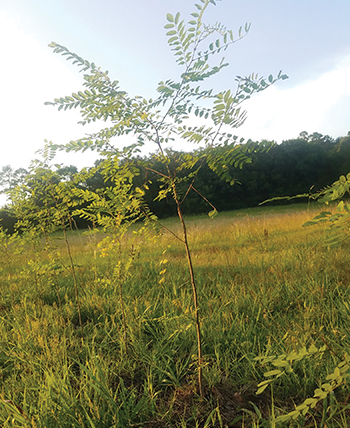 A black locust planted in the pasture at Beyond Description Farm.
NCX (Natural Capital Exchange) has been popular with forest landowners because they offer payouts on year-to-year contracts. When I contacted them this summer, they said forest owners could (at that time) expect to earn between $5 and $20 an acre for the year depending on the location, timberland characteristics, and regional market dynamics. NCX has no minimum acreage requirements; the median is roughly 325 acres.
In June, NCX had a setback. Verra Verified Carbon Standard — the 3rd party certification gold standard in today’s carbon offsets and the leading offsets registry — declined to go further for now with NCX’s proposed and controversial year-to-year carbon accounting. Critics say such short-term carbon storage doesn’t help the climate in the long-run, and landowners can be paid for the year or years ahead of an already planned tree harvest. NCX is pursuing additional 3rd party certification. Working Trees and the Family Forest Carbon Program work with Verra.
While carbon payouts are low relative to planting volumes of trees, farms obviously benefit greatly from trees in the landscape with water conservation, broader soil fertility, food for animals and people and wildlife habitat. (See the February 2021 GFM article “Small orchards and agroforestry in the field.”) Lick Skillet is planting oaks, native pines, black locust (nitrogen fixing) and honey locust (each tree can produce 100 pounds of high-calorie pods that can be stored). At Beyond Description Farm, locust trees will provide food for the sheep but they won’t let them eat too much because of the high protein. Instead, they’ll see if ground pods will be viable chicken feed.
The carbon credit landscape is exploding and shifting into new territory. This article merely offers a point-in-time snapshot of several programs that accept smaller acreages. No doubt, many of us approach the topic of carbon credits with strong skepticism. Examples abound of companies buying credits to offset pollution instead of reducing fossil fuel use and of forests counted in carbon sequestration that no longer exist because they’ve been clearcut or scorched to the ground in wildfires. Some carbon credits also are sold without adding any environmental benefits (termed “additionality”) when, for example, landowners weren’t planning to cut down the trees within a timeframe anyway.
Yet, no one can ignore the tidal wave of demand for carbon credits as companies and government entities around the world rush to reach net-zero greenhouse gas emissions. By necessity, carbon markets are recruiting private landowners, including those with smaller acreage. The majority of U.S. forests are in private hands and much of it a mosaic of smaller parcels.
With such high demand for credits there are new approaches on the horizon. Height connected me with Arjun Dürr, Program Development Director at the American Forest Foundation. He is working on pasture land and reforestation and prioritizing small land owners. He explained that while larger acreage obviously spreads the cost, they are trying to find a balance so they can enroll more landowners with less acreage. At some point in the next year or so, they will launch a pilot project on marginal crop land and pasture.
The American Forest Foundation and Family Forest Carbon Program are investigating how landowners one day might be rewarded in the marketplace for biodiversity. “We do try to understand with the practices what the co-benefits might be for wildlife and incentivizing biodiversity,” Height said. “That doesn’t exist for biodiversity right now and is nowhere near developed.”
Meanwhile, Kristen and Joe will continue to execute their vision for Beyond Description Farm, serving as an example of a regenerative, diversified farm. Her advice to farmers and landowners considering the carbon markets: “Read the fine print, understand what is being asked of you for how long and make sure it fits your long-term vision.”
Jane Tanner grew cut flowers and specialty crops at Windcrest Farm and Commonwealth Farms in North Carolina, and helped manage the biodynamic gardens at Spikenard Farm in Virginia.
Copyright Growing For Market Magazine.
All rights reserved. No portion of this article may be copied
in any manner for use other than by the subscriber without
permission from the publisher.