











Year one running a SARE trial project
We grow cut flowers year-round at Moonshot Farm in East Windsor, New Jersey, but find that timing flowers for December — including winter holidays like Christmas and Hanukkah — to be the trickiest time of year for production. To bloom in December, most cut flowers need to be planted under the extreme hot weather and long days of August to then bloom during the shortest, coldest days of the year. Meanwhile, consumers often are willing to splurge on holiday decor, and competition for local blooms is low this time of year.
In 2024, we were awarded a Sustainable Agriculture Research and Education (SARE) Grant to research cut flowers for December production. For our SARE project, we are testing nine different varieties to determine which are most feasible, marketable, and profitable for December production: stock, snapdragons, Asiatic hybrid lilies, Oriental hybrid lilies/roselilies, amaryllis, chrysanthemums, dahlias, ranunculus, and anemones.
We received additional funding through an Association of Specialty Cut Flower Growers Grower Grant to add additional species to the trial: Tissue Culture scabiosa (e.g., scoop scabiosa), dianthus barbatus (Sweet William), caryophyllus (carnation), and seed-strain anemones.
After our first December of the project, I’m relieved that this is a multi-year project. We made a lot of mistakes and have a ton of lessons learned; reliable results will require several years of data to account for grower error and weather conditions. In 2026, I hope to share detailed results with you about what flowers are the best for December production and how to grow them profitably.
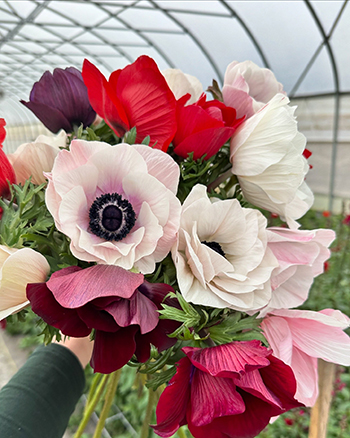
Festive anemones were one of the most profitable crops in our trial so far. All photos courtesy of the author.
In the meantime, I wanted to share some lessons about running a large trial on your farm–whether it’s grant sponsored or not. I also encourage you to read Maryellen Sheehan’s excellent series from 2023 about running a brassica-related SARE trial on their farm.
Connecting with expert suppliers
One of the first things we did, even before being awarded the grants, was reach out to suppliers to get their guidance on the feasibility of the project. We asked for their ideas about what crops would work well and how best to provide ideal growing conditions in December. This set our project up for success from the start. As an added bonus, several suppliers donated plant material to the research.
Dr. Alicain Carlson from Syngenta Americas was one of the first suppliers I contacted. She was extremely enthusiastic about the viability of the project. I had initially contacted Alicain about trialing mums for Christmas, and she suggested that we also try dahlias, a crop I hadn’t considered. Alicain (along with my local extension agent) became a technical advisor for the project and has provided a wealth of guidance about crop timing, rooting cuttings, and lighting schedules (not to mention thousands of donated cuttings).
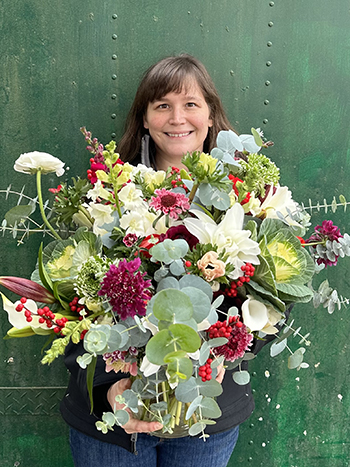
We are trialing around a dozen different crops for December production across two years, including stock, snapdragons, Asiatic hybrid lilies, Oriental hybrid lilies/roselilies, amaryllis, chrysanthemums, dahlias, ranunculus, anemones, scoop scabiosa, Sweet William and seed-strain anemones.
Similarly, Farmer Bailey, another supplier, has advised us for the ASCFG-funded portion of our project. The company provided lots of guidance about crop schedules and heat/light conditions, as well as plugs for scabiosa and the seed-strain anemones. Zabo Plant provided lily and amaryllis bulbs (some varieties of which had never been grown in the USA before), as well as detailed information about how Dutch growers time these crops for December.
Working directly with these suppliers gave the project a huge leg up. We had experts to call on whenever issues arose and were able to set the project up for optimal success. For many modern cut flower varieties, trials have been conducted in South America, Asia, or Europe, but little data exists for plants in North American climates — especially in winter greenhouses. So, these trials are valuable for suppliers as well.
Planning ahead and backup plans
An unexpected roadblock we encountered with our grant was sourcing plant material out of season. Because few growers in North America are growing December blooms, bulbs and plugs may not be readily available. For example, ranunculus and anemone corms are typically shipped from suppliers in October. However, for December blooms, these corms need to be planted in August, so we needed to save the prior season’s order for nearly a year.
Similarly, dahlia cuttings were not readily available in their ideal planting weeks. During the first year of our grant cycle, we learned to be flexible about planting dates, varieties, and colors. Even if flowers were pink instead of more seasonal red/white, and even if they bloomed in February instead of December, there were plenty of valuable lessons to be learned.
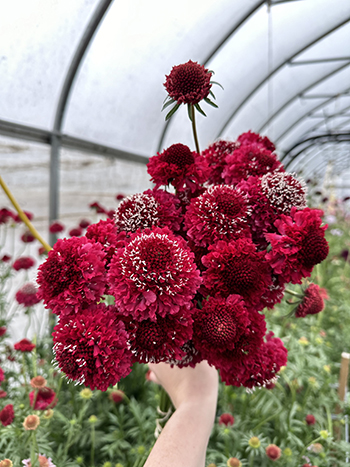
Connecting with suppliers and plant breeders has been crucial for the work. Farmer Bailey provided scabiosa plugs and guidance on growing them.
We also were careful to make some backup plans for aspects of the trial where we were uncertain. One crop we had never before grown was anemones from seed. For the ASCFG aspect of our trial, we grew Gemstone anemones which are grown from seed (rather than corms like most anemones).
First we tried to get them started in our hot greenhouse in August and had an abysmal 0% germination rate. The breeder Sakata recommends germination at 59° to 68°F, so, we next tried to sprout them in our germination chamber set as cool as we could, around 68° to 70°. This was cooler but still not quite cool enough, and we had germination only around 8%.
Luckily, we had a backup plan in place otherwise we would not have been able to trial this crop at all. Farmer Bailey helped us source plugs from Plug Connection in California. This plug grower has evaporative cooling systems in their greenhouses, which enabled them to give the anemones the cold start they required. It was a big relief when full, beautiful trays of anemones arrived ready for planting in September. The trial could go on.
Using existing systems
A large trial like this requires extensive record-keeping and note taking, which quickly became a challenge on our already busy farm. It’s easy to let even the best intentions slip away when there are hundreds of other weekly tasks outside of the trial.
We found our trial worked best when we incorporated it right into existing systems on our farm. For example, we already keep a daily harvest log (via a Google Form that all of our staff have access to). So, we entered data for the trial crops right into there. Similarly, trial plantings were incorporated into our existing field plans and seeding spreadsheets, which made sure that they wouldn’t be forgotten or overlooked. We also tracked sales related to the trial in Square, just like we do for every other crop we sell.
Using existing systems went beyond just record-keeping. For example, plants during seedling stage were placed right alongside our farm’s other plugs which ensured they got watered and fertilized on time.
Trial plantings that deviated from our normal systems encountered issues and we found that “out of sight, out of mind” often resulted in major issues. For example, as part of our grants we had committed to planting some of the trial crops into bulb crates rather than just testing in-ground beds. The idea was that this would give better information for growers who only have access to container growing in the winter (for example, in a propagation greenhouse). Because we rarely grow crops in containers, we ended up neglecting many of these. They were under-watered and underfed — or in some cases, we forgot to plant into containers at all.
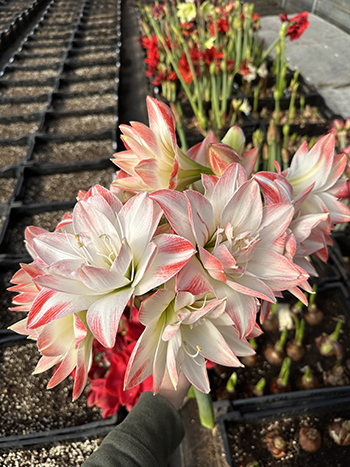
So far, cut flower amaryllis have been the least profitable crop for December production due to high input costs.
The worst example of system deviation was probably our chrysanthemums. Mums in our region typically bloom in November, after a certain period of short days. To get a later, December-blooming crop, mums need night interruption lighting so that they think the days are still long and remain vegetative, growing tall stems. We started lighting the mums right on schedule in early September. This is a time of year when nothing else on the farm is getting supplemental light, so it was outside of our normal systems.
Unfortunately at some point in the fall, the mum lighting got unplugged for a couple of days when someone needed to use the outlet. Triggered by cool temps and normal short day length, the chrysanthemums started to bloom at just 4-inches tall. The crop was a failure.
Now we know that when a trial crop relies on a task or record outside of our existing systems, we need to make extra efforts to ensure it doesn’t fail. This might mean setting alarms on our phone to remind us to water, or big “Don’t Unplug!” signs above any critical power cords.
Embracing the imperfect
Our farm has built its brand around producing the highest quality flowers. For us that means pest-free blooms with tall stems and large flowers. Generally, if something isn’t up to par — for example, blooming on short stems or infested with a pest beyond control — we move on, till it in, and plant the next thing.
During our December flowers trial, however, we’ve learned to embrace imperfect (and imperfectly timed) flowers, as they can still provide lots of valuable research data. After that initial planting of mums failed, Alicain at Syngenta encouraged us to try again. With cuttings arriving in November, there was no way we’d be able to get them for December flowers. But she suggested that we could still learn how to effectively keep them in their vegetative state during the winter, using warm enough temperatures and correct night interruption lighting.
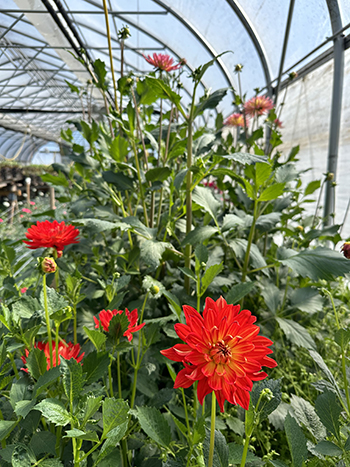
It’s been important to keep an open mind throughout the project; I was surprised by how tall and healthy winter dahlias were.
We accepted the replacement cuttings and were able to grow them out successfully. While the flowers ultimately bloomed in March, three months after Christmas, the method ultimately mattered more than the result. Heading into the second season of the grant, we’re feeling much more confident in our ability to grow the chrysanthemums properly.
Another example of a “successful failure” was the winter dahlia crop. In the field, our worst dahlia pests are beetles, thrips, and tarnished plant bugs. However, in the cool winter greenhouse, an entirely different pest infested the crop: aphids. We had never dealt with aphids on dahlias before, didn’t scout for them regularly, and by the time we realized how bad the infestation was there wasn’t much we could do to save the crop.
Typically this severe of an infestation means we would remove the plants, as none of the stems were marketable; but for the grant we let them keep growing. While we didn’t get to sell any of the winter dahlias due to the aphids, we were still able to glean valuable data about yields and stem length. In Year 2, we’re looking forward to being much more on top of aphids on the dahlias.
Keeping an open mind
Of all the crops in the trial, I was most skeptical about growing dahlias for December. We had attempted growing dahlias under cover before to extend the season slightly earlier/later and had generally poor results. Previous dahlias we’d grown in high tunnels often had shorter stems and open centers due to hot temps, and they were infested with powdery mildew. But the breeder suggested that we trial them, so I tried to have an open mind.
It turns out that dahlias really thrive under the cool conditions of a heated winter greenhouse. We grew them in our geothermal greenhouse which stays consistently around 60° to 65°F all winter. To grow dahlias in the winter, we provided night interruption lighting (from 10 p.m. to 2 a.m.) to the plants as soon as the unrooted cuttings arrived at the farm. Dahlias are facultative short-day plants, that means they’ll bloom faster under short days, but eventually will bloom under long days. At the breeders’ suggestion, we kept the lighting on them throughout their lifecycle, as short days can cause dahlias to bloom with open centers.
Wow, were we surprised by these spectacular plants. The dahlias were towering at over 7-feet tall, incredibly productive with huge perfect flowers. Although we entered the trial skeptical, winter dahlias have now completely won us over. We can’t wait to try them again next year for Christmas (and hopefully for Mother’s Day, too).
Planning for weather
Of course, farming is always impacted by weather — what a revelation —but our trial ended up even more impacted than I expected. In our grant applications, we committed to starting one to two plantings of a crop depending on the species. In retrospect, several more plantings (maybe five, six or more) would have provided valuable insight.
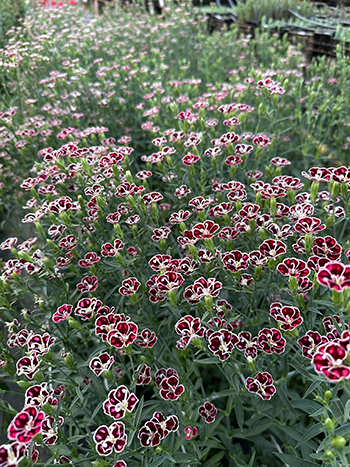
Next year, thanks to a second year of grant funding from the ASCFG, we’re adding several species of dianthus to the trial.
For example, our initial planting of stock got completely fried during an August heatwave and we lost the plugs. We started some new ones but by then we had missed the window for December blooms and the stock flowered at the end of January. With winter growing, just a few days difference in planting can make a difference of weeks in bloom time. Next year, we’ll start stock every five days over a few weeks to better nail down our timing.
Overall, most of our crops bloomed significantly earlier than we expected, likely due to our warm and unusually sunny fall. Ranunculus and anemones started blooming in November. Several of our lily varieties (which make just one stem per plant) as well as our snapdragons bloomed in November. Thankfully, the red and white flowers were as marketable for Thanksgiving as they would have been for Christmas.
Unfortunately, by the time December actually rolled around, we didn’t have many flowers left. Had the weather tipped to the other extreme and been unusually cold, our flowers may have been delayed into January or beyond.
Ultimately precise timing matters less to our farm as we attend farmers markets all year round. But if we had no outlets in November or January, I might not want to grow for December as so much of winter timing is up to the weather conditions.
Looking ahead
Despite all of the issues outlined in this article, the trial was really fun and promising. We’ve already demonstrated two of the main objectives of the grants: local flowers can successfully be grown for December and they are definitely marketable with customers.
Year two will be focused on homing in on growing these crops and better nailing timing specifically for December. Once we’ve completed another season, I hope to share detailed crop schedules and profitability data about all of the flowers in the trial. Of all the flowers so far, the ones we are most excited about are scabiosa, dahlias, and chrysanthemums. With high yields per square foot, we think these have the most potential to be profitable December crops for local farms.
On the other hand, it’s looking like cut flower amaryllis is not a profitable option for American farms due to the high bulb cost, unless your market can bear very high prices ($15 to $18+/stem which is high even for us in NYC). Thanks to a second year of grant funding from the ASCFG, we’re also adding several dianthus species to the trial. In 2025, we experimented with the flowers with great success for Valentine’s Day and we think they’ll be a strong option for December.
Although it feels like we just finished up the first season of the grant project, it’s almost time to get started again as our first plantings for the second season will need to be sown in late July/early August. Here’s to a successful second year full of wins and also plenty of valuable failures.
This material is based upon work supported by the National Institute of Food and Agriculture, U.S. Department of Agriculture, through the Northeast Sustainable Agriculture Research and Education program under subaward number FNE24-087. Any opinions, findings, conclusions, or recommendations expressed in this publication are those of the author(s) and do not necessarily reflect the view of the U.S. Department of Agriculture.
Rebecca Kutzer-Rice owns Moonshot Farm, a specialty cut flower farm in East Windsor, NJ. She grows flowers year-round including in a geothermal greenhouse, for retail markets in and around NYC.
Copyright Growing For Market Magazine.
All rights reserved. No portion of this article may be copied
in any manner for use other than by the subscriber without
permission from the publisher.