











Americans have always been inclined to like big things, often the bigger the better. A lot of marketing has been based on supersizing. This attitude has been applied at farmers markets as well — big red tomatoes, big ears of sweet corn, big heads of cauliflower. But it would be a mistake to assume that great size is always an asset. More and more, bigger is not better.
This growing lack of interest in largeness has many reasons. Not as many people are cooking for large families anymore; in fact, many farmers market shoppers are feeding households of one or two. Traditional harvest time foods are still prepared or stored by some folks (e.g., crocks of sauerkraut, giant squashes). However, not as many people prepare these particular quantities these days, at least not to the same degree.
Sometimes I am not sure how well some large vegetables ever sold; I mean just how many people really want an enormous banana squash or zucchini? So, has it ever really been worth it to produce them? And with the recurrent discussions about food being wasted in this country, many people are more aware of what they are actually eating and what they are throwing away.
Also, there are many advantages to the grower that should be considered for planting on a small scale. Today, many types of mini produce are not being widely grown and harvested, so they represent rare and unique offerings (e.g., radish pods, extraordinary melons). Some crops are rapid growers (e.g., radishes, baby greens) and better allow for succession plantings. Other small varieties grow on very compact plants (e.g., cabbage, eggplant, summer squash) and therefore permit high density plantings. Still others can thank their size for the high productivity of their plants (e.g., peppers, winter squash), another trait that can make the production of small crops pay off.
Let’s take a closer look at when it pays to be petite.
Compact crops
Some produce is small no matter the variety. Harvesting these crops tends to be labor-intensive, so you must make sure you can make them work in your particular circumstances. When you can, it often pays to do so. Such crops, for example, include all manner of small berries, shallots, salad radishes, various green peas, and Brussels sprouts (though when you leave them on the stalk, your labor-intensive harvest problems are at an end).
There are other less familiar crops that come small. Husk cherries, cape gooseberries, garden huckleberries, radish pods, the unique Mexican sour gherkin, and the even more unique, long-season jelly melons and litchi tomatoes. If you are interested in growing one of these, you will want to discern if you can find a market for them.
Starting small with an eye on expanding production for the future is a good idea. Try out value-added product options if that is your thing, or look for possible wholesale or contractual production alternatives to diversify your sales streams for the very unique.
Prompt picking
Some plants will ultimately produce a larger-sized (and perfectly marketable) crop, but by harvesting early you can increase your sales options. I remember one summer when a farmers market co-vendor surveyed the sellers and discovered a lot of zucchini competition. He decided to harvest his at baby size (about 3 to 4 inches long) for the rest of the season. Instead of joining in the competition for the lowest price, he opted for an altogether different product and no competition. When we raised patty pan summer squash, we regularly harvested about half of our crop at the baby stage for customers who only wanted them at that size.
The baby and regular dual harvest is how we do kale. If we allowed all of our kale to grow the larger leaves, we would probably not be able to sell it all. By harvesting baby leaves, the larger leaves are kept at a sellable level of production. We make good money (and have very happy customers) with our baby kale. White Russian, a Siberian-type kale, is especially prolific as a leaf and therefore baby kale producer.
Some early carrot varieties (such as Aranka and Mokum) perform well for baby carrot harvesting. Also, early beet pulling will give you baby beets, though varieties that are bred to be harvested at a small size may be better proportioned at a small size. You may discover you have a market for other crops harvested at a diminutive size. Small scallions, small eggplant, small Swiss chard. There is the Muncher cucumber, which can be harvested at both pickler and slicer size. The only slicing cucumber we grow anymore is the white-skinned Silver Slicer because we harvest it at pickling size and mix it into our pints and quarts.
And then there are potatoes. Most potato plants have a few small individuals on them, ones that didn’t size up by harvest time. Box up the ones around the size of a shooter marble, do not simply toss them away. I have known people who want these cuties for roasting, soups, and other recipes where they just clean them off and use them whole.
Varieties can even be mixed together provided they have the same texture and intended use. Likewise, slender asparagus stalks and undersized sweet potato tubers should not be cast aside. I know many customers who prefer the tenderness and appearance of slim asparagus, and also those who live alone and simply don’t want a big sweet potato for themselves.
Teeny types
There are many unusual vegetable varieties (frequently less-grown) that are small in size. If you have always passed them over in favor of their larger counterparts, you really should give them a second look. In the allium family, there are baby leeks, and cipollini, pearl or another variety of mini onion. Purplette is our favorite. We sell it as a salad onion.
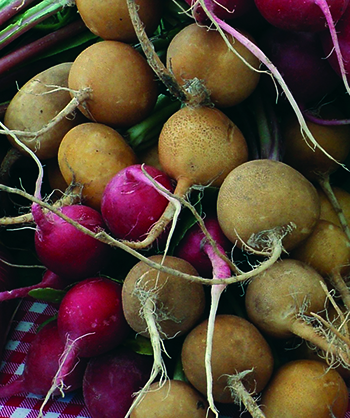 The tan Zlata radish can be harvested small on its own or mixed with other radishes.
Have you ever heard of the slender haricot (also filet or French) bean? What about the anellino or shrimp beans with their singular curved shape and good flavor. They are prized by chefs and are small in their own unique way. And as more customers desire salads that are a mixture rather than one lettuce variety, the usefulness of raising mini lettuce heads for mixed bagging is clear. Though you can opt to harvest baby heads of varieties that will grow larger, true minis like Little Gem, Tennis Ball, and Tom Thumb (another favorite) are very suited to rapid growth, often in less ideal conditions.
But these are just the tip of the iceberg.
The world of roots has the carrot and radish to offer. As well as those harvested as babies, some carrots are small at full maturity. These include Adelaide (which has a traditional appearance), Atlas, Parisienne, or any of the other round Parisian market-type carrots that I have seen absolutely delight customers. Though most of the unique radishes you come across are distinguished by being large, the Czech/Polish braising radish called Zlata is the size of an average round salad radish but with an almost russeted yellow, tan skin. It can be eaten raw, but cooking really brings out its flavor. Small enough to use whole, they can be stir-fried, added to a stew, and, yes, braised.
Brassicas afford endless options to downsize. You could start with bunching kohlrabi —adorable and frequently sold in bundles. Then there’s broccoli. Though customers used to think broccoli had to have a large head and found boxed up side-shoot florets weird, many now prefer them because they require less prep and are just as good if not better than the big heads. Broccolis like Solstice excel at producing side shoots. It is not a universal broccoli growth habit so you have to look for it specifically. Additionally, there are the customers in search of the baby (mini) broccolis like broccolini, broccoli raab (rapini), kailaan, or piracicaba with their slightly different flavors, tendernesses, and optimal uses.
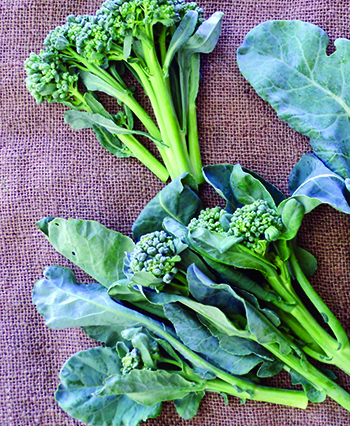 Piracicaba is an unusually heat-tolerant variety of broccoli that can be harvested as florets and bunched.
Far less prevalent is sprouting cauliflower, which I forecast will be increasing in popularity if enough people start growing and offering it. And finally, cabbage is very big on being small. Many people are simply put off by 4 or 5 (or 7 or 10) pounds of cabbage when 1 to 2 pounders will suit them so much better. Mini cabbages can be found pointed (Early Jersey Wakefield), red (Omero), pointed and red (Kalibos), or as straightforward round and green (of which the fast growing Early Bird has been our exceptional grower). You may be able to earn a better price per pound and make more use of your space with little cabbages.
The Nightshade family also has its share of mini-members. The best known are probably the collection of small-fruited tomatoes. From grape to cherry to pear all the way to currant, these come in many colors and bicolors. They have novel shapes and unique tastes, and can be mixed in a pint container and to dramatic (and highly sellable) effect. If you have a market for currant tomatoes, harvesting them with stems and branch intact dramatically helps reduce the labor of picking- otherwise they’re so small it’s probably not profitable to fill a container with individual fruits unless you’re charging a very high price.
In addition to heirloom varieties that have long been with us, there has been, in recent years, an increasing prevalence of (and interest in) small-fruited peppers. This is strictly a non-hot pepper conversation. People don’t buy little hot peppers because of an appealing appearance or desire for less product, but because of the heat, which is quite a different motivator. New and old varieties may be tapered, bell-shaped, or the flattened cheese shape. They may be used for cooking, stuffing, or particularly for snacking.
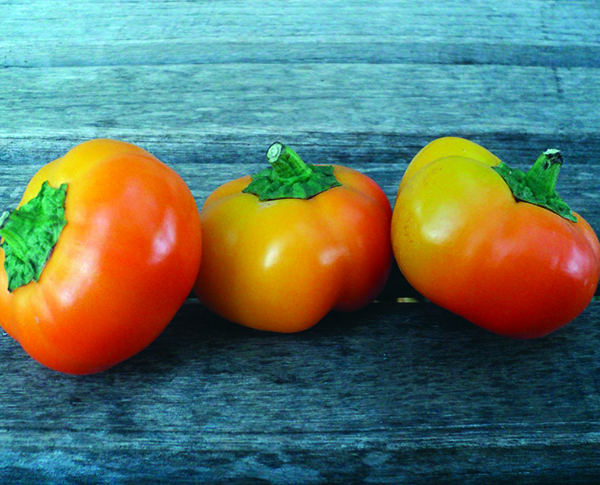 The Doe Hill pepper is one of the author’s favorites.
Various pimento varieties are well-known for their thick walls, red colors, and super sweet flavors and are a favorite amongst small peppers. The pre-1900 Virginian heirloom Doe Hill is our favorite. It is very sweet and orange-fleshed with crisp, thick walls. Though, of course, minis could be harvested in their unripened, green state, they are principally for a ripened, sweet, colorful harvest. Smaller peppers don’t always have fewer days until ripening than large bell peppers. We have always harvested our first bell peppers green while the first minis on the plants have continued to ripen. They always arrive as our first colored peppers of the season and are well received. A production note we have found is that little peppers are also better at dodging the sunburn that can sometimes afflict larger peppers.
Finally, little eggplants have been steadily taking over ground once occupied solely by the familiar large, purple, Italian eggplant. Whether a slender and elongated Asian eggplant, or any of the truly mini varieties with 2 to 4 inch long fruits, they tend to offer abundant harvests on compact plants, giving real value for their space. In almost every color there seems to be a small eggplant. You can find green (Applegreen, Lao Green Stripe), orange (Cookstown Orange, Turkish Orange), yellow (Thai Yellow Egg), white (Japanese White Egg, Lao White), purple (Lao Purple Stripe) — you get the point.
Cucurbits are another major source of diminutive crops. The patty pan (or scalloped) and round-shaped summer squashes, even when harvested at their mature stages, are not very big. The Piccolo zucchini is particularly attractive, as it is egg-shaped and has alternating light and dark green stripes which make it look like a little watermelon.
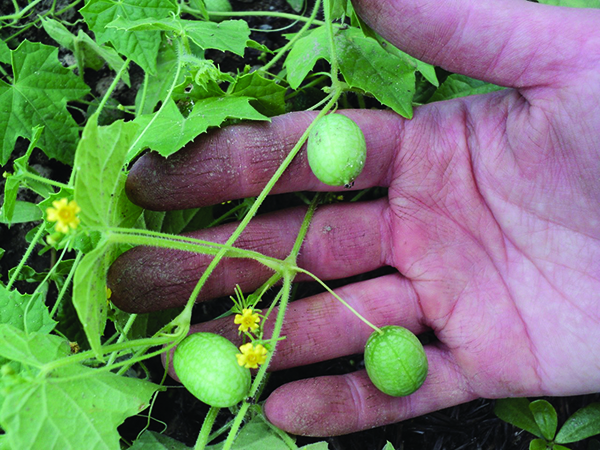 Mexican Sour Gherkins look like miniature watermelons when ripe, are very cute, and have a tart flavor, almost like they’ve already been pickled.
On the cucumber roster, you will find some true novelties. Many small cukes have “apple,” “lemon,” “white,” or “yellow” in their variety names and possess white to yellow skins and round shapes that are wildly productive. The Richmond Green Apple is a green, roundish cucumber, and the Parisian Pickling is so small (a gherkin or cornichon-type) as to be a novelty. And on the subject of pickling cucumbers, don’t forget that “kirbies” are wonderful (and preferred by many) for fresh eating, not just processing.
Though watermelons are not ones to be teeny tiny, it is certainly true that some folks want them as small as you can get them, avoiding their 13- to 25-pound brethren. But if you really want to take full advantage of mini-melons, you must look to Cucumis melo. From the always petite French Charentais-type melons to the cantaloupe, muskmelon, and honeydew varieties that remain small, individual-serving melons in which your half a melon is your “bowl,” remain in high demand. Popular muskmelons with orange flesh include Emerald Gem, Minnesota Midget, and Golden Jenny, and green-fleshed options Jenny Lind and Green Machine aka Ice Cream (these two name alternatives referring to the perfect “ice cream bowl” size of the melons and to the high productivity of the plants).
Beyond these are melons of unique shape and exotic origins: the teardrop-shaped Apple Melon of South America; the very small pear-shaped Golden Crispy of Korea; and the apple-shaped, edible-skinned Sakata’s Sweet of Japan. There’s also the very productive and very beautiful Tigger (each has brilliant red as a portion of their rind), the very small Rich Sweetness, and the Indian melon Kajari. Growing any of these can be quite exciting for you and your customers.
However, this is a good place to emphasize that there is a difference between vegetables that are simply smaller versions of familiar produce and those that are small and utterly different. You can certainly grow both. However, while the true miniatures will be easy sells, the glaringly different will probably require the cajoling, sampling, and explanation required when you are vending any unfamiliar food. A melon that looks like a muskmelon but is small is one thing. But, for example, the rather small Mother Mary’s Pie Melon, with bright yellow peel-able skin and sweet-tart flesh (which is commonly used as half of the filling in an apple/melon pie) is something else.
Lastly, the realm of winter squash deserves very special notes. Everyone quickly learns that there are customers who will go for squashes 6 pounds and up (and up and up), and those who will stick to smaller squashes. There has been extensive movement of late toward the small end of the spectrum, with some varieties remaining at a ½ to 1 pound in size.
Baby Hubbards are becoming more prevalent, as well as the even smaller and red-skinned Hubbard called Red Kuri. Flattened Kabochas (or Kuris) such as the Blue Kuri are relatively small, with the variety Sweet Jade being so small as to be labeled “personal size.” The oblong Delicatas are another favorite for petite eating, one of the first choices for those in the past who wanted a break from acorns. But even the acorns have upped their game. Many acorns have moved beyond the plain dark green skin, from the truly dainty Honey Bear and (early maturing) Uconn, to the white-with-green-stripes and very sweet Sweet Dumpling, to the renowned heirloom Thelma Sanders’ Sweet Potato, to the wildly colored Carnival which many customers use as decoration prior to eating.
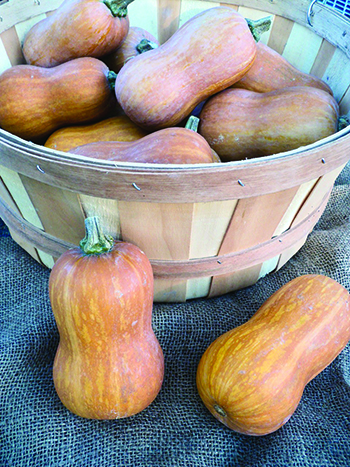 The Honeynut butternut squash stays in the half to one-pound range and has very good flavor potential.
And again, many of these varieties grow on compact bushes, maximizing profit potential per square foot. However, our major mini seller has been the Honeynut Butternut. Generally with a 1½ pound maximum weight, it is a perfect little butternut shape with dark tan skin that almost appears variegated at times. And its deeply colored, tasty flesh (with a smoothness I find somewhat reminiscent of the buttercup) combined with its looks makes it a real crowd pleaser. Customers came flocking back the next week for more and reserving their supply for the winter. They weren’t priced cheaply.
Hopefully our favorites give you some inspiration for small crops you can go big on!
Leah Smith is a freelance writer and home and market gardener. She works on her family’s farm in mid-Michigan, Nodding Thistle, which was certified organic from 1984 to 2009. A Michigan State University graduate, she can be reached at noddingthistle@gmail.com.
Copyright Growing For Market Magazine.
All rights reserved. No portion of this article may be copied
in any manner for use other than by the subscriber without
permission from the publisher.