











Why nutrition is diminishing and how to improve it
Well, hello, dear reader. I am happy to have your interest and your eyes for a few brief pages. I’ll do my best to offer you a diverting respite from the height of the season in your precious idle moments.
When last I wrote you, we spoke of micronutrients (aka trace minerals) in the soil and how to manage them in the January GFM. Ultimately, we grow and eat plants so that the nutrients they make from water, air, and soil may nourish our bodies (and our spirits if we are fortunate). Whereas most of the ag world is concerned with producing quantity or yield, our subject is the quality of our produce — its fitness for nourishing us.
Athletes can eat a large quantity of calories (like doughnuts), but if the quality of the food is low, their performances suffer. Quantity and quality are two very different things. Are you growing quality produce? How can you tell? What can you do to improve the quality of your produce? Do your customers care about quality? Should they? In this article, we’ll do our best to get at those questions.
While I am a disciple of soil and farming, I am not an expert on nutrient density. I read the work of many experts for this article and interviewed three authors to reach my own understanding. Still, this article is a mere reflection of my own understanding at this time.
The problem
Let’s start by understanding what we mean when talking about produce quality. By quality, we mean a vegetable’s potency for promoting the eater’s health. We can see quality as the amount of minerals, vitamins, proteins, and other nutrients in a vegetable — its nutrient density. Nutrient density also impacts other qualities such as a vegetable’s flavor and storage ability.
Did you know that vegetables can differ widely in the amount of nutrients they contain? If you shopped the produce section at Walmart and the farmer’s market and bought carrots from several sources, then tested the nutrients, you would likely find a large variation in the nutrients contained in a single carrot.
Ultimately, because as humans we get most of our nutrition from food, the amount of calcium, magnesium, protein, and other nutrients in our vegetables (and grain and meat) has a huge impact on our health. Over time, intentional experiments in science, and the unintentional experiments of history, have illustrated the serious effects of food with higher or lower nutrient density.
In general in the Western World, the nutrient density of vegetables has dropped significantly over the last 100 years. Let science prove the point: every few decades the USDA tests a large sample of major vegetables and computes the average nutrient content. In 1975, on average, 100 grams of broccoli had 103 milligrams of calcium, but in 1995 the average calcium content had dropped to 48 mg, down 53 percent.
This means that to get 1000 mg of calcium from broccoli in 1975, you would need to consume 2.13 lbs, but in 1997, you would have to consume 4.6 lbs to get that same amount of calcium. That is, you would need to consume 2.14 times as much in 1997 as in 1975 to get your necessary calcium. The same USDA study shows overall reductions in many other nutrients for a variety of vegetables, and European countries have also measured clear declines in the nutrient density of their vegetables.
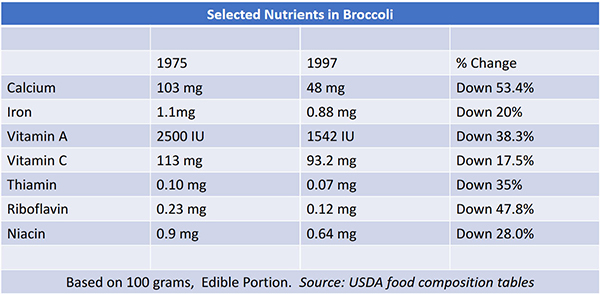
Figure 2: Nutrient content in broccoli, 1975 vs. 1997. From America’s Vanishing Nutrients by Alex Jack.
The impacts of this low level of nutrient density in our food is clear. About 50 percent of American adolescents are deficient in calcium, about a third are deficient in magnesium, and almost all adolescents have low potassium. When you consider that 80 percent of American adults do not eat the recommended amount of vegetables, it is crucial that the precious few vegetables they do eat contain the maximum density of nutrients. Additionally, scientific feeding experiments on animals have drawn a clear connection between food’s nutrient content and chronic disease, fertility, life expectancy, and mood.
If you’re anything like me, after understanding the general decline in the nutrients in our food, you’re left asking why, what happened to cause this?! If we can understand what we’ve done to make our food of poorer quality, hopefully we can change our practices to grow food of higher quality — fit to grow humans of a high-grade physical stature. Let’s ask that question of what went wrong, and then look into what we can do to get the nutrients back in our produce.
Steve Solomon, who wrote the book The Intelligent Gardener, put it well when we spoke. He said, “Nutrient density is for health, but yield for profit.” The goal of our conventional agriculture and capitalist values has been profit. And because profit in agriculture is typically driven by high yield and low costs, we have gotten quite good over the past century at producing high yielding vegetables. The methods that have given us high yields have often also lowered the nutrient density of our produce. (Oh, Icarus, only you know the hubris of humanity.) Let me show you what I mean.
The causes
Varieties: Modern breeding has reduced the nutrient density of our food in two ways. Our vegetable varieties now are all generally bigger (yield), but the way that math works is that there is a ‘dilution effect.’ A larger head of broccoli spreads out (dilutes) the minerals, so that whereas a large head of broccoli may contain more nutrients overall, an individual bite of broccoli from that large head will have fewer minerals compared to a smaller head. Breeding for size usually means selecting for plants that produce more starch or hold more water. These are not crucial human nutrients, but they do dilute those crucial nutrients.
Modern breeding has tended to reduce the nutrient density in a second way. Because modern breeding is generally done under conventional management, varieties are selected that take their nutrients from applied fertilizers rather than the soil. We have selected for vegetables that pump themselves up on N-P-K, to the detriment of other nutrients. Conventionally bred plants become addicted to fertilizers, tend to have smaller root systems, and are less able to forage nutrients on their own.
Fertilizers: We use more synthetic fertilizers than we did 100 years ago. And these synthetic fertilizers can interfere with overall nutrient density. Plants have intelligence, they practice preferential feeding. When there are a lot of certain nutrients present, plants will feed on these to the detriment of other nutrients. In general, as more nitrogen or phosphorus is applied, the plants will grow bigger, but they will take up fewer other nutrients.
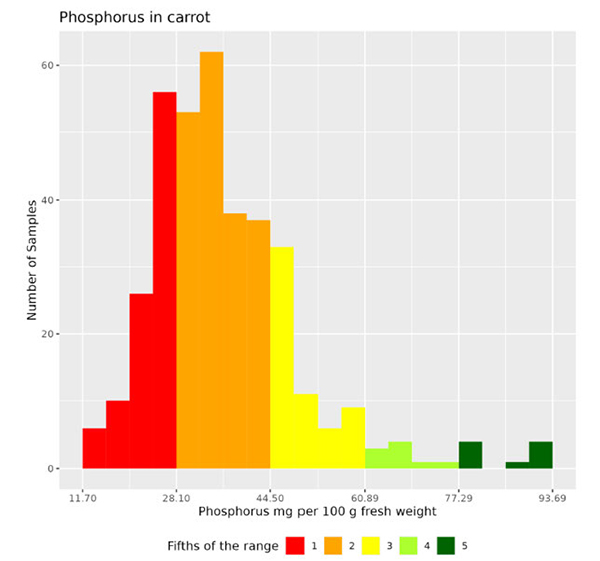
Figure 1: 398 samples of carrots were analyzed for phosphorus. They spanned geography, growing practices, farm size, and cultivar. You can see the wide variation in phosphorus content, and that most carrots fell in the lower range (red and orange). There were few carrots having high levels of phosphorus. Courtesy of the Bionutrient Food Association.
For example, applying more nitrogen fertilizer tends to reduce the plant’s uptake of calcium and most vitamins and can reduce iron uptake by 20 percent. Plants generally become progressively inferior in nutrition value in proportion to the synthetic fertilizers used to grow them. Which is to say that the more that yields are increased with fertilizers, the lower the nutrient density of that food.
Soil: Over the last hundred years, the fertility of our soils has generally decreased. The combination of tillage without soil-building cover crops or additions of organic matter tends to reduce the nutrients in the soil, the ability of soil-life to release soil nutrients into a plant-available form, and the ability of the soil to hold onto nutrients. In addition, herbicides like glyphosate can bind nutrients in a way that makes them unavailable to plants. Indeed, glyphosate (Roundup©) was initially patented as a metal chelator meant to clean the accumulated metals out of pipes. Later it was also patented as an antibiotic, which means it can be detrimental to the soil microbes and fungi.
A solution
Okay, yikes, the ability of our agriculture to produce quality food fit for human health is something we could get sad about. Should we care about low nutrient density? What can we do about it? It’s hard enough to be a farmer, and it’s unlikely that farmers or consumers will measure the nutrient density of their vegetables … or is it?
I spoke with Dan Kittredge, leader of the Bionutrient Food Association. Dan coined the term nutrient density and has done a lot of research on the facts behind quality food. He told me that consumers clearly care about the nutrients in their food to the point that large food companies like Walmart and McDonald’s are now interested in measuring and advertising the nutrient density of their food.
But we can’t value what we can’t measure (at least in the marketplace.) To that end, Dan is working to develop a ‘bionutrient meter’ that can allow consumers to measure the nutrient density of their food. With such a tool, consumers could compare the nutrients between the carrots from different vendors at the farmers market.
While not yet commercialized, it’s coming. “It is likely in three to five years that the camera on your smartphone will be able to analyze the nutrient content of vegetables at the store,” Dan says. The science of spectroscopy allows us to learn about the presence and amount of compounds in an object based on how it reflects light. This is how your phone camera can conceivably be made to tell you about the nutrient density of a vegetable you point it at.
Dan thinks that direct-market farmers should be ready for this. As a believer in organics, I had assumed before talking to Dan that organically grown vegetables have more nutrients than their conventionally grown counterparts. But Dan has done the testing, and while organic does mean less pesticides and herbicides in food, it does not necessarily mean higher nutrient density.
The Bionutrient Food Association tested carrots from all over the country. Growing practices (such as conventional, certified organic, regenerative, biodynamic, no-till) did not predict nutrient density. The source (farm, store, farmer’s market, garden) did not predict the nutrient density. The region (Southwest, Northwest, Northeast) did not predict nutrient density. We can’t assume that because we grow our vegetables with good intentions, organic certification, cover crops, or no-till, that they are more nutrient dense. Specifically, Dan tested samples from market gardens that had raised their organic matter to high levels by applying piles of compost, and that high organic matter did not cause high-nutrient density.
Well, what does increase nutrient density?! Dan suggests two things. Having the nutrients in your soil so they can be taken up by your plants is important for nutrient density and plant health. For example, even though plants need cobalt in the smallest amounts, it is the crucial element in vitamin b12. Or take molybdenum, even though you only need maybe 1 pound per acre, molybdenum is the center of the nitrogenase enzyme that allows bacteria to fix nitrogen from the atmosphere into your soil. Comprehensive soil tests and amending accordingly can be hugely important in increasing the nutrient density of our produce.
As a farmer, Dan found that when he applied rock dusts and other mineral sources, he “started seeing profoundly positive effects.” However, even though having the nutrients in your soil is crucial to nutrient density, there is a more important factor. Remember that when you harvest that field of broccoli, only about 5 to 10 percent of the total biomass comes from soil nutrients. Most plant mass is made up of carbon, hydrogen, and oxygen (which the plant gets from CO2 and water). So, Dan stressed that while soil minerals impact nutrient density, another factor is even more important.
That is soil life. Plants evolved with microbes and fungi making nutrients available to the plant. To encourage microbes and fungi, plants release about 30 percent of all the sugars they make into the soil through their roots to feed soil-life. In return for this microbe go-juice, plants receive the nutrients made available by soil life — a virtuous cycle.
Plants and microbes need each other to be healthy. In fact, most soil microbes can only reproduce in the presence of a living root, meaning that high organic matter alone does not mean you have a healthy soil. This is why Dan’s tests showed that a market garden that raised their organic matter to 12 percent with large additions of compost is not automatically growing nutrient dense food: organic matter alone does not a healthy soil make.
Organic matter is an important attribute of healthy soil, but we also need lots of living roots pumping sugars into the soil and powering that virtuous cycle where soil life makes nutrients available to plants. “To increase nutrient density farmers should focus on creating a flourishing soil microbiome, more than adding the specific nutrients needed for a cucumber versus a carrot,” Dan said. “We want a microbe-centered model.”
Ask yourself what microbes like (hint: it’s the same things we humans like) — oxygen, food (root exudates, organic matter, minerals), temperature (not too cold or hot), water (not too little or too much) — and try to maximize those with your management. Farming is a balance of so many things, while oodles of compost might drive yields or tarping may smother weeds, those practices may not maximize soil health or nutrient density.
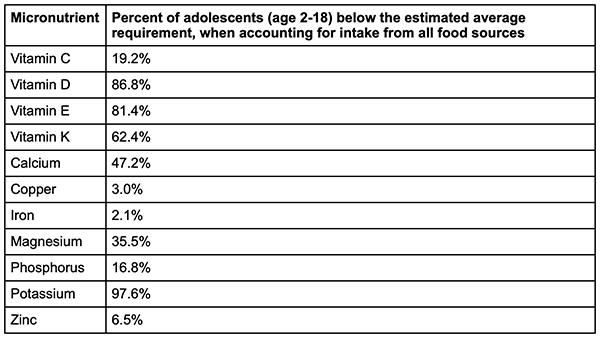
Figure 3: A table the author made from the data in the National Health and Nutrition Examination Survey (2003-2006) based on Micronutrient Inadequacies in the US Population: an Overview by Victoria Drake. The data takes into account all the food eaten, including those enriched with nutrients, like vitamin A in milk, niacin in flour, etc.
I hope you have a better understanding of how: 1. Yield is different from nutrient density (quantity vs. quality). 2. The nutrient density of our food has generally decreased over time. 3. Americans have significant nutrient deficiencies which impact our health. 4. Several characteristics of our modern agriculture are understood to be driving this overall reduction in nutrient density. 5. Farmers can improve the nutrient density of their crops through soil tests, amendments, and improving their soil microbiome (soil health).
Let’s say you’ve read this far and you’re kind of fired up, you’re thinking, “Yeah, I want to increase the nutrient density in my vegetables, and I may even advertise this to my customers to get a premium at market.” How can you as a farmer measure nutrient density? Sending samples to a lab can be several hundred dollars each. One method is your observation. Nutrient dense vegetables should taste better and sweeter, they should have great color, they should store longer, and they should be resistant to insects and disease. There is also a cheap tool you can use to measure the nutrient density and health of your crop right on the farm.
A refractometer measures the total dissolved solids in plant sap, called Brix. While not a direct measure of nutrient density (hopefully Dan and his Association will get there soon), a plant’s Brix correlates closely to quality, taste, and disease/pest resistance. The process is pretty simple: you crush part of the plant to extract sap/juice, you put that sap in the refractometer and see how much the total dissolved solids bend light, and you get a number. Here is a fact sheet on measuring Brix in vegetables: ohioline.osu.edu/factsheet/hyg-1653.
To the degree that your soil becomes a haven for microbes and fungi, the Brix of your plants should rise, and we assume that reflects an improvement of their nutrient density. As a rule of thumb, Dan says 12 is the magic number for Brix. “If you get your plants there, you will see a dramatic reduction in pest/disease problems.” But each plant is different, so The Bionutrient Food Association has a chart on the ideal Brix for each vegetable: bionutrient.org/brix-chart.
I am hoping that I absorbed useful information from the fertile ground of my experience, science, books, and interviews; transmuted those facts in my own mind into a clear understanding; and shared with you an article dense with useful information that can improve your farming practice. My best wishes to you for the rest of your summer season.
Sam Oschwald Tilton is an organic agronomist, and helps farmers improve their weed management, soil, and machinery systems. He also delivers hands-on trainings and works with organizations to develop resources, through his business Glacial Drift Enterprises. He organizes the Midwest Mechanical Weed Control Field Day (August 20th this year in Ames, IA). Sam lives in Minneapolis and enjoys gardening with the neighborhood. You can contact him at glacialdrift@protonmail.com.
Copyright Growing For Market Magazine.
All rights reserved. No portion of this article may be copied
in any manner for use other than by the subscriber without
permission from the publisher.