











#ToolsForGrowingForMarket
As I was preparing one of many beds this week on the farm for seeding and transplanting our fall and winter crops, I once again was appreciating how good the DeWit Seed Bed rake is. Compared to the ubiquitous 12-inch bow rakes sold in most garden centers and hardware stores, the Seed Bed rake has a handle that’s about a foot longer and a head that’s about 6 inches wider, with longer, heavier duty teeth that are more widely spaced. At this point we don’t even use a bow rake anymore, and although I have numerous types of rakes in my collection with different strengths, the DeWit is the one that gets the most use.
The DeWit’s long handle makes it expensive to ship, but much more ergonomic to use. It has more reach, and also requires less stooping for tall folks like myself. The widely spaced teeth on the head means it doesn’t clog easily, and those teeth are heavy enough to break up good sized clods, or pull out fist sized rocks.
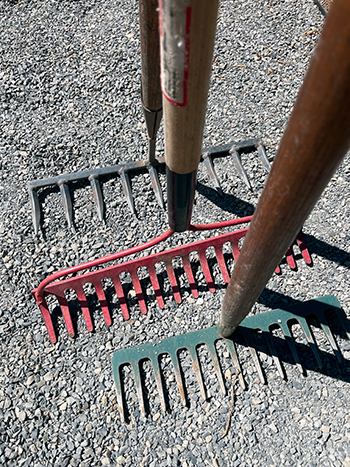
A comparison between three different rake heads. The DeWit Seed Bed Rake is the biggest (back), just slightly larger than a bow rake and much larger than the 12-inch garden rake in front. Note that foreshortening makes it look slightly smaller but it’s actually larger than the other two. You can also see that the teeth are longer, more substantial and spaced further apart.
Uses
On the scale of our farm where our beds are 160’ and we’re often just planting part of a bed, I am usually using this rake in conjunction with, or instead of our BCS power harrow to sift out larger plant material that I’d rather compost than leave in the bed (this makes hoeing easier later). Sometimes it gets used before the bed is loosened just to pull plant material off the surface. After loosening the surface, by flattening the angle of the head (thumbs up positions on the rake handle), it’s good at sifting through the surface layer and pulling out plant material and small rocks. When conditions are just too wet for the BCS to work in but we’re desperate to get a bed planted it’s often our only choice.
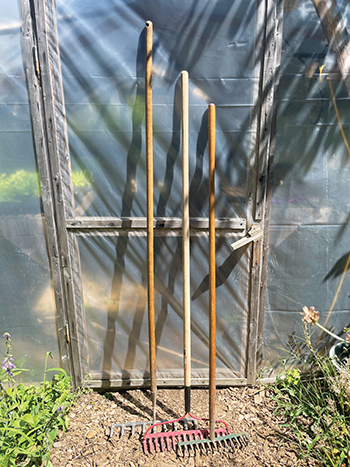 A comparison of handle lengths, with the DeWit being the longest and the garden rake the shortest.
To break up clods and leave a smoother bed surface I find that it’s best to smack the clods on a push stroke (essentially pushing the handle into the head socket) and then lightly rake back. I never use a chopping motion as it just doesn’t seem useful or good for the tool (wood is strong in tension and compression along the grain and less strong when bending). Occasionally I’ve found myself turning the head on it’s side and using the side of the end tooth to pull a weed. This works but you need to take some care to not pull to hard like this as it is possible to bend the neck with this uneven leverage (speaking from experience).
When I’ve used a Johnny’s six-row seeder in the past I found that raking through the surface of a bed with the seed bed rake before running the seeder through was the perfect way to find anything that was going to clog between the openers and to get them out of the bed, before trying to run the seeder through. This has been the case for other seeders, too, although the double disk openers on the Jang have pretty much eliminated any clogging for me on their own.
Maintenance
Because of the way the head is fixed to the handle I have found that it has a tendency to come loose with heavy use and changes in the weather, but it’s easy to re-tighten before using simply by holding it vertically with the head at the top and then banging the bottom end of the handle on a concrete or similar surface to drive the head on to the handle and then giving the screw a little twist (this works better than actually trying to hit the head to drive it on). I occasionally rub linseed oil into the handle to keep it smooth and I appreciate that it came raw, with no lacquer or sealer, which I find less comfortable to hold and harder to maintain.
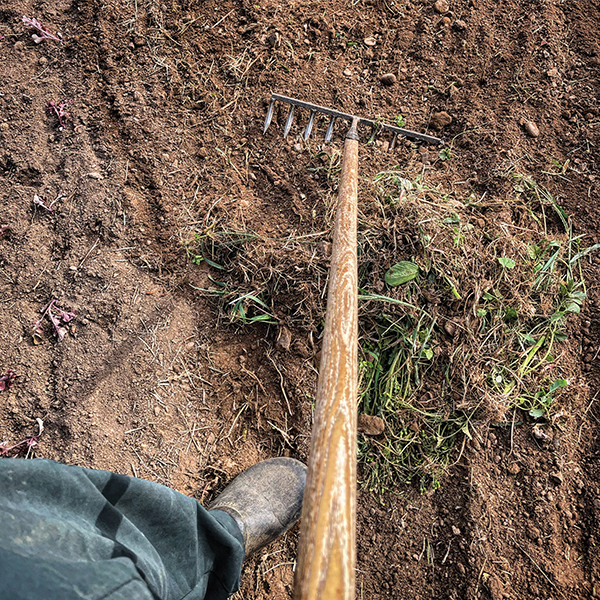
This is the kind of work I use this rake for, sifting plant debris out of the beds before planting to make cultivating weeds easier later.
More tools
Share the tools you’ve been using forever, that make things easier for you and that you really love using the #toolsforgrowingformarket hashtag on social media to make it easier for other folks to find them. You can also send photos and suggestions to me directly (josh@slowhandfarm.com) as I love to see what other folks find useful and to hear about why.
Josh Volk farms in Portland, Oregon, and does consulting and education under the name Slow Hand Farm. He is the author of the books Compact Farms: 15 Proven Plans for Market Farms on 5 Acres or Less, and Build Your Own Farm Tools, Equipment & Systems for the Small-Scale Farm & Market Garden, both available from Growing for Market. He can be found at SlowHandFarm.com.
Copyright Growing For Market Magazine.
All rights reserved. No portion of this article may be copied
in any manner for use other than by the subscriber without
permission from the publisher.