











By mid-August, only seven of 20 beds in our 34 X 96 foot high tunnel have summer crops left in them. We’ll leave the sweet potatoes for another month before we dig and cure them for winter farmers markets. The two beds of colored peppers will come out in the first or second week of October to make way for the final planting of baby salad. The last bed of eggplant probably should have been pulled already but we left them to ripen the last few fruits on each plant.
Planting the fall hoophouse is always a juggling act. You don’t want to take out productive summer hoop-house crops any sooner than necessary. But you do need to plant fall crops in time to have them growing well before the days get too short.
At our farm, we tend to direct seed cool-season crops more than most of the farmers we know. There are a number of reasons for this, but the main one is that we both have multiple off-farm jobs so if we can direct seed something and water it once a day while it’s germinating (or miss a day if we are out of town for work) we usually go for it. It also saves us time and money that we would spend buying or making media, filling flats, watering twice a day, etc. That shouldn’t be seen as a knock on transplanting fall crops in tunnels or growing transplants on the farm. Many of our friends do that and we may be there someday, but, for now, this is the decision we have made for our farm based on our off-farm responsibilities.
Direct seeding, though, means we have to start fall planting earlier. For other farmers, transplanting fall crops allows the summer crops to stay in the tunnels longer — which means higher yield of the tomatoes, peppers, melons, and other summer crops that customers love.
If you haven’t yet torn out your summer hoophouse crops, you still may have time to direct seed fall crops. In this article, I’ll describe our direct seeding schedule, spacing, and seed costs for fall hoophouse crops.
Scheduling
The 13 beds that don’t have summer crops are either already planted with fall crops, or they are being watered to flush the weeds before we plant. Beets seeded on August 13 are off and running after emerging in just three days; carrots seeded the same day came up in four days in nice straight rows and are pushing their first true leaves; Swiss chard and Tuscano kale are coming up in small clumps of multiple plants soon to be thinned. Weeds are popping up in the open beds, too, leading to visions of stirrup hoes slicing them off like a guillotine, followed by weed-free beds for our three salad mixes. We usually don’t have empty beds like we do this year, but we added a 26 X 48 foot movable tunnel in April. This house has our tomatoes in it and will have them again next year in a different location. Because of this we are finding ourselves with more open space in the big tunnel. If we were to use transplants, we could do a quick crop of radishes, turnips, or other fast crop but we are actually enjoying the chance to flush the weeds.
Our fall hoophouse plantings are a little different than our spring ones in that we tend to do more hand seeding in fall. This isn’t because we want to torture ourselves by holding seeds in our hands while we scoot along close to the ground, trying not to tip over and drop all those seeds in the aisle or the bed next to us. It more has to do with getting the right spacing as we transition out of outdoor production. In the spring, we seed kale, chard, head lettuce, and other leafy or heading crops in the hoophouse using the Earthway seeder, which tends to put the seeds every 2 inches or so, depending on the plate. In the spring we use that as a way to produce our own field transplants directly in the hoophouse beds. Crops that are seeded in February and early March are ready to be transplanted out in late March and April. At that point, we transplant out most of the crops from the beds and leave them at either 8 X 8 inch spacing (head lettuce) or 12 X 12 inch spacing (kale, chard, other leafy greens). It’s an easy and efficient way to grow our own transplants without a lot of extra work or cost. But in the fall, we don’t need transplants for the field, so we seed in the hoophouse at the desired final spacing.
While our outdoor plantings stay relatively the same in spacing and density, very few crops are planted at the same spacing or density from year to year in the tunnels. They aren’t significantly different, but there are little tweaks. For direct seeding in the tunnel, we use a six-row precision seeder and an Earthway seeder. We have moved over to seeding some seeds by hand (as mentioned above), but those are only in the fall and only for a few crops. We still transplant warm-season crops and buy them from a friend who has started a business around supplying transplants for hoophouse farmers that want them earlier and later in the year than they are otherwise available. It’s really important to say again that we understand that transplanting fall and early spring leafy crops in the tunnels is a better use of time in them but this is what has worked for our farm.
Bed preparation
When we are growing crops year-round we get three or four crops per year in each bed. If we choose a quick crop like radishes or hakurei turnips we usually get four. Otherwise it’s three. Between crops we use a Troy-bilt Horse that we can get down the outside aisles and maneuver in the beds without tilling or stepping on the beds directly next to what we are prepping. We used a broadfork, three-tine claw, and rake in the first two years of the farm and really like what that does for the beds, but have moved to the tiller because of how quickly it can prep the beds. We still use the fork-claw-rake once a year to break up any hard-pan that could form using the tiller each time. This happens between the summer and fall/winter crops. Even though it would be easier and we would have more time available if we did it in the spring, we think it is best at this time because we have been in there harvesting more and walking on the edges of the beds. When we have had a tomato or cucumber crop centered in a bed that we have been harvesting multiple times a week for many weeks we can definitely tell that the edges of the beds get stomped down and the aisles get much wider. This is in contrast to when we have a crop like salad mix or spinach in a bed that we are harvesting from the aisles and that takes up the entire plantable area of a bed so that we are not ever walking on the edges. Each 3 X 28 foot bed then gets 8 cubic feet of compost that is lightly worked in using the three-tine claw. We usually smooth the bed out with a rake and then plant. If we are using the six-row pinpoint seeder, we like to roll the bed once with no seed in it to firm it up and make it more level. If we are using the Earthway or seeding by hand we don’t roll the bed.
Seed Spacing and Density
This is something that changes a lot for us. We started out with extremely close, tight spacings and have been moving away from them for most crops, except salad mix (which we grow a lot of) and scallions (which we don’t grow anymore because scallions don’t sell in our markets). At first we thought it was all about how closely we could get crops but have been discovering over the past three years that we think it is more about a balance between spacing, crop size, and disease management.
Carrots are the best example of this. When we started, we used to plant carrots at 18 rows in a 36-inch bed. There are farms that do this and grow great carrots, but for us we spent a lot of time picking through small carrots to get ones that we would put in a nice bunch of 12 and charge $3 for. We sold small baby carrot bunches but it was still time consuming to bunch all of those small carrots. Last year we moved to 12 rows and, of course, ended up with larger carrots but still felt that there were too many small ones we had to pick through (we also had to eat a lot of stew in the winter to use those small ones up). This year we have 9 rows of carrots in a 36 inch bed and from the looks of the spacing right now we are going to be very happy with this. The other advantage of the wider spacing is that it is easier to weed. Outside, we plant four rows of carrots in the same size bed so we are still more than double our outside density. Wider spacings also help to manage disease. The winter tunnels usually run around 50-65°F on a somewhat sunny day. We vent to try and lower the humidity but it is still fairly warm and very humid most days. By decreasing our planting density, we are hoping to see less disease through increased airflow, especially in the short, cold, cloudy days of late December and most of January.
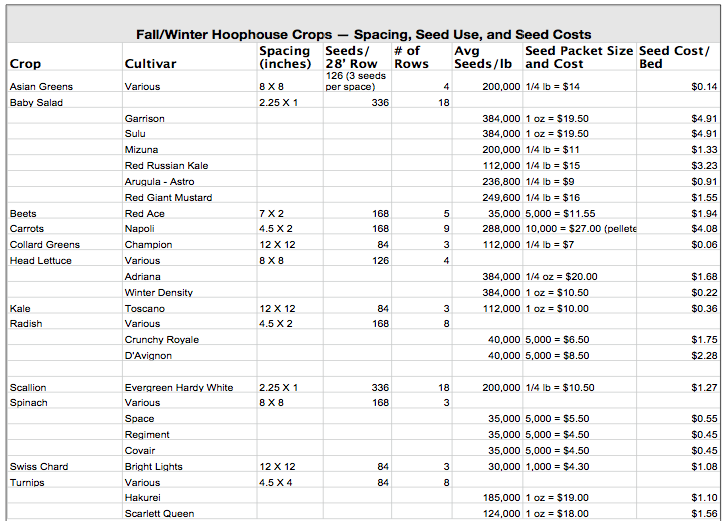
Above is a table of crops that we have grown in the tunnels in the winter. We don’t necessarily grow all of them anymore. The spacings we feel are a good starting point to finding the balance between intensive production, crop size at harvest, and disease management. If you are transplanting these crops, the spacings for the heading and leafy crops are the same as if they were direct seeded, and they can be planted later in the year. Also included are the costs per seed or per planting. This is a piece of our ongoing attempt to put together some enterprise budgets that are crop specific for tunnel production. We are recording labor, labor by activity, and a few other categories to really look closely at the economics of our farm. As these get recorded and entered we plan to have more tables like this available and potentially a more complete enterprise budget for winter production.
Adam Montri owns Ten Hens Farm in Bath, MI, and works with farmers through his outreach position with the Michigan State University Student Organic Farm. For more information, visit www.hoophouse.msu.edu.
Copyright Growing For Market Magazine.
All rights reserved. No portion of this article may be copied
in any manner for use other than by the subscriber without
permission from the publisher.